Summary
Grayscale's top assets in the second quarter include three new project assets, two of which are related to DePIN. Messari shows that the DePIN track has grown to a market value of $50 billion, with financing scale in the first quarter slightly increasing compared to last year, but the number of projects significantly decreasing, indicating that DePIN is moving towards maturity.
Messari collaborated with FrodoBot Lab last month to explore the DePIN+AI robot paradigm revolution, with the main point suggesting that the development of embodied intelligent AI depends not only on algorithms but also on hardware upgrades, data accumulation, funding support, and human participation. In the past, the robot industry's development was limited by high costs and the dominance of large enterprises, hindering innovation speed. The construction of DePIN robot networks means that by leveraging decentralized networks, robot data collection, computing resources, and capital investment can be coordinated globally, not only accelerating AI training and hardware optimization but also lowering development barriers, allowing more researchers, entrepreneurs, and individual users to participate, while hoping that the robot industry will no longer depend on a few tech giants but be driven by the global community, moving towards a truly open and sustainable technological ecosystem.
I. DePIN+AI Constructing the Robot Paradigm in the AI Era
On February 27, Messari hosted a podcast about "Building Decentralized Physical Artificial Intelligence," inviting Michael Cho, co-founder of FrodoBot Lab. In this podcast, Michael Cho focused on the opportunities and challenges of DePIN+AI in the robotics field.
After Messari's fermentation, the concept of DePIN robots quickly became popular, and discussions about DePIN robots began to proliferate.
Our industry observation this week will also focus on analyzing and discussing this track.
Before expanding our discussion, let's first look at the development of artificial intelligence itself:
- In the computing power field, Nvidia's quarterly revenue has increased fivefold in the past three years;
- In the bandwidth field, North American data center construction has also grown fivefold in the past three years;
- In the energy field, OKLO alone requires 12.0GW, and TerraPower requires 4.0GW;
- In the data field, large companies invest over $500 million annually to purchase wholesale data for training AI models.
Against the backdrop of overall global economic downturn, AI, as the main technological revolution for the next ten to twenty years, is leading all players (computing power, energy, data) to accelerate at a growth rate of several times per year.
While developing at such a high speed, concerns about AI are also increasing daily. The reason is that if AI computing power (similar to a car's engine), AI large models (similar to controllers and processors), AI energy (similar to oil and fuel), and AI data (similar to raw materials) are controlled by a few centralized large companies, the future technological era might be completely controlled by a few companies, potentially leading to absolute centralization and authoritarianism, where we may truly open the largest Pandora's box.
It is precisely due to concerns about this centralized situation that a new track and direction are being widely discussed: DePIN+AI. We at DePIN ONE are willing to define it as DePAI, that is, DePAI=DePIN+AI.
How will DePAI help AI become more decentralized?
We will expand and analyze based on the main content of Messari's podcast with Michael last month.
Currently, AI has many pain points. Although they have various functions, they are mostly processing surface-level information like text. Such information is cold and lacks depth of perception and understanding.
DePIN networks can serve as AI's "sensory organs" and "limbs".
"Sensory organs" help AI perceive the real world comprehensively. Some developers are now using ioID and W3bstream to connect real-world devices to the blockchain and verify their actual activities using zero-knowledge proofs.
The "limbs" can help AI make precise judgments based on its perception and put those judgments into action, effectively implementing the "training" -> "modeling" -> "automation" system.
(Translation continues in the same manner for the rest of the text)On the other hand, DePIN networks are helping AI robots land with higher efficiency and lower costs.
A specific example is FrodoBot Lab's collaboration with a DePIN project that secured two boxes of NVIDIA H100 GPUs - each box containing eight H100 chips' computing power, providing researchers with the necessary computational capacity to process and optimize AI models using data collected from robot deployments. Without such computing resources, even the most valuable datasets cannot be fully utilized. It is evident that through access to DePIN decentralized computing infrastructure, robotics networks can enable global researchers to train and evaluate models without being restricted by capital-intensive GPU ownership. If DePIN can successfully crowdsource data and hardware advancements, the future of robotics might arrive earlier than expected.
3, DePIN is Assisting AI and Embodied AI in Achieving More Efficient Business Efficiency
Similar to Sam's AI agent (a travel KOL robot with a meme coin), this demonstrates a new profit model for decentralized robotics networks.
Sam operates autonomously, live streaming 24/7 in multiple cities, while simultaneously increasing the value of its meme coin.
This model showcases how DePIN-driven intelligent robots can sustain their finances through decentralized ownership and token incentives. In the future, these AI agents might even pay human operators with tokens, rent additional robotic assets, or bid on real-world tasks, forming an economic cycle beneficial to both AI development and DePIN participants.
Expectations
The development of embodied intelligent AI depends not only on algorithms but also on hardware upgrades, data accumulation, funding support, and human participation.
In the past, the robotics industry's development was limited by high costs and the dominance of large enterprises, hindering innovation speed. The establishment of DePIN robotics networks means that, leveraging decentralized network power, robot data collection, computing resources, and capital investment can be coordinated globally, not only accelerating AI training and hardware optimization but also lowering development barriers, allowing more researchers, entrepreneurs, and individual users to participate.
We also look forward to the robotics industry no longer depending on a few tech giants but being driven by the global community towards a truly open and sustainable technological ecosystem.
II. DePIN Track Data and Observations
1, DePIN's Total Share is Only 0.1% of the Trillion-Dollar AI Market
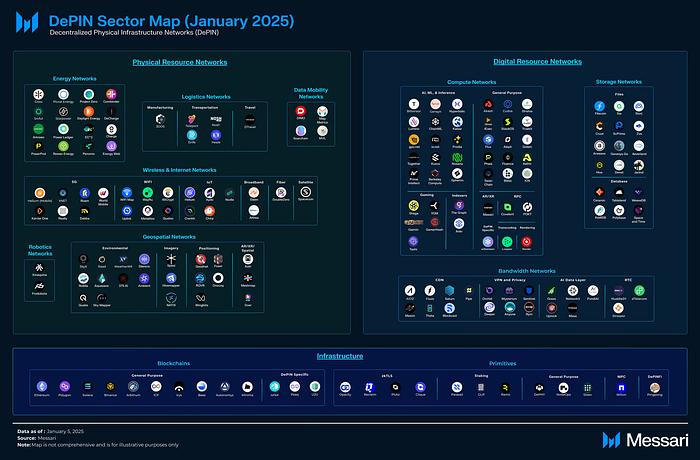
DePIN project numbers grew from 100 in 2022 to 1,170 in 2024, with market value soaring from $5 billion to $50 billion, and active node rates increasing from 2% to over 50%. However, DePIN's total share is only 0.1% of the trillion-dollar AI market, and it is no exaggeration to say that this track has 100-1000 times growth potential.
2, DePIN Financing Amount Grows, but Financing Numbers Decrease
According to Messari's data, DePIN financing growth is year-on-year flat, with more financing amount but fewer financing rounds in the first quarter of 2025.
First quarter of 2024: 62 rounds of financing totaling $156 million.
First quarter of 2025: 36 rounds of financing totaling $159 million.
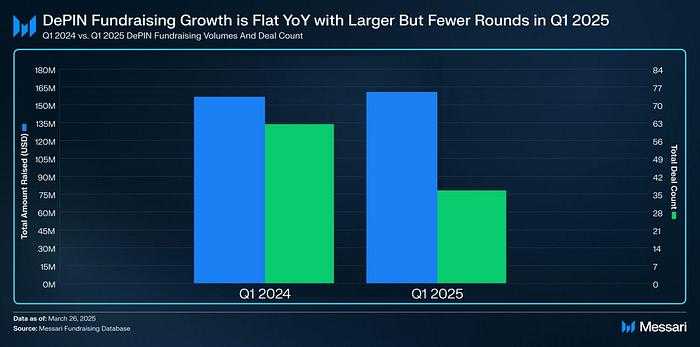
The data indicates: fewer emerging early-stage startups, but mature DePIN projects are expanding.
Currently, the global market share of leading DePIN projects in their respective fields is still very small, representing an absolute early-stage opportunity.
Wireless transmission market share is 0.002% (leading project Helium), computing market share is 0.03% (leading project Filecoin), energy market share is 0.001% (leading project Daylight), and identity authentication market share is 0.2% (leading projects Worldcoin and Anymal).
In the AI track's agency artificial intelligence market, significant growth is expected in the next decade, from $520 million in 2024 to $196.6 billion in 2034, with a compound annual growth rate of 43.8%.
3, Grayscale Releases Q2 Quarterly Report, Focusing on RWA, DePIN, and IP Tokenization
Grayscale released its 2025 Q2 quarterly report this week, focusing on RWA, DePIN, and IP tokenization, thus adding three tokens to the Top 20: IP, SYRUP, and GEOD, while removing Akash Network, Arweave, and Jupiter.
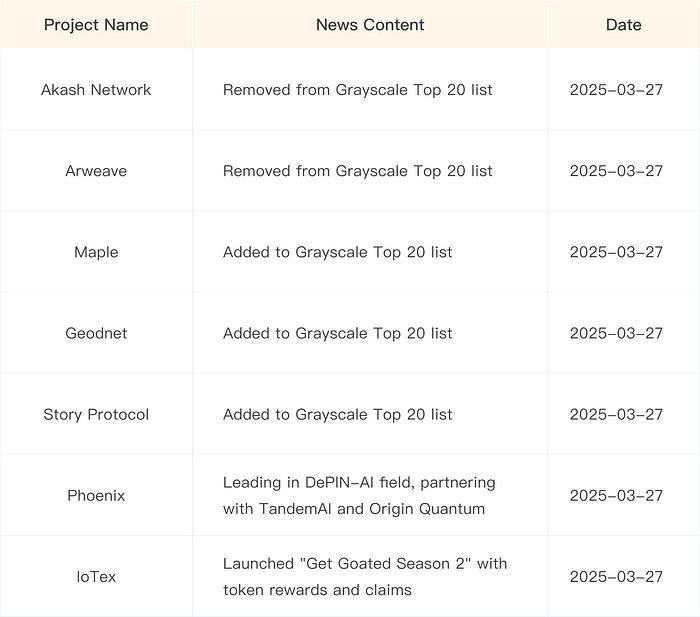
The report shows that this quarter, Grayscale will focus on tokens reflecting non-speculative blockchain technology applications in the real world, categorized into RWA (Real World Assets), DePIN (Decentralized Physical Infrastructure), and IP (Intellectual Property Tokenization).
Among the three assets added to the Top 20 list for the second quarter of 2025 - Maple (SYRUP), Geodnet (GEOD), and Story (IP) - two are DePIN projects.
- Geodnet (GEOD): Geodnet is a DePIN project for collecting real-time positioning data. As the world's largest real-time dynamic positioning (RTK) provider, Geodnet offers geospatial data with accuracy up to 1 cm, providing cost-effective solutions for users like farmers. In the future, Geodnet may provide value for self-driving cars and robots. The network has expanded to over 14,000 devices in 130 countries, with annualized network fee revenue in the past 30 days growing to over $3 million (approximately 500% year-on-year growth). Notably, compared to other top 20 assets, GEOD has a lower market value and fewer listed exchanges, thus considered higher risk.
- Story Protocol: Focused on intellectual property management on the blockchain, more of a decentralized application than physical infrastructure, potentially marginal to DePIN. Story Protocol is attempting to tokenize the $70 trillion intellectual property (IP) market. In the AI era, proprietary IP used for training AI models leads to copyright infringement claims and massive litigation, such as the previous New York Times lawsuit against OpenAI. By bringing IP on-chain, Story will enable companies to use their IP for AI model training while allowing individuals to invest, trade, and earn IP royalties. Story has already brought Justin Bieber and BTS songs on-chain and launched an IP-centric blockchain and token in February.
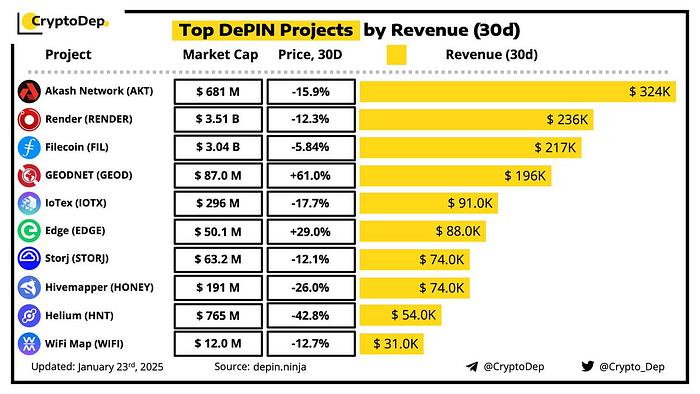
4, DePIN Track Income Ranking in the Past Thirty Days
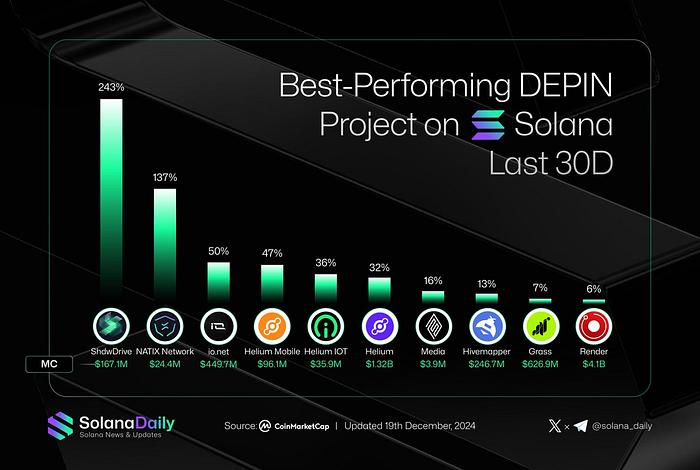
Best performing DePIN projects on Solana in the past 30 days
5. Industry Event Tracking
- The global Web3 online network service Roam, a must-have for conference attendees, has reached 2.8 million global nodes, allowing users to achieve seamless international roaming at 30% of the cost of traditional operators. Roam plans to launch a similar incentive mechanism in the second half of 2025, with spatiotemporal data collected by distributed nodes becoming fuel for training vertical AI models.
- Phoenix is collaborating with TandemAI and Origin Quantum to promote the integration of AI and decentralized physical infrastructure, helping Phoenix lead in the DePIN-AI field.
- IoTeX launched "Get Goated Season 2", involving token rewards and claiming process. The $IOTX claiming window closed on March 27, with unclaimed tokens to enter the IoTeX treasury pool. Sponsors include Geodnet, Uprock, Drop Wireless, and Network3. The claiming window will start on April 7, with a review period from March 28 to March 31, using zkPass verification. This move may enhance community engagement and attract more users to the IoTeX ecosystem.
- According to Messari's Helium Q4 report, Helium network operational data grew significantly. Operator data offloading increased by 555% quarter-on-quarter to 576TB, mobile hotspots grew 14% to 24,800, and daily mobile paid traffic increased by 99%, showing its disruptive potential in the telecommunications industry. Helium unified $HNT as the sole token through HIP 138 proposal, optimized its economic model, and announced a partnership with Telefónica to enter the Mexican market, covering 2 million Movistar users. Additionally, Helium was included in Grayscale's top 20 watched tokens and Coinbase's COIN50 index, attracting institutional investor attention. In smart city applications, the network has been used for flood monitoring and forest fire warnings in the US. Helium is expanding through the DePIN model, consolidating its leadership in the Web3 telecommunications market.
6. Financing Information
- Filecoin's largest DeFi protocol GLIF released its $GLF governance token, airdropping 94 million tokens, representing 9.4% of total supply. $GLF will expand to new functions like loyalty rewards. GLIF is expanding to decentralized physical infrastructure networks (DePIN) beyond the Filecoin ecosystem. Currently, GLIF has over $102 million locked on Filecoin and will support more DePIN networks in the future.
- Decentralized business network Domin Network announced strategic investments from Animoca Brands, Kucoin Labs, Web3Labs.club, IBC Group Official, DWF Ventures, Presto, Outlier Ventures, KnightFury, ThreeDAO, Awakening Ventures, and AB DAO. Domin Network is a decentralized business network that uses Non-Fungible Tokens and DePIN Rollup technology to connect software, hardware, and consumer behavior data on-chain, enabling users to earn crypto rewards by sharing their consumption data.