GoPlus Security has revealed the latest method by which an organized fraud network targets unsuspecting cryptocurrency users with promises of easy USDT earnings.
Meanwhile, AI deepfake is becoming an increasing concern. Bad actors exploit reputable voices in the industry to target unsuspecting victims. This is a worrying revelation reflecting the growing sophistication of cryptocurrency scams.
GoPlus Security Reveals the Latest Cryptocurrency Fraud Tactics
Analysis shows a multi-stage fraud chain starting with small transactions to build trust and ending with silent fund withdrawal from victims' wallets.
GoPlus Security covers major blockchain networks with multi-dimensional risk detection capabilities. The company revealed that attackers operate through addresses linked to a campaign that begins by launching seemingly legitimate projects.
These projects attract users with promises of "stable USDT rewards, no fees" in exchange for completing simple, low-effort tasks. After establishing initial contact, fraudsters send small tokens and a minimal USDT amount over several days to create trust. But it's all a calculated scheme.
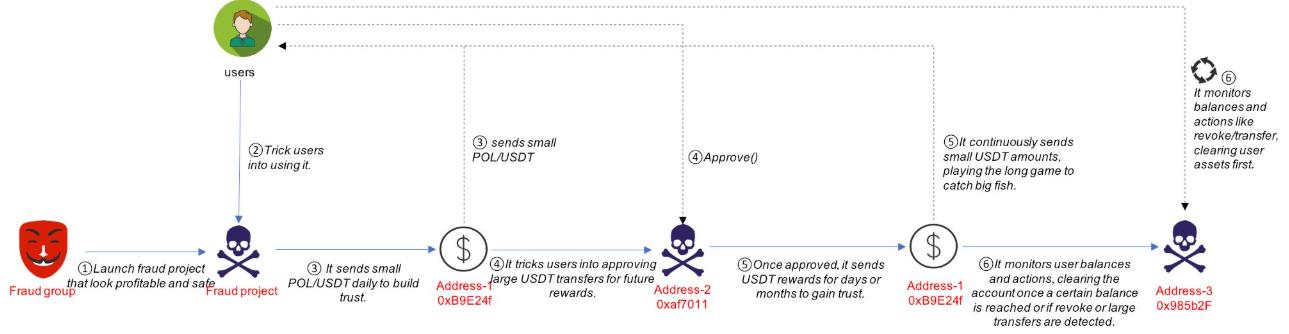 Latest method of hackers stealing cryptocurrency. Source: GoPlus Security on X
The ultimate goal is to convince users to grant token approval, typically for external owned accounts (EOA). Once approval is granted, fraudsters continue sending rewards for days or weeks while monitoring the wallet.
When the user's balance exceeds a threshold or recovery activity is detected, high-speed front-running bots will rush in and withdraw funds within seconds. These trading bots are ready to spend gas at any cost.
"This is a long game to catch big fish," GoPlus warns in their statement.
In light of this, GoPlus Security warns against granting unlimited token approvals, especially to EOAs. The company also encourages users to adopt proactive on-chain security tools.
"There's no such thing as free money — don't believe projects claiming you can easily earn money just by participating," they add.
Their findings closely align with recent guidance from on-chain investigator ZachXBT. The investigator outlined critical checks users should perform to avoid cryptocurrency scams.
As BeInCrypto has reported, these checks include verifying token contracts and approval history, using permission-limiting tools, or automatically revoking inactive approvals.
Deepfake Fraud: The New Frontier of Crypto Scams
Beyond blockchain, cryptocurrency scams are exploiting artificial intelligence at a dangerous scale. Bad actors are also using deepfake technology, creating convincing fake videos of public figures to defraud investors.
In an early warning this year, Binance co-founder Changpeng Zhao (CZ) revealed AI-generated clips promoting fake investment platforms allegedly endorsed by prominent cryptocurrency figures.
"There are deepfake videos of me on other social media platforms. Please be careful," CZ stated.
A recent alarming example emerged in Ghana. Ashesi University condemned a deepfake of its president, Patrick Awuah Jr. Fraudsters had used him to promote a scam called "Crypto Klutz."
They embedded the video in a fake article mimicking Graphic Online. The fraudsters distributed it along with edited X screenshots to create credibility.
"...Neither Patrick Awuah nor Ashesi University is associated with this or any similar platform. Please help protect our community by reporting it as a scam when encountered and encouraging others who see it to do the same," the university stated.
Cybersecurity company McAfee added urgency to this issue, reporting that the average American now encounters three deepfake videos daily. The company outlined five warning signs for detecting AI-enhanced cryptocurrency scams.
They pointed out promises too good to be true, fake celebrity endorsements, and non-existent exchanges or wallets. Other warning signs include urgent tactics to push decisions and requests for private keys or upfront payments.
A Variety report confirmed that deepfake-assisted fraud has exceeded $200 million in damages just in Q1 2025. This figure demonstrates the rate at which fraudsters are expanding operations through generative AI and synthetic media.
As on-chain scams become more patient and AI deepfakes become more convincing, the cryptocurrency community faces an unprecedented dual-threat environment.
"AI scams are changing the cryptocurrency game. With deepfakes, voice copying, and AI-generated fraud, scammers are earning millions of dollars," the Crypto Frontline trader commented.