As the crypto ecosystem continues to grow, trust issues have become one of the biggest pain points for participants. Ethos Network, an emerging reputation platform, is breaking into the InfoFi market with its "Credibility Score" system, establishing a transparent and trustworthy interaction mechanism for the crypto community. This article will guide readers on how to participate in Ethos's upcoming event.
Table of Contents
ToggleWhat is Ethos? Creator of Credibility Scoring in the Crypto Domain
Ethos Network officially launched in January this year, dedicated to establishing trust standards in a decentralized architecture through review and staking mechanisms. Users can cross-evaluate and vouch for project parties and KOLs, further forming a "Credibility Score".
These scores can be displayed in real-time on major platforms (such as X) through a Chrome extension, allowing users to quickly identify potential risks or trustworthy targets.
Ethos founder Trevor Thompson said in an interview with Decrypt:
The crypto domain is currently like the Wild West, with scams everywhere. We hope to provide a safer environment for crypto participants through credibility scoring.
The platform has received $1.75 million in financing led by 60 crypto community angel investors earlier this year, indicating significant attention.
How Does Reputation Work? Breaking Down Ethos's Scoring Mechanism
Ethos's scoring system is composed of three core factors:
Interaction History and Personal Profile: New users start with a score of 1,200 points, with addresses with rich interaction records and long-term active community accounts able to improve initial credibility.
Trust Transfer through Invitation System: New users invited by high-credibility users can enjoy additional score bonuses and form a 90-day mutual influence binding relationship. During this period, the inviter bears 20% of the impact of the invitee's score changes (whether rising or falling), aimed at ensuring users carefully choose invitation targets.
Three Interaction Mechanisms: Review, Vouch, and Slash
Review: Users can post reviews about others and mark emotions (positive, neutral, or negative), with all reviews on-chain to ensure transparency. Gas will initially be covered by Ethos, with users paying subsequently.
Vouch: Users can stake ETH to "endorse" others. If A and B vouch for C in sequence, C can receive a 1% economic reward of the total vouch amount, while A can get a 4% reward of B's vouch amount. Additional rewards are available for mutual vouching.
Slash: Users can vote to initiate judgment for malicious behavior. If proven true, the account's score will drop, and vouch funds will be partially deducted. If innocent, the voters' scores will be deducted.
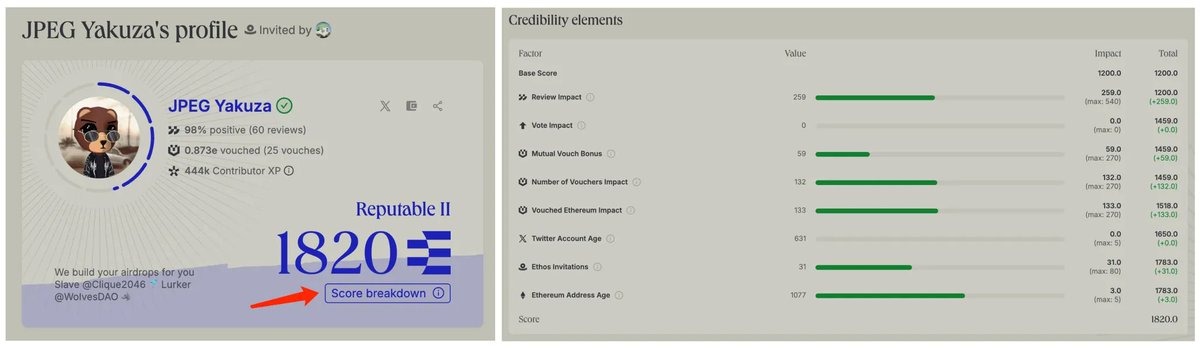
Additionally, as shown in the image, users can view their score composition and detailed data through the "Score Breakdown" function, enhancing reputation management transparency.
How to Join Ethos? Understanding Registration Thresholds and Practical Tips
Currently, Ethos uses an invitation system with invitation codes in short supply, obtainable only through official channels or partners (such as Tako Protocol). Crypto KOLs @ai_9684xtpa and Daily Coin Research founder Alvin also provided some suggestions:
Find high-scoring inviters to share rewards.
Bind existing community accounts and active EVM addresses.
Perform daily cross-evaluation tasks and use the Chrome extension to earn XP.
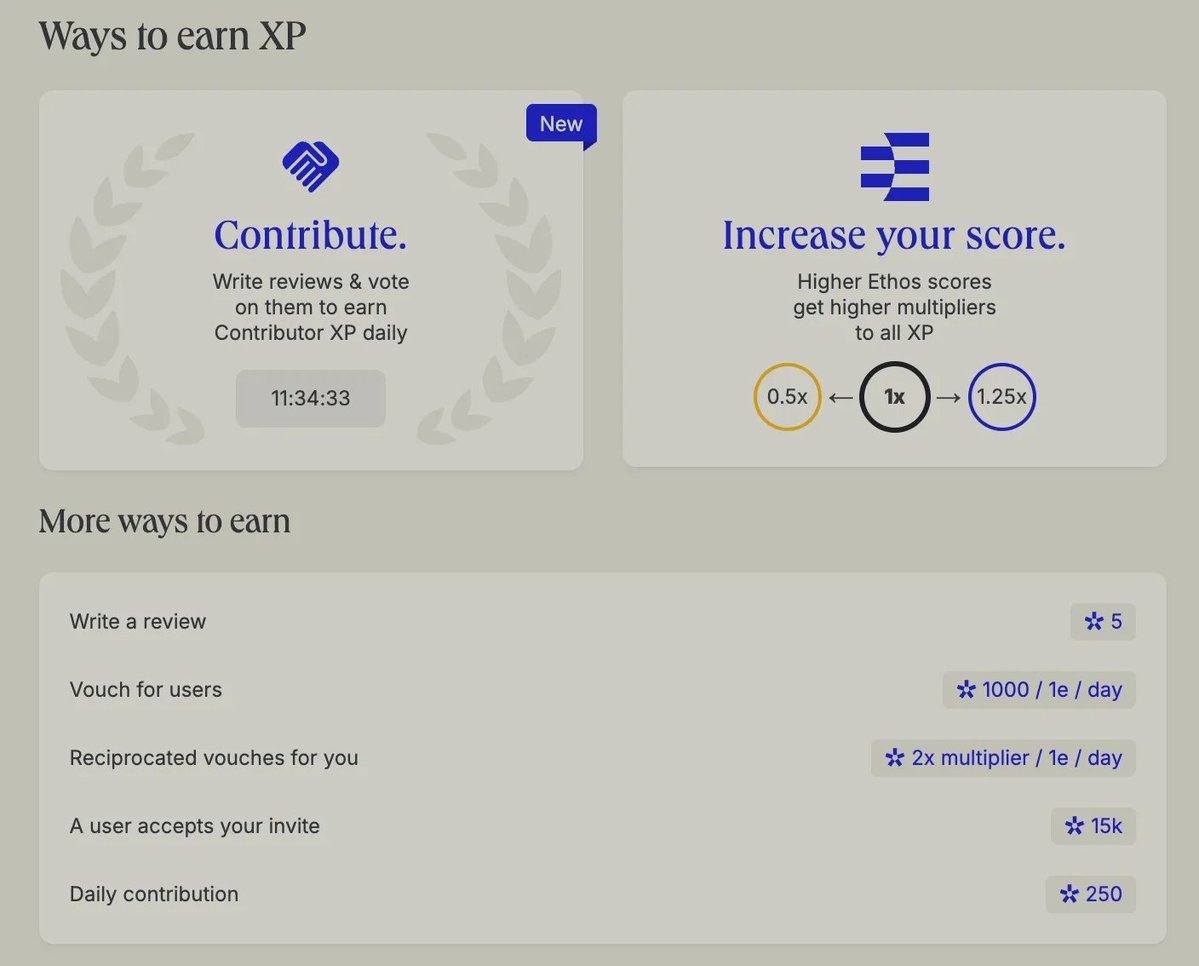
Although the purpose of XP has not been disclosed, the community generally believes it is closely related to future token airdrops.
Ethos vs. Kaito: Comparison of Reputation and Traffic
Although Ethos and Kaito both belong to the trust and information financialization track (InfoFi) in the crypto field, their directions are completely different:
Kaito: Analyzes tweets and content interaction volume through AI, giving Yap points as contribution evaluation, suitable for users pursuing traffic and high productivity.
Ethos: Builds decentralized community trust through interpersonal evaluation and staking, more suitable for users who focus on interpersonal relationships and reputation.
In short, Kaito is a data-driven "data judge," while Ethos is a relationship-oriented "trust."
Challenges and Breakthroughs in Continuous Innovation:'s Path of Evolution
Recently recently, Ethos has released two new features: "Automatic Comment Translation (now online)" and "Anonymous Comments Based on Zero-Knowledge Technology (ZK) (still in testing)" which have enhanced-and cross-language participation possibilities.
However, Ethos still faces challenges such as "invitation-only entry threshold, gas fee burden," and further optimization of mechanisms is needed to maintain the authenticity and sustainability of ratings.
In the Trust Desert of Web3, Ethos May Become a Beacon
Ethos Network provides not just a scoring tool, but a community culture of trust building. It allows users to no longer passively receive information, but actively participate in the process of reputation building. a true Builder,, Ethos is not just a tool to enhance personal credit, but possibly an "entry ticket" to network.
Risk Warning
Cryptocurrencyurrinvestment carries high risks, and its price may fluctuate dramatically. You may lose all your principal. Please carefully cautassess the risks.