Written by: Stacy Muur
Translated by: Odaily Golem
First comes the Web3 stage, then the protagonist is born.
When a protocol becomes popular, we can see people talking about it endlessly on social media, and all other projects either start to "curry favor" with it or begin to imitate it. You should understand that feeling, definitely on Pump.fun, and if you're experienced, you can find the same feeling on platforms like FriendTech, Farcaster, Bananagun, and UniBot, each with its own cycle.
The cruel reality is that the Web3 stage is always there, hype will continue, but the protagonists are constantly changing. Not because the product failed, but because people have discovered something more dazzling. In this field, people's novelty retention time is very short, and the spotlight never lingers for too long.
This is not an obituary. Although not all once-popular protocols have died, they have all experienced a cycle from being hot to becoming silent. This article is about projects that once had a halo, and what they look like when they are no longer on the front page.
Who are the "has-been stars"
If you've been in Web3 long enough, you can see a cycle: a protocol becomes popular, occupies everyone's timeline, and then disappears. The table below is a snapshot. It doesn't measure Total Value Locked (TVL) or token price, but something more elusive: attention, memory, and emotional relevance. These projects were once stars, some of which still survive today.
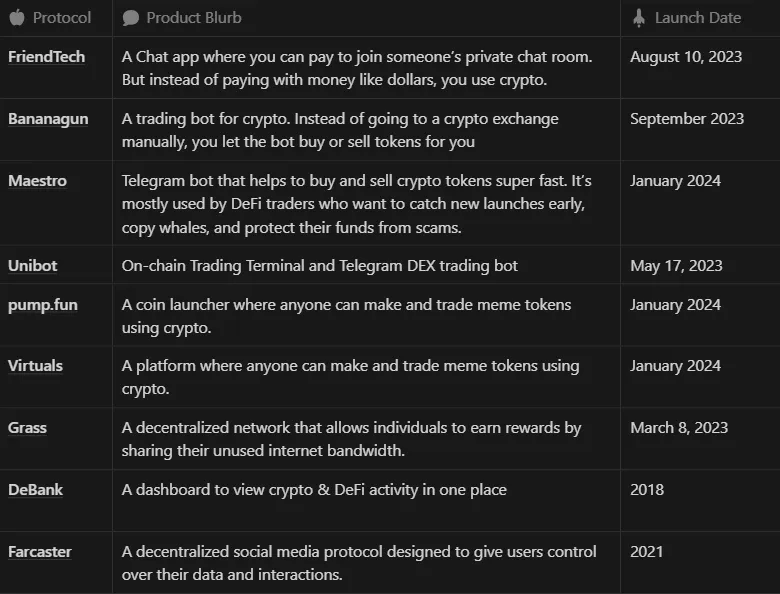
Web3 Has-Been Stars
Take FriendTech as an example, its rise was rapid and high-profile, but its decline was thorough. No roadmap, no user stickiness, no signs of recovery. After falling from grace, people realized it was just a facade.
UniBot is slightly better. It has experienced hacker attacks, copycat competition, and market decline, but is still recognized as having one of the best trading experiences in its category.
Virtuals is one of the few companies that not only survived but also transformed. Initially a prediction platform based on Base, it now positions itself as "Wall Street in AI agents". Such a transformation is not easy in the crypto field, especially for projects born in a "degen casino".
Pump.fun and Maestro haven't died, they've just been diluted in the market. They're still operating, still active, with user activity surging, but no one calls them revolutionary anymore. Meme coin manufacturing machines and sniper bot networks were never built for longevity; they were born for sensation. And they did achieve that, more than once.
There are also slow-burn projects like Grass, DeBank, Farcaster, each with its own characteristics: speculative returns, DeFi social identity, and decentralized social networking. They are not flashy projects, nor have they perished, they just quietly develop after the hype period.
Still building, still iterating
If the first table measured attention, the following table focuses on something completely different: perseverance. A project's hype period can be lively, but the building process is quiet and grueling.
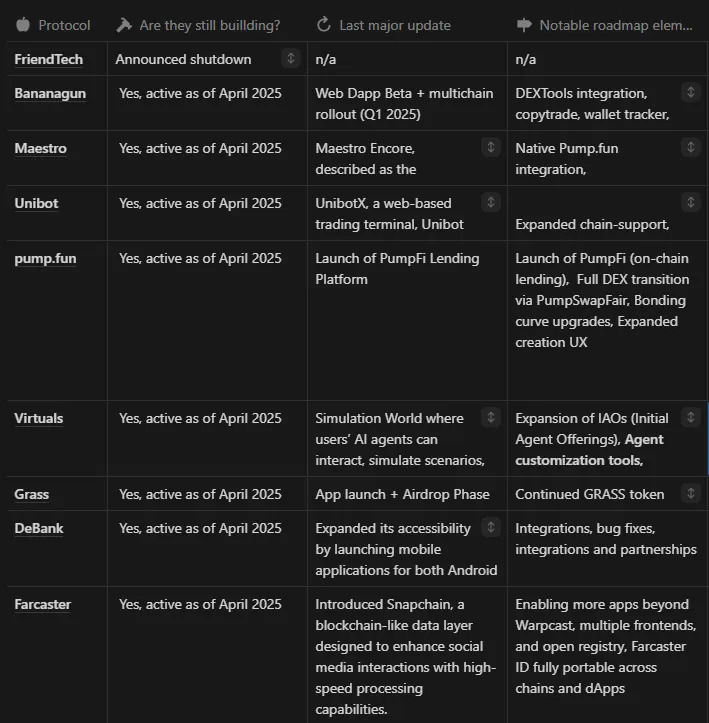
Some protocols in the above table have not stopped developing, even though they are not hyped by the masses. This table depicts the lesser-known reality of who is still pushing updates, expanding integrations, or strengthening infrastructure long after the spotlight has moved away.
Unfortunately, FriendTech was the first to give up and officially closed in September 2024. The rest of the projects are still growing quietly, not on Twitter's timeline, but in project update logs.
(Translation continues in the same manner for the rest of the text)Bananagun tells a narrative of fair competition. Quick sniping, smart token economics, and a bot for everyday traders. It thrived in the Telegram bot wave, gaining reputation through sharper and faster speed. Now it continues to run and serve traders, but has become infrastructure - useful, yet no longer leading trends.
UniBot
UniBot focuses on trading speed and precision. It positions itself as a tool for the sharpest Telegram traders, more than just a product, but an identity. Despite facing competition and even hacking attempts, UniBot's image remains unshaken. Its features continue to expand, and its user base remains enduring. It doesn't rely on viral spread, but on reliability. This narrative still applies today.
Pump.fun
Pump.fun decentralized token creation and brought stories of sudden wealth. At its peak, it felt like a new token was born every 10 seconds, but the market quickly became saturated. Today, it remains active, but the magic has disappeared. The narrative of "anyone can issue tokens" lost its luster in the "PVP" environment.
Virtuals
Virtuals was initially a speculation center based on Base, understanding attention but later dominating it. It shifted to an AI agent platform, redefining itself beyond predictive markets. Now, it no longer chases memes but builds infrastructure. "Wall Street of AI agents" is a bolder, more enduring narrative, making it one of the few protocols in this article capable of rewriting its own story.
DeBank
DeBank told the market that a user's DeFi portfolio could constitute their identity, making wallet tracking social. This narrative was once effective but remained stagnant. DeBank's product remains fully functional and highly regarded among advanced users, but it never evolved from a tool to a network. In some ways, DeBank is a victim of its own user experience stability - too good to ignore, yet lacking sufficient appeal for active promotion.
Farcaster
Farcaster's original intent was: own your social experience. It didn't try to replicate Twitter but reimagined on-chain posting, interaction, and building. Current circumstances prove that Farcaster has not declined. It has been slowly accumulating trust and appeal, and as a long-tail narrative, avoiding viral spread might make it more resilient.
Which Once-Popular Projects Are Nearly "Dead"
Besides the mentioned well-known examples, other protocols also gained significant attention in the short term, but subsequently showed clear declines in user activity, trading volume, or related data. These were not marginal projects; at their peak, they led market narratives and drew strong attention. This section highlights some such cases.
Blast
During the points-driven surge in July 2024, Blast reached a peak of 900,000 monthly active users. Currently, monthly active users are around 120,000, with the yield narrative quickly dying after user points fatigue.
Scroll
At the peak of zkEVM hype, Scroll's monthly active users reached 1.2 million, but are currently around 111,000. Scroll continues to operate, but market novelty fades as infrastructure shifts towards performance-priority narratives.
Starknet
Starknet once had bridge deposits reaching $1.6 billion, now around $390 million. Some developer loyalty remains, but mainstream adoption has slowed due to cost and tool friction.
Renzo Protocol
Renzo's peak monthly active users were 155,000, now slightly below 19,000. While still influential in liquid restaking, its shine has been overshadowed by more powerful EigenLayer ecosystem participants.
SushiSwap
SushiSwap's peak trading volume reached $11.3 billion. Current volume is around $200 million. This is a cautionary tale showing how fragmentation, governance expansion, and centralized exchange competition can erode pioneers' advantages.
These protocols were once considered industry leaders. While some remain active, their data indicates user interactions have transformed. Is this decline due to changing market environments, narrative evolution, or simply stronger market forces? The lesson remains consistent: early growth momentum does not correlate with long-term project survival.
Conclusion
In Web3, most narratives haven't died, they're just no longer discussed. The projects in this article weren't selected for failure, but for their significant short-term relevance. They didn't fail because they lost funds or users, but because they lost narrative momentum - an immeasurable force that transforms products into action.
The deeper pattern lies in the emotional arc of belief. When this arc flattens, users leave, not because they're disappointed, but because they lack a reason to stay.
This explains why long-lived projects are so rare in Web3. To be enduring, protocols must not only be usable but narratively vibrant. They need to offer more than just returns or tools - they must provide identity, possibilities, and a reason to say "I'll be back tomorrow".
Web3's next narrative breakthrough won't just come from solving problems, but from creating meaning. And the projects worth watching are quietly building after the hype, waiting for their second moment.