


Written by | Caijing Special Contributor Jin Yan
On Thursday, May 1st local time, U.S. media reported that U.S. National Security Advisor Mike Woltz is set to leave his position and be reassigned as the U.S. Ambassador to the United Nations, with Secretary of State Rubio to temporarily fill the vacancy. Woltz's deputy, Alex Wong, will also be departing. He had previously assisted in arranging the summit between Trump and North Korean leader Kim Jong-un and was one of the few senior officials with practical East Asian diplomatic experience. U.S. President Trump's Middle East envoy Wittkoff is currently considering taking over as National Security Advisor from Mike Woltz, but no final decision has been made.
Trump's first term was characterized by frequent high-level personnel changes, but his second term only saw its first major personnel shift after 100 days in the White House. The National Security Council (NSC) is the core institution for formulating and coordinating security policies for U.S. presidents, with its members often making critical decisions on global hotspots. Woltz was seen as an official firmly supporting traditional security alliances (such as NATO) and was a relatively moderate voice advocating for external coordination within the Trump administration. This change came very suddenly, with even the U.S. State Department spokesperson Tammy Bruce learning about it from reporters during that day's briefing.
Meanwhile, Elon Musk, the global business tycoon who was at the height of his influence earlier this year, has now faded from the core decision-making circle. On Wednesday, April 30th, Musk claimed at a White House meeting that the Government Efficiency Department (Doge) he led had saved $160 billion in expenses so far. This falls far short of his promise from last autumn to "cut at least $20 trillion".
Some institutions have calculated that Doge-related "dismissals, rehiring, productivity losses, and paid leave for thousands of staff will cost over $135 billion in this fiscal year", meaning the Doge project may actually lead to an increase in government net expenditure.
Double Exit
Musk played an extremely special role in the Trump administration by supporting Trump's election with nine-digit campaign funding. He frequently participated in phone consultations with foreign heads of state, hosted high-level meetings at the Pentagon and National Security Agency, and even directly conversed with Indian Prime Minister Modi. Now, Trump's key lieutenants are taking shape, including trade advisor Navarro, who has risen to become a crucial figure in the Trump administration with an unprecedented "single-voice" status that no one dares to challenge directly; and Treasury Secretary Bessent, whose influence has grown as U.S. dollar hegemony wavers. Musk had fierce disputes with these two White House heavyweights. Treasury Secretary Bessent and Musk exchanged harsh words outside the presidential office, while Musk called Navarro an "idiot" on social platform X.
U.S. media said that the first female White House Chief of Staff, Wiles, played a crucial role in Musk's exit. She believed Musk's physical presence in the White House threatened the collaborative spirit she wanted to establish. Her efforts significantly reduced Musk's opportunities to appear in the West Wing, ultimately leading to his fade-out.
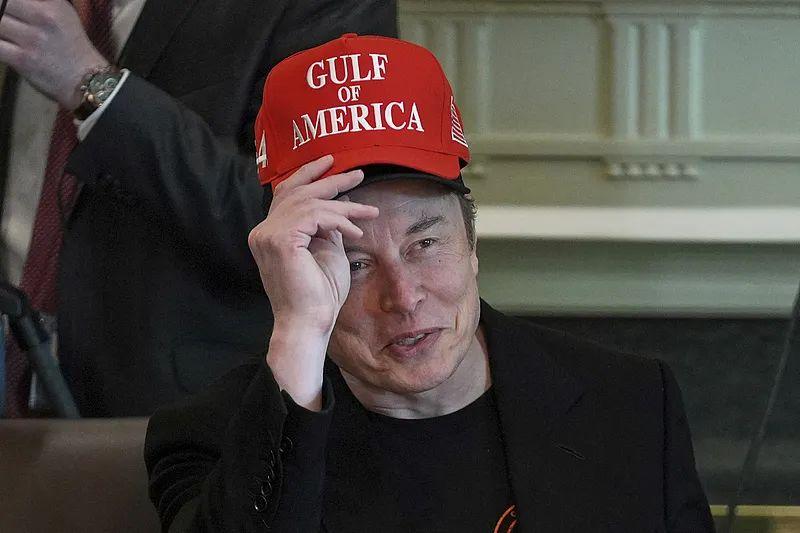
On April 30th, Musk attended a cabinet meeting at the White House wearing two hats - one was the red "America Bay" hat favored by Trump, and the other was a Doge hat. Musk repeatedly switched between the hats, ultimately deciding to stack them. Musk, who was trying to navigate both political and business spheres, was now facing a double exit.
Musk's formal position in the cabinet will end around May 30th, after which he will serve as an informal advisor. Additionally, due to Tesla's stock price decline and investor dissatisfaction with Musk's deep political involvement, Tesla's board is seriously considering finding Musk's successor. Although Tesla subsequently rarely publicly denied this, Musk becoming a net negative asset has caused the company's first-quarter revenue to drop 9% year-on-year, with automotive business revenue down 20% and net profit plummeting 71%.
Musk recently told investors in a Tesla earnings call that from May, he will significantly reduce his work time in Doge and refocus on Tesla. The Tesla brand has been severely damaged by Musk's political work and faces performance challenges - with sales and performance both declining sharply. An unnamed Doge department employee told Caijing that Musk had previously led a requirement for government workers to work 40 hours per week in the office or lose their jobs. Because they found that U.S. government civil servants essentially have 10 people doing a job one person could complete, Musk chose to battle the massive government employee group, who then channeled their dissatisfaction towards him.
Musk is seen as Tesla's soul. Wedbush Securities analyst Dan Ives once said: "Tesla is Musk, Musk is Tesla." However, Tesla currently faces numerous challenges, with aging product lines, intensifying competition from China, and the Doge action and resulting political backlash causing both product demand and profits to decline.
Recently, Musk's rocket and satellite company has been collaborating with software manufacturer Palantir and drone manufacturer Anduril to bid on key parts of the "Golden Dome" project, which has attracted significant interest from rapidly developing defense tech startups. There are indications that Musk's SpaceX and its two partners are poised to win key parts of President Trump's "Golden Dome" missile defense system bid. However, 42 Democratic lawmakers have called for an review of Musk's role in this missile defense system bidding process.

Musk's SpaceX has generated extensive attention. SpaceX and its two partners are likely to win key parts of President Trump's "Golden Dome" missile defense system bid. Photo/Jin Yan
Personnel Turmoil
In March this year, Woltz drew close attention after mistakenly adding Jeffrey Goldberg from The Atlantic Monthly to a Signal chat group. Goldberg disclosed Woltz's discussions with national security senior officials about military strike plans against Houthi targets in Yemen. After Woltz privately acknowledged the report's authenticity, White House officials debated whether he should resign, but Woltz never proposed resignation, and Trump at the time did not request his resignation. Trump had publicly expressed support for Woltz, calling him "a good person" who had "learned his lesson".
Woltz's departure marks the end of a month-long personnel upheaval within Trump's national security apparatus. Since April 1st, the National Security Council has fired at least 20 members, causing severe personnel shortages in multiple key departments. Informed sources revealed that the actual scale of layoffs exceeds previous reports, causing some critical national security institutions to face staff shortages.
The layoff action began with about 15 people being dismissed in the first week, initiated after conservative commentator Laura Loomer submitted a list of "disloyal" officials to President Trump, with the dismissal process continuing. Media reports suggest that several important departments within the NSC are currently in a near-standstill state, including teams responsible for Latin American policy, international organization affairs, and legislative matters.
Additionally, the US Department of Defense dismissed three senior officials on April 18, accusing them of "unauthorized disclosure of national security information". These three officials subsequently issued a joint statement, firmly denying the allegations and accusing the Pentagon of "baseless defamation". The Department of Defense had previously launched an investigation into multiple "leak incidents" to determine how sensitive information about the second US aircraft carrier heading to the Red Sea, potential military action plans for the Panama Canal, Musk's visit to the Pentagon, and the US suspension of intelligence collection for Ukraine were exposed to the media.

The US Department of Defense launched an investigation into multiple "leak incidents". Photo/Jin Yan
After Trump's return to the White House, the Pentagon has already conducted one "purge" of senior officials, dismissing high-ranking officials such as Charles Brown, the Chairman of the Joint Chiefs of Staff appointed by the Biden administration, in February.
These purge actions have severely damaged the morale of certain departments within national security agencies. These officials also added that some government departments lack relevant national security expertise, and in some cases, it is difficult to attract senior talent.






