1. Introduction
Iceland, thanks to its unique climatic conditions and natural resource reserves, has gradually become one of the important mining bases for cryptocurrencies. Iceland's cold climate provides excellent heat dissipation conditions for mining machines, and Iceland's abundant and cheap electricity resources and stable and friendly political policies give it strong competitiveness in the crypto mining industry. As a shelter for the cryptocurrency industry and a base for global miners, Iceland's cryptocurrency tax system and regulatory dynamics have also attracted much attention. This article revolves around this topic.
2. Iceland’s basic tax system
2.1 Overview
Iceland has a relatively friendly tax environment and a relatively complete tax system. In recent years, the Icelandic government has focused on simplifying the tax system, lowering tax rates, and expanding tax sources in tax reform. It has signed double taxation avoidance agreements with more than 30 countries including China, the United States, and the United Kingdom. Iceland also offers tax incentives to attract foreign investment, such as tax breaks, cash subsidies, training assistance and land leases. Iceland adopts a two-level taxation system, namely, central and local taxes. At the central level, taxpayers need to pay corporate income tax, national personal income tax, value-added tax, environmental and resource taxes, tariffs, accommodation taxes, national television and broadcasting fees, etc.; at the local level, taxpayers need to pay municipal personal income tax, social insurance, municipal taxes, real estate taxes, stamp duties, inheritance taxes, etc. These taxes can be broadly divided into direct taxes and indirect taxes, of which indirect taxes are the main form of taxation in Iceland. Compared with other countries, Iceland's tax system is characterized by simplicity and effectiveness, which enhances the attractiveness of foreign investment and the international competitiveness of local companies.
2.2 Main taxes
2.2.1 Corporate income tax
All companies incorporated in Iceland are considered resident companies in Iceland. Foreign companies that set up branches in Iceland or have effective management in Iceland are also considered resident companies. Resident enterprises pay corporate income tax based on their net income. According to the official announcement of the Tax Changes in 2025 (Skattabreytingar á árinu 2025) released by the Icelandic Tax Office, the general tax rate applicable to joint-stock companies and limited liability companies is 20%, and the special tax rate applicable to other entities such as partnerships and cooperatives is 37.6%.
2.2.2 Personal income tax
Any individual who spends more than 183 days in Iceland within a 12-month period is considered a resident individual from the date of arrival and is fully taxable on his/her worldwide income. Individuals who temporarily stay in Iceland for 183 days or less are considered non-resident individuals and are subject to national and municipal income taxes on Icelandic source income. Taxable income is wages minus pension fund premiums, and the individual income tax rate is progressive, as shown in the figure:
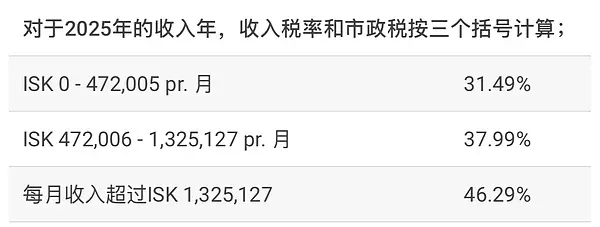
In addition, capital gains (such as dividends, interest) received by individuals who are not engaged in business activities are taxed separately at a rate of 22%. Each person also enjoys a personal tax credit of ISK 68,691 per month, which is deducted from the calculated tax, and non-resident individuals can enjoy the same expense deductions as resident individuals.
2.2.3 Value Added Tax
Value Added Tax (VAT) is an indirect consumption tax levied on all stages of domestic business transactions and on the importation of goods and services. Domestic and foreign companies or self-employed individuals selling goods and services in Iceland must declare and pay VAT of 24% (standard rate) or 11% (reduced rate, applicable in some cases). The taxpayer should complete the corporate VAT registration, after which he will obtain a VAT registration number and a registration certificate. In particular, persons who sell labour and services exempt from VAT, as well as businesses and individuals who sell taxable goods and services for ISK 2,000.000 or less in each 12-month period after the commencement of their business activities, are exempt from the obligation to register for VAT. In addition, Iceland has implemented a policy of reduced tax rates or complete exemption for a series of goods and services, such as exempting public transportation, healthcare, and the operation of schools and educational institutions from value-added tax.
2.2.4 Environmental and resource taxes
Iceland's environmental and resource taxes include three types: fuel consumption tax, carbohydrate tax, and electricity and heat consumption tax. Fuel excise tax is levied on energy fuels. The carbohydrate tax is levied on liquid fossil fuels (i.e. natural gas and diesel, gasoline, aviation fuel and liquefied petroleum gas). Companies that obtain a license for carbohydrate research or processing, as well as companies that are directly or indirectly involved in carbohydrate processing or distribution, must pay processing tax and carbohydrate tax. Electricity and heat consumption tax is a special tax collected from entities that sell electricity or hot water at the user sales stage. If the annual sales amount is less than ISK 500,000, then it is tax-exempt.
3. Iceland’s cryptocurrency tax system
3.1 Overview of Crypto Taxation
Iceland has not yet enacted specific legal provisions specifically for cryptocurrency taxation, so related issues are handled in accordance with the general provisions of Icelandic tax law. The definition of "income" in the Icelandic Income Tax Act is a broad concept that covers any form of monetizable benefits obtained by a taxpayer, unless otherwise expressly exempted by law. Therefore, the Icelandic Tax Office imposes taxes on cryptocurrency assets. In addition, according to Iceland's definition of tax residents, regardless of whether the relevant company is registered in Iceland or whether the relevant individual is a permanent resident, it is subject to Icelandic tax laws.
In different scenarios, the corresponding tax treatment varies depending on the nature of the transaction. For example, capital gains earned by individuals from cryptocurrency transactions are subject to capital gains tax at a rate of 22%, while cryptocurrency profits of companies are taxed at the corporate tax rate of 20%. Mining income is considered taxable income and falls under the category of business income and is taxed at the standard income tax rate. In this regard, the Icelandic Tax Bureau pointed out that taxpayers mainly trigger tax obligations in two scenarios: one is when receiving cryptocurrencies, such as mining, employers using cryptocurrencies for salary payments, etc.; the other is when exchanging cryptocurrencies for other values, such as selling and consuming cryptocurrencies.
3.2 Receiving Cryptocurrency
Mining: Mining is generally regarded as a commercial activity, and the mined cryptocurrencies are subject to corporate or personal income tax based on business profits. Commercial mining is subject to cost deduction rules, and costs such as hardware depreciation, electricity costs, and handling fees can be deducted. Individual occasional, non-large-scale mining activities are not considered commercial mining, and costs cannot be deducted. Their income is taxed as ordinary personal income. In addition, Iceland does not currently impose special electricity taxes on mines based on electricity consumption or environmental impact.
Cryptocurrency received as remuneration for services rendered: When an employer pays wages in cryptocurrency, it must be converted into Icelandic krona at the market price on the day of payment and included in personal income, and taxes must be withheld and paid on the employer's behalf. Tax calculation is consistent with legal tender wages, and progressive tax rates apply.
Received cryptocurrency: Received cryptocurrency is tax-exempt if its value does not exceed the regular gift range, such as small gifts between relatives and friends.
3.3 Exchange Cryptocurrency for Other Assets
Tax liability is triggered when cryptocurrencies are used to exchange for other assets (goods, services, fiat currencies or other cryptocurrencies). Common scenarios include selling cryptocurrencies for fiat currencies, exchanging between different cryptocurrencies, and using cryptocurrencies to purchase goods or services. However, there is no tax on the transfer of cryptocurrencies between different wallets by the same user because there is no actual exchange of value.
Under this item, cryptocurrency transactions are divided into two types: one is personal non-commercial transactions, and the income is subject to capital gains tax (22%); the other is commercial transactions, and the income is subject to business profit tax. The criteria for distinguishing the two include the continuity, profit-making intention and independence of the trading behavior, that is, whether the frequency and scale of transactions are similar to business operations, whether the main purpose is to make a profit from the difference, and whether it is an independently conducted financial activity. Trading activities with characteristics such as high-frequency trading or institutional investment will be judged as commercial transactions.
As for the specific calculation of capital gains, it follows the formula "Cryptocurrency capital gains = transfer value - acquisition cost - deductible expenses". Among them, the transfer value is based on the actual market price of the cryptocurrency when the transaction occurs; the acquisition cost is the purchase price plus the handling fee when it is purchased, and the market price when the cryptocurrency is generated when it is mined; among the deductible expenses, there is a profit and loss offset rule, that is, the annual loss of the same cryptocurrency can be offset against the gain (for example: BTC loss can be offset against BTC profit), but it cannot be offset across currencies. In addition, losses caused by loss of private keys or theft of wallets do not fall within the aforementioned deductible losses.
4. Iceland’s cryptocurrency regulatory front-end and development trends
At present, Iceland has not yet enacted specific laws on cryptocurrencies, but relies on the existing financial system for regulation. The Financial Supervisory Authority (FME) and the Ministry of Finance supervise the crypto industry in accordance with their existing responsibilities.
In 2018, Iceland introduced the "Virtual Currency Service Provider Rules", requiring cryptocurrency exchanges and wallet providers to register with the Financial Markets Authority and comply with Anti-Money Laundering (AML), Know Your Customer (KYC) regulations and Counter-Terrorist Financing (CTF) regulations, establishing a basic regulatory framework for cryptocurrency businesses in the country for the first time. In 2019, the Icelandic Financial Supervisory Authority approved the country's first cryptocurrency institution, Monerium, enabling it to provide electronic currency services based on blockchain technology within the European Economic Area, which was seen as an important breakthrough. In June 2023, the European Union officially released the "Markets in Crypto-Assets Act" (MiCA), which will come into full effect on December 30, 2024 and apply to European Economic Area countries including Iceland. MiCA has made detailed provisions on the definition of crypto assets, access permits for issuers and service providers, and business management. As one of the signatory members, Iceland's cryptocurrency regulatory system is consistent with MiCA and in line with EU standards. This move will also play a key role in Iceland's future compliance with cross-border crypto business.
The impact of crypto mining on Iceland's energy consumption and environment has gradually attracted the attention of the Icelandic government. In March 2024, the Prime Minister of Iceland expressed his desire to reduce the country's crypto mining activities in an interview. In view of this, it is expected that the country will shift its focus from crypto mining to the entire blockchain industry. At the same time, Iceland has also shown an interest in exploring the issue of central bank digital currency (CBDC). The central bank believes that CBDC may be a viable alternative to the traditional monetary payment system. Its feasibility depends on the specific design of CBDC. Like many countries, Iceland's evaluation of CBDC is still ongoing and may take more institutional measures in this regard in the future.
5. Conclusion
Iceland has a relatively relaxed and friendly attitude towards the regulation and supervision of cryptocurrencies, which has enabled Iceland to occupy an important position in the global cryptocurrency trading and mining market. Relatively speaking, the cryptocurrency industry has brought a lot of investment to Iceland and even promoted Iceland's economic recovery after the bankruptcy crisis in 2008. It has also played a positive role in Iceland's economic development. In recent years, the Icelandic government has been supporting the development of the cryptocurrency economy in the country, and its regulatory measures have always focused on preventing illegal financial activities. On the one hand, the government may continue to focus on this issue in the future, strengthen international cooperation in combating financial crimes, and promote the healthy development of the cross-border encryption industry. On the other hand, the impact of crypto mining on the country's environment and resources has already attracted the attention of the government. Iceland may conduct more exploration on the road of upgrading or transforming related industries, which also brings new opportunities and challenges to crypto companies.