The Binance Alpha Points System is a tool for assessing user activity, where point levels determine eligibility for Web3 token generation events (TGE) and airdrops. Points are composed of balance and trading volume, with double points activities enhancing scoring efficiency. By optimizing trading strategies, selecting low-cost chains and potential tokens, players can efficiently accumulate points at a low cost and seize Web3 dividend opportunities.

Opening: A "New Track" in the Points Realm
The Binance Alpha Points System is like a battle for points in the cryptocurrency world. After the rule update in May 2025, competition has become increasingly intense. The $BOOP airdrop threshold has soared to 137 points, with some players reaching 150 points in just 15 days, maintaining a daily average of 10-12 points, truly embodying the "grinding" spirit. These points are not a simple number game; they directly determine whether you can obtain the "entry ticket" to the Web3 world - whether participating in token generation events (TGE) or grabbing airdrop benefits, point levels are the hard truth.
Today, we will deeply analyze the rules of Binance Alpha Points, combine on-chain data, sort out a low-cost, high-efficiency scoring strategy to help you stand out in this points race and steadily grasp the Web3 dividends.
Chapter One: Points Rule Breakdown, Know Yourself and Your Enemy
1.1 What are Binance Alpha Points?
Binance Alpha Points is a points system specifically designed to evaluate user activity, mainly used to measure your participation in the Binance Alpha section and Binance wallet ecosystem. Point levels directly determine whether you can participate in token generation events (TGE) or Alpha token airdrops. Simply put, points are your "ticket", and the higher the points, the more opportunities.
1.2 What are Binance Alpha Tokens?
Binance Alpha Tokens refer to a special type of token displayed in the Binance Alpha section. Binance Alpha officially debuted on December 17, 2024, dedicated to discovering early-stage projects with growth potential in the Web3 ecosystem. These tokens are usually tokens of emerging projects, some of which may have the opportunity to be listed on Binance spot markets in the future, but not all tokens will successfully list, so investment requires caution.
1.3 How are Points Calculated?
Binance Alpha Points consist of two parts: balance points and trading volume points, with the final score being the daily average over the past 15 days. Daily points are snapshoted based on your asset balance and trading behavior, with the snapshot time zone being UTC, ensuring fair global user participation.
· Balance Points: Based on the total asset balance in your Binance CEX account (main account) and non-custodial wallet (including Alpha tokens and tokens previously displayed in the Alpha section and now listed on spot markets). Sub-account balances will be merged into the main account for calculation and cannot be manipulated by dispersing funds.
· Trading Volume Points: Based on the total amount of Alpha tokens purchased on the Binance Alpha platform and non-custodial wallet (only buy transactions count, sell transactions do not). Trading volume points only look at purchase amount and are not affected by subsequent sales. For example, if you buy tokens worth $600 and then sell $500, points will still be calculated based on $600. Token value is calculated at the dollar equivalent market price at the time of transaction to ensure point fairness.
Even more exciting is that starting May 1st, Binance launched a double points activity. If you purchase Alpha tokens through Binance Smart Chain (BSC) or use limit orders to buy any Alpha tokens, the trading volume will be directly doubled. For instance, a $10 BSC transaction will be calculated as $20, directly earning 10 points. This "buy one, get one free" benefit is simply a gospel for point-grinding players.
To more intuitively understand the points rules, we have compiled the following table showing the specific calculation methods for balance points and trading volume points:
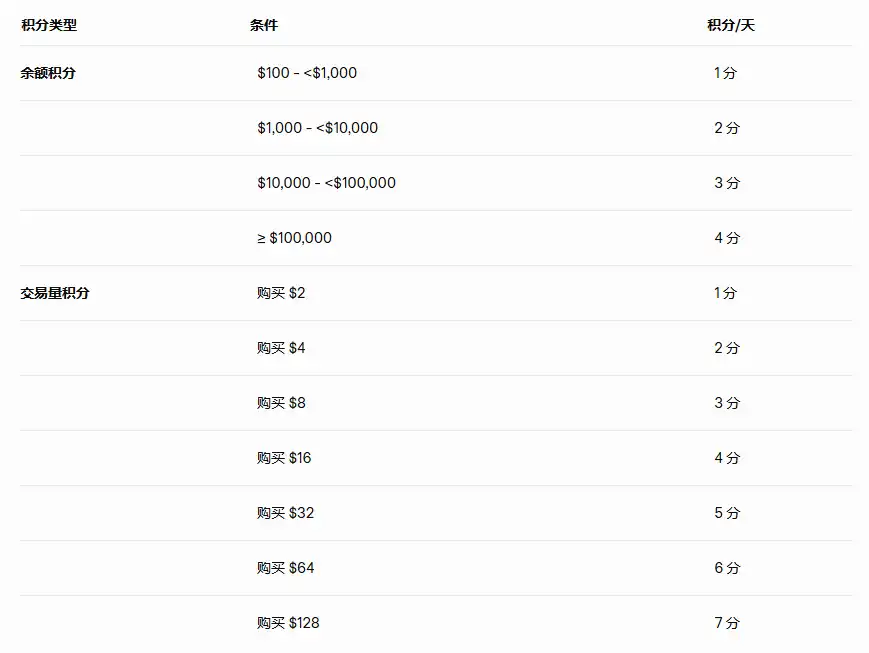
Note: Trading volume points add 1 point for each doubling, with balance snapshot time zone being UTC.
Through this table, you can clearly see that balance points grow slowly, while the doubling mechanism of trading volume points makes it the main force for point grinding.
The beauty of this method is that you not only earn points but may also gain profits from token appreciation. For example, suppose you invest $300 in $gork, earn 300 points in 30 days, and if the token appreciates by 50%, you could earn an additional $150, easily covering the $60 transaction cost. However, be cautious and try to choose tokens with stable K-line trends, avoid chasing highs, and prevent potential losses from sudden price drops.
To help you choose a strategy that suits you, we compared three methods:
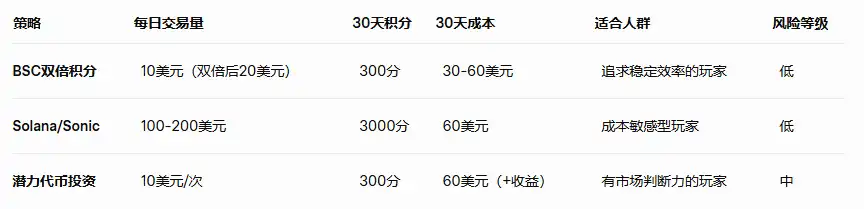
From the table, it's clear that the BSC strategy is suitable for players seeking stable efficiency, the Solana/Sonic strategy has low costs and high points, while the potential token strategy may bring additional returns but with slightly higher risks. You can choose the most suitable plan based on your needs.
Chapter Four: Breaking Through Bottlenecks and Striving for Higher Goals
The points world has never been smooth sailing. Currently, many players are approaching 150 points, and the seemingly stable pace of 10-12 points per day feels like hitting an "invisible wall" when trying to sprint to 180 points or higher. Don't panic, here are a few tricks to help you break through bottlenecks and move towards higher goals.
Increase Trading Volume to Sprint for High Daily Points
The current pace of 10-12 points per day is mainly based on a daily trading volume of 20-24 dollars (after double bonus). If you want to break through the bottleneck, try increasing your daily trading volume to 200 dollars. With the double bonus, this is equivalent to a 400-dollar trading volume, allowing you to earn 200 points in a single day. Maintaining this pace for a few days can quickly widen the points gap. However, be aware that increasing trading volume also increases costs. It's recommended to operate in batches, with each trade of 5-10 dollars to avoid slippage risks from large one-time trades.
Multi-Chain Collaboration, Efficiency Doubled
Single-chain operations might trap you in an efficiency bottleneck. Try a multi-chain collaboration approach. For example, simultaneously trading on BSC, Solana, and Sonic, with 50-70 dollars per day on each chain, totaling 150-210 dollars, easily reaching an average of 200 points daily. BSC is suitable for high-frequency trading, Solana has low costs, and Sonic might offer activity bonuses. Each chain has its advantages, and combining them not only diversifies risks but also improves overall efficiency. Especially the Sonic chain, recent activities might bring additional point rewards, worth investing more effort.
Optimize Trading Periods, Catch Low Volatility Windows
Market fluctuations significantly impact scoring efficiency. Trading during periods of intense price volatility can increase slippage, affecting cost control. It's recommended to choose relatively calm market periods, such as avoiding the volatility period after major news releases, or selecting the Asian session (Beijing time, 8 AM to 2 PM), when market liquidity is more stable and slippage can typically be controlled within 0.1%. Reasonably arranging trading times can elevate your scoring efficiency to the next level.
Utilize Tools to Enhance Operational Efficiency
If you manually operate every day, time costs might exhaust you. Try some automated tools, such as setting up automatic trading scripts through Binance API, pre-setting limit order buy and sell prices for high-frequency trading. This method is particularly suitable for players with some technical background, significantly saving time while ensuring trading stability. However, be sure to test strategies thoroughly before using tools to avoid financial losses due to incorrect settings.
Chapter Five: Risk Control, Winning Steadily
Scoring might be exciting, but don't let your wallet take a heavy hit. In the points world, winning steadily is the long-term strategy. Here are key risk control points to ensure your scoring journey is both efficient and safe.
(Translation continues in the same manner for the rest of the text)Strategy Adjustment: Flexibly Responding to New Changes
The points arena changes rapidly, with rules and market environments potentially adjusting at any time. For example, Binance might introduce new token support or modify the calculation method for double points. It is recommended to regularly check official announcements and follow on-chain data dashboards like Dune to understand the latest trading volumes and token trends. Flexibly adjust strategies based on market changes, such as switching to other chains or tokens when trading volumes of popular tokens decline, always maintaining an efficient points-earning rhythm.
Conclusion: Winning in the Points Arena Through Wisdom
Binance Alpha points system opens a door to Web3 opportunities for players. Whether utilizing BSC's double bonus, choosing low-cost transactions on Solana and Sonic, or achieving a win-win through potential tokens, the key to success lies in low costs and continuous action. There are no shortcuts in the points arena, but with strategy and wisdom, you can go further in this game. May your points steadily rise and unlock your Web3 dividends soon!
Welcome to join BlockBeats official community:
Telegram Subscription Group: https://t.me/theblockbeats
Telegram Communication Group: https://t.me/BlockBeats_App
Twitter Official Account: https://twitter.com/BlockBeatsAsia