Author: Jules Winnfield, CoinTelegraph; Translated by: Wu Zhu, Jinse Finance
I. What is AGI?
When the boundaries between humans and machines become blurred, we see Artificial General Intelligence (AGI). Unlike Narrow Artificial Intelligence (ANI), which uses AI to solve a single problem, AGI refers to artificial intelligence that can understand, learn, and apply knowledge in a way that is difficult to distinguish from human cognition.
AGI is still in the theoretical stage, but the prospect of artificial intelligence completely replacing human input and judgment naturally attracts widespread attention, with researchers, technology experts, and scholars working to turn the concept of AGI into reality.
Currently, another mainstream research tries to explore the feasibility and impact of AGI and ANI in an increasingly AI-influenced world.
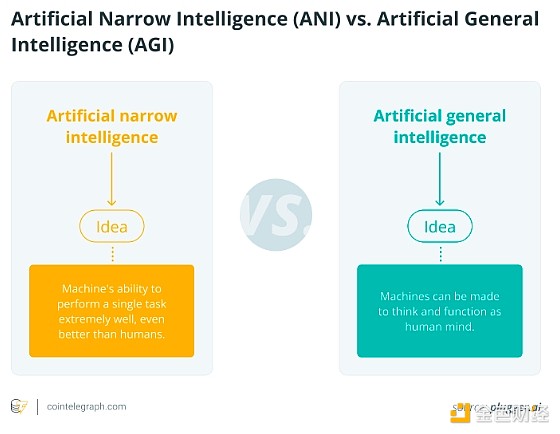
In fact, while ANI has already changed various industries, the potential of AGI goes far beyond that. Imagine a world where a machine can not only assist humans in completing tasks but also proactively understand the driving factors behind specific tasks, predict outcomes, and autonomously create innovative solutions to achieve the best results. This paradigm shift could completely transform healthcare, education, transportation, and countless other fields.
II. Why is AGI so powerful?
Unlike ANI, AGI is not limited to performing pre-programmed tasks or predefined responses within a limited domain. Instead, it has the potential to generate and apply knowledge in various contexts.
Imagine a self-driving car driven by AGI. It can not only pick up passengers from a train station but also personalize your journey through customized suggestions, such as stopping at the train station, choosing a sightseeing route, or navigating unfamiliar roads, ultimately reaching the destination. Moreover, as AGI is a machine, it does not feel fatigue and can continuously learn and improve at an exponential speed.
Vitalik Buterin provided the following definition of AGI, emphasizing its enormous potential:
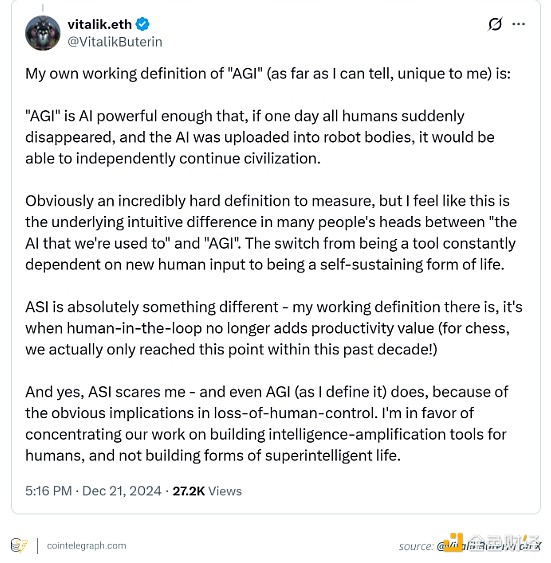
This example highlights some interesting characteristics of AGI, including:
Learning Ability: AGI can learn from experience and continuously improve its performance over time without additional dataset training by human programmers. This learning is not limited to specific tasks but covers a wide range of activities.
Problem-Solving Ability: AGI can use logical reasoning like humans to solve complex problems. This includes considering non-traditional variables such as emotional influences, thereby revealing broader potential outcomes.
Adaptability: AGI can adapt to new situations and environments without explicit programming, meaning it can thrive in dynamic and unpredictable environments.
Understanding and Interpretation: AGI can understand natural language, abstract concepts, and emotional nuances, enabling complex human-machine interactions.
III. The Pursuit of AGI: Where Will It Stand by April 2025?
AGI is currently a sci-fi version of AI. However, despite being in the theoretical stage, its enormous potential makes it a sci-fi version of artificial intelligence.
While existing models like ChatGPT are continuously developing and improving, the journey to making AGI a reality still requires overcoming significant technical challenges, such as:
Defining the Technology Stack: The purely hypothetical nature of Artificial General Intelligence (AGI) makes it difficult, or even completely impossible, to determine the exact nature of the technology stack required for actual implementation.
Neural Networks: Advances in deep learning have driven development in this field, but AGI still needs specialized neural networks to simulate brain structure for processing information and introduce emotions and nuances.
Natural Language Processing (NLP): The NLP field needs to make significant progress to enable machines to better understand and generate human language, incorporating nuances, emotions, and complexity. This includes more complex analysis of language grammar, semantics, and context, which are still evolving in traditional machine learning models using NLP.
Reinforcement Learning: Using reward-based mechanisms to train machines in decision-making will enable AGI to learn optimal behavior through trial and error.
Despite progress, creating an AGI that can truly think like humans remains a challenging goal.
IV. Can AGI Think Like Humans?
The question of whether Artificial General Intelligence can think like humans delves into the core of human cognition. The hallmarks of human thinking are consciousness, emotional depth, creativity, and subjectivity. While AGI can simulate certain aspects of human thinking, replicating the full range of human cognition is a formidable challenge.
Several dimensions of human cognition are particularly difficult to mimic:
Consciousness and Self-Awareness: One of the distinctive features of human thinking is consciousness, the awareness of oneself and one's environment. No matter how complex, AGI lacks the intrinsic introspective ability of human consciousness. AGI operates on a set of underlying algorithms and complex learning patterns, lacking subjectivity or genuine emotions.
Emotional Intelligence: Humans experience a wide range of emotions that influence their decisions, behaviors, and interactions. While AGI can be trained to recognize and respond to these emotions, the lack of genuine emotional experience means it cannot fully replicate them. Human emotional intelligence includes empathy, compassion, and moral considerations, which are difficult to encode in machines.
Creativity and Innovation: Creativity involves generating novel ideas and solutions, often achieved through intuitive leaps and imaginative thinking. AGI can simulate creativity by combining existing knowledge in new ways, but it lacks the intrinsic motivation and subjective insights that drive human innovation. True creativity stems from emotional experiences, personal reflection, and cultural context, which AGI cannot authentically replicate.
V. The Main Advantages of AGI
The litmus test for Artificial General Intelligence is whether it can fully replicate human experiences. Once achieved, its potential benefits will be immense and will benefit various industries, affecting every aspect of daily life.
Despite its limitations, AGI is increasingly seen as a positive force across industries, including:
Healthcare: AGI can use massive foundational training data to assist in disease diagnosis, develop personalized treatment plans, and predict personalized health outcomes.
Education: AGI can provide customized learning experiences, tutoring, and academic research support. AGI can adapt to individual learning styles and learning progress, thereby enhancing educational outcomes.
Economics: AGI can optimize financial models, predict market trends, and improve productivity. It can analyze economic data, forecast market trends, and guide investment decisions.
Environmental Science: AGI can analyze climate data, simulate ecological impacts, and propose sustainable solutions.
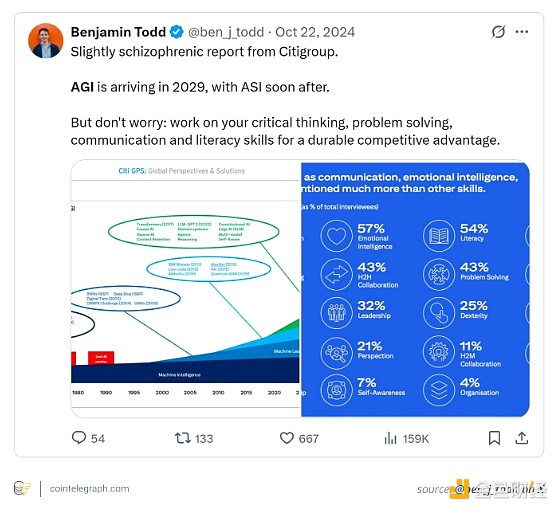
Moreover, the potential of AGI extends to transportation, communication, and entertainment, providing new frontiers for innovation.
VI. Ethical and Social Considerations
The rise of AGI raises significant ethical and social questions.
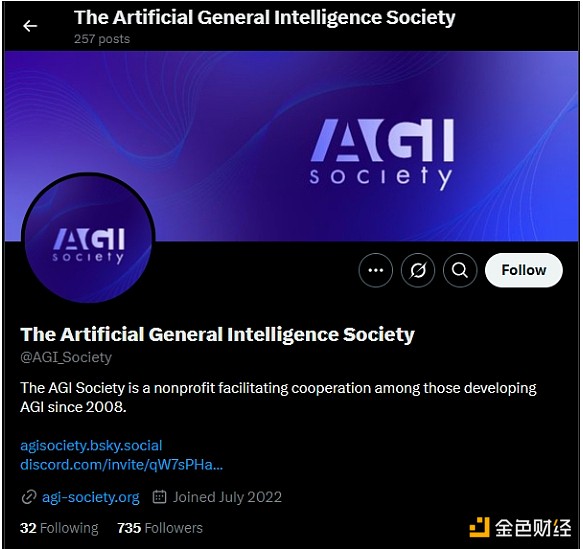
Although AGI is powerful, its safe use requires careful consideration, which has prompted the establishment of some non-profit associations, such as the AGI Association shown in the image below.
Fundamentally, it is crucial to address the following issues:
Safety: Ensure that Artificial General Intelligence (AGI) operates within safe and controllable parameters to prevent unintended consequences. This includes conducting rigorous testing and introducing regulatory frameworks to oversee AGI deployment.
Privacy: Protect personal data from being misused by AGI systems. As AGI can process massive amounts of data, protecting privacy is critical.
Bias and Fairness: Prevent discriminatory practices and ensure fair access to AGI benefits. Developers must ensure that AGI systems do not contain biases that could lead to unfair treatment.
Employment: Address the impact of AGI on job loss and labor dynamics. As AGI automates tasks, it is necessary to consider its impact on employment and provide support for affected workers.
Integrating AGI into society requires a thoughtful governance approach that ensures it serves the public interest and respects social values.
VII. Can Blockchain Empower AGI?
Artificial General Intelligence (AGI) can create computers as intelligent as humans, revolutionizing fields like cryptocurrency trading or market analysis. However, AGI needs trust and fairness to benefit everyone. Blockchain, the technology behind Bitcoin and Ethereum, provides a secure and transparent way to achieve this.
Here's how blockchain can enhance AGI performance using cryptocurrency-inspired solutions:
Clear Training Records: Blockchain works like Bitcoin's open transaction log, recording every piece of data used to train Artificial General Intelligence (AGI), such as cryptocurrency trading patterns. This helps ensure the system is fair and unbiased.
Shared Decision-Making: Similar to Ethereum's smart contracts, blockchain will allow developers, traders, and users to vote on AGI rules, ensuring no single company can control it.
Secure Data Sharing: Just as crypto wallets protect funds, blockchain can protect sensitive data from cryptocurrency exchanges, enabling secure sharing of AGI training data and preventing data breaches.
Fair Rewards: Developers building fair AGI (such as accurate trading predictors) can receive digital tokens, similar to cryptocurrency mining rewards, thus encouraging ethical work.
However, ongoing challenges such as blockchain's slow speed, crypto transaction delays, and limited storage capacity may make it difficult for Artificial General Intelligence (AGI) to process data quickly or handle large datasets.
To prepare blockchain for Artificial General Intelligence (AGI), researchers are exploring:
Off-Chain Storage: Decentralized systems like InterPlanetary File System (IPFS) are used for off-chain storage of large files, with blockchain only storing verifiable hash values, thus reducing congestion.
Sharding and Danksharding: Similar to Ethereum's scalability upgrade, sharding splits data across multiple nodes, allowing Artificial General Intelligence (AGI) to process more information without slowing down the network. Additionally, danksharding, an advanced sharding form being developed for Ethereum, combines rollup and data availability sampling to efficiently scale data access, which is ideal for real-time AGI applications.
Data Pruning: Advanced blockchain models like the Decentralized AI Blockchain Computing Network (DAIBCN) prune old or irrelevant data, keeping the system lean and optimized for high-demand tasks like Artificial General Intelligence (AGI). DAIBCN also supports secure distributed AI computation, perfectly blending blockchain trust with AI performance.
VIII. The Future of AGI
Artificial General Intelligence represents the pinnacle of AI development, promising capabilities comparable to human intelligence.
While AGI can simulate certain aspects of human thinking, achieving truly human-like cognition remains a distant goal. Consciousness, emotional depth, and creativity are intrinsic attributes of human experience that pose significant challenges for Artificial General Intelligence.
Nevertheless, the pursuit of AGI continues to drive innovation and reshape our understanding of intelligence. As we advance towards this frontier, we must balance ethical considerations and social impacts to responsibly harness the potential of Artificial General Intelligence.
Continuous research, identifying practical opportunities and technical requirements, and engaging in societal dialogue are key steps in addressing the challenges and opportunities presented by AGI.
The future of Artificial General Intelligence is promising, but it requires a balanced approach to ensure its ultimate integration into society enhances human well-being and respects ethical standards.