Comparing Dune, Flipside, Transpose, Footprint, and BigQuery.
Original: The Race for Data Domination: An Evaluation of Today's Top Crypto Analytics Platforms
By Carson Brown
Compilation: Katie Koo, translator for Odaily Planet Daily
Cover : Photo by Shubham Dhage on Unsplash
This article summarizes my research on the five on-chain data analysis platforms of Dune, Flipside, Transpose, Footprint and BigQuery, and evaluates their positioning and performance in the encryption ecosystem.
Five on-chain data analysis platforms that I use frequently
Dune
- Features: data dashboard function
- Cons: Difficult to get data directly from the website
- Data query language: V1—PostgresSQL | V2—Spark SQL
- Number of Twitter followers: 79.7 k
Dune Analytics is clearly ahead in terms of adoption and growth. Founded in Norway in 2018, Dune realized the need for accessible on-chain data early on. They persisted in building in the cycle of bull and bear markets, generated a specific user base, and raised 6942 in February 2022 million, valued at $1 billion.
Dune primarily focuses on analytics and data dashboards. If you know SQL (database management systems) and are comfortable with cryptography, Dune's simple user interface makes it easy to start querying, graphing, dashboarding, and sharing data in minutes.
Even though they recently announced the release of their API at the Dunecon event in September 2022, Dune leaves a lot to be desired in terms of supporting analytics beyond the interface. Unless you want to pay $390 per month for Dune Pro to export CSV files, you can only request access to the private beta version of the API or wait for the full public release (according to their docs, expected in December 2022, but Prices have not yet been disclosed).
Dune also launched Dune V2, which utilizes Apache Spark (analytics engine) to handle a wider range of queries and supports Cross-chain queries in the user interface.
Flipside

- Featured: ShroomDK (NFT-based SDK, programmable query access to comprehensive blockchain data)
- Cons: In-browser user experience
- Data query language: Snowflake (Twitter's open source high-performance ID generation algorithm)
- Number of Twitter followers: 40k
Founded in the US in 2017, Flipside, like Dune, has held its own through bull and bear cycles. While Flipside also provides easy access to encrypted data and dashboard functions, their focus is on bounties and Multichain integration. Flipside puts its bounties prominently on the site, while Dune's bounties are more subdued.
Flipside has also been the innovator of the ShroomDK*SDK, which provides free API access to all their data for anyone holding a ShroomDK NFT. ShroomDK NFTs can be minted or purchased like any other NFT, but each NFT is bound to an API Key that users can use to query Flipsides data.
Flipside's focus on bounty and accessibility through its API is important to the data community, but its user interface still leaves a lot of room for improvement. While Flipside offers a robust toolset for dashboards, the experience is nowhere near as good as Dune's, and I've seen some dashboards that are more powerful than Dune's, but the interface and user experience lag behind. On top of that, large queries can freeze the browser.
Transpose
- Features: low latency
- Disadvantage: Access to old saved queries
- Data query language: Transpose SQL
- Number of Twitter followers: 3 k
Transpose is making waves with its unique user interface and indexer focus. Founded in 2021, the "small and young" team focuses on its API.
Transpose focuses on its API and up-to-date data. The project hopes to provide user-readable blockchain data in batches in the form of APIs to solve the data access problems that developers are facing, thereby promoting the development efficiency of the entire Web3 ecosystem. They also focus on clear data organization - organizing tables by settlement layer, asset layer, and protocol layer. Also, there are no analysis or graphing tools, highlighting their focus on builders rather than analysts.
Transpose is clearly still young, there is still a lot to be desired, and being able to save and access queries easily would be a huge plus. The UI looks cool, but there are some inconveniences that come with it.
Footprint

- Features: number of chains supported
- Cons: User Experience
- Data query language: MySQL
- Number of Twitter followers: 12 k
Founded in 2021, Singapore-based Footprint Analytics also provides querying, graphing and dashboarding tools for encrypted data analysts. Their expansive list of backing chains makes it easy to gather data from multiple players in the crypto space, plus they offer their own research findings and NFT collections. Footprint also has a paid API with multiple pricing tiers (including free) that provides access to all data.
In terms of user experience, Footprint lags a little behind the others. While they do support some unique chains, their interface is not very intuitive.
BigQuery
- Features: Speed
- Cons: Not a crypto-native product
- Data query language: ANSI SQL
Companies like Google have also started supporting the crypto community. Launched in 2011, Google BigQuery was built for fast querying of massive datasets, and it shows in their performance. The use cases and intent of BigQuery go far beyond encryption, the amount of encrypted data they hold is enormous. Of course, it was built first and foremost as a query engine and does not provide the analytical features that other engines do, such as visualizations and dashboards. Additionally, BigQuery does not provide any project-specific parsing data, only core protocol data such as transactions, blocks, and logs.
The performance of the data analysis platform on the chain
Below I'll evaluate each platform's data processing, latest blocks, connection speed, and number of supported chains.
data processing
To analyze number crunching capabilities, I ran a similar query on all platforms. The query simply returns the top 100 addresses that received the most transactions between October 15th and October 22nd. Each platform uses the same time zone to ensure they get data for the same time period.
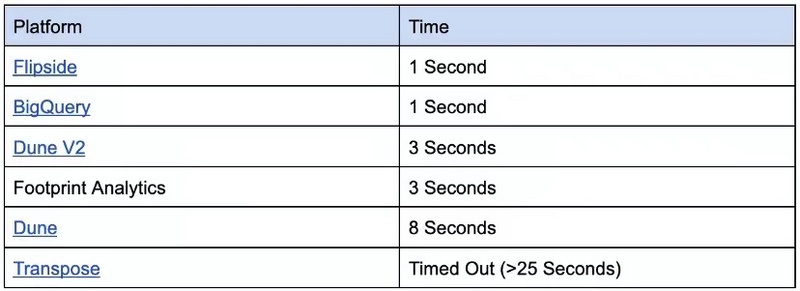
Flipside's competition with BigQuery is impressive. The significant improvement from Dune V1 to Dune V2 is also interesting. But Transpose timed out, probably because they didn't prioritize the analysis. It would be a good thing for users if using these types of queries improved performance.
latest block
Next, I looked at the latency on each platform. To do this, I queried the latest Ethereum block on each platform. I've done my best to make this as consistent as possible, however, I can't run these on all platforms at exactly the same time.
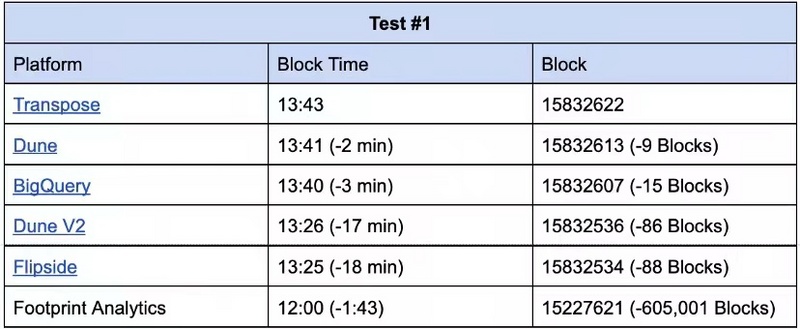
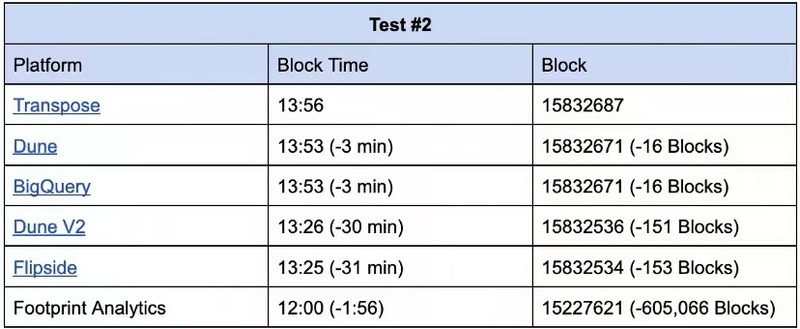
Transpose is positioned as an indexer, not an analytics platform. When I ran this test, the block returned by Transpose was the latest block at the time. Another thing to note is that there are no new outputs from Flipside, Dune V2, and Footprint between the two tests. They will most likely upload the data in chunks, which means that depending on your query times, the results can vary wildly.
connection speed
To test the connection speed, I queried all blocks between blocks 15833400 and 15833500 and connected all transactions in those blocks. For all platforms, I logged the time it took and the number of block rows returned.
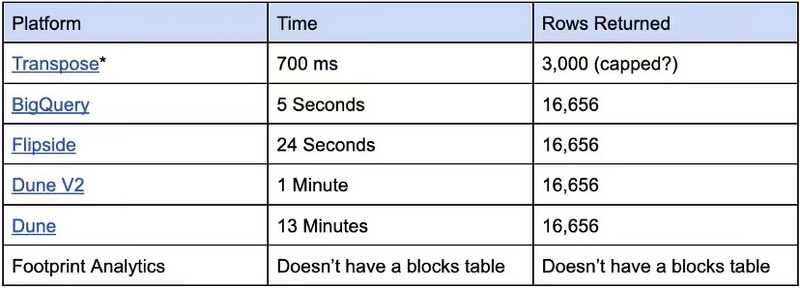
Transpose is the fastest query, however, the output is limited. In second place BigQuery is clearly the fastest, followed by Flipside and then Dune V2. Footprint doesn't have a block table, so I can't test the query. Dune V1 to V2 improved, but Flipside still surpassed them in performance.
chains supported
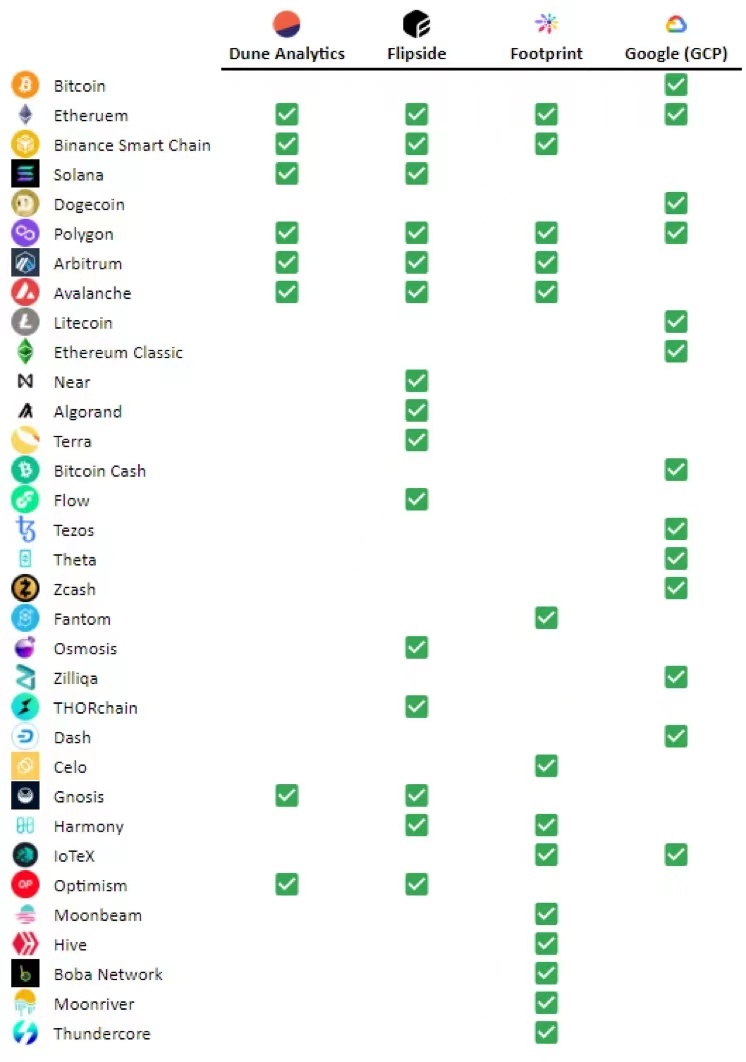
While this is not a performance metric, the number of supported chains is also a major driver of who uses the analytics platform and why. I used the graph below from @primo_data to see who has the most supported chains. Transpose did not appear in the original tweet, they currently only support Ethereum and Polygon.
According to the above table, the following platforms support the most chains, in order: Footprint (19), Flipside (16), BigQuery (13), Dune (8) and Transpose (2).
Summarize
Throughout the analysis, the platforms were very different. Taking into account the different interfaces, priorities and performance variability, I come to the following conclusions for my ideal analysis tool:
- Share analysis results (choose Dune): If your goal is to share analysis results, Dune is undoubtedly your best choice. While not quantitatively measured, their dashboard tool is better and smoother than others. The community surrounding Dune positions it as the go-to platform for synthesizing and sharing on-chain analytics.
- Performance (Choose Flipside): Flipside consistently outperformed Dune when evaluating both connection speed and data analysis. While Flipside has underperformed against BigQuery competition, Flipside leads the way with a vast list of smart contract-enabled chains and crypto-native tables, and Flipside will continue to prioritize maintaining and sharing crypto-focused tables. If fast-running query speeds are your preference, Flipside is for you.
- Chain Latency (Choosing Transpose): Even though Transpose is a newcomer and only on Ethereum, Transpose really blew me away because of how quickly they can collect the latest data from the chain. If you are a builder who needs up-to-date data for any reporting or visualization, you should give Transpose a try.
- Multichain(choose Footprint or Flipside): Footprint and Flipsite have access to more chains. If you want to prioritize viewing more chains, then Flipside or Footprint should do the trick for you. Almost every chain you care about is covered by them.
As the depth of encrypted data continues to grow, we will likely continue to see new players entering the space with their own unique use cases and capabilities. Before doing that, it's important to note that each platform has its own learning curve, and for 90% of enthusiasts, using the platform you're most familiar with is the best bet.
Disclaimer: As a blockchain information platform, the articles published on this site only represent the personal views of the authors and guests, and have nothing to do with Web3Caff's position. The information in the article is for reference only, and does not constitute any investment advice or offer, and please abide by the relevant laws and regulations of the country or region where you are located.