Source: Bankless; Translated by: Tao Zhu, Jinse Finance
What happens when the world's largest tech monopoly is taken to court by one of the most powerful studios in the gaming industry and ultimately loses? The answer will likely forever change mobile development...
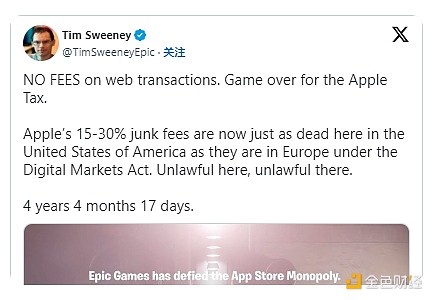
After nearly five years of legal battles, Epic Games forced Apple to rewrite the App Store rules. This not only brought enormous opportunities for cryptocurrencies but also marked a turning point for developers long constrained by Apple's walled garden: they can finally profit freely as they wish.
Today, we will delve into Epic's years-long legal battle and explore its profound impact on mobile app developers.
Apple's Antitrust Liquidation
In August 2020, Epic Games sued Apple, accusing the tech giant of anti-competitive behavior after removing Epic's wildly popular multiplayer battle royale game 'Fortnite' from the App Store.
The core of the dispute was Apple's policy of mandating all in-app purchases go through the App Store and charging up to 30% payment fees; Epic Games had attempted to circumvent this predatory policy by launching its own in-game payment system.
Although Apple ultimately made minor concessions, allowing developers to link to other payment options, the updated policy still requires a 27% share with Apple and strictly limits payment display within apps.
Neither side was willing to compromise, but after nearly five years of protracted litigation, the U.S. Northern California District Court finally made its ultimate ruling.
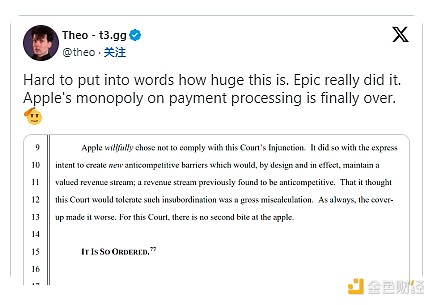
In an eighty-page scathing condemnation, Judge Yvonne Gonzalez Rogers ruled that Apple deliberately violated the law by establishing anti-competitive barriers designed to protect its billions of dollars in App Store revenue.
Furthermore, she referred Apple and one of its financial vice presidents to federal prosecutors, accusing them of contempt of court for violating a 2021 injunction prohibiting anti-competitive pricing practices in the App Store.
The 2021 injunction primarily challenged Apple's arbitrary 30% commission, while this latest ruling explicitly prohibits Apple from charging commissions on external purchases and controlling developer-user communication.
A Golden Age for Cryptocurrencies?
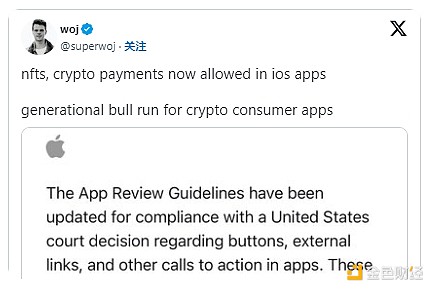
To comply with Judge Gonzalez Rogers' ruling, Apple was forced to update its App Store review guidelines for the United States.
The revised guidelines not only lifted any ban on external links but also explicitly allowed developers to display Non-Fungible Token collections. This marks a significant victory for the emerging crypto gaming industry, struggling blockchain artists, and others profiting from blockchain collectibles.
Most importantly, the updated guidelines exempt U.S. applications from Apple's previous ban on external payment methods that bypass its 30% revenue share in the App Store.
Cryptocurrency payments are praised for their near-instant speed and extremely low costs. Previously, mobile app developers could only use approved, high-fee payment channels. Apple's recent defeat has cleared the path for developers to use any payment method as they wish!
In an era where mobile apps can choose user payment methods, many cost-conscious developers will rationally abandon Apple's "walled garden" and high fees, opting for alternative solutions.
Using App Store payment by default provides undeniable convenience for app end-users: they have already registered their payment information with Apple and may be reluctant to store sensitive financial information on random third-party platforms.
While large studios like Epic Games might find developing independent proprietary payment portals worthwhile, for smaller studios, this new unlimited environment provides fertile ground for stablecoin experimentation.
App users can now make instant payments using any token from their crypto wallets without repeatedly loading credit card information onto random websites, simplifying the payment process and ensuring a trustless experience for all participants.
In turn, developers can instantly access their full funds (potentially stored in stablecoins) and outsource payment responsibilities to on-chain economies built specifically for this purpose, allowing them to focus on game development.
This is a truly compelling proposition for all parties, promoting interaction between users and apps, enhancing mobile app development's economic efficiency, and encouraging crypto payments to become mainstream.
Apple's policy shift is yet to settle, but the doors to mobile monetization are clearly open. In this new era, developers can build, profit, and expand as they wish.
With the emergence of seamless crypto payments, the future of on-chain applications has never looked brighter.