Author: Guatian Laboratory
Introduction
Since ChatGPT made its debut in late 2022, the AI sector has been the darling of the crypto field. Web3 nomads have always embraced the concept of "anything can be hyped," let alone AI with its infinite narrative potential and application capabilities. Therefore, in the crypto circle, the AI concept initially became a sensation through a "MEME wave," after which some projects began exploring its actual application value: What new practical applications can crypto bring to the rapidly developing AI?
This research article will narrate and analyze the current evolution path of AI in the Web3 domain, from the early hype wave to the current rise of application-type projects, and help readers grasp the industry context and future trends through case studies and data. Let's throw out an immature conclusion right from the start:
01
The AI meme phase is already in the past, with those who should have been cut and those who should have profited left as eternal memory fragments;
02
Some basic Web3 AI projects have always emphasized the benefits of "decentralization" for AI security, but users are not buying it. Users care about "can the token make money" and "is the product good to use";
03
If looking to ambush crypto projects related to AI, the focus should shift to pure application AI projects or platform AI projects (that can centralize many tools or Agents easy for C-end users to get started with), which might be the longer-term wealth highlight after the AI MEME wave;
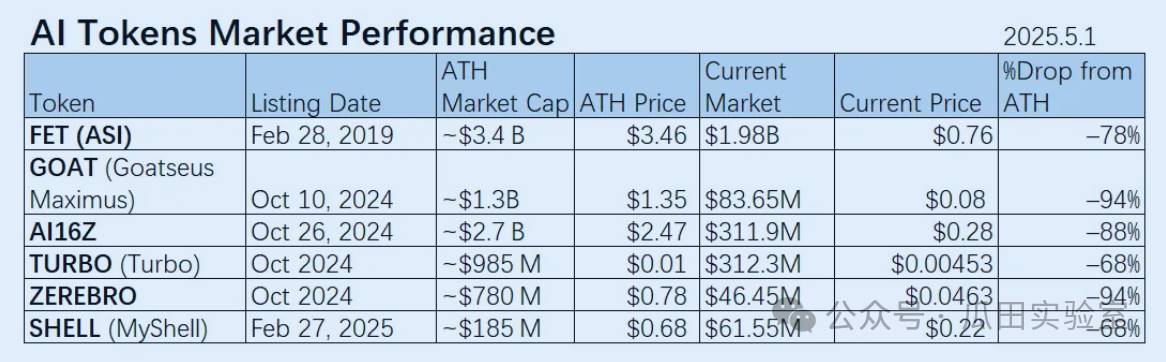
Development Path Differences of AI in Web2 and Web3
AI in the Web2 World
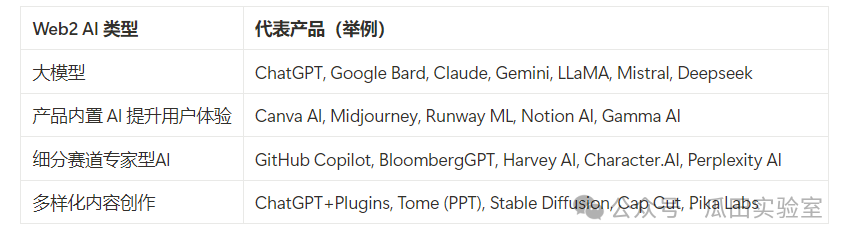
AI in the Web2 world is mainly driven by tech giants and research institutions, with a relatively stable and concentrated development path. Large companies (such as OpenAI, Google) train closed black-box models with non-public algorithms and data, where users can only use the results, lacking transparency. This centralized control leads to non-auditable AI decisions with issues of bias and unclear responsibility. Overall, Web2 AI innovation focuses on improving base model performance and commercial application landing, but the decision-making process remains opaque to the public. This opacity is precisely what led to the rise of new AI projects like Deepseek in 2025, which appear open-source but are actually "fishing in troubled waters".
Besides the opacity defect, large AI models in Web2 also have two other pain points: insufficient experience across different product forms and lack of precision in specialized track subdivisions.
For instance, when creating a PPT, an image, or a video, users will still seek out new AI products with low entry barriers and better user experience, and pay for them. Currently, many AI projects are trying to develop no-code AI products to lower user thresholds.
Moreover, many Web3 users have probably experienced the frustration of using ChatGPT or DeepSeek to obtain information about a crypto project or token, as large models' data still cannot precisely cover detailed information in every industry subdivision. Thus, another development direction for many AI products is to delve deepest and most precisely into data and analysis within a specific industry subdivision.
AI in the Web3 World
The Web3 world is centered on the crypto industry, a broader concept integrating technology, culture, and community.
Leveraging blockchain's decentralized architecture, Web3 AI projects typically claim to emphasize open-source code, community governance, and transparency, hoping to break the traditional AI monopoly by a few companies through a distributed approach. Some projects explore using blockchain to verify AI decisions (zero-knowledge proofs ensuring trustworthy model outputs) or having DAOs audit AI models to reduce bias.
In an ideal state, Web3 AI pursues "public AI", allowing community auditing of model parameters and decision-making logic, while incentivizing developers and users through token mechanisms. However, in practice, Web3 AI development is still constrained by technical and resource limitations: building decentralized AI infrastructure is extremely difficult (training large models requires massive computing power and data, but no Web3 project has funding close to OpenAI's). A few projects claiming to be Web3 AI still actually depend on centralized models or services, merely integrating some blockchain elements at the application layer. These relatively credible Web3 AI projects are at least genuinely developing applications; while the vast majority are pure MEME or MEMEs disguised under a real AI banner.
Moreover, differences in funding and participation models also influence their development paths. Web2 AI is typically driven by research investment and product profitability, with a relatively smooth cycle. In contrast, Web3 AI combines the speculative attributes of the crypto market, often experiencing "wave" cycles with dramatic rises and falls based on market sentiment: when the concept is hot, funds rush in driving up token prices and valuations; when cool, project heat and funding rapidly decline. This cycle makes Web3 AI's development path more volatile and narrative-driven. For instance, an AI concept lacking substantial progress might trigger token price surges due to market sentiment; conversely, even with technological progress, it might struggle to gain attention during a market downturn.
We maintain a "low-key yet anticipatory" stance towards the Web3 AI main narrative of a "decentralized AI network" - what if it actually succeeds? After all, Web3 has epoch-making entities like BTC and ETH. However, at the current stage, everyone needs to pragmatically conceive immediately implementable scenarios, such as embedding AI Agents in existing Web3 projects to improve project efficiency; or combining AI with other new technologies to generate novel ideas applicable to the crypto industry, even if just to attract attention; or creating AI products solely serving the Web3 industry, providing services that Web3 organizations or individuals can accept, whether in data precision or better alignment with Web3 work habits.
To be continued, the next article will mainly review and comment on the five waves of Web3 AI, and some products within them (such as Fetch.ai, TURBO, GOAT, AI16Z, Joinable AI, MyShell, etc.).