



Written by: Fairy, ChainCatcher
Liquidity staking has been a hot market narrative, but most liquidity staking tokens remain at the "yield packaging tool" stage, lacking composability and strategy flexibility. This leaves users with a dilemma: sacrificing asset liquidity for yield or giving up yield to participate in more complex DeFi strategies.
Glow Finance aims to solve this problem. By integrating lending and trading functions, Glow helps users improve capital efficiency, flexibly manage risks, and execute complex strategies.
What is Glow Finance?
Glow is a decentralized margin trading protocol that provides a comprehensive set of financial tools designed to maximize capital efficiency and expand yield opportunities. Its cross-margin account feature allows dynamic interaction between assets, enabling users to manage, borrow, and operate positions within a unified framework.
At the core of Glow Finance is a "margin account + modular components" liquidity engine. Users can lend, trade, and manage assets through non-custodial margin accounts, avoiding frequent platform switching. The account also supports sub-account functionality, similar to centralized exchange sub-accounts, facilitating advanced strategy deployment and risk isolation.
Glow Finance Product Matrix:
Glow Margin Accounts: Achieve cross-protocol, composable leverage, and unlock trading capabilities.
Glow Recipes: Automated yield strategies to help users execute complex DeFi operations.
$glowSOL: Supported by Solayer super validators, providing a liquid restaking token (LRT) with premium yields on Solana.
Team Background and Project Progress
Glow Finance co-founder Nicholas Roberts-Huntley holds a master's degree in evidence-based policy assessment and economics from Oxford University. From 2013 to 2018, he worked as a doctor in medical fields, focusing on urological oncology, emergency medicine, and colorectal surgery. After 2018, he transitioned to venture capital, serving as a venture investment architect at Virtual Ventures, later becoming a vice president at Point72, and founding Concrete in 2022.
Image source: Nicholas Roberts-Huntley
Glow Finance originated from the lending platform Jet Protocol. In October 2024, Blueprint Finance acquired Jet and comprehensively reconstructed it, updating the technical architecture and redefining product positioning. The Blueprint Finance team previously built Concrete, a yield protocol in the Ethereum ecosystem. Concrete has currently accumulated over $650 million in TVL.
On April 14, Glow Finance officially launched on the Solana mainnet, but the team's vision extends beyond Solana. Nicholas Roberts-Huntley stated that Glow's architecture is already prepared for future expansion to new Solana Virtual Machine (SVM)-based ecosystems like Fogo and Atlas.
How Glow Finance Works
Glow Finance provides a set of complementary DeFi tools, built around margin accounts, pooled lending, and automated strategies.
Glow concentrates user assets into margin accounts and connects them to margin pools and external protocols through adapters, ensuring users can access various DeFi services while optimizing capital efficiency.
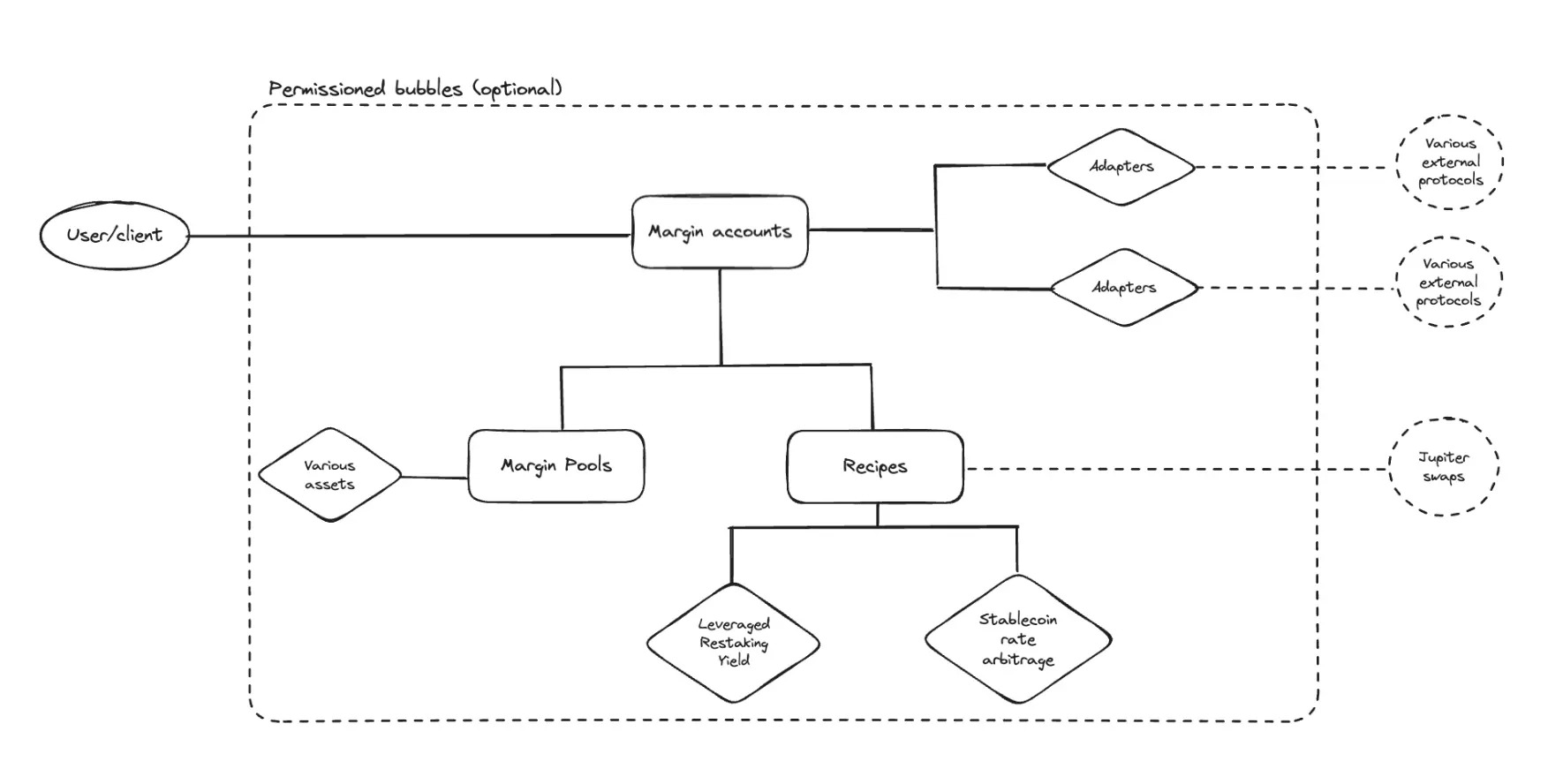
Glow Core Architecture and Functions
The leveraged SOL restaking strategy is Glow's flagship strategy, aimed at maximizing yields and points from Glow and Solayer while avoiding exposure to SOL price volatility. The strategy creates a position with selectable leverage multiples using glowSOL and sSOL (Solayer's liquid staking token).
Users can obtain multiple SOL restaking yields in a standalone margin account, earn dual points from Solayer and Glow, and mitigate SOL price volatility risks. This position can effectively isolate risks through Glow's independent margin account mechanism, avoiding liquidation due to SOL fluctuations.
Specific operation method:
User creates a Glow margin account and enters the "Leveraged glowSOL Restaking" page;
Guided by the application interface, users can choose to deposit SOL from their wallet or existing margin account and invest it in the strategy;
The user's glowSOL will continuously appreciate with accumulated staking rewards, earning yields in a price-neutral position;
glowSOL is also wrapped sSOL, meaning users can earn Glow and Solayer points, with point quantities increasing based on selected leverage multiples;
Users borrow SOL and hold glowSOL, making the position essentially neutral to SOL price changes, avoiding downside risk while enjoying staking rewards. Unless the SOL and sSOL anchoring relationship breaks, users will not face liquidation risk.






