1. Team and financing: A fantastic journey from a “licker” to a “traitor”
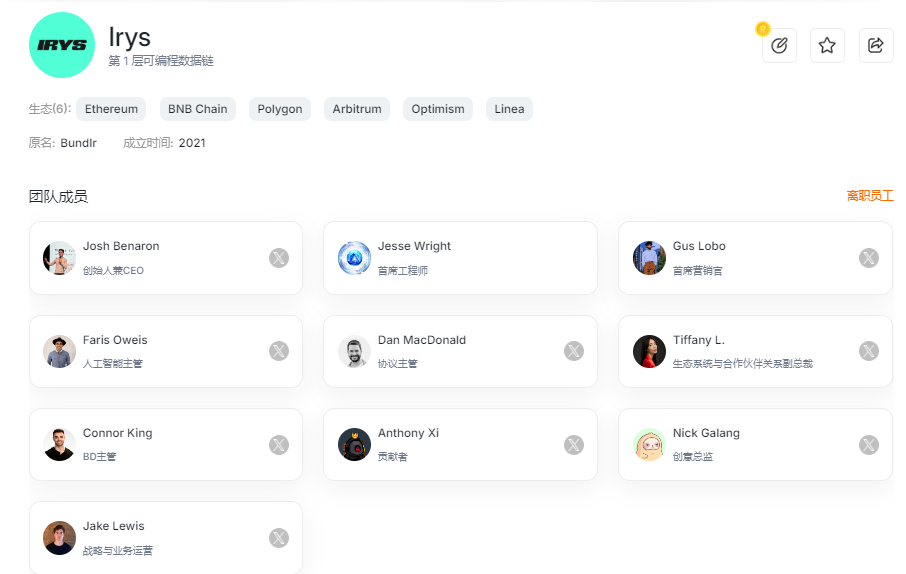
To talk about the Irys project, we must first start with its "magical realism" team composition. Founder Josh Benaron, a technology fanatic who calls himself a "ten-year veteran in the blockchain storage field", has a career that can be described as a "Game of Thrones" - one foot was still a "suck-up" in the Arweave ecosystem, and the next foot he led the core technical backbone to stage the "Northern Rebellion" drama.
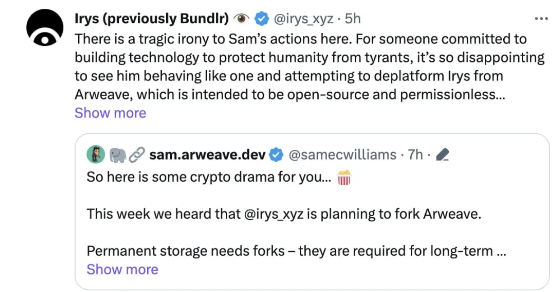
On December 18, 2023, Irys is planning to fork Arweave in a destructive manner, which is equivalent to public chains such as Ethereum. Arweave focuses on permanent storage, and the data stored on it is far more important than the protocol cognition data. Therefore, trade forks can easily lead to the loss of user data, and ultimately the collapse of the concept of "permanent storage", which is of no benefit to both parties.
The most magical thing about this team is that they are clearly relying on the Arweave ecosystem (contributing 82% of data uploads before 2023), but they insist on destroying their master's work. According to the official statement, it is "the pursuit of anti-censorship freedom", but anyone with a discerning eye knows that when the packaging service provider Irys (formerly Bundlr) controls the lifeline of the ecosystem, the fork is essentially a classic drama of "technical backbones kidnapping financial backers."
This operation is like a worker stealing the core technology of his boss and then directly opening a competing store and hanging up a sign saying "authentic time-honored brand".
What’s even more ironic is that this team, which claims to be the “Guardians of Permanent Storage,” even has a temporary feel to its organizational structure.
Connor King, director of ecosystem development, has a resume that can be described as a "nomad" in the blockchain circle - from open source communities to DeFi protocols to storage tracks, wherever there is a big trend, he can be seen waving the banner of "ecosystem construction."
This kind of "professional job-hopper" in charge of the ecosystem makes people wonder whether Irys' long-term roadmap is a technological breakthrough or a fancy financing PPT.
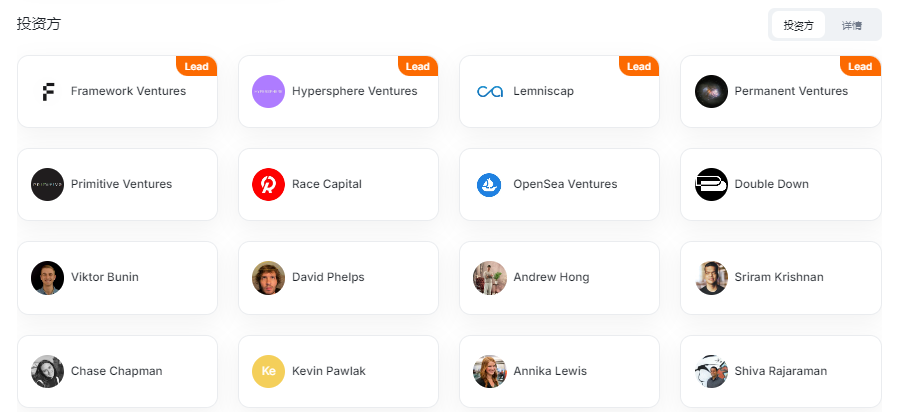
When it comes to financing, things get even more exciting. This project perfectly illustrates what is meant by "the leek harvester in the capital market": when it raised US$5.2 million in financing in May 2022, it called itself "the best partner of the Arweave ecosystem". In June 2024, after receiving a strategic investment of 3.7 million, it turned around and announced its independence. During this period, institutions such as OpenSea Ventures also followed up with "money-throwing" investments.
The most outrageous thing was that when the fork was announced in 2024, the founder Sam Williams was so angry that he live-streamed the split on the X platform, and Irys played the sad card of "user data autonomy" in return, which was a blockchain version of "The Legend of Zhen Huan".
2. Products and technologies: The genius logic of using "Russian dolls" to solve storage problems

Image source: Irys white paper; https://docs.irys.xyz/
Irys’ technical white paper can be called “the most confusing blockchain behavior award”. They claim to create the "first programmable data chain" and forcibly bundle the storage layer and the EVM execution layer for sale, calling it the "data immortality package."
It's like selling coffins in a hot pot restaurant - you enjoy the hotness of the moment, but you also have to pay in advance for the embalming costs for three hundred years after death.
Its core selling point, the combination of "permanent storage + on-chain computing", is essentially a three-layer Russian doll design to cover up the fundamental contradiction:
The first layer of nesting dolls: Put Arweave's permanent storage mechanism on the "smart contract panel", claiming to solve the problem of data programmability. But if you look at the document carefully, you will find that the so-called IrysVM virtual machine is just a reskinned EVM, and even the compatibility test cases are directly copied from the Ethereum developer toolkit.
The second layer of nesting dolls: Use the "staking mining + data proof" mechanism to forcibly bind node interests. Miners are required not only to store data, but also to run smart contract verification, under the euphemism of "improving network efficiency." The actual effect is to turn miners into cheap computing laborers who work 24/7 - they have to be both warehouse managers and accountants, but their salary is still storage fees.
The third layer of nesting dolls: create a "data coffin resurrection technique". It claims that even if the mainnet is shut down, users can still retrieve data through the historical node hard drive. But anyone who knows a little about distributed systems knows that this is equivalent to letting users bear the cost of cold backup themselves, essentially turning decentralized storage into a blockchain version of the "online disk selling hard drives" business.
Even more outrageous is the cost accounting logic. The project team claims that "a one-time payment will cover 200 years of storage costs", but according to its economic model, assuming an average annual hard drive damage rate of 3% and an annual electricity price increase of 5%, the actual funding pool will be in deficit in the 47th year. This kind of "using 21st century math to calculate 22nd century bills" operation is comparable to asking elementary school students to solve calculus equations using addition and subtraction.
Token Economics: A Carefully Designed Ponzi Board Game
Irys’ token model can be described as “blockchain financial performance art”. Although the white paper is very secretive about the economic mechanism and the specific token model has not yet been announced, three core routines can be found from the test network rules and node requirements:
"Coffin Fund" Fund Pool
85% of the storage fees paid by users go into the "Eternal Life Fund", which appears to be reserved for future miners, but in fact it builds a self-circulating fund - using the money of new users to pay old miners, and it can be maintained as long as the growth rate of leeks exceeds the depreciation rate of hardware. This model is very similar to the pay-as-you-go pension system, the difference is that Irys does not even have the credit backing of the government.
Hostage mechanism
Miners need to stake tokens to participate in storage verification, but the staking income is linked to the amount of smart contract execution. This leads to a strange phenomenon: in order to earn more transaction fees, miners will deliberately create junk contract transactions, turning the blockchain into a "self-brushing perpetual motion machine." Looking at the meaningless Snake game transaction records on the test network, it is hard not to suspect that these are the water armies hired by the project party to "step on each other's feet to get to the sky".
Schrödinger's deflation model
While the official emphasized that the total amount of tokens is constant, it also hinted that deflation may be achieved through a destruction mechanism in the future. The subtlety of this "quantum state economic model" lies in the fact that if it goes up, it is due to the deflation model; if it goes down, it is because the market has misunderstood the design. Either way, it can be explained away in the AMA.
Comparing Filecoin's continuous payment model and Arweave's one-time buyout, the essence of Irys's patchwork economics is: using Arweave's charging model to raise money, using Filecoin's staking mechanism to lock positions, and finally creating a financial derivative that is neither fish nor fowl.
No wonder one developer complained: "Saving files on Irys is like buying lifetime insurance - by the time you really need to make a claim, the insurance company may have switched to selling health products."
4. Competitive product analysis: performing water ballet in the "storage red ocean"
Throwing Irys into the pool of storage competitors is like a live broadcast of a "chicken fight":
Competing with Filecoin: The pot calling the kettle black
Although Filecoin has been criticized as a "scientists-only chain" due to its complex proof mechanism, at least it clearly knows that it is making money from enterprise-level cold storage. Irys wanted to grab Filecoin's corporate customers, and also wanted to reap Arweave's NFT storage dividends, but ended up being a "jack of all trades and master of none" - it wanted to please developers with EVM compatibility, but the smart contract gas fee was more expensive than the storage fee; it wanted to attract C-end users with the concept of permanent storage, but the tutorial on the official website was so complicated that it could make a liberal arts student autistic.
Backstab Arweave: A drama about killing one's father and marrying one's mother
This "Oedipus Rex of the storage world" drama is full of black humor: Irys held high the banner of "anti-censorship" when it forked, but its own node censorship rules are stricter than those of the original chain; it claimed to optimize data accessibility, but the actual test network throughput is not as high as Arweave's level three years ago. What’s even more ironic is that its core customers, such as Emet and AI Protocol X, are all old users who were “abducted” from the Arweave ecosystem. They are a typical example of “freeloaders” in the blockchain industry.
5. Future Outlook: A Fantastic Journey from “Digital Coffin” to “Metaverse Cemetery”
Looking back at the development of Irys in 2025, we will find that it perfectly replicates the “life cycle law” of blockchain projects:
- Phase 1 (2021-2023): Hold on to Arweave and use the concept of "permanent storage" to become an ecological star in the NFT bull market
- Phase 2 (2024): Taking advantage of the AI + blockchain trend, the company changed its name and packaged itself as a "programmable data chain" to defraud the second round of financing
- The third stage (2025): On the eve of the coin issuance, team infighting, technical loopholes, and miners’ strikes broke out, and the community split into “rights protectionists” and “believers”
- Final Game (2026+): Either it will be acquired and become a storage module of a public chain, or it will become a "blockchain archaeological site" on GitHub
The real value of this project may be that it has contributed many classic failure cases to the industry:
- Prove that playing "EVM compatibility" in the storage track is a false proposition (miners want stable storage income, not smart contract fees)
- Verifying the “Permanent Storage Economic Model” is essentially a cross-period risk transfer game (using today’s money to gamble on the technology costs a hundred years from now)
- Create a new school of "PPT fork technique" (create new chains without changing the code)
So next time you see a blockchain project that combines “permanent storage”, “programmable data” and “EVM full compatibility”, I suggest you call the leek harvesting hotline directly.
As the blockchain storage field has developed to this day, most projects are short-lived, visible but intangible, and untraceable, but there are always people willing to pay for mirages.