I. The Demise of Non-Fungible Tokens
The final cry of Non-Fungible Tokens ends with Pudgy Penguins' token issuance, and Doodles' recent token release on Solana only created a small ripple. Yuga Labs' subtraction continues, this time even involving their most soul-defining IP, Cryptopunks. The BitCoin Non-Fungible Tokens from the last wave of revival have nearly reached zero, and these once-crazy narratives have indeed fallen into obscurity, with no one paying attention anymore.
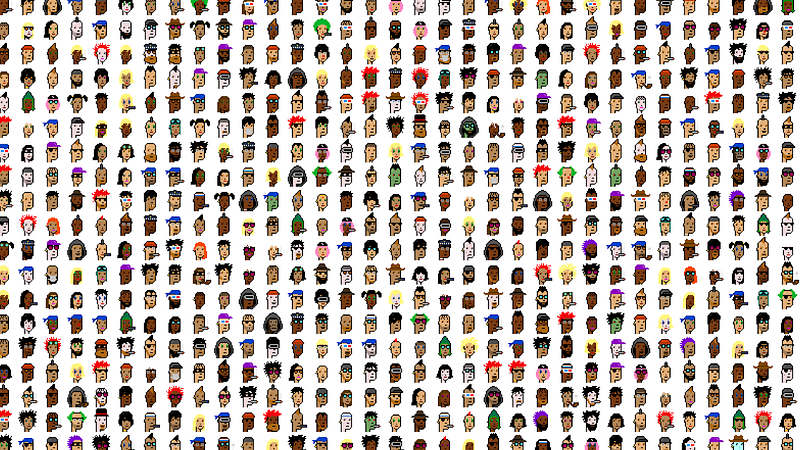
The vision of 10k PFP was once beautiful, with a perfectly-sized community helping an bottom-up IP project go global, which was completely different from traditional IP projects that previously invested heavily in content support. For example, Marvel Universe, Star Wars, and various animation characters under Disney often require years of accumulation and countless funds to deeply embed these IPs in people's hearts and ultimately become a gold mine.
Non-Fungible Tokens are entirely different, with an extremely low entry barrier, and the speed of creating an IP and asset-izing IP is remarkably fast. Creators only need to pay some gas to list their artwork on Opensea for sale, without galleries, toy companies, film companies, or any professional team - a new IP and artist are born this way.
We witnessed some bottom-up IPs becoming popular in top entertainment circles of Europe, America, Japan, and South Korea three to four years ago. A grassroots artist could achieve a commoner's counterattack through Non-Fungible Tokens. For me, as a Z-generation who grew up watching anime, being able to participate in IP investment and incubation through crypto that was previously inaccessible to ordinary people was a dream-like experience.
However, after BAYC's "crazy nested dolls" and Azuki's disaster-level sub-series Elemental release, the blurry status of Non-Fungible Tokens gradually became clear. It was not like equity or investment, but more like an expensive luxury item with membership benefits. Project parties still hoped we would continuously purchase sub-series to support their ongoing investment in IP value core Roadmap. The seeds of contradiction were planted here - project parties knew content creation was expensive, but the IP would die without content. Sub-series released every few months continuously drained OG series holders, tormenting every community member. Waiting for content feedback might take many years, or perhaps this feedback would never come. The cracks began to grow, and those beautiful fantasies started to shatter with the floor price's decline, leaving only various arguments.
II. The Ace MCN of the IP World - PoP MART
... [rest of the translation continues in the same manner]The success of Pudgy Penguins lies in being pragmatic, pragmatic, and pragmatic. Non-Fungible Tokens themselves don't create significant technical differences; no matter how clever the Mint process is designed, it's ultimately just a JPG. The challenge with Non-Fungible Tokens is implementing IP, which is hundreds of times more difficult than creating a 10K PFP. Yuga Labs wants to create a metaverse, Azuki wants to create anime. Okay, these are cool, but these projects that start with costs in the hundreds of millions will only ask community members to pay.
This extremely compressed world is too impetuous, with everyone wanting to succeed quickly. Holders want to make big money, project teams want to rise to the top overnight. Few blue-chip projects are willing to humble themselves, and the more impatient they are, the harder they fall. The original Pudgy Penguins team was once such an impetuous grassroots team, and after their reputation was damaged, they sold the little penguins at a low price.
At this point, the little penguins met their true owner, Luca Netz, a worker with years of physical marketing experience who brought the penguins back to their proper height. Luca Netz is truly building a brand, operating a company for Non-Fungible Token holders. From marketing to plush toys to future games, every step of the little penguins is solid, with the company able to profit and holders able to profit. There's nothing special about this; it's just doing what it should do. Therefore, it's proven that bottom-up IP can exist in Web3, only that too many project teams are unwilling to lower their stance.
So, I hate the word "falsification," as if some things should never exist. Electric cars were once stupid, and Siri on my phone was also stupid. But this doesn't prevent green-plated cars from now filling entire cities, and don't even get me started on AI.
Many so-called falsified tracks will still be attempted by Web3 in the future, just lacking a matching project team.
IV. Path
The path to success is simple, and the path to success is also difficult. The next stop for PFP will ultimately need to break free from some inherent crypto logical frameworks, and becoming the next Web3 Disney requires extensive accumulation. I've previously discussed whether NFT scarcity has been counterproductive in the process of reaching the masses. If defined as a trendy consumer good, perhaps the 10K limitation is too large; if defined as a unique Web3 asset and fundraising method, the IP ultimately needs to be converted into physical consumer goods to fulfill the community's promise, rather than a bunch of strange subseries.
Based on the unique culture of crypto and the attributes of Non-Fungible Tokens, clinging to an IP until old age is also unavoidable. How to do more with these PFPs? How to expand a project into an IP factory? This may require us to accept some new concepts and introduce more technology and gameplay.
V. Is Token Issuance the Final Stop?
I still don't understand the significance of Non-Fungible Token token issuance. This situation seems more like exploitation of lower-level members by upper-level members and a dilution of OG Non-Fungible Token value. I can only understand it as the project seeking an easy liquidity exit method.
From APE to DOOD, they all seem like variants of air tokens. Their empowerment often involves staking to obtain some on-chain transaction dividends, purchasing props in the metaverse, governance rights, and so on. In an ideal scenario, it's a perfect cycle of holder → staker → developer. But from a realistic perspective, it's more like air, trapped in a death spiral of Non-Fungible Token price decline, gold-making income decline, and token price decline.
For OG Non-Fungible Token holders, while the Token divides some dividends and rights, they mostly receive a large airdrop during TGE, so no one complains. But in the long term, as mentioned in the fourth paragraph, this is a dilution, and distributions like Azuki's Anime are even more of a blatant grab.
Short-term heat is important, but the project's longevity is more important. Don't let token issuance become the final stop.
Conclusion
In this fast-paced, dopamine era, we've witnessed the rise of many Web2 emerging IPs. Non-Fungible Tokens should grow well in this era, with many irreplaceable characteristics. Four years ago, I viewed it as a cyber Maotai, but reality is more like a cyber tulip. Few are willing to manage the ruins, but I believe that beneath the ruins, the next Labubu is certainly hidden.