Written by: 0xResearcher
While the market is still boiling over meme coins and ETF hype, some traditional financial players with a longer-term vision are quietly turning to another direction: infrastructure with stronger performance, higher compliance, and smoother cross-chain capabilities. They are not seeking "short-term stimulation" but the underlying system that can truly run the next generation of finance. And Sei is becoming their hot choice.
Careful observation reveals its most prominent features: retaining the technical advantages of crypto native while proactively embracing regulatory frameworks. Not pursuing short-term popularity, but focusing on solving the two most challenging problems of blockchain implementation - performance bottlenecks and compliance thresholds. This development philosophy of "slow is fast" may be exactly what the industry needs when transitioning from speculation to practical application.
Performance Innovation: From "Seconds" to "Milliseconds"
While most blockchains are still dealing with "hundreds of transactions per second", Sei has pushed speed to another dimension: processing over 12,500 transactions (TPS) per second, with a final confirmation time of only 400 milliseconds. In comparison, Ethereum's mainnet confirmation time is 470 times longer, and even Solana, known for being "lightning-fast", is 22% slower.
Moreover, Sei is fully compatible with Ethereum ecosystem development tools like Hardhat and Foundry, allowing developers to "painlessly" get started, significantly reducing migration and development costs.
Compliance Design, Born for Institutions
When institutions truly begin participating in blockchain, the focus shifts from "can it be used" to "can it be trusted". In this aspect, Sei significantly reduces the risk of being captured by MEV in large transactions and improves the predictability of overall transaction costs by introducing a "deterministic gas fee" model. Additionally, with nanosecond-responsive high-performance RPC nodes and an audited memory pool architecture, these greatly enhance the chain's friendliness to institutional users.
Its compliance capabilities are not just verbal promises. For instance, a new entity in its ecosystem recently established a compliant operational structure in the United States and launched a $65 million fund to support DeSci (Decentralized Science) projects, which itself signals a long-term commitment to compliance.
ETF Endorsement: Key Signal for Market Confidence
Beyond solid technical and compliance foundations, Sei has also achieved key breakthroughs in asset financialization. Recently, Canary submitted the first ETF based on Sei staked assets in the United States, which is not only a significant milestone for Sei but also an industry recognition of its underlying asset quality.
It's important to emphasize that not all blockchain projects meet the conditions for launching staked asset ETFs. Therefore, Sei's inclusion in an ETF product represents a strong market endorsement. Against the backdrop of gradually warming market sentiment, such developments are likely to be key variables in boosting community and institutional confidence.
Cross-Chain Liquidity Aggregation: Breaking Inter-Chain Barriers
To solve the liquidity fragmentation problem, Sei has collaborated with cross-chain protocols like Wormhole and Axelar to achieve seamless connections with mainstream blockchains such as Ethereum and Cosmos. Users can freely interact between protocols on different chains without complicated bridging operations.
Additionally, Sei has collaborated with Circle to develop a compliant cross-chain USDC channel, ensuring stable coin safe circulation across different chains. To incentivize liquidity providers, it has established a $50 million Liquidity Bootstrapping Fund (LBF) to support cross-chain transactions and asset management.
Rapid Ecosystem Expansion: Comprehensive Bloom from DeFi to Gaming
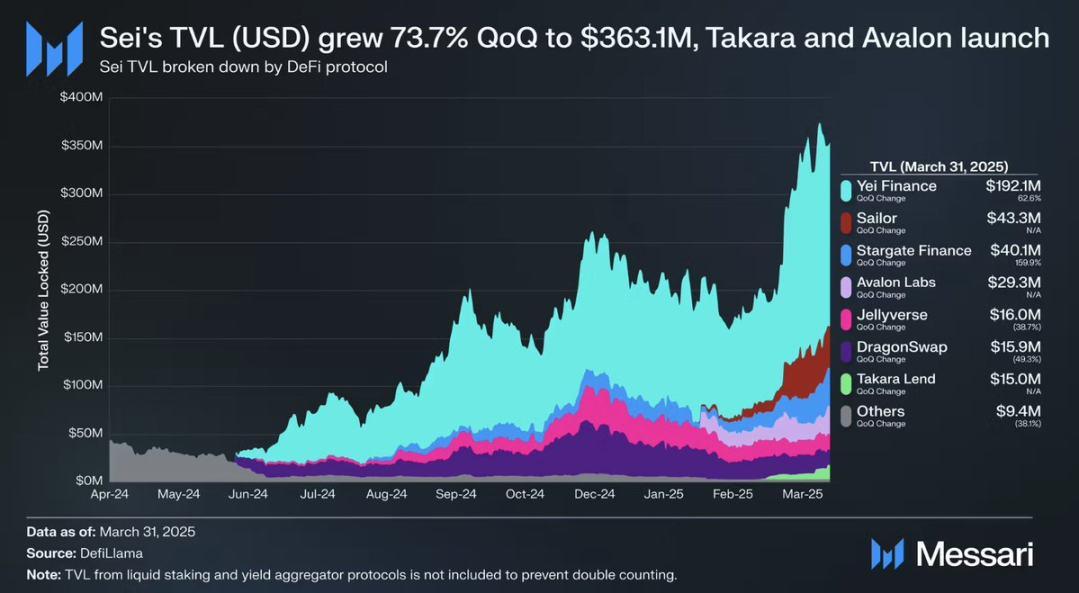
Since mid-2024, Sei's ecosystem has rapidly developed, attracting over 150 projects to deploy on its mainnet, with daily active addresses reaching 400,000 and total users exceeding 6.5 million. In the first quarter of 2025, total locked value (TVL) grew by 73.7%, reaching $363 million, with stablecoin market value hitting a historical high of $178 million.
Notably, the gaming sector has become the primary growth driver. Average daily game-related transaction volume reached 354,000, a year-on-year increase of 79.8%. For example, a massively multiplayer online role-playing game like World of Dypians has achieved significant user growth on these platforms.
Furthermore, it launched a $10 million Creator Fund and a $250,000 Street Team program to support NFT and social projects, encouraging global creators to participate in ecosystem construction.
Starting Point of a New Phase: Giga Upgrade and Future Blueprint
Although current data is already impressive, Sei's ambition is clearly not limited to this. The Giga upgrade planned for launch in 2025 will introduce a brand new EVM client, with performance improvements expected to reach 50 times the current level. This not only means a qualitative change in processing capacity but also symbolizes another leap towards the goal of "universal infrastructure".
From infrastructure to ecosystem prosperity, and then to institutional design and technological evolution, Sei has completed in less than two years what traditional projects would take five years to explore. It may not be the loudest voice in the market, but it could be the most determined force in building the next blockchain era.
Towards a Decentralized Future
Sei's technological upgrades are not just a performance leap but an important step in its global strategic layout. By establishing legally compliant operational entities in the United States, it provides a solid foundation for global expansion. As its ecosystem continues to grow and technical performance continuously improves, it is leading blockchain technology towards a truly decentralized future.
In this process, Sei not only provides developers with a powerful technical platform but also brings more efficient and safer blockchain application experiences to global users. With continuous technological progress, it is expected to become a bridge connecting Web2 and Web3, leading the development of the next-generation internet.