A Nordic forest elf with pointy ears and a mischievous grin, Labubu, is sweeping the globe at an astonishing speed, becoming a fashion item, social currency, and even an alternative financial tool in the eyes of Generation Z.
Recently, Labubu's third-generation soft toy series made a strong debut, triggering a buying frenzy upon release. From instant sell-outs on domestic e-commerce platforms to overnight queues at overseas flagship stores, from being the center of attention in street fashion to dominating social media, Labubu is evolving into a cultural meme that spreads across borders.
Behind this global trend lies not only a precise hit on young people's deep desire for personality expression and emotional release but also an alternative asset that has caught the attention of capital markets, attracting not just traditional collectors but also the crypto world.
Surging Tens of Folds in a Week, LABUBU Returns to Millions in Market Value, Sweeping Thailand
Recently, MEME coin $LABUBU has become a market focus again due to the heat generated by a new product series. Notable crypto KOLs like Ansem have released tweets featuring Labubu's image, triggering strong resonance in the community.
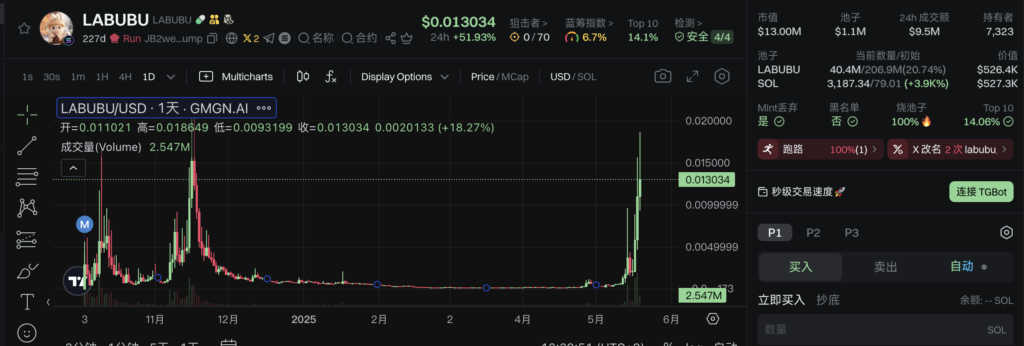
According to GMGN data, as of press time, $LABUBU's market value has soared from hundreds of thousands of dollars to 18 million dollars in just a week, a surge of tens of times, with a trading volume of 9.5 million dollars in the past 24 hours. Holderscan data shows that the number of token holders has significantly increased since May 14, indicating continued user engagement and market enthusiasm.
In fact, this is not the first time $LABUBU has caused a market frenzy. As early as November 2024 during the MEME coin sector's outbreak, $LABUBU's market value once exceeded 20 million dollars. Although not an officially released MEME coin, it became one of the hottest IP projects at the time. The Thai market was a key traffic driver for this round of market activity.
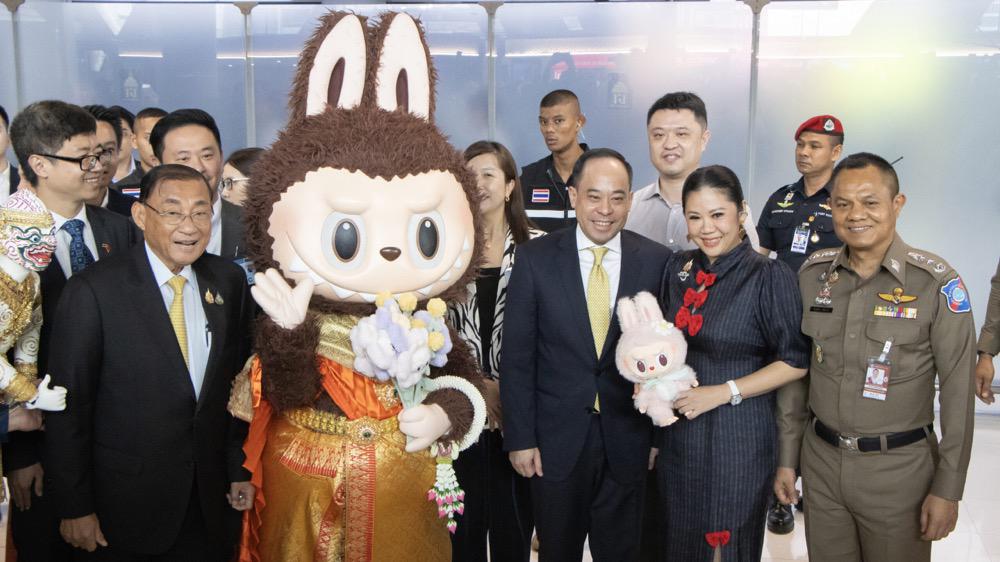
At that time, Labubu had already caused phenomenal attention in Thailand, with its image frequently appearing on Bangkok streets as a symbol of trendy culture. From celebrities like Blackpink's Lisa, who shared an Instagram photo with Labubu, to the Thai princess using Labubu as a daily handbag companion, and ordinary young people wearing Labubu clothing or even getting Labubu tattoos. Under such high popularity, Bubble Mart's Labubu-related products in Thailand were once in short supply. The heat even caught the attention of the Thai Tourism Bureau, which granted Labubu the title of "Magical Thailand Experience Official" and held a grand welcome ceremony, with the Minister of Tourism and Sports personally attending.
According to Bubble Mart's mid-2024 financial report, overseas revenue reached 1.35 billion yuan, a year-on-year growth of 259.6%. Among this, Southeast Asian market contributions were 560 million yuan, accounting for over 40% of total overseas revenue. Labubu's strong performance in Southeast Asia has greatly boosted investors' confidence in its related MEME coin.
Simultaneously, another Thai local IP MOODENG (little hippo) has also gone global, deriving a namesake MEME coin with a market value hyped to hundreds of millions of dollars, driving market attention to Thai IP assets. Recently, MOODENG's strong rebound has further pushed market focus on Labubu, possibly becoming an important spillover effect for $LABUBU's market recovery.
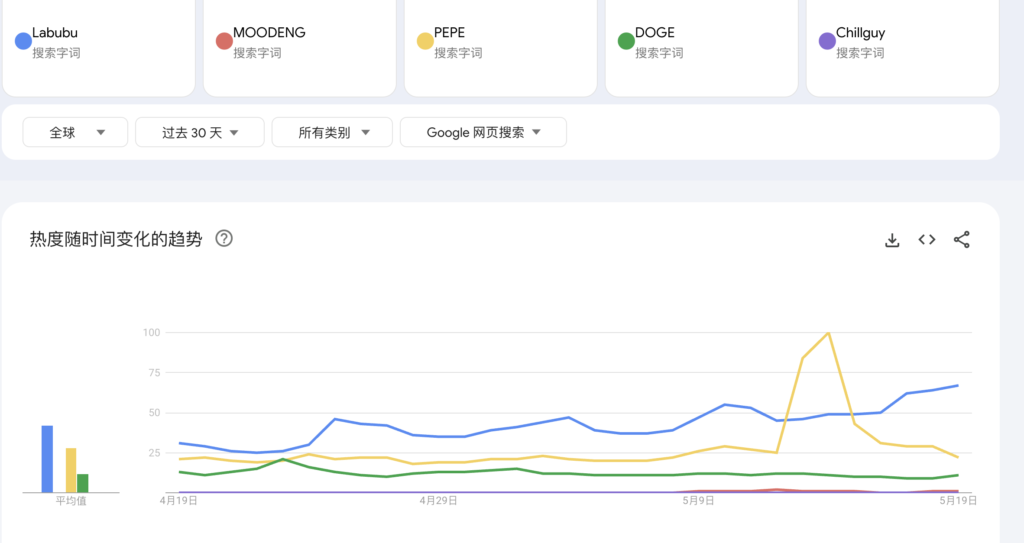
Currently, Labubu's global heat continues to rise. According to Google Trends, in the past 30 days, Labubu's global search volume far exceeds MOODENG, PEPE, DOGE, and Chillguy and other MEME-related IPs. This indicates that Labubu's brand influence and market attention are rapidly climbing globally, far surpassing other similar MEME projects.
From Trendy Toys to Social Currency: The Cultural Economic Rise of Generation Z
The goal of "recreating a Bubble Mart overseas" is gradually being realized by Labubu's amazing outreach speed.
From American pop star Rihanna being photographed with a Labubu hanging on her bag at Los Angeles Airport to Hermès senior player Bryanboy hanging a Labubu doll on a rare platinum bag... Labubu has been jokingly referred to as "successfully breaking into America". Behind this globally sweeping cultural export, Labubu has quietly completed a cultural migration from the trendy toy circle to the global mainstream fashion scene.
Driven by star power, Labubu quickly swept the globe. Just last month, Bubble Mart released the "High Energy Ahead" series of Labubu's third-generation soft toys globally, again triggering a new round of buying frenzy and obvious premium phenomena in multiple markets. Besides domestic fan's crazy pursuit, fans even queued overnight at Bubble Mart stores in Chicago, Los Angeles, London, Milan, New Zealand, and Tokyo's Harajuku, just to grab their desired Labubu, becoming a contemporary global trendy culture spectacle.
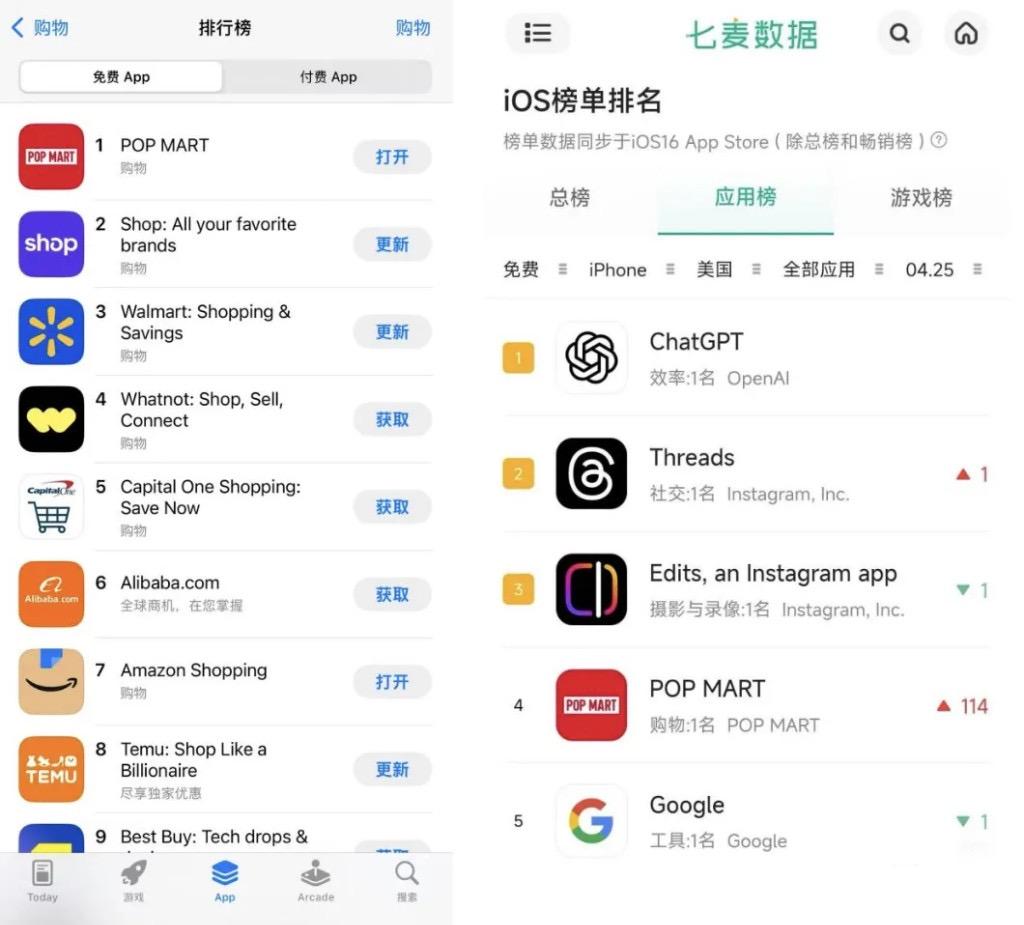
Not only offline sales are hot, but online sales are also unstoppable. Bubble Mart App topped the US App Store shopping chart, soaring 114 positions to fourth place on the free list, showing its huge appeal in the North American market. On second-hand trading platforms, the premium for the "High Energy Ahead" Labubu series is particularly shocking - originally priced at 99 yuan, ordinary boxes generally increase 10%-200%, while hidden editions' premiums even reach dozens of times, becoming a "financial tool" in players' eyes, like gold and Bitcoin in the trendy toy world.
On social platforms like TikTok and Instagram, Labubu is a traffic password. Young people are enthusiastic about releasing "blind box unboxing", "trendy outfit matching with Labubu", "doll showcasing" short videos, even opening dedicated content accounts to quickly gather millions of followers, with topic heat and attention continuously rising. This viral transmission path not only amplifies Labubu's social influence but also constitutes the core lever of Bubble Mart's content and community operations.
More notably, unlike the previous perception of trendy toys as mere collectibles or hobbies, Labubu has been elevated to a "universal currency" in the global youth social scene. At Bangkok's midnight markets and trendy gatherings, players exchange hidden edition Labubu for luxury bags and concert tickets; in London's Harrods, a collector traded a second-hand Hermès Kelly bag for a rare Labubu character; at the Coachella Music Festival in Los Angeles, fans exchanged limited edition Labubu for festival passes; during a previous Shanghai trendy exhibition, players even traded three iPhone 14 Pro for a hidden edition Labubu... This "trendy toy as currency" phenomenon not only signifies Labubu as a form of social capital but also becomes a media symbol of identity recognition and aesthetic resonance among young people.
Today, Labubu has gradually become a global IP with comprehensive commercial capabilities, driving the flywheel effect of Bubble Mart's business logic. In 2024, the MONSTERS series to which Labubu belongs contributed 3.04 billion in revenue for Bubble Mart, a year-on-year growth of 726.6%, occupying nearly a quarter of the company's annual revenue. Among this, soft plastic plush products became Labubu's annual bestseller, with sales revenue reaching 28.3 billion, increasing from 3.2% to 21.7% of sales, becoming the company's second-largest product category after figurines. Simultaneously, in terms of stock performance, Bubble Mart has reached a historical high of 201.6 Hong Kong dollars, with an annual return rate of nearly 121.4%.
In a sense, Labubu's global popularity path is quite similar to the rise of MEME coins. Both are essentially cultural phenomena driven by emotional value, rapidly breaking through circles through social media proliferation, community self-propagation, and strong identity recognition. Whether young people queuing overnight to grab hidden edition Labubu or investors swarming to buy a token because of a MEME image, what is demonstrated is the contemporary young generation's desire for self-expression, circle identity, and discourse participation, becoming templates of the new generation's cultural economy.