ETHPanda Talk is a program that focuses on how to build a better digital future based on Ethereum. We will invite outstanding Ethereum builders to share their motivations for building Ethereum and the projects they are promoting, as well as their experiences and gains, including their outlook for the future. We hope that by exploring the stories and ideas behind these, we can bring you more diverse perspectives or inspirations, and inspire everyone to participate in the construction of Ethereum.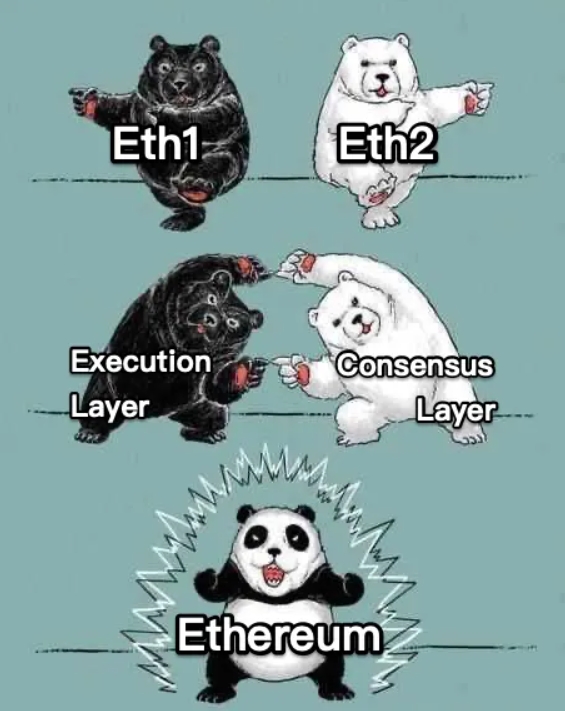
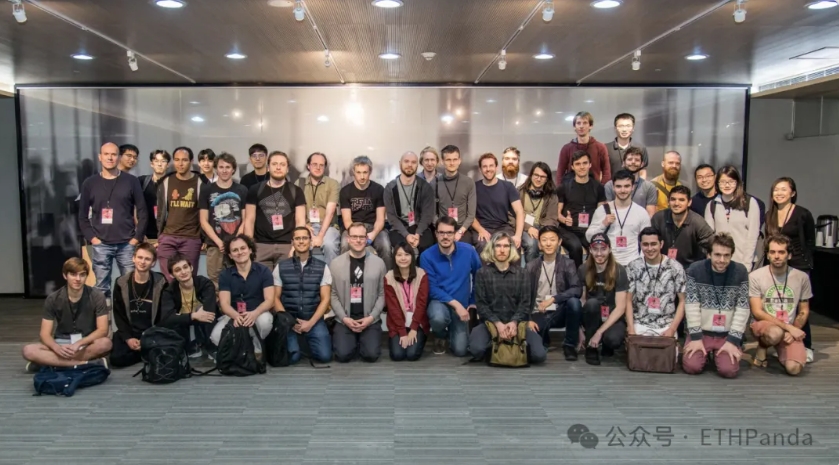
The guest of this issue of ETHPanda Talk, Hsiao-Wei Wang, joined the Ethereum Foundation as a researcher in 2017 and has been working in the Ethereum Foundation for nearly 8 years, participating in multiple important Ethereum upgrades including The Merge, Shapella, Dencun, etc. In April 2025, she just took over as the co-executive director of the Ethereum Foundation, and this is also her first interview since taking office.
In this issue, we discussed with Hsiao-Wei her growth experience, the details of the Ethereum technical roadmap, the highlights and difficulties of community building, and her work at the Ethereum Foundation. We hope to bring new ideas and thoughts to everyone.
01
Hsiao-Wei Wang's personal growth experience
Bruce:
You first joined as a researcher and grew up step by step, so I believe many viewers are interested in your personal growth experience. You just mentioned that you entered this industry in 2017. Are there any important people who brought you here at all times? What is the reason for you to join Ethereum? What are your mental journeys that you can share with everyone?
Hsiao-Wei:
My background is in computer science, and after graduating from graduate school, I entered the telecommunications field. My base is in Taiwan. During this period, one day, the topic of an internal training in the company happened to be blockchain, and the main topic was Bitcoin.
In 2016, there were not many blockchain startups in Taiwan. Most of them were exchanges, which allowed ordinary people to buy Bitcoin in Taiwan. When I was wondering whether I should change my career path, my college classmate told me that their company was going to set up a blockchain research department, so I submitted my resume. Later, I was fortunate to meet a former colleague of mine in my previous job, who was also my former colleague at the Ethereum Foundation, Professor Chen Chang-wu (now at ImToken). He first went to the Ethereum Foundation as a researcher. Around 2017, the Foundation was recruiting researchers in Asia, so I also applied. The Foundation was a very special opportunity for me, because when I was in my previous company, I learned about Ethereum and felt the community culture of Ethereum. I felt that there were many blockchain innovations in the world besides Bitcoin. Ethereum was particularly attractive, so I joined the Ethereum Foundation.
Bruce:
In your career as a researcher over the years, what have you done or learned that made you feel like you were suddenly upgraded, achieved a huge breakthrough or a sense of accomplishment?
Hsiao-Wei:
As Ethereum researchers, half of our research will be adopted, and the other half may not be adopted. The Beacon Chain roadmap has changed many times. I think it was not until the Beacon Chain was launched that we finally found a definite route. Whether it is PoS or Sharding, we have found an integrated route. The other previous research was not in vain, and some of it was applied, but I felt that there was a sense of sweetness after hard work.
Bruce:
We also know that in 2022, Ethereum completed The Merge and officially switched from PoW to PoS. The difficulty is often likened to changing the engine of an airplane during flight. After participating in the whole process, what do you think was the biggest challenge at that time? Are there any unknown stories?
Hsiao-Wei:
Because we already have a lot of things on the chain, and a lot of people are involved in this project. There are a lot of clients, and I think coordinating manpower is the biggest challenge.
There is a little easter egg. There are many zeros in front of the Deposit Contract because everyone will use it for several years to come and remember this address. So the person in charge of Deploy spent some time calculating and generating this unique address to reduce the risk of phishing scams. We also do a lot of work to prevent other scammers from using Deposit to defraud money. So we spent some time generating this contract address and put a lot of zeros in front of it.
(Deposit Contract: 0x00000000219ab540356cBB839Cbe05303d7705Fa)
Bruce:
I remember there was a panda meme on The Merge, how did you come up with that?
Hsiao-Wei:
This is a Dragon Ball meme. At that time, I was about to give a speech to introduce The Merge, and I was thinking about how to let everyone understand that we are not destroying the original chain, but merging the Beacon Chain containing the Consensus Layer, and how to visualize this merger. I happened to find a meme of a panda merger, which is a black bear and a white bear. This is the work of a Thai artist. We used it as a metaphor, and it became very popular.
The Merge Panda meme
So ethPandaOps was established at that time. They were a very powerful DevOps team behind The Merge, responsible for the operation and maintenance of the Ethereum network. Later they named it ethPandaOps.
Bruce:
In fact, we can see that in the past few years, the entire industry has had some relatively large fluctuations, and there are often some so-called Ethereum killers. Have you ever been emo in this process, or questioned whether what we are doing is valuable? If you are depressed, how do you persevere?
Hsiao-Wei:
Some people use blockchain technology to do bad things, which may give the public a very negative impression, causing the general public to think that Crypto is a bit speculative. We in this industry hope that technology will progress, and this phenomenon is a sad thing for those of us who have better visions.
Fortunately, my colleagues around me have a similar atmosphere. Of course, education is also important, but we may not be able to change people's negative impressions of the chain in an instant. But there are good things about blockchain or Ethereum. We hope to carry it forward, and this is where we can do something.
Bruce:
I actually feel that the environment is very important when choosing to work with builders. But if you are in a low mood, you can huddle together for warmth, and then do some research and experiments together, and slowly you may get better.
Hsiao-Wei:
But the other part I want to emphasize is that sometimes you need to leave the ivory tower and listen to some negative opinions. Because I have been working hard recently.
02
Ethereum technical route and future development
Bruce:
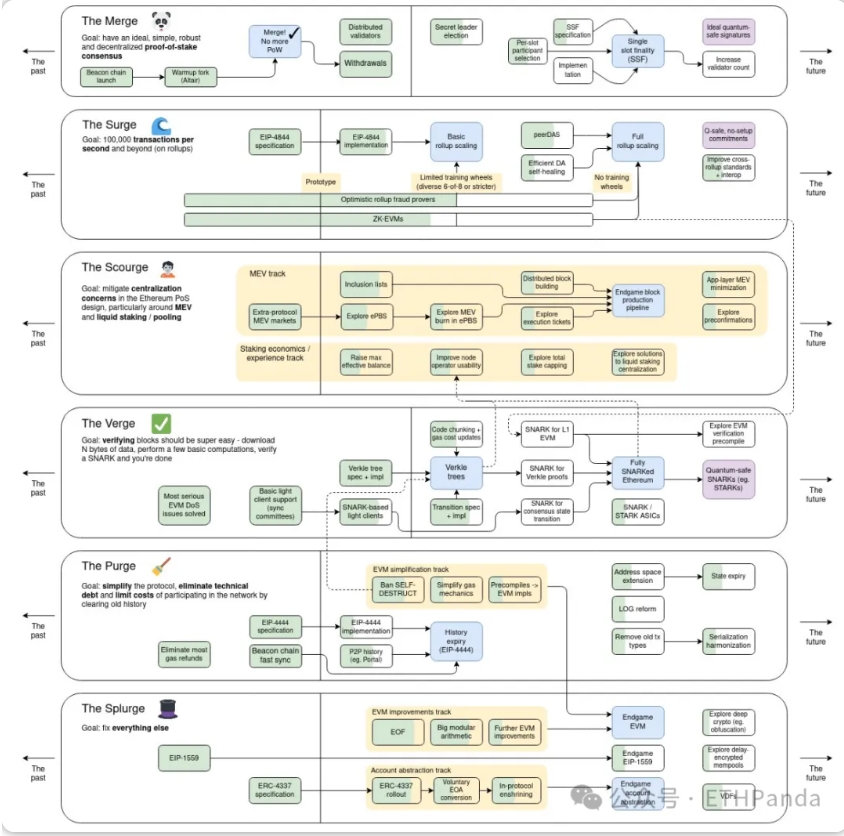
We often see Vitalik update a very complex roadmap full of various terms every year. Can you introduce how the roadmap is designed, how it is determined, and how it is promoted? What is the general process?
Vitalik's Ethereum Roadmap in 2023
Hsiao-Wei:
Vitalik has been posting this chart for more than three years. We also urged him to post it last year. In the end, he chose to write 6 articles: "Possible futures of the Ethereum protocol".
His technical roadmap is a high-level guide. He pointed out that we want to go in this direction, and there are actually three plans A, B, and C internally. Which one is more likely to succeed is what developers and researchers need to think about this year. He gave a high-level idea, and it is also a channel for community communication. However, the actual direction of development progress is still determined by the Core Devs in our community. When he drew this picture, it was actually very simple, and he used the researchers' ideas to cut in. Later, different options were proposed on how to implement this roadmap.
There are a lot of EIPs that may have been around for 3 or 5 years before they were put on the chain. There was a proposal first, and the time it took for the proposal to be adopted was very wide. Maybe it was put in a few weeks ago, like EIP-7702 may have been adopted relatively late.
There is an EIP Repository on Ethereum's GitHub. Anyone can post an EIP proposal here and use a template to write the proposal. The content should be how you would like to change the protocol specifically. Then, when the proposal receives more attention and more reviews, there will be an opportunity to discuss it at the ACD (All Core Devs Weekly Meeting) for all client developers and researchers to discuss.
Usually, someone who particularly supports this EIP will attend the meeting to make a presentation, and others will give some feedback and signals. If this EIP has a lot of voice, it is more likely to be adopted. It will be proposed to be discussed at the ACD, and then to the final EIP Inclusion meeting. Last month, because Pectra was about to hard fork in early May, everyone had already started planning the content of the next hard fork.
When this EIP is very likely to be adopted, we will give it a tag called CFI (Consider for Inclusion) to send a bigger signal and let people in the industry pay attention to it.
To summarize briefly, Vitalik will roughly set the route, but will not involve any specific content, and researchers will make some progress in these directions. At the same time, anyone can submit an EIP to tell the community that they want to make changes, and then hold an ACD meeting, and then improve it through community feedback, and finally finalize the EIP and release it, and then each client team will start developing changes and then go online at a set time.
Hsiao-Wei:
The main organizers of ACD over the years have all been from EF, and EF is also thinking about the extent to which we need to lead. Each hard fork is different. For example, the Core Devs of Pectra's upgrade all have things that users hope to be adopted, so the final scope is actually quite large, but for Fusaka, everyone's consensus is to give us PeerDAS, and everyone has a more cohesive consensus, which simplifies the process a lot, and each coordination is different.
Bruce:
This process is very interesting. It is not like a company operation, but the whole community participates in promoting an upgrade with a very wide impact. You expect the Pectra upgrade to be launched in May. What practical changes will it bring? Which of these EIPs do you think are the most promising?
Hsiao-Wei:
Each EIP has its own purpose, but the one that has the greatest impact on developers and applications is EIP-7702, which allows you to set a code for your original EOA address. If the original code unit is empty, you can change its value. It just provides functionality, but if it is a code, it has a very broad design. We hope that this change can unlock some designs of account abstraction and pave a very broad road. How do you design the AA contract on Layer 1, and how do you design Layer 2? There are many options.
The Ethereum Foundation is also actively negotiating a standard that can be used by the industry. Of course, this is also very interesting. We hope to have more designs and more innovations. But at the same time, we also hope that everyone uses safe contracts.
Bruce:
I've also been looking at EIP-7702 recently. I think there is a lot of room for imagination. In the past, we had to click on various pop-up windows, but now we can merge them into one. Including Gas Fee and Sponsorship payment, but at the same time, I also think that if it is too flexible, it will also bring some security risks. What do you think, how can we better protect security?
Hsiao-Wei:
First of all, the AA contract must be fully audited. The foundation also provides implementation cases to enhance the trust of everyone in the contract. In terms of wallet standards, many of our teams are integrating this function into the wallet.
Bruce:
In fact, Ethereum capacity expansion is a very long-standing topic. We often see words or concepts such as sharding and ZK. From your perspective, can you briefly introduce the concepts of ZK rollup and sharding, what other important tasks are there, and what are the main challenges?
Hsiao-Wei:
The concept of sharding actually comes from the design of the database. In our earlier design, there would be an open main chain, and then there would be some other Shard Chains underneath, but now we also have a Rollup-centric roadmap, not going down, but up, and there is Layer 2 up, so we can see Sharding + ZK rollup expanding the development of Layer 1 at the same time. In the near future, the main thing is how do we increase the number of blobs? Blob is the data layer of Ethereum. Once it is enhanced, Layer 2 can regularly pass the hash value to the space of Layer 1, and the overall frequency is also expected to increase.
So if we expand Layer 1, it actually helps Layer 2 at the same time, and the two multiplied together are the output of the entire Ethereum.
Bruce:
What are the main challenges and is there any way to speed up this development?
Hsiao-Wei:
In the near term, the main goal is testing. We have many clients. In the research part, the design of cryptographic algorithms is almost done, but in the network layer, it is an engineering problem. More testing and parameter adjustment are needed. Also, maybe a client is OK in internal testing, but there may be some problems when it comes to interoperability. So the main goal is testing regularly. So it is also good for everyone to go to the test network to brush it more when they have time.
03
The development of Ethereum ecosystem, applications and community
Bruce:
The Ethereum ecosystem not only includes the protocol layer, but also applications, communities, etc. Which applications do you think have the potential to explode? What are your observations or ideas?
Hsiao-Wei:
I personally think the interesting aspects might be Identity or the design of SocialFi. Recently, I find the mini-apps on Farcaster interesting. Because you can see what your friends are using and what games they are playing, and you can share them on social platforms immediately. This kind of mini-app is actually easy to penetrate into the lives of ordinary users, but it will take some time to explode. If you innovate here, you may find some user groups to use it immediately.
As for larger projects, I wonder if there will be some interesting designs in the financial sector in the next one or two years. One part is DeFi, and I hope to see more innovative application cases. The other part is RWA, which has been very popular recently, and it should also be classified as one of the application categories.
Bruce:
Many Ethereum communities are spontaneously established by local Ethereum enthusiasts and volunteers. However, manpower or funds are not always stable. From your perspective, do you think the community has a more stable and sustainable development method? Have you seen any good cases of the community?
Hsiao-Wei:
I am actually the co-founder of both Taipei Seminar and ETHTaipei. Many members of communities in Taiwan are open source communities, some of whom may be members of Python PyCon, or have had an open source spirit in other communities. So many people want to use the open source spirit to develop Ethereum.
Ethereum Sharding Workshop in Taipei, March 19-21, 2018
What’s interesting about Taiwan is that everyone has no problem doing things that are in the public interest. We work during the day, and at night we work together to dig holes, fill them up, and do things.
But this behavior model requires bringing in new people. How do you pass on this spirit? I think it is very important to constantly onboard new people.
Because it is an open source community, individuals do not have much ownership in this community, and everyone does something. If there is no one, then this is your job. If there is no open source background, it may not be easy to promote this model in other places.
There are many interesting designs in the Chinese area, each with a different style. Maybe because Taiwan is relatively small, it seems that the people who do things are all the same group of people. The diversity is a little lower than other places. In other large places, they are all popping up like mushrooms after rain, which I think is also good.
Bruce:
Talking about this diverse community. Since 2018, you have been promoting some related Ethereum communities, including the development of ETHTaipei. What are the advantages or challenges of the developer community in Asia? What role do we play in the global Ethereum system?
Hsiao-Wei:
I think there are many talented developers in Asia. Asia’s strengths are product development and user experience. I feel that Europe and the United States may have a longer history of studying Ethereum. So sometimes there are cultural differences between the two sides. I think it is also very important to maintain characteristics, and it would be better if we can communicate better. Ethereum wants to be a world computer, and we must face global users and global developers. Therefore, there is a gap in cultural ideas. I hope to understand each other through communication.
Bruce:
I feel the same way, because there are so many people in the Asia-Pacific region, and everyone's culture is somewhat similar. So we are more experienced in user experience and application. Let's look at it from an overall perspective. What community-related work do you think lacks promotion or support? In other words, what undeveloped or relatively blank parts should be promoted to make the entire Ethereum ecosystem better?
Hsiao-Wei:
In recent years, AI has become so convenient that reading English information does not seem to be a big problem. Thanks to ETHPanda, we will immediately provide Chinese key summary translations on Twitter, and the response speed is very fast. However, I think the demand for translation may decrease in the next few years, which is the benefit of AI for everyone. We need to be able to promote and bring in more new blood. I have been in the community for 7 years and I am really an old man. So how can we onboard more new people? For new people, we mainly hope to promote them in the student community.
04
What the Ethereum Foundation does
Bruce:
You are now the co-executive director of the Ethereum Foundation. Since your transition from a researcher to an executive director, has your daily work changed? What new challenges have you encountered?
Hsiao-Wei:
The speed of change must be accepted. My previous main work and activities were mainly at the level of Consensus Specs (consensus layer standards). I thought I could come back to review PRs when I have nothing to do. However, the focus in the past month has shifted to management. At the same time, I need to closely discover the latest developments in research. Challenges really come from all directions.
I am also very honored and grateful that my work partner Tomasz is the co-executive director. He is very active in collecting feedback from the community and turning it into a broader route for EF. I don't feel alone on this difficult road.
Bruce:
I also have a very good experience. Tomasz would post some appeals on Twitter so that everyone could contact him. I actually posted one too, and then he immediately created a group to connect with EF colleagues the next day. I think this is a very good positive change.
In the past quarter, or in the past few months, EF has made frequent adjustments in its organizational structure and personnel, including the establishment of non-EF organizations such as Etherealize or new external organizations, making it more diverse. Can you introduce the background and goals of these changes?
Hsiao-Wei:
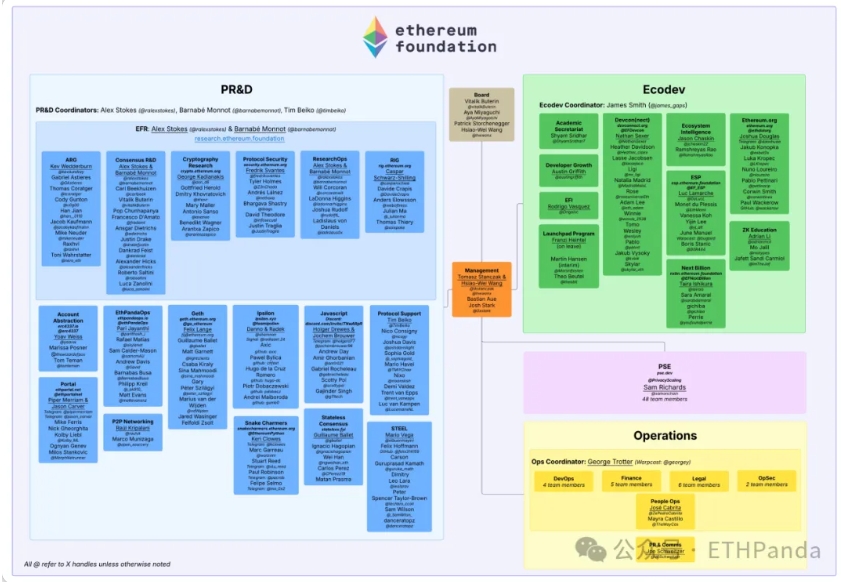
I can first introduce the general structure of EF. First, we have the board of directors, and then the management team, under which there are three business clusters, which are not strictly defined departments. The first is the Operations department, including Finance, HR, and Legal, which are needed for the daily operation of a company or a foundation. The second is the Development department. After some relatively large spin-offs in recent times, it is now mainly focused on Protocol R&D, and the Research Team is also in this development department. The third is the Eco Dev department, which is related to ecological development. This part may include departments that issue Grants such as ESP and Next Billion Fellowship.
Bruce:
Could you please give us a brief introduction to some organizations outside EF, such as Etherealize?
Hsiao-Wei:
If I remember correctly, Etherealize was actually established last year. The Foundation and Vitalik supported them a little in the early days of their establishment. Their activities in the United States are mainly on Wall Street. It also reflects the change in the direction of the world's political situation towards Crypto. Their establishment can go to Wall Street to do some things that I think are very helpful to us, and do some things that EF may not directly execute. Their BD part can better directly face American users, as well as the current traditional finance or traditional large companies in the United States. They want to promote this area, which I think is very good.
Bruce:
From what I just heard, EF doesn’t have a marketing team, right?
Hsiao-Wei:
Yes, we only do Communication. Because as Josh Stark said, Ethereum doesn't have a BD team, Ethereum has one hundred BD teams. For other applications, whether it is Layer 2 or some Dapps, their BD teams are also like our BD teams.
We do not regard Ethereum as our own brand. For example, we have recently changed some accounts on Twitter. Since the beginning of this year, there is now an Ethereum account and an Ethereum Foundation account.
I think the separation is quite good, because in the past, whenever we wanted to post something on the Ethereum account, everyone seemed to think that this was the intention of the foundation, which was very restrictive. Now we use this account to do BD-like things, and do some publicity work to help the community understand what major events are happening. Anyway, I think this separation is very good, and both accounts can be used flexibly.
Bruce:
This also brings a lot of convenience to our work, because the official account of Ethereum is a good source for us to translate and import content, and we can get the latest changes and provide better publicity to the community.
I just mentioned ESP. As a very important part of EF, it has always played a role in boosting the development of the entire ecosystem. After this new architecture, are there any changes in the budget allocation design of EF and the areas that ESP will pay more attention to?
Hsiao-Wei:
I just mentioned that we have different departments such as Eco Dev and Development. The team leaders of developers and researchers in these departments are already capable of managing relatively large grants. ESP and other Eco Dev Teams are other parts. If we talk about the main major areas, one may be AGR, which is not within ESP, but is somehow tied to ESP. This is the academic research part, and there is a grant every year. The application should be closed this year, and it is currently under review.
In other areas, I think ESP is actually our front office for receiving inbound requests, so I think their choices are quite broad. They don’t require setting a certain budget for an activity, and may not have such a strict definition.
Sometimes what the Ethereum Foundation wants to support may not necessarily be Grants support, or money, but rather the Foundation’s Shout Out (publicity and diffusion).
When deciding whether to give Grants to an activity, the foundation sometimes does not necessarily consider how many direct users the activity can bring to us, but rather what kind of Grants allocation can have a greater impact, which activities or projects can only be supported by the foundation, and which are useful and can bring some public goods that are helpful to everyone.
Bruce:
To sum up, for this kind of activity or project, the foundation may be the only organization willing to support it, and the thing itself is necessary.
I actually see that EF has introduced more external organizations to participate in influencing decision-making, such as the EF Silviculture Society recently?
Hsiao-Wei:
They are a bit like a board of directors. We have selected some advisers who are very concerned about public interests in different fields. We are very grateful to them, so I think they mainly represent the spirit of Cypherpunk, and then security and privacy.
If we regard Ethereum as a business and have business advisers, we can easily hear a lot of opinions. How can we better listen to the voice of the community? This is the significance of the formation of this council.
In other aspects, we have also been listening to the opinions of some DeFi experts recently. EF has also been doing a lot of Twitter Space recently to actively communicate with Layer 2 Interop and some successful Dapps projects. At the same time, external project team leaders will come to EF to do seminars. We listen to expert opinions and community feedback in this way.
Bruce:
In fact, some people have been suggesting that the Ethereum Foundation should obtain income through DeFi instead of continuing to sell coins publicly. What do you think of EF's funding operation model? What are the potential input channels that can ensure the long-term sustainability of this foundation?
Hsiao-Wei:
This year, the foundation began to actively participate in DeFi. In early February, there was a wave of deployments. We put some money into ETH DeFi Lending, and the second phase is also planned. We are evaluating whether to increase investment in Lending or explore more creative ways to use ETH assets; the second major area is Staking. We are also exploring different Staking Options, while thinking about whether EF's participation in Staking can bring positive benefits; the third point is still in the exploration stage, which is Tokenization, such as participating in some RWA. Our participation is mainly in some more conservative funds, or funds that are better for L1.
Bruce:
It seems that there are still many new ideas and attempts in this direction. In fact, the community has also received some feedback, including the operation of selling 100 ETH from time to time. Although it will not cause much selling pressure, it may have some impact on everyone's emotions. What is the view within the foundation?
Hsiao-Wei:
Well, we have to sell it because we have 200 to 300 people in the foundation, and about 75% of the expenditure is in fiat currency, and 25% is in Crypto. So the first point is that the foundation needs to operate, so it needs to rebalance its assets.
The second is that our community may not be aware of our need, so we may strengthen communication. There is another point to mention first. We do not sell coins at high points. People often say that we sell at high points, but in fact, many times we sell at low points. When the price is low, people do not magnify it, and we do not have a big design here.
Bruce:
In fact, we have also heard voices from the community saying that it can be done through OTC or some more covert methods. What do you think?
Hsiao-Wei:
Our main treasury is actually very open and transparent, so maybe this is okay in the short term, but everyone can see the changes in the main treasury.
Bruce:
Regarding the work of the Ethereum Foundation, some people speculate that EF may gradually fade out or disband after completing a certain mission or stage, allowing the community to drive the operation of Ethereum. What do you think of this direction? If that day really comes, how do you think the Ethereum community will operate?
Hsiao-Wei:
First of all, this year is a particularly important year for the Foundation. We have invested a lot of budget in the transformation of the entire organization. Maybe next year, if the Foundation finds that there are more entities in the community that can replace the Foundation's role, we can operate in a conservative and shrinking state. What's more interesting is that we need to change our strategy every year, and the theme that the Foundation focuses on every year may be different. Maybe when the Foundation focuses on Protocol, its presence will be stronger.
So maybe when we focus on the application layer or the Wallet in the future, we may not need such a strong presence, so this presence changes every year. I personally hope that the foundation can always think about how we can increase the number of people who can do what we do today. In the future, we will do things that only we can do, and maybe we will continue to do them. For example, the coordination part depends very much on the changes of various factors in the future, as well as some support from the community. If the community can do well, the foundation can turn to more complex things, or things that are less lacking in attention.
Bruce:
We are almost at the end of this interview. We have talked about a lot, including personal experience, technology roadmap community, and foundation work. We can end with some lighter topics. Because our audience includes students and relatively young developers, as an "old man" in Ethereum, what advice do you have for those who are just entering or want to enter the industry?
Hsiao-Wei:
I think many people say that choice is more important than hard work. I think we can add one more point: you should choose a place where you have more choices. Ethereum has a lot of very large communities, and very dynamic developers have paved some roads in front. I hope that new friends can all develop in this field. Whether you are a developer, educator, product maker, or user, you can find some people like mentors in the community, so that you can have more choices.
Bruce:
Recommend some books or materials that are helpful for building Web3 thinking or personal growth.
Hsiao-Wei:
The blog post that I read most often is probably Vitalik’s. Because if the level of thinking is two, then you might want to see what a person with a level of thinking of four thinks, that is, a person with a squared level of thinking.
I have also been reading books on business management recently. There is a book called "Principles", which describes some general directions and principles. I think the important thing to learn from this book is that you should establish your own principles. His principles may not be so applicable to me, but the important thing is that you should establish principles. If the principles are established and you can follow them, then the things you do afterwards may be much simpler.
Bruce:
Do you have any favorite sports or other leisure activities besides work?
Hsiao-Wei:
I am a very homebody, mainly watching TV series and playing chess, which are all static activities. But now my leisure time has been greatly reduced recently, and I have a lot of work to do.
Bruce:
Thank you Hsiao-Wei for sharing today. Thank you very much for bringing us some interesting and profound thoughts. Thank you for watching or listening to this ETHPanda Talk. Special thanks to Hashkey for providing us with a free venue. If you like our content, please follow and share to support us. See you next time!