Over the past month, the DeFi landscape seems to have undergone a structural change. Unlike the previous every-man-for-himself approach, some top protocols are moving towards "grouping" through collaboration, integration, and even direct interest alignment.
In this article, we will delve into the most representative "grouping actions" from three perspectives: lending and trading integration, stablecoin landscape evolution, and RWA fusion, and analyze the underlying logical changes and potential impacts.
Lending + Trading: Interconnected Interests Between Protocols
Collaboration between DeFi protocols is moving from superficial asset integration to deeper structural fusion. The recent synergy between Uniswap and Aave is a prime example of this trend.
The core upgrade of Uniswap V4 is not about gas savings, but introducing the Hook mechanism. It allows developers to insert custom logic at critical points in liquidity pools (such as adding or removing liquidity, before and after trade execution), enabling whitelist control, dynamic fees, customized price curves, and even embedded game rules. This transforms Uniswap from a trading protocol to a more open liquidity infrastructure.
Based on this, Aave plans to support Uniswap V4's LP Token as collateral for lending and return part of the GHO stablecoin interest to the Uniswap DAO. The two have formed a substantial connection in assets, functions, and yields. This collaboration enhances the capital efficiency of LPs and provides a more realistic template for complementary relationships between protocols.
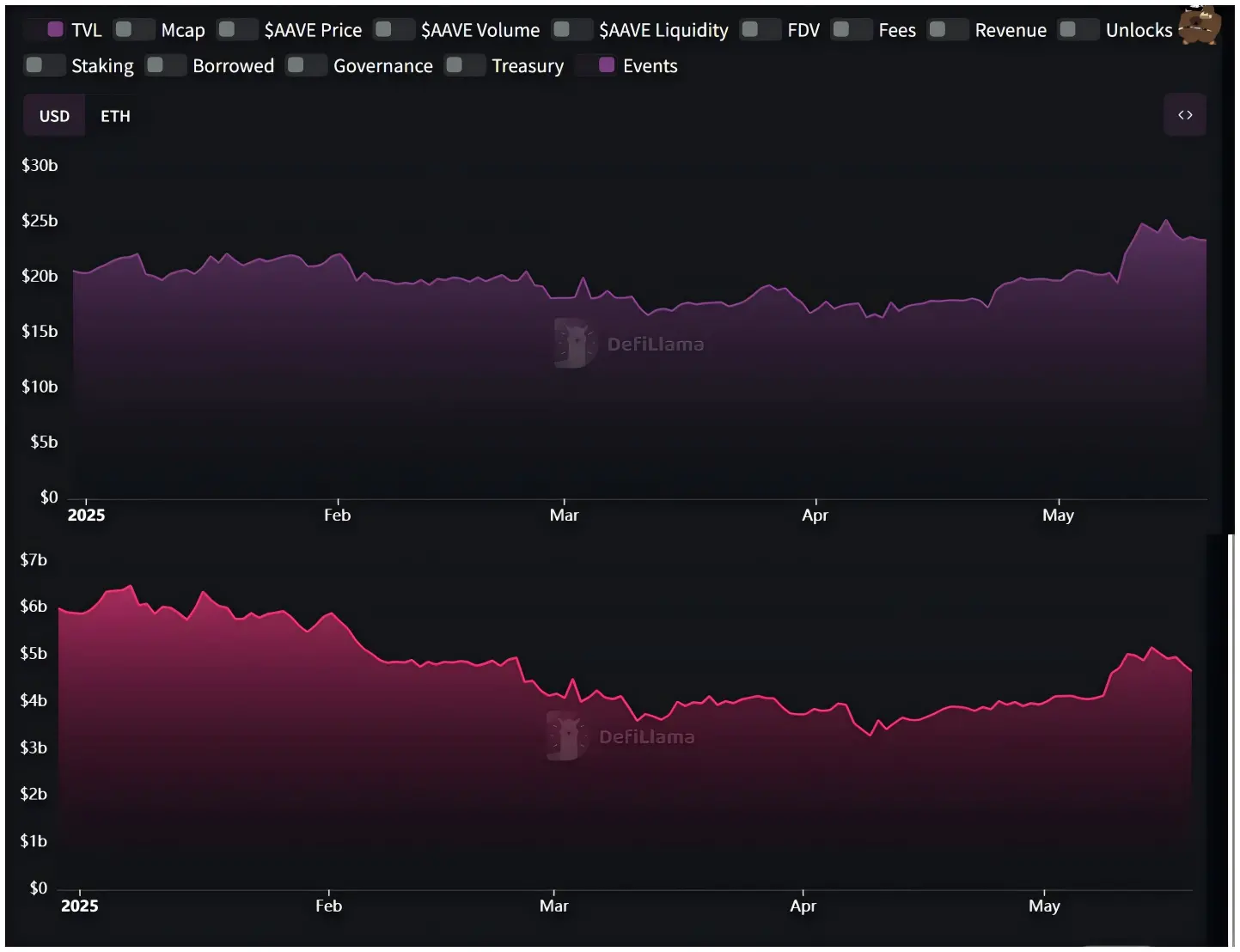
Market data suggests that this "grouping effect" is releasing positive signals. Since May, Aave's TVL has risen from $19.708 billion to $23.347 billion, an increase of over 18%. Uniswap's TVL has also grown by about 11%, from $4.178 billion to $4.65 billion. Their simultaneous strength may not be a coincidence.
Stablecoins: A New Stage of Differentiation and Specialization
The stablecoin competition is no longer limited to "who is more decentralized" or "who offers higher yields". More protocols are pushing stablecoin products towards professional uses and structural layering.
Take Ethena as an example. Currently, the most active stablecoin in its ecosystem is USDe, deeply integrated with Aave and supporting up to 90% lending collateralization rate (LTV). However, since May, USDe's TVL has declined from $5.725 billion to $4.993 billion, a drop of nearly 13%. Behind this, Ethena is launching another more conservative new product, USDtb.
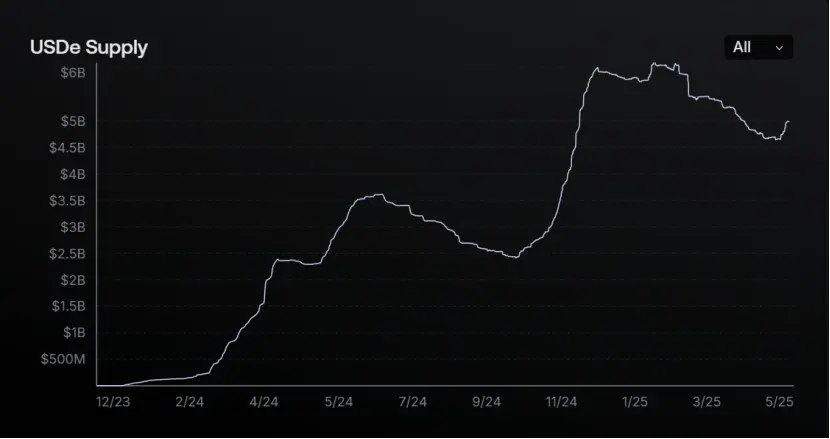
USDe supply change, source https://app.ethena.fi
USDtb is a non-yielding but fully collateralized stablecoin, composed of BlackRock's tokenized money market fund (BUIDL) and USDC. Currently, its on-chain supply exceeds $1.44 billion, with a collateralization rate of 99.4%. Unlike USDe's strategic hedging, USDtb is more like an "on-chain dollar", providing institutions with a reliable, non-volatile stable anchor. Especially when the market experiences negative funding rates, Ethena can transfer USDe's hedging funds to USDtb to stabilize the entire asset pool structure.
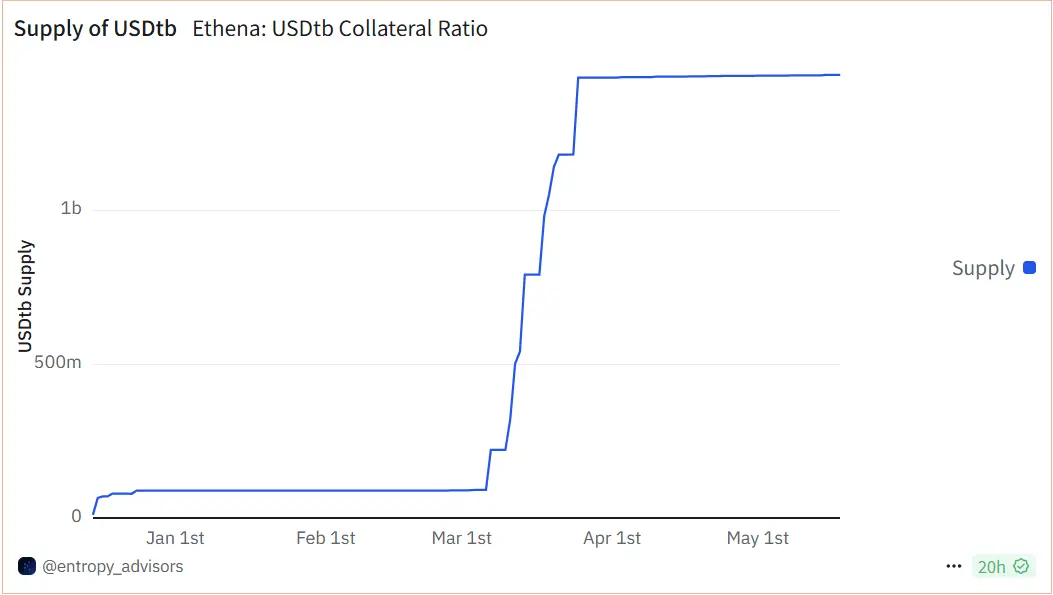
USDtb supply, source: Dune
Another variable in the stablecoin landscape is USDT₀. This stablecoin, launched by Tether in collaboration with LayerZero based on the OFT protocol, has already expanded to multiple chains including Arbitrum, Unichain, and Hyperliquid, with TVL growing from $1.042 billion to $1.171 billion in May. In contrast, its goal is not financial innovation, but to connect multi-chain liquidity, becoming a stable "fuel" in DeFi.
This stablecoin competition is no longer a single-dimensional efficiency battle, but has evolved into a structured, scenario-based product ecosystem. Products like GHO, USDe, USDtb, and USDT₀ are positioning themselves in lending, hedging, security, cross-chain, and payment domains, reflecting that the stablecoin ecosystem is undergoing a reshuffling of "functional specialization" and "clear application scenarios".
RWA: On-Chain Convergence of Real-World Assets
RWA, once viewed as an "appendage of traditional finance", is now becoming a strategic collaboration entry point for DeFi giants. In the past few months, multiple protocols and organizations have formed a clear grouping trend around tokenized US Treasury bonds and have begun actual on-chain deployment.
The most representative case is Arbitrum DAO. On May 8th, the community passed a proposal to allocate 35 million ARB to three RWA issuance platforms: Franklin Templeton ($BENJI), Spiko ($USTBL), and WisdomTree. These three companies are heavyweight players in traditional finance and asset management, providing tokenized U.S. Treasury bonds. This fund was allocated through the STEP (Stable Treasury Endowment Program), with the goal of establishing a stable, interest-bearing on-chain treasury asset pool. According to official data, the first phase of the program has created over $650,000 in yield.
Aave's RWA platform Horizon follows a "use case priority" approach. The primary assets on Horizon are tokenized money market funds (MMFs), which institutions can use as collateral to borrow GHO or USDC. This means RWA is no longer just an investment target, but is actually integrated into the core functions of DeFi protocols, becoming a transferable and lendable financial component.
Whether it's DAOs, lending platforms, or infrastructure providers, RWA is now seen as a key pathway to achieving real yield on-chain, connecting with traditional finance, and enhancing user confidence.
DeFi is not huddling for warmth, but evolving through collaboration
On the surface, this round of collaboration among DeFi protocols seems like a joint effort under "track anxiety," but from a structural perspective, it looks more like a systematic integration and reconstruction.
These changes are not simply functional expansion kits, but an upgrade in the collaborative methods between protocols. It signals that the next stage of DeFi will move from isolated single-point tools to a mutually nested and interconnected financial network system.
For ordinary investors, the focus may not be on whose TVL is higher, but on which combination structures are more stable, more efficient, and better able to navigate volatility cycles. Collaboration does not equal price increase, but it may be the foundation for the next round of growth.