The stablecoin market with interest rates has seen strong growth in recent years. Although small investors have not paid much attention, the latest data shows significant potential in this field.
This article explores the challenges that the interest-bearing stablecoin space is facing in the context of changing regulations and increasing institutional interest.
Yield Stablecoin Market Capitalization Exceeds $10 Billion by 2025
Interest-bearing stablecoins differ from traditional stablecoins in that they not only maintain stable value but also generate profits for holders. These profits come from investment strategies such as staking, lending, or investing in yield-generating assets like government bonds.
According to data from Stablewatch, the total supply of interest-bearing stablecoins has increased 13 times in less than two years, from just $666 million in August 2023 to $8.98 billion in May 2025. At one point, in February 2025, the market reached an All-Time-High of $10.8 billion.
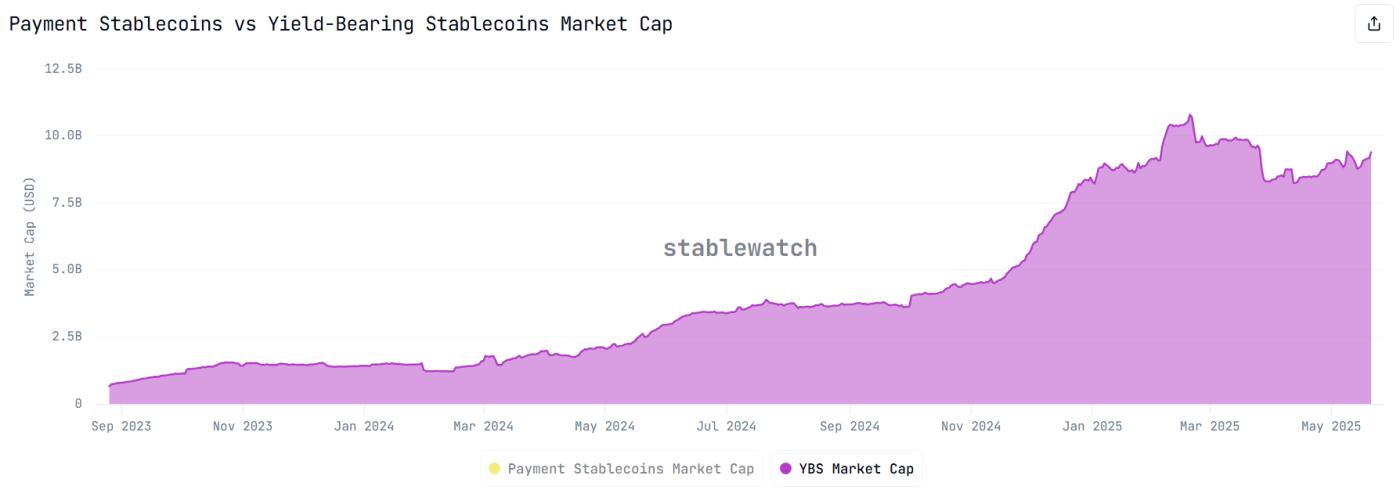 Yield-Bearing Stablecoin Market Capitalization. Source: Stablewatch
Stablewatch also reports that the total accumulated profits paid out have reached nearly $600 million. The current average payout is around $1.5 million per day.
Among the most prominent projects, Ethena's sUSDe and Sky's sUSDS and sDAI are leading the market. Together, these projects account for 57% of the total market capitalization of interest-bearing stablecoins — approximately $5.13 billion.
Data from defillama shows that the market currently includes over 1,900 stablecoin pools, spread across 465 protocols and more than 100 different chains. These pools allow investors to deposit stablecoins and earn profits.
Despite impressive growth, Jacek Czarnecki, co-founder of L2Beat, points out that interest-bearing stablecoins still only represent a small portion of the larger stablecoin market. At the time of writing, the total stablecoin market capitalization had reached over $244 billion.
"Profit-prioritized stablecoins are still only a small part (3.7%) of the overall stablecoin market," Jacek said.
However, this small portion also reflects the enormous growth potential of interest-bearing stablecoins. More and more investors are seeking passive income opportunities in the DeFi space.
Challenges Facing the Yield Stablecoin Sector
According to Jacek Czarnecki, interest-bearing stablecoins still lack a standard definition. This lack of clarity makes classifying and evaluating these assets difficult.
Jacek categorizes stablecoins into two groups: payment and yield. Although simple, this distinction could help form separate legal frameworks for each type.
"Stablecoins are widely seen as a prominent use case for cryptocurrencies. But to expand, we need a legal framework that focuses more on users. You shouldn't buy coffee with your yield portfolio. Combining both types in one portfolio (as many dashboards do) is like storing your salary in an investment fund: technically possible, but not very rational," Jacek explained.
Legislators are beginning to recognize this distinction. For example, the GENIUS Act in the US stipulates that stablecoins providing yield or interest do not qualify as "payment stablecoins."
This means these stablecoins fall outside the scope of the bill. Instead, they may be classified as securities, subject to oversight by the US Securities and Exchange Commission (SEC).
Meanwhile, MiCA (Markets in Crypto-Assets Regulation) in the European Union completely prohibits interest payments on stablecoins. Due to regulatory ambiguity and these legal restrictions, the interest-bearing stablecoin market may not have exploded yet. So far, it has mainly attracted attention from industry insiders and early investors.
However, the participation of large financial institutions in the stablecoin sector provides reason to expect a more flexible attitude from legislators. To maintain growth momentum and ensure sustainability, projects must address critical regulations, challenges of transparency, and risk management.