A famous economist has declared the beginning of a new long-term inflation regime, potentially the most significant in three decades. This structural transformation could profoundly impact the global economy and financial markets.
Notably, periods of high inflation have supported Bitcoin (BTC), as its scarcity and speculative appeal often drive demand.
Could Rising Inflation Trigger the Next Bitcoin Price Surge?
Henrik Zeberg, Chief Macro Economist at Swissblock, recently shared a long-term view on the US government's 10-year bond yield. His chart categorizes historical economic periods into inflation and deflation regimes.
It highlights a "rounded bottom" pattern in bond yields as a harbinger of rising inflation, which has now emerged.
"This doesn't mean inflation will immediately (reverse). But it means the economy and financial world in the next decade will be completely different from the past 30 years," Zeberg wrote.
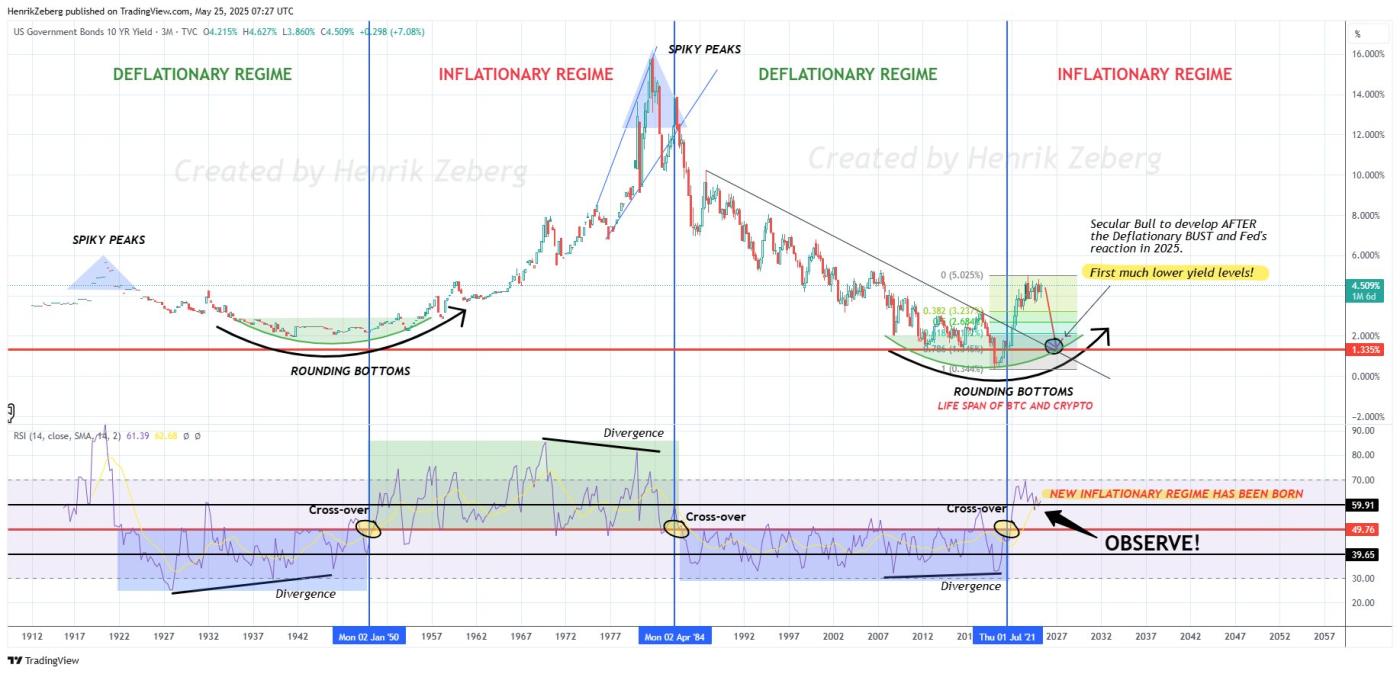 Alternating Inflation and Deflation Regimes. Source: X/HenrikZeberg
Zeberg's analysis suggests that before a sustained yield increase, there could be a deflationary recession in 2025. This would, in turn, prompt a strong policy response from the Federal Reserve. This turning point will trigger a new long-term growth market.
Meanwhile, crypto analyst Michaël van de Poppe also emphasized that a bond market collapse could force central banks to print more money. This could lead to a debt bubble burst and another deflationary phase. In a recent X post, he provided a strategy to navigate this.
"How do you escape this? Maximize the next few years by investing in risky assets: Crypto, Altcoins, and Bitcoin," he stated.
He subsequently recommends transferring those profits into safer assets like commodities, Bitcoin (as a value store), and cash before the expected market collapse, then returning to risky assets during the recovery phase. Van de Poppe describes this cyclical strategy as "perhaps the best plan" to navigate the upcoming economic volatility.
As the global economy prepares for a potential inflation regime, Bitcoin's role as a hedge against high prices continues to draw attention. Geoff Kendrick, Head of Digital Assets Research at Standard Chartered, had previously emphasized this trend.
Importantly, inflation prospects have begun affecting financial markets, especially Bitcoin. The largest cryptocurrency recently reached a new All-Time-High, surpassing $110,900.
Ryan Lee, Head of Analysis at Bitget Research, attributes this price surge to multiple factors. These include institutional acceptance, increasing regulatory clarity, and supply scarcity after halving.
"Macro conditions are playing their part. Expectations of interest rate cuts and persistent inflation reinforce Bitcoin's appeal as a hedge, with many targeting $113,000 as a realistic short-term goal in June 2025," Lee told BeInCrypto.
However, he warns that strong Bitcoin price surges often precede corrections, citing potential risks like a stronger USD or geopolitical tensions.