Deng Tong, Jinse Finance
In February this year, former CFTC Commissioner Brian Quintenz officially became a candidate for CFTC Chairman. According to a Bloomberg report on May 27, in a document released by the US Government Ethics Office on May 25, Brian Quintenz disclosed key positions in cryptocurrency and market companies directly related to CFTC's regulatory focus, and revealed assets worth at least $3.4 million.
Who is Brian Quintenz? What companies is he associated with? What impact will the CFTC have on the crypto industry in the future?
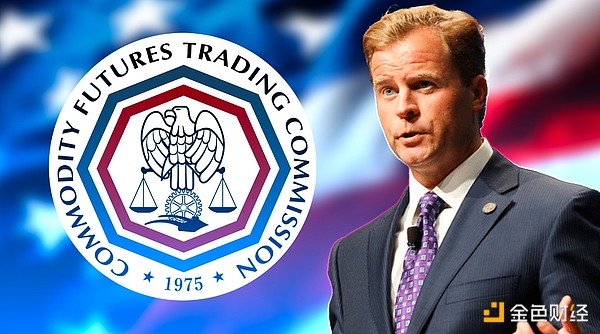
I. Brian Quintenz
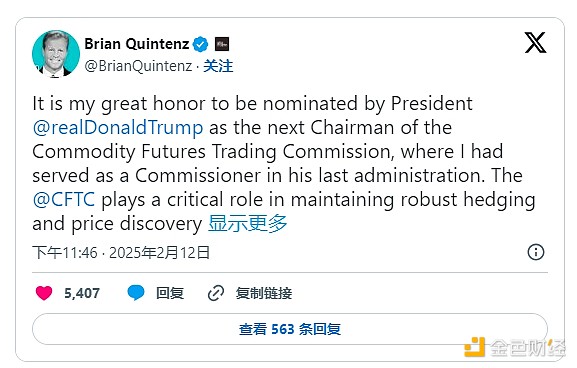
Brian Quintenz is an American financial manager and policy advisor who served as a Commissioner of the US Commodity Futures Trading Commission (CFTC) from 2017 to 2021. On February 11, 2025, President Trump nominated Quintenz to be the CFTC Chairman.
Early in his career, Quintenz served as an advisor to Rose International and was a senior assistant at Hill-Townsend Capital.
From 2001 to 2007, he worked for US Representative Deborah Pryce, initially as an assistant and later promoted to senior policy advisor.
He was the head of Saeculum Capital Management, an investment company he founded in 2013.
In March 2016, Quintenz was nominated by Obama as a CFTC Commissioner.
In early 2017, Trump withdrew Quintenz's CFTC nomination and then renominated him to complete the remaining part of a five-year term, which expired on April 13, 2020.
On August 3, 2017, Quintenz was confirmed by the US Senate and began serving on the commission on August 15.
II. Companies Associated with Quintenz and His Next Steps
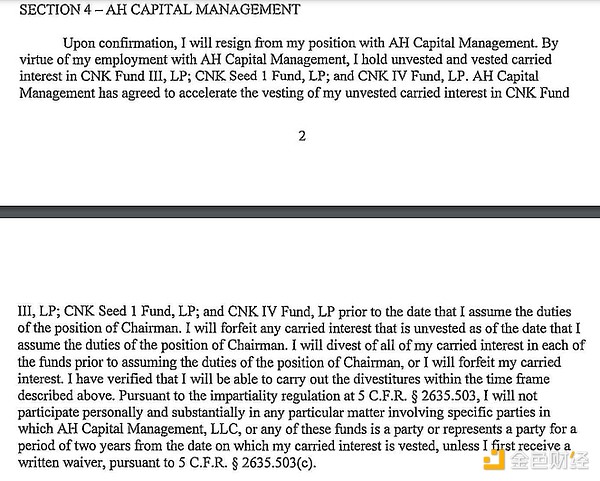
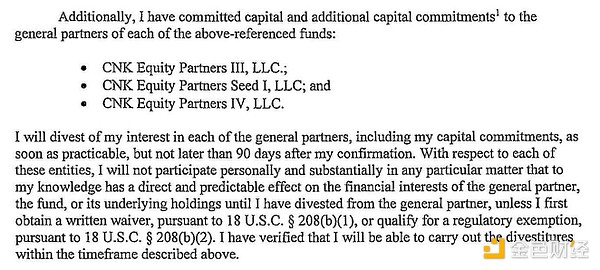
Currently serving as the Global Crypto Policy Head at Andreessen Horowitz. He stated that if confirmed by the Senate as CFTC Chairman, he would resign from this position. Quintenz holds interests in three AH Capital Management investment funds: CNK Fund III, CNK Seed 1 Fund, and CNK IV Fund, along with capital commitments to related general partners. These funds focus on investing in blockchain networks, blockchain-based storage and data retrieval systems, smart contracts, blockchain applications, and payment solutions.
Upon confirmation, I will resign from my position at AH Capital Management. Due to my work at the company, I hold unvested and vested carried interests in CNK Fund III, LP, CNK Seed 1 Fund, LP, and CNK IV Fund, LP. AH Capital Management has agreed to accelerate the vesting of my unvested carried interests in the aforementioned funds before I assume the chairman position. I will forfeit any carried interests not vested on the day I assume the chairman position and divest all carried interests in the funds before assuming the chairman position, otherwise I will forfeit these interests. I have confirmed my ability to complete the divestment within the specified timeframe.
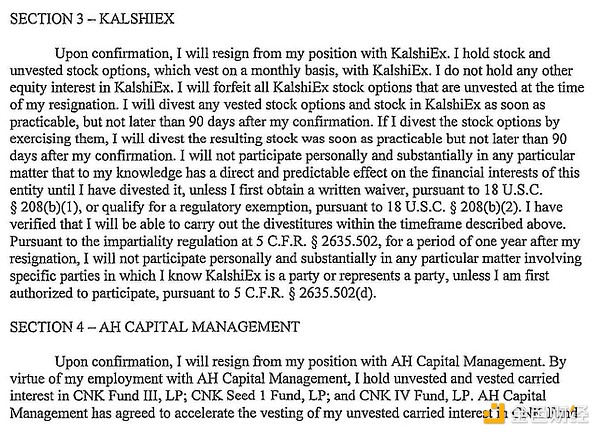
He is also a board member of the prediction market platform Kalshi, owning stocks and unvested stock options in the company. Kalshi Inc., established in July 2021, is a US financial trading and prediction market headquartered in Lower Manhattan, New York City, offering event contracts. Retail and institutional traders can trade on various future events, including economic indicators, weather patterns, awards, and political and legislative outcomes. The company has engaged in a regulatory battle with the CFTC by attempting to offer derivatives based on political events. Kalshi has also partnered with major trading platforms like Robinhood and Webull to introduce event contracts to retail investors.
Upon confirmation, I will resign from my position at KalshiEx. I hold stocks and monthly vesting unvested stock options in KalshiEx, with no other equity interests. I will forfeit all unvested stock options upon resignation and divest all vested stock options and stocks as soon as possible (but no later than 90 days) after confirmation.
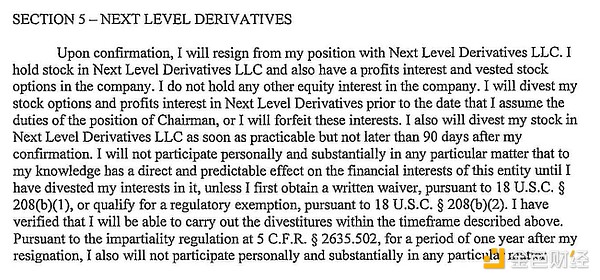
Quintenz also works at Next Level Derivatives. Next Level Derivatives is a market research company providing liquidity solutions for the Treasury market.
Upon confirmation, I will resign from my position at Next Level Derivatives LLC. I hold stocks, profit interests, and vested stock options in the company, with no other equity interests. I will divest stock options and profit interests before assuming the chairman position, otherwise I will forfeit these interests, and divest stocks as soon as possible (but no later than 90 days) after confirmation.

III. Quintenz's Efforts as a CFTC Commissioner during Trump's First Term
Enforcement Matters
During his tenure as a commissioner, Quintenz supported enforcement matters, requiring market participants to be responsible for clear violations of the Commodity Exchange Act and CFTC regulations. His past statements focused on fairness and ensuring entities "do not circumvent these rules to the detriment of US customers and law-abiding market participants". During his tenure, Quintenz often worked to promote innovation and suggested that the CFTC should not take measures that might hinder institutions from developing new products or services or participating in market activities. In a 2018 speech, he stated: "I prefer engagement over enforcement - but if there is no engagement, enforcement is our only choice."
Regulatory Approach
Quintenz's perspective on rule-making during his tenure as a commissioner emphasized a "principles-based" approach, previously stating his preference for industry-driven solutions over prescriptive regulatory requirements.
For example, in 2017, in his first public speech after becoming a CFTC commissioner, Quintenz criticized the agency's proposed regulation on automated trading ("Reg AT") as "poorly crafted and flawed public policy". He advocated for more research into the specific risks in automated trading and the controls already in place to address these risks before proposing broad rule-making. The commission later completely withdrew Reg AT and instead proposed and ultimately adopted more limited "Electronic Trading Risk Principles". Quintenz supported this, believing it took a principles-based approach rather than Reg AT's "extremely prescriptive requirements".
Quintenz also supported developing regulatory regulations that could ensure market stability while promoting innovation. This perspective was evident in two areas the commission has consistently focused on: (1) cryptocurrency and digital asset regulation; (2) event contracts.
During his CFTC tenure, Quintenz worked to promote coordination between the CFTC and SEC. As a commissioner, he collaborated with SEC Commissioner Hester Peirce to coordinate and unify SEC and CFTC regulatory provisions affecting entities simultaneously registered as swap dealers/security-based swap dealers, broker-dealers/futures commission merchants, and commodity pool operators/investment funds.
Digital Assets
Quintenz sponsored the CFTC's Technology Advisory Committee during the launch of the first Bitcoin futures contracts. During his tenure, the committee oversaw "custody of digital assets within traditional clearing infrastructure, the proliferation of blockchain technology, and the creation of crypto-tokenized commodities", and discussed other topics related to digital assets.
Event Contracts
Regarding event contracts, Quintenz criticized the comprehensive ban on certain event contracts without specific public interest determination. In December 2020, ErisX submitted a self-certification proving that certain NFL event contracts meet the requirements for listing on a registered Designated Contract Market (DCM) under the Commodity Exchange Act. When opposing the CFTC's rejection of these contracts, Quintenz opposed the explicit prohibition of "gambling", arguing that it goes against public interest and advocated for a more precise regulatory approach. He also believed that such broad bans contradict statutory requirements and disagreed with the burden placed on registrants (ErisX) to prove that NFL event contracts have hedging functions (and thus serve public interest).
This issue has once again become a focus of the committee, as multiple contract markets have listed contracts related to sports events, election results, and other novel event contract applications.
Swap Dealer Regulation/Swap Market Oversight
Quintenz emphasized that the policy goals of the Dodd-Frank Act regarding swap dealer registration include reducing systemic risk, protecting counterparties, and improving market efficiency. He noted that any adjustments to the minimum registration threshold for swap dealers should be consistent with these goals, especially ensuring that regulations can effectively address anticipated risks without imposing unnecessary burdens.
Based on this perspective, Quintenz criticized the use of notional total value as an indicator for determining swap dealer minimum thresholds in a 2019 statement, believing that this figure does not well measure the activity level of dealers. He suggested that the CFTC should consider indicators that better represent the actual market impact, rather than adopting a one-size-fits-all approach. Quintenz also advocated for excluding clearing swaps from the minimum threshold calculation, as from his perspective, most swap trading activity would remain below the $8 billion threshold. He also advocated for reviewing and adjusting required swap dealer business conduct standards, including certain disclosure obligations.
During his tenure as commissioner, Quintenz supported flexibility in the implementation of maritime regulations. He also expressed support for aligning maritime regulations with international standards.
"America First" Market Policy
This view aligns with Quintenz's overall approach to international regulatory coordination. During his tenure, Quintenz advocated for cross-border respect, encouraging home country regulators to be the primary point of contact for market participants. However, Quintenz firmly defended the American market against foreign regulatory interference, especially from the European Union. He emphasized the importance of maintaining trust in international regulatory relationships, particularly highlighting how foreign legislative changes could negatively impact U.S. market participants.
IV. What Impact Will the CFTC Have on the Crypto Industry?
The crypto industry has long pushed for the CFTC as the primary regulatory body while demanding a clearer regulatory framework in the United States. Therefore, the CFTC under Quintenz's leadership may have a profound impact on the crypto industry.
Christy Goldsmith Romero, the outgoing CFTC commissioner, stated that the CFTC should focus on defining retail customers to ensure that new investment flows for "cryptocurrencies and some other products" have retail customer protection systems similar to the U.S. Securities and Exchange Commission.
Members of WilmerHale's futures and derivatives practice predicted earlier this year that whether it's cryptocurrencies, individual stock futures, over-the-counter derivatives, or artificial intelligence, they expect the CFTC to coordinate with other U.S. agencies, especially the U.S. Securities and Exchange Commission. The CFTC will also maintain a key role with the Financial Stability Oversight Council (FSO), which typically serves as the center for policy-making in government financial services.
Sources: Jinse Finance, U.S. Office of Government Ethics, Wikipedia, CoinTelegraph, WilmerHale, Koehler Group, Yogonet, etc.