The boom and bust cycle of LRT: from points boom to revenue fizzle
Since the second half of 2023, LRT (Liquid Restaking Token) has gradually become one of the hot narratives in the market. By re-staking LSTs (liquidity pledged assets) in the LRT protocol, users expect to obtain a new layer of protocol incentives in addition to the original staking income.
Among them, ether.fi pioneered the "non-commitment points" and improved user activity and capital accumulation through behavior binding, driving the rapid growth of Restaking TVL. This mechanism adopts the "non-commitment incentive + operation behavior binding" points model to build a predictable but indirect future incentive path for LST holders, which greatly improves user participation and capital accumulation without clarifying the issuance of coins.
As ether.fi's model gained market validation, it quickly triggered a battle for TVL in the entire Restaking track.
Several leading projects including EigenLayer, Renzo, Kelp DAO, Swell, Puffer, etc. have also launched their own versions of the points system, thus establishing the mainstream position of "points-driven growth" in the LRT field. Even the DeFi protocol Pendle has built an infrastructure for advance trading and pricing for these points based on its zero-coupon bond model.
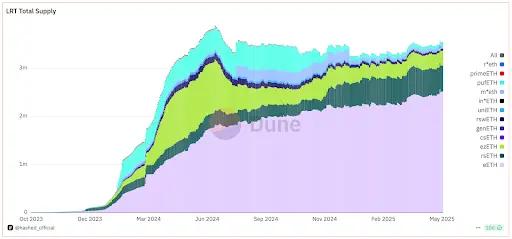
In fact, after a short-lived frenzy, the LRT market gradually entered a phase of slowing growth as several projects completed TGE and distributed airdrops to users with accumulated points last year. Data shows that since May and June 2024, the total supply of LRT tokens has begun to decline after reaching a peak of $3.88M, and has maintained a very limited and slow growth level for a period of time thereafter, and the market activity has also tended to stabilize or even cool down.
The points feast is over, real yield is the next stop
From the perspective of the crypto market, profit-seeking liquidity never sleeps. Therefore, the fundamental reason for the overall downturn in the current LRT market is that the real yield level continues to decline, coupled with the market's lack of clear expectations for future returns.
After experiencing initial dividends, the points model exposed three major structural problems:
- Unsustainable incentives: incentives are broken after TGE, TVL declines, and APR decreases;
- Insufficient ecological stickiness: Most LRT assets lack multi-scenario usage and poor asset reusability;
- Imbalance in community participation: large households dominate the list, small households cannot get any airdrops, and “buying coins is worse than mining” has become a consensus.
After the original logic of "you can get additional airdrops as long as you participate" became invalid, LRT users gradually realized that what was left was only the basic income corresponding to the mainstream LST, and the annualized rate was generally only in the range of 4-6%, which greatly reduced its attractiveness.
More importantly, driven by highly popular narratives such as Meme, AI, and RWA, market funds and users are gradually turning to tracks with greater short-term returns. In a market environment that is extremely sensitive to liquidity, users and funds tend to "migrate for profit", going wherever the returns are higher, and are increasingly unwilling to be bound to a certain LRT protocol for a long time.
Therefore, after the TGE of multiple projects was realized, the community generally showed strong disappointment. Not only was the airdrop amount lower than expected, but the tokens also performed poorly in the market, further leading to a decline in users' willingness to participate in the entire LRT track. How to build an LRT mechanism that truly has "native profit ability" and "long-term participation stickiness" has become a challenge that the project must face in the next stage.
At a time when the current LRT market is in a period of transition, Lair Finance is taking a different approach. The protocol builds a multilateral incentive coordination layer that no longer relies on pure point expectations or short-term airdrop incentives, but is committed to introducing a sustainable and verifiable real yield path to the LRT market through a series of innovative mechanisms, injecting momentum into a new round of growth in the LRT market.
Lair Finance’s path to breakthrough
The traditional LRT model can be understood as a further repackaging based on LSD, that is, the "secondary structuring" of LST assets. Although different protocols have slight differences in mechanism design, the underlying paradigm is basically the same, and the core logic is basically built around the Ethereum ecosystem. In fact, more than 90% of the current LRT protocols are based on the ETH and EigenLayer systems, resulting in natural limitations in terms of revenue scalability and mechanism flexibility. The rigid asset path and single on-chain scenario make the actual income obtained by users mainly rely on the native interest of LSD, making it difficult to form a compound incentive model.
In contrast, Lair Finance is not limited to the Ethereum ecosystem, but has built a cross-chain liquidity re-pledge protocol that is adapted to the multi-chain structure from the beginning, connecting multiple Layer1s including Kaia, Berachain, Injective, Somnia, Story and Initia, etc.
Its core value lies in three aspects:
- Multi-chain adaptability: deployed on emerging high-potential public chains such as Kaia and Berachain;
- Multi-source income design: native staking + re-staking + ecological incentive three-layer flywheel;
- Multilateral ecological connection: covering three behavioral scenarios: on-chain users, game players, and Web2 users.
This design allows Lair to break away from the traditional "ETH-EigenLayer" path, flexibly design an LRT framework with native adaptability, and build a sustainable and traceable compound incentive closed loop.
In the new liquidity pledge system, pledged assets can not only obtain basic income, but also obtain additional incentives through multi-dimensional income superposition and combined deployment with DeFi protocols, while participating in the security guarantee of validators, and improving the native yield without sacrificing liquidity. More importantly, Lair unlocks the liquidity bridge between different Layer1 blockchains, thereby amplifying the security and economic synergy potential of each underlying blockchain, and becoming a new infrastructure to promote the growth of the multi-chain ecosystem.
Currently, Lair has been deployed on two emerging L1 networks: Kaia and Berachain:
- On the Kaia chain , Lair occupies more than 66% of the TVL in the staking market, and has connected more than 3.6 million KYC users through cooperation with 7 applications in the LINE ecosystem, including Catizen, Avalon, LineNEXT, etc. , to promote the transformation of Web2 users into on-chain asset participants.
- On the Berachain chain , Lair has reached in-depth cooperation with the leading LSD protocol Infrared, integrating more than 95% of the LST liquidity market , and launched LrBGT through the AVS mechanism to achieve a closed-loop multi-source income structure on Berachain.
To sum up in one sentence: Lair is not just doing re-staking, it is building the infrastructure for "incentive coordination".
feature | Traditional LRT | Lair Finance |
Ecological coverage | More than 90% are based on ETH/EigenLayer system | Kaia, Berachain, Injective, Story and other chains |
Asset Path | Single LST asset re-pledge (based on ETH) | Multi-chain LST asset re-staking and capturing compound incentives from tracks such as DeFi/GameFi |
Incentive Model | Basic LSD income + one-way points airdrop | LSD basic staking income + real yield+ ecological incentives" three-layer flywheel |
User coverage | Pure on-chain users | On-chain stakers + 300 million LINE Web2 users |
Help Kaia Ecosystem to Form a Community Flywheel
Kaia is a new generation of high-performance Layer1 blockchain launched by LINE NEXT for the Asian market, dedicated to achieving a seamless transition for Web2 users to the Web3 world. One of its core advantages is that it deeply integrates the Mini App system of the mainstream communication platform LINE, significantly reducing the threshold for developers to build dApps or migrate traditional applications to the chain, while providing a huge user base and strong traffic entry for applications, thus creating a Web3 application environment with high scalability and user-friendliness.
Relying on the LINE ecosystem, Kaia has a potential user base of more than 300 million, and through Mini dApp, points system and preset identity mechanism, it has opened up the key path for user cold start. Therefore, Kaia is regarded as one of the most promising infrastructures for achieving large-scale user migration of Web3.
In terms of ecological structure, Kaia actually connects two completely different community groups:
- One category is crypto users represented by Web3 natives, who interact with the Kaia network through staking and on-chain transactions;
- The other category is Web2 users from LINE Mini dApp, who mainly access on-chain activities through consumer-oriented light applications such as games, SocialFi, and Memes.
However, the differences in cognitive structure and behavioral patterns between the two have led to a lack of consensus between $KAIA coin holders and actual DApp users. It is also difficult for Web2 users to deeply integrate into the community ecology, so Kaia has not yet formed a complete community flywheel effect.
As Lair Finance further expands its layout in the ecosystem and builds the LRT system based on Kaia's KIP-163 proposal (CnStakingV3), the long-standing community faults and staking participation threshold issues in the Kaia ecosystem are gradually being improved.
For users who are not yet familiar with KIP-163, this proposal introduces a new generation of staking architecture for the Kaia mainnet. The previous CnStakingV2 framework only supports users to stake $KAIA tokens to a limited number of nodes, resulting in uneven distribution of staking income, concentration of node power, and even potential security monopoly risks. The biggest innovation of CnStakingV3 is that it supports "open delegation", that is, any non-validator user can also freely delegate their KAIA to a trusted GC (member of the governance committee), thereby achieving a more decentralized and more balanced staking ecosystem.
Lair Finance is the first staking service agreement built on the Kaia CnStakingV3 architecture. Users can entrust $KAIA to multiple GC nodes through its platform, and on this basis further participate in the LRT system built by Lair to obtain multiple staking returns with richer structures and more complex returns. The entire process does not require custody, which not only ensures the security of assets, but also greatly improves the convenience of $KAIA holders to participate in ecological governance and obtain income. It is worth mentioning that Lair Finance currently accounts for 70% of TVL on the Kaia chain.
Hierarchical re-pledge system drives multi-dimensional income flywheel
Lair Finance's liquidity pledge system has several parts:
- Lair Finance LSD Pool
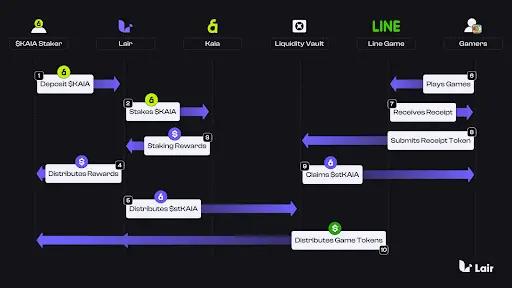
Support $KAIA token holders to stake their tokens in the pool to mint $stKAIA. Lair Finance will work with GCs with the best APR to stake these users' staked $KAIA tokens on the Kaia chain to obtain chain-native income rewards, and distribute part of them to $KAIA token stakers and the other part to Liquidity Vault.
The income from the staking pool will be automatically accumulated without the need for users to manually claim it. After users stake $KAIA, they will receive the income token stKAIA, the value of which will increase as the staking rewards increase. For example, if a user stakes 1 $KAIA at an annual interest rate of 10%, after one year, the value of the stKAIA they hold will increase to 1.1 $KAIA.
- Re-staking Pool
Users who hold $stKAIA (or other LST tokens on Kaia such as $sKLAY, $gcKLAY or $stKLAY, etc.) can stake these LST assets together with the equivalent $LAIR tokens (Lair Finance protocol tokens) in the Lair Finance re-staking pool to generate $rstKAIA tokens. The token holders will further enjoy the annualized return of $LAIR tokens. In turn, this also indirectly enhances the rigid demand and practicality of $LAIR tokens.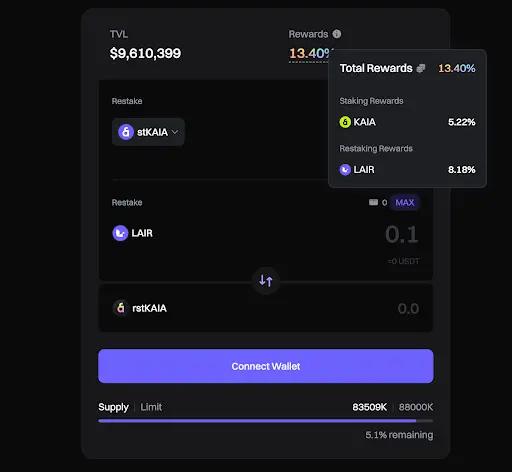
- Liquidity Vaults
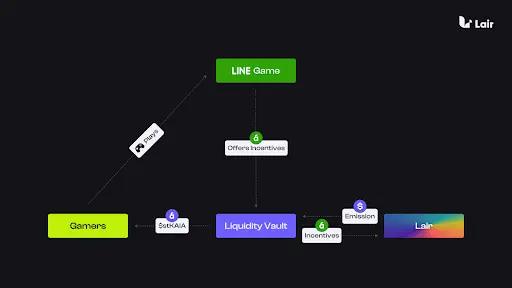
The incentive pool is aimed at two types of user groups: Web3 stakers and Web2 LINE users. Its structure includes a game reward pool and multiple active verification staking vaults (Active Vault Services, AVS Vaults for short).
AVS is an original mechanism of Lair Finance, which allows users to deposit re-pledged assets (such as $rstKAIA) into a specific Vault. Users can earn points and rewards by completing on-chain behaviors (such as participating in designated GameFi games, holding specific NFTs, or completing interactive tasks). These Vaults are usually initiated by Kaia ecosystem projects (the first phase is mainly game developers on LINE) and are launched after being reviewed by Lair DAO.
As mentioned earlier, Lair's LSD pool will inject part of the staking rewards into the game reward pool under Liquidity Vaults. When LINE game users participate in the game, they will receive a receipt token, which can be used to redeem $stKAIA rewards in the Vault.
In fact, the AVS mechanism is integrating “staking” and “interaction” and leveraging a new logic of value capture for on-chain behaviors. Driven by this mechanism, the early explosion of GameFi may be repeated in Lair’s AVS model.
At the same time, users holding $rstKAIA can further stake it in AVS Vaults, which contain tokens from LINE games (such as Game Tokens, points, etc.) to incentivize staking users.
It is worth mentioning that Lair Finance has recently successfully completed the first round of AVS activities. The first round of AVS cooperation projects include:
- Elderglade (Binance IDO, Bybit Megadrop, already live)
- Bombie (linked with Cattea, TGE is approaching)
- Frog Defense (Launch on BingX)
- As well as Slime Miner, Captain Tsubasa -RIVALS, Heroic Arena, etc.
The first round of AVS cooperation project TGE had a high starting point and high community attention, which set off expectations for the upcoming second round and once again verified the strong potential and project screening capabilities of Kaia Ecosystem and Lair Cooperation Matrix .

In fact, the re-staking system is gradually promoting a positive value cycle among coin holders, game players, and game developers/project parties, jointly promoting the growth and endogenous drive of the Kaia ecosystem.
For $KAIA coin holders, this staking system provides a clear and measurable triple income path:
- Stake $KAIA to Lair to obtain $stKAIA and enjoy the native staking income from the Kaia PoS (Proof of Stake) consensus mechanism.
- Users can re-stake $stKAIA and $LAIR together to mint $rstKAIA, thereby further obtaining Lair platform token incentives
- $rstKAIA can be further pledged to AVS Vault to obtain tokens, points and airdrops from cooperating game projects.
Under this series of incentive mechanisms, $KAIA holders not only become long-term participants and loyal users of LST, but are also essentially transformed into co-builders and beneficiaries of Kaia’s gaming economic growth.
For gamers, the incentive mechanism drives them to maintain high frequency and activity in LINE mini dApp games. By completing game tasks to obtain Receipt Tokens, players can redeem $stKAIA in Lair's liquidity vault, further participate in on-chain staking or asset utilization of ecological DApps, realize the natural transition and deep integration from Web2 to Web3, and gradually settle as on-chain users.
For game developers/project parties, after obtaining Lair DAO review and successfully establishing AVS Vault, project tokens can be distributed to $rstKAIA users to complete early user guidance and cold start. At the same time, players enter the on-chain ecosystem after obtaining $stKAIA in the game, which not only enhances user stickiness, but also helps the game obtain real on-chain behavior data and potential governance participants, thereby building a sustainable community foundation.
As this value system continues to operate, Lair is using the "re-staking + incentive coordination layer" model to create an ecological flywheel for Kaia that is driven by the resonance of stakers, players and developers, becoming the core engine for on-chain application growth and capital circulation.
From PoL to LrBGT, unleashing the real power of Berachain
Following Kaia, Berachain becomes the second Layer1 network deployed by Lair Finance.
Compared with other chains, the biggest feature of Berachain lies in its consensus mechanism centered on liquidity - PoL (Proof of Liquidity). This mechanism essentially transforms "liquidity providers" into block producers, building an incentive model that deeply binds network security and ecological activity.
In the PoL framework, the role of ordinary coin holders has also been redefined. Unlike the traditional PoS model where tokens are staked to verification nodes, users on Berachain will entrust $BERA to PoL pools they trust. These pools are operated by ecological project parties and must be approved by the Berachain governance mechanism before they can join the incentive system.
This means that coin holders are actually supporting a specific "liquidity strategy" rather than simply participating in network consensus security.
These PoL pools usually use the received assets to build liquidity for key trading pairs in DEX, thereby enhancing the trading depth and market efficiency of on-chain assets. In return, the pool operator will receive the ecological token $BGT issued by Berachain based on the scale and activity of its liquidity contribution, and can distribute part of the income to liquidity participants through the incentive mechanism set by the protocol. To some extent, PoL transforms "security mining" into "ecological construction mining", forming a positive growth closed loop with incentive alignment as the core, which promotes the active development of Berachain's application layer.
At present, the PoL Vault LAIR/BERA mining pool deployed by Lair Finance on Berachain has been approved for launch on Kodiak. Currently, users who provide liquidity to the pool can obtain native LP income and LAIR token income while also being able to further obtain $BGT token income.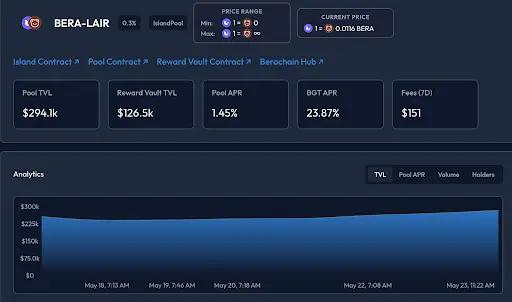
At the same time, the WBERA/LAIR pool deployed by Lair Finance on Infrared Finance is also newly launched. While users participate in LP to obtain basic income, they will also receive iBGT (BGT LST token on Infrared Finance) rewards.
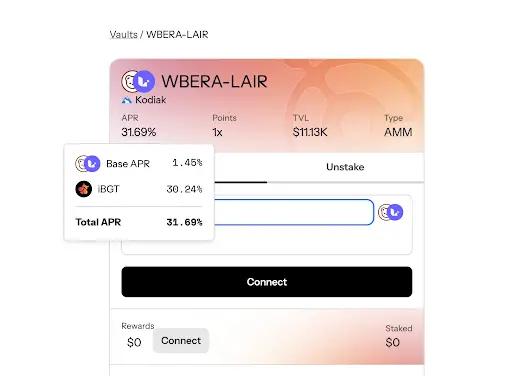
Of course, in addition to deploying the PoL Vault, Lair Finance has further brought a new LRT system to Berachain, bringing multiple benefit effects to BGT token holders and continuing the continuity of the POL mechanism benefits.
Currently, Lair Finance has introduced its liquidity re-pledge token LrBGT on Berachain. This asset is a Liquid Restaking Token (LRT) built on Berachain's native asset $BGT. This mechanism integrates the liquidity pledge token iBGT issued by Infrared Finance, and builds a financial derivative asset with automatic compounding and composability on its basis. Users only need to deposit their iBGT into Lair's re-pledge contract to mint LrBGT tokens. The entire process does not require additional pledge $LAIR or other assets.
The core advantage of LrBGT lies in its compound income structure and asset liquidity compatibility. When users hold LrBGT, they will automatically receive the following two types of income:
- Basic staking rewards: from the validator node block rewards generated by staking behind iBGT$BGT. This part of the income is provided by Infrared and automatically compounded through the Lair mechanism without the need to actively claim it.
- PoL Ecosystem Incentives: Since LrBGT is part of the contribution assets in the PoL model, users can also receive $BGT incentives from the Berachain network, and in the future may also include additional incentives provided by Lair or other cooperative protocols (such as $LAIR).
At present, although LrBGT does not support re-staking, we have seen that Lair Finance shows that LrBGT's secondary staking will be launched soon. Considering the way of obtaining game token incentives through secondary staking on Kaia, perhaps after users perform secondary staking of LrBGT, they may be able to further obtain token airdrop rewards from other projects on Berachain, etc.
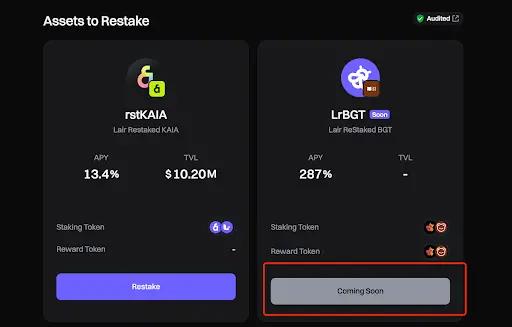
In fact, the significance of Lair building LRT for $BGT is not only to improve the profit efficiency of holders, but also to release the capital potential of the PoL mechanism and the Berachain ecosystem.
As the governance and incentive core of the network, $BGT has long been facing a short-term behavior pattern of "mining-extraction-selling". Users lack coin loyalty and willingness to participate in governance, resulting in a decrease in the effectiveness of token incentives and insufficient community stickiness.
At the same time, the current Berachain DeFi system has limited support for the capital efficiency of $BGT. Most of the pledged assets are in a closed state, making it difficult to participate in lending, trading, combined income and other scenarios, which inhibits its DeFi activity and system composability, and also weakens the actual incentive effect of $BGT under the PoL model.
The introduction of LRT is a structural response to the above dilemma.
By "liquidating" the pledged assets in the form of LrBGT, $BGT is re-empowered to participate in the ecosystem. While users continue to receive basic pledge income, they can also hold LrBGT to enter various DeFi paths such as liquidity mining, lending, and re-pledge, significantly improving capital utilization efficiency and income combination space.
At the network level, LRT lowers the staking threshold for users, allowing more BGT holders to shift from "wait-and-see" to "participation", which not only helps to improve staking coverage and network security, but also further promotes a virtuous cycle of on-chain governance and incentive structure.
Furthermore, as a structural derivative asset, LrBGT has the ability to participate in more protocol components as a "second-order asset" in the PoL model, becoming a composable capital unit in the Berachain DeFi system. This not only provides new financial building blocks for protocol developers, but also brings users a more flexible compound income strategy, further expanding the application radius and value anchoring ability of $BGT.
From a more macro ecological perspective, the promotion of LRT has gradually formed a growth flywheel around $BGT.
Although the structure adopted by Lair on Berachain is slightly different from that on Kaia, as the platform TVL continues to expand, LrBGT and iBGT provided by Infrared have established a stable connection, which jointly amplifies the liquidity influence of core staked assets. As the re-staking mechanism continues to gain user recognition within the PoL framework, BGT's staking participation and ecological stickiness are simultaneously enhanced, and more capital is flowing into the incentive structure built by Lair.
At the same time, the penetration of LrBGT in various application scenarios of Berachain has also accelerated the market's recognition of the functions and value of $LAIR, gradually solidifying its role as an incentive center.
In the positive closed loop of "staking assets → LRT derivatives → protocol participation → incentive distribution → token value growth", the DeFi activity of $BGT has been re-stimulated, and $LAIR has achieved cross-system value synergy in the multi-chain ecosystem, consolidating its core positioning as a connected protocol asset.
It is worth mentioning that through deep binding with Infrared, Lair Finance currently occupies 95% of Berachain's LST market and is realizing a new liquidity sharing.
Conclusion
Through the three-layer path of "PoS native staking to LRT derivative assets, and then to DeFi/GameFi incentives", the Lair Finance protocol is transforming the staking behavior from a closed one to a composable and sustainable compound income system, forming a structured positive cycle.
In the Kaia ecosystem , Lair connects the incentive mechanism between stakers, players and developers, and binds LINE player behavior with re-staking income through the AVS points model, truly realizing the connection between Web2 users and the LRT model for the first time. In the first round of AVS activities, the total staked scale of rstKAIA reached 74 million, and TVL accounted for 70% of the entire network, which shows the ecological penetration.
In the Berachain ecosystem , Lair has built a dual-income path based on the PoL mechanism. Users can obtain double benefits of node rewards and PoL incentives through the iBGT → LrBGT structure, and participate in mining pools such as LAIR/BERA and WBERA/LAIR. It currently occupies about 95% of the LST market share on Berachain.
As the closed loop of "staking → derivative assets → multi-scenario participation → value return" gradually matures, Lair Finance is injecting truly verifiable native earnings capabilities into the LRT architecture.
Lair Finance is building a new path: it has both Lido-style liquidity entry capabilities and integrates EigenLayer's security consensus mechanism and LayerZero's cross-chain scheduling capabilities. Its goal is to become a true "multi-chain unified incentive layer". It not only covers real user behavior, but also has cross-ecological incentive scheduling and asset distribution capabilities, and has all the characteristics of becoming the "next generation cross-chain Restaking hub".
Current mainstream LRT projects such as ether.fi ($ETHFI) and Renzo ($REZ) have reached FDVs of more than $2.5 billion and $1 billion respectively, even though they have not yet completed commercial closed loops. In contrast, Lair has actually implemented a multi-layered revenue structure on Kaia and Berachain, and combined with diversified application scenarios such as GameFi and DeFi to build a traceable real incentive path. The overall valuation is still in the early stage and has great potential.
The current Lair is more like the prototype of "infrastructure-level LRT": through on-chain behavior drive, cross-chain revenue synergy and multilateral ecological linkage, a systematic closed loop is constructed. For the market that is looking for the "second spring of LRT", Lair may not only be an undervalued project, but also an undervalued paradigm.
The next round of incentive distribution is on the way, and the real story of re-staking infrastructure has just begun.