The increasing trend of public crypto treasuries has created a race among altcoins. Each altcoin is trying to become the top choice for companies and organizations wanting to establish strategic reserves.
In this race, the XRP community provides many reasons to prove XRP's superiority. What are those reasons? This article will delve into and explain.
Many Companies Are Listing XRP as a Treasury Asset
Recently, Webus International, a China-based company, filed Form 6-K with the US Securities and Exchange Commission (SEC). This filing confirms plans to build a strategic reserve fund worth $300 million focused on XRP.
Webus is not alone. VivoPower International also announced plans to reserve $121 million in XRP. Meanwhile, Wellgistics has invested $50 million in XRP.
According to a recent report from BeInCrypto, VivoPower also plans to purchase $100 million of XRP through BitGo's over-the-counter (OTC) desk.
The list continues to expand. Other companies like Ault Capital Group (ACG), BC Bud Corporation (BCBC), Worksport (WKSP), and Remixpoint have all made similar moves.
These actions show that large companies worldwide are increasingly viewing XRP as a strategic financial reserve asset.
What Drives Businesses to Choose XRP for Strategic Reserves?
Companies choose Bitcoin for strategic reserves because they believe in its value storage during inflation. But what drives them to choose alternative altcoins?
Altcoins are more volatile and often heavily dependent on the transparency and actions of their development teams.
Each altcoin has its unique value. XRP supporters believe they have solid reasons to trust it.
Austin King, co-founder of OmniFDN, suggests that companies may want to integrate XRP into their international payment systems.
They believe XRP's fast transaction speed and low costs make it ideal for cross-border payments. This could help businesses improve financial efficiency and enhance transparency in global services, like Webus's ride-sharing platform.
"Most people will look at this and think it's primarily about price speculation, but that's not really what's happening here — the real strategy is to tap into these rapidly developing crypto networks to share their growth," Austin King said.
Analyst Pumpius offers a different perspective. He believes this is not just speculation but a strategy to leverage the XRP ecosystem's reality. A significant development is the integration of RLUSD—Ripple's stablecoin—into Ripple's payment solutions.
"XRP is not seen as a cryptocurrency — but an asset for payment architecture. Webus is not betting on price. They are betting on utility," Pumpius said.
These arguments are attracting attention, especially as experts predict that the GENIUS Act is likely to be passed. If approved, it could pave the way for RLUSD's development.
As of June 2025, RLUSD has a market capitalization of $369 million. It is designed to support fast, low-cost cross-border transactions, complementing XRP and helping build a more robust financial ecosystem.
Each transaction using RLUSD on the XRP Ledger (XRPL) requires XRP as a transaction fee. This gradually reduces the XRP supply, potentially driving its long-term value.
What Are the Risks of Holding XRP as a Strategic Reserve?
However, XRP remains a highly volatile digital asset. Its price history shows it has dropped over 80% in two major downturns: 2018 and 2021. This raises serious concerns for companies using XRP as part of their strategic reserve.
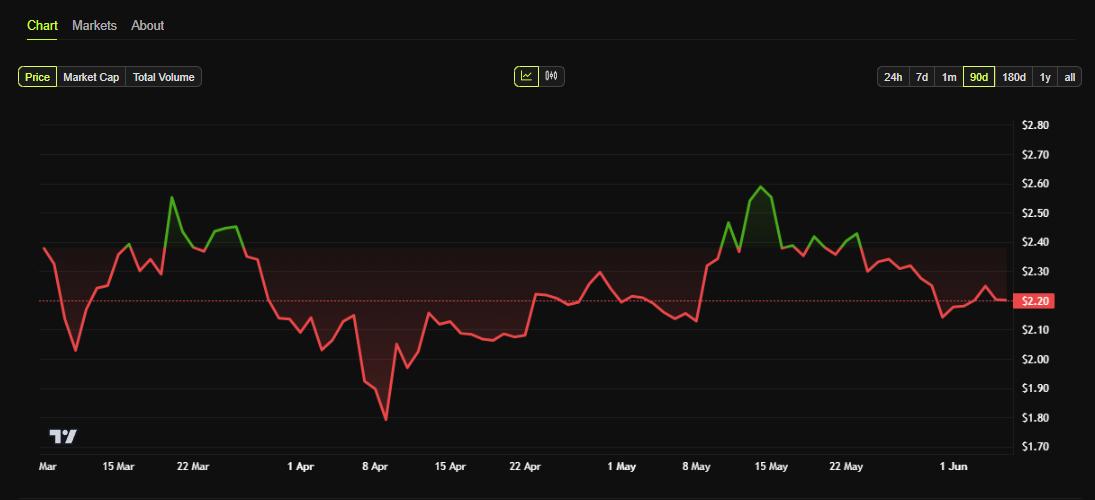 XRP price volatility in the past three months. Source: BeInCrypto
Investor expectations may be far beyond actual data. For example, the total value locked on XRPL is under $60 million. On-chain activity has significantly decreased, and the number of validator nodes remains low.
This suggests the network may not be ready for global adoption.
Additionally, experts are warning about the risks of the Public Crypto Vehicles trend. Many companies are using crypto accumulation to boost their stock prices.
However, they may be overlooking long-term consequences if the value of the altcoins they hold significantly decreases.