1. Introduction
On June 30, 2025, the Monetary Authority of Singapore (MAS) officially implemented the new rules for digital token service providers (DTSP), marking the official implementation of the crypto asset regulatory system that was proposed in 2022 and has been brewing for three years. The implementation of the new rules has caused some panic among community practitioners. This move not only affects Web3 projects operating locally in Singapore, but is also seen as a key event that may reshape the entire Asian crypto industry landscape. A large number of unlicensed institutions may be driven out of Singapore, and a small number of licensed institutions such as Coinbase OKX HashKey will receive more dividends. Hong Kong, Dubai, Tokyo, Kuala Lumpur, Bangkok, etc. will take over these retreating people.
2. Policy Background: The “Three-Year Preparation Period” Did Not Receive Enough Attention
Singapore's regulatory changes to the crypto industry did not happen overnight, but were planned for several years. Although the new regulations are generally regarded as "cliff-like regulation" by the outside world, in fact, MAS has passed the Payment Services Act since 2020 to include digital payment tokens (DPT, i.e. cryptocurrencies) in regulation, requiring local companies that provide services such as crypto exchange to apply for licenses. Since then, the Monetary Authority of Singapore (MAS) has realized that there is still room for regulatory arbitrage: some crypto companies set up bases in Singapore but only serve overseas customers to evade local licensing requirements. In order to plug this loophole and meet the standards of the Financial Action Task Force (FATF), Singapore passed the Financial Services and Markets Act (FSMA) in April 2022, Part 9 of which specifically introduced a licensing system for digital token service providers (DTSP). After the law was passed, MAS did not strictly enforce it immediately, but reserved sufficient buffer time and planned to officially implement the new regulations in 2025. MAS clearly stated in its guidelines that there would be no transition period.
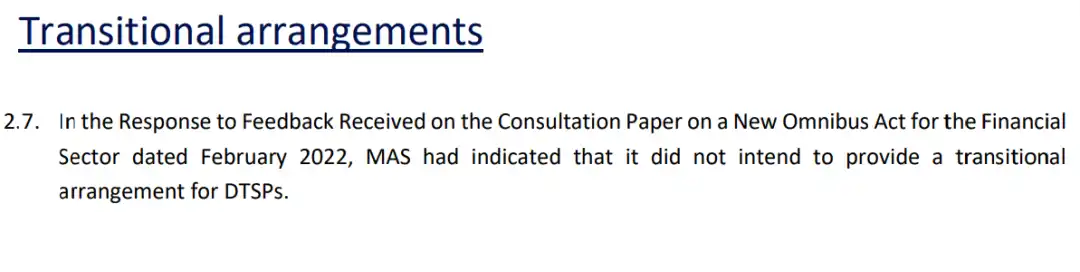
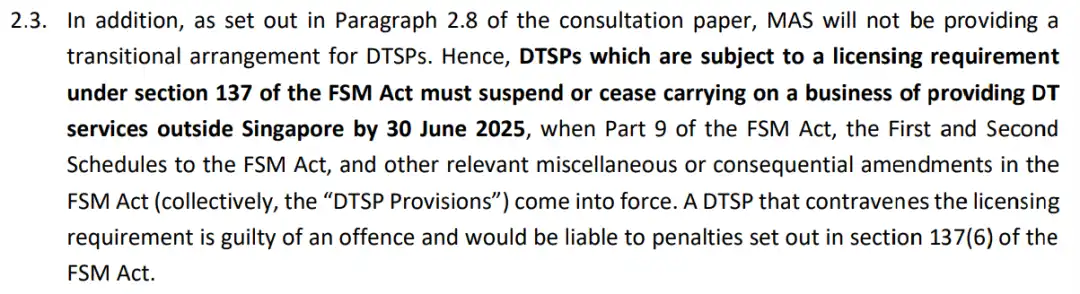
In other words, from the formulation of the law to its implementation, Singapore gave the industry nearly three years of adjustment period. Therefore, the new regulations recently announced by MAS are not a "cliff-like" sudden attack, but a regulatory path set many years ago. However, the Asian crypto community was shocked when MAS reiterated the hard deadline of June 30 and no buffer period when it released the final regulatory response document on May 30, 2025. Some practitioners had previously hoped that the regulator would give them a break, but it turned out that MAS's execution attitude was very firm, and it only regarded the past few years as a window period for the industry to adjust themselves. In general, Singapore's DTSP licensing system has been implemented after long-term preparation and public consultation (such as the consultation report in late 2024), and it is not a sudden "one-size-fits-all" turn. The formal bill will be issued in 2022, and after multiple rounds of solicitation of opinions, it will be officially implemented in 2025.
However, due to the Chinese community's lack of attention to policy dynamics, most practitioners did not feel the regulatory pressure until the eve of implementation, resulting in panic interpretations and "Web3 retreat" public opinion.
III. Interpretation of Core Terms
1. DTSP Definition
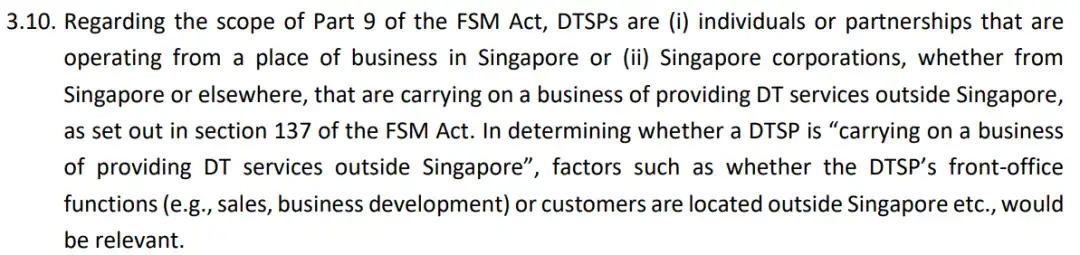
DTSP stands for Digital Token Service Provider. According to the definition in Section 137 of the FSM Act and the content of Document 3.10, DTSP includes two types of entities:
1) Individuals or companies that have a “place of business” in Singapore to conduct business;
2) Regardless of whether the actual place of operation is in Singapore or overseas, as long as it is a Singapore-registered company that provides digital token services to customers outside Singapore.
2. Applicable scope "In or From Singapore"
According to the above definition, whether it is an individual or a company, as long as an individual engages in digital token-related business in Singapore, or a company is registered in Singapore but provides encryption services overseas, it falls within the scope of DTSP supervision. It is worth noting that the source of customers here is no longer important: regardless of whether the service targets are locals or overseas customers, as long as the operating entity is related to Singapore, it must be licensed, otherwise it is illegal operation. For example:
· The core development/operations team is located in Singapore;
The server or hosting system is located in Singapore;
· The marketing campaign is clearly targeted at Singaporean customers;
· receiving funds or capital from users in Singapore;
That is, as long as you provide DTSP services in Singapore or to Singapore users, you need to apply for a license.
3. Broad definition of “place of business”
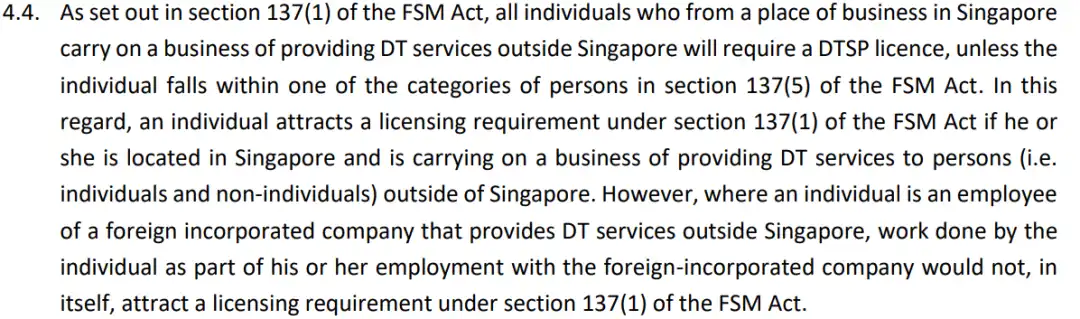
MAS's definition of "place of business" is very loose, almost equivalent to any place where business is conducted. Officials have clearly stated that "place of business" can be any place used to conduct business, even temporary or mobile places such as roadside stalls. As long as you are in Singapore, whether in a company office, a shared workstation, or on your own sofa at home, as long as you are engaged in digital token-related business (and without a license), you are considered to have a place of business in Singapore and operate illegally. This explanation dispels the fluke mentality of some people - in the past, many practitioners believed that working remotely at home for overseas projects did not count as a "place of business", but MAS obviously does not recognize this way of evasion.
However, MAS also provides a little flexibility: if the person is a formal employee of an overseas company and works remotely for the company from home, then the responsibility mainly belongs to the employer, the company needs to be licensed, and the individual does not need to apply separately. The key to this regulation lies in how to define the identity of "employee": Is the founder of the entrepreneurial team considered an employee? What about the consultant who holds shares? These gray areas are not clear at present, and MAS may need to further explain them through FAQs in the future. In any case, the regulatory intention is very clear - to put an end to the wandering behavior under the banner of "being in Singapore and serving overseas", even if it is working from home, it cannot be an excuse to evade supervision.
4. Covered Digital Token Services
Simply put, anything related to "transactions" is not allowed. Under the supervision of the DTSP license, the scope of "digital token services" is extremely broad, covering almost every aspect of the crypto business. According to the FSMA schedule, there are as many as ten categories of related activities, mainly including:
1) Issuance or Arranging Issuance of Digital Tokens
Anything that involves creating or issuing digital tokens for others, including IDO, Launchpad, Token Generation Event (TGE), etc. Any service that involves providing or selling digital tokens is regulated. This not only refers to the project party issuing tokens directly to the public (similar to ICO), but also includes the act of inducing or prompting others to buy/sell tokens. In short, whether it is an issuer or an intermediary, as long as they promote tokens and raise funds, they need a license.
2) Digital Token Custody Services
Holding or controlling a client’s digital tokens, including cold and hot wallet services. Whether providing a custodial vault, custodial wallet, or executing token-related instructions on behalf of a client (e.g., helping a client operate their token account, executing a transaction), as long as the service provider has control over the token or its control tools, it is a regulated activity. This means that providing clients with an interface or system to securely access their assets is also regulated.
3) Brokerage, Matching and Exchange Services
4) Operate centralized or decentralized order books and transaction matching services (including OTC, DEX Aggregator).
This covers platforms for buying, selling and exchanging digital tokens, as well as brokerage services that facilitate token transactions for others, such as providing a trading platform interface (UI/UX) to assist buyers and sellers in reaching a transaction.
4) Transfer or payment services
Any service that assists customers in transferring tokens from one wallet or account to another (i.e. acting as an intermediary in transactions or cross-chain bridge transfers also requires taking photos). This includes payment gateways, bridge protocols, and the "transfer on behalf of customers" function provided by wallets.
5) Validation / Governance Participation
Participating in node verification on behalf of clients (e.g. staking on behalf of clients), running validator nodes, or participating in on-chain governance voting. Or behaviors involving collecting income or rewards from staking or governance.
6) Technology Enabling Custody
Providing the infrastructure or technical support required for custody services (such as MPC wallet service providers, key custodians, and custody API developers). Although not directly controlling assets, technology plays a key role in the asset control process.
The above scope shows that the DTSP license covers almost all services in the life cycle of digital tokens, from issuance, trading, transfer, to custody and operation, all of which cannot escape supervision.
4. What businesses do not require a license?
1. Pure Advisory / Consultancy
For example: project design, token economic model consulting, legal structure advice, product design guidance, etc. As long as you do not participate in the actual custody of assets, issuance on behalf of others, or execution of transactions, you will not be considered a DTSP.
2. Marketing / Publicity Services
Including community management, advertising, brand design, etc., even if you help a Web3 project with marketing in Singapore, as long as you are not involved in asset circulation, transaction matching or token management, it is generally not subject to supervision; but if you directly arrange token sales/distribution or transfer on behalf of your clients, it may trigger regulatory obligations.
5. Severity Analysis: Why MAS changed from lenient to strict
Web3 is not a lawless place. Transactions and fund transfers are regulated everywhere. The only difference is that Singapore's policies are more "forward-looking". The new rules are strict in their uncompromising execution and strict entry standards. This is stimulated by external events and reflects the consistent regulatory philosophy of MAS:
1. Singapore’s “everything requires a license” rule of law culture
Singapore implements detailed licensing management for any business activities: mobile vendors must complete regular training and obtain vendor licenses; even coffee shops need to apply for public broadcasting licenses if they want to play background music; if you want to operate a swimming pool after opening a hotel, you must also obtain additional licenses. Singapore's "crypto-friendly" does not mean that there is no supervision of the industry. Therefore, the same applies to the crypto industry - it also requires "first certification, then employment, and regular review". The essence is "registration system" rather than "laissez-faire" friendly. No matter what you do in Singapore, you need to be regulated.
2. Investor and fund security is a national policy
The Singapore government is a patriarchal government that is very particular about the welfare of its citizens, especially fund management. For example, in order to prevent retirees from having no money for retirement in their later years, the Singapore government even restricts retirees from gradually withdrawing their CPF deposits until they are 55 years old. At the same time, MAS places great emphasis on the protection of investors' rights and interests. That is, MAS emphasizes AML/KYC, capital and insurance requirements in crypto licenses to ensure that if something goes wrong, there will be accountability and compensation. The person responsible can be found in a timely manner, and there are corresponding collateral and insurance.
3. (Fujianese organized crime) The 3 billion Singapore dollar money laundering case of the "Fujian Gang" triggered the regulatory red line
The primary reason for MAS's tightening this time is to prevent cross-border financial crimes and money laundering. Digital token services are often carried out across borders through the Internet. They are characterized by strong anonymity and fast capital flow, making them more likely to be used by criminals to launder money or finance terrorist activities. Singapore has personally experienced some lessons in recent years, and the most influential of them is the "Fujian Gang" cross-border money laundering case exposed in 2023. The case involves 10 foreigners from Fujian, China and other places. They laundered money by opening companies and bank accounts in Singapore. The amount involved was as high as 3 billion Singapore dollars. It is the largest money laundering case in Singapore's history. The bad nature of the incident even had some public opinion impact on this Singapore election.
MAS is not afraid of fraudulent platforms damaging Singapore's reputation. The Singapore government has extensive experience and means to deal with such incidents. Through Singapore's IAL list (https://mas.gov.sg/investor-alert-list), it can be seen that what the Singapore government is really afraid of is the diplomatic crisis caused by the inflow or outflow of illegal funds and its position as a capital reservoir in Asia.
4. The “strict entry and strict management” of licenses stems from the “demystification” of audit practices
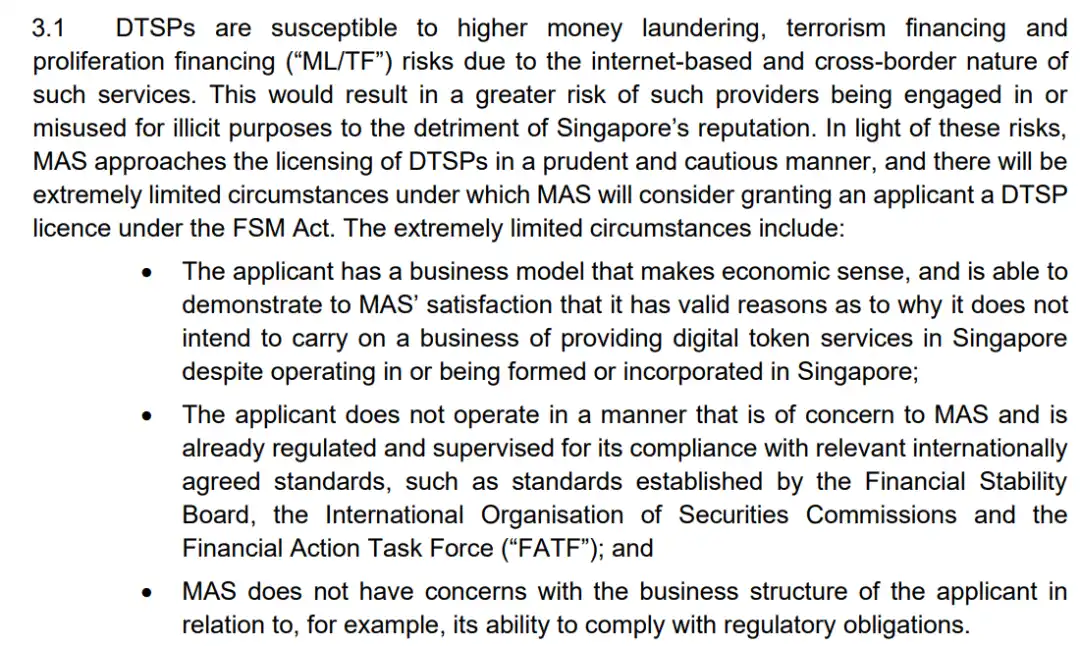
MAS's toughness is also reflected in its strict entry standards. According to the guidelines, MAS stated that it would consider issuing DTSP licenses "only in very rare cases" and gave almost harsh approval conditions:
1) The applicant must demonstrate that its business model is economically justifiable and that there are sufficient reasons to operate in Singapore but not serve the local market (in other words, it must convince MAS why it only does business overseas).
2) The applicant needs to assure MAS that its operations will not cause regulatory concerns, and that it has obtained regulatory approval or is regulated in all foreign jurisdictions where it provides services, and complies with international regulatory standards (such as those of the Financial Stability Board, IOSCO and FATF). In other words, the company must comply with laws and regulations in every country where its customers are located, which is almost an impossible task for many new startups.
3) MAS also emphasizes that the applicant’s organizational structure and compliance capabilities should not cause concern to regulators, such as the company having sound corporate governance, sufficient manpower and financial resources to fulfill its regulatory obligations.
Therefore, after the application was opened in 2021, more than 500 institutions rushed for licenses at the peak, but most of them had mediocre qualifications and the application approval rate was less than 10%; as of the end of 2024, only 13 companies obtained the DPT main license, and the total number of license holders increased from 16 to 29. In addition, the MAS regulatory staff is tight and the approval process has been tightened.
5. Web3 has not brought "precipitation" economic benefits to Singapore
The crypto industry is pouring into Singapore, but many projects have low registered capital, rent luxurious offices but do not pay taxes locally; the funds do not stay in local banks but continue to be spent, pushing up housing prices, wages and car ownership costs, leading to a deterioration in social evaluation. Local voters do not buy it, so the government naturally has no intention of "doing a thankless job".
6. Industry impact assessment: Who will be impacted? Will Web3 experience a “massive retreat”?
1. Affected groups:
Individual practitioners: such as independent developers, crypto project consultants, market makers, miners, KOLs (self-media people), community operators, project founders, business development, etc. In the past, these individuals did not need a license to work in Web3 in Singapore, but under the new regulations, a sword may be hanging over everyone's head. For example, independent developers write smart contracts for overseas blockchain projects, consultants provide solutions for token issuance, and KOLs write token analysis. In theory, these activities are all "providing digital token services."
Unlicensed institutions: such as crypto trading platforms (whether centralized CEX or decentralized DEX) that have not yet obtained a PSA license, DeFi project teams, NFT trading platforms, crypto wallet providers, cross-border payment networks, and various blockchain startups. If these institutions have staff or company registrations in Singapore but do not have any licenses, they will be the first to face the risk of business interruption. In particular, some entrepreneurial projects that have been rooted in Singapore and focused on overseas markets in the past, if they do not meet the application conditions, are equivalent to being sentenced to "suspended death sentence" and will not be able to continue operating in Singapore. According to the new regulations, they must shut down the relevant business by June 30 at the latest, otherwise it will be illegal operation.
2. Exempt groups:
Institutions that are already licensed or exempted under PSA/SFA/FAA do not need to apply for a DTSP license under FSMA, but they need to implement the additional obligations of FSMA.
Typical example: Custodian: If it is already licensed/exempted under PSA, it is exempted from obtaining a DTSP license even when facing overseas customers. However, it is required to fulfill the additional regulatory obligations of FSMA on technology, auditing, and AML/CFT.
FSMA Additional Compliance Checklist:
1) Technology Risk Management (TRM): Architecture, backup, penetration testing, and third-party services must all comply with industry best practices.
2) Annual independent audit report: must cover the two dimensions of finance and system control and be submitted within the specified time limit.
3) Higher AML/CFT requirements: stricter requirements for KYC, transaction monitoring and suspicious reporting obligations.
4) Major security incidents must be reported within 1 hour: data leakage, loss of control of private keys, continuous downtime, etc. must be reported to MAS immediately.
5) Prohibition of high-value cash transactions: Single cash payments ≥ S$20,000 are completely prohibited.
Singapore's official implementation of the DTSP licensing system marks the end of the era of regulatory arbitrage and the beginning of a new stage. Under the general trend of stricter global regulation, major jurisdictions are gradually filling the regulatory gaps for crypto activities, and Singapore is just one of the more radical examples. The model of "establishing in Singapore and providing services overseas", which was often used in the past, is now included in the regulation across the board, which undoubtedly sends a clear signal to the industry: the future development of Web3 must be based on legality and compliance, and attempts to integrate the regulatory powers scattered under PSA/SFA/FAA, eliminate the "grey runway", and shift the focus of supervision from "whether it is licensed" to "whether it is compliant". The supervision of stablecoins is also being upgraded simultaneously.
1) Single Currency Stablecoin (SCS): implemented under an independent framework.
2) Other stablecoins: continue to be regarded as DPT and still belong to PSA; if they serve as the underlying assets of derivatives, they may fall under SFA supervision.
There will be fewer and fewer gray areas outside of regulation. Compliance operations will become the mainstream, and the era of "taking advantage of loopholes" by taking advantage of differences in different jurisdictions is coming to an end. If Asian crypto entrepreneurs were still keen on finding regulatory lows in 2018-2021, then after 2025, most of the companies that can gain a foothold are those that are willing to embrace regulation and have compliance capabilities. Major financial centers in the region are also competing to introduce clear regulatory frameworks. Rather than saying that companies are "escaping" from a certain place, it is better to say that they are looking for a regulatory environment that best suits their own business.
7. Two self-examination questions for operators
1. Am I licensed or exempted under the PSA/SFA system?
2. Do I provide any DT services to overseas clients?
If the answer to question 1 is “yes”, no new license is required, but compliance upgrades will be initiated immediately.
If you answered "no" to question 1, you must obtain a license or close by June 30.
MAS's regulatory bolts will only get tighter - don't wait until the last day to act. Licensed institutions should regard "compliance upgrades" as a regular project; teams that have not yet obtained a license should decide whether to apply, merge, or withdraw as soon as possible if they do not have a full set of compliance chips. The tough measures of not setting a transition period and requiring violators to immediately stop their business are also sending a signal to the market: Singapore will not be a safe haven for uncontrolled crypto businesses. Even though it has been regarded as a "crypto-friendly" place in the past few years, loopholes are not allowed now. MAS's move shows that Singapore's crypto regulatory environment has been tightened significantly, and many local companies either have to pay a high cost to obtain licenses or restructure their businesses and exit overseas markets. It would rather bear the cost of some corporate losses in the short term than let Singapore's international reputation and financial security be eroded.
8. Indirect Benefits to Surrounding Areas
Singapore's move may indirectly benefit other regions, prompting a new division of labor and migration in the Asian crypto landscape. As another crypto center in Asia, Hong Kong has vigorously promoted the legalization of virtual assets and the construction of a regulatory framework in recent years. Coinciding with Singapore's tightening, Hong Kong is actively taking over the squeezed out crypto business. Wu Jiezhuang, a member of the Legislative Council of Hong Kong and a member of the National Committee of the Chinese People's Political Consultative Conference, tweeted that Singapore had earlier issued the "Guidelines on Licensing for Digital Token Service Providers", which has new policies for companies, institutions and personnel related to virtual assets. Hong Kong has welcomed the industry to develop in Hong Kong since it issued a virtual asset declaration in 2022. According to informal statistics, thousands of Web3 companies have landed in Hong Kong. Companies engaged in related industries in Singapore are welcome to relocate their headquarters and teams to Hong Kong, and are willing to provide policies and landing assistance. The intention is to build Hong Kong into Asia's leading crypto hub.
Click here to learn about BlockBeats' BlockBeats job openings
Welcome to join the BlockBeats official community:
Telegram subscription group: https://t.me/theblockbeats
Telegram group: https://t.me/BlockBeats_App
Official Twitter account: https://twitter.com/BlockBeatsAsia