Original Author: Jay Jo, Tiger Research
Translation: AididiaoJP, Foresight News
TL;DR
InfoFi is a structured attempt to quantify user attention and activity and link it to rewards.
InfoFi currently faces some structural issues, including content quality decline and reward centralization.
These are not limitations of the InfoFi model itself, but design problems with evaluation criteria and reward distribution that urgently need improvement.
The Era of Attention as Tokens
Attention has become one of the scarcest resources in modern industries. In the internet age, information is overflowing, while human capacity to process information is extremely limited. This scarcity has prompted fierce competition among enterprises, and the ability to capture user attention has become a core competitive advantage.
The crypto industry has demonstrated the intensity of attention competition in an even more extreme form. Attention share plays a crucial role in token pricing and liquidity formation, which has become a key factor determining project success. Even technologically leading projects are often eliminated by the market if they fail to attract market attention.
This phenomenon stems from the structural characteristics of the crypto market. Users are not just participants, but also investors, and their attention directly leads to actual token purchases, thereby creating greater demand and network effects. Where attention is concentrated, liquidity is created, and narratives develop on this liquidity basis. These established narratives subsequently attract new attention and form a virtuous cycle, driving market development.
InfoFi: A Systematic Attempt to Tokenize Attention
The market operates based on attention. This structure raises a key question: who can truly benefit from this attention? Users generate attention through community activities and content creation, but these behaviors are difficult to measure and lack a clear direct reward mechanism. So far, ordinary users can only obtain indirect benefits by buying and selling tokens. For those who truly create attention, there is currently no reward mechanism.
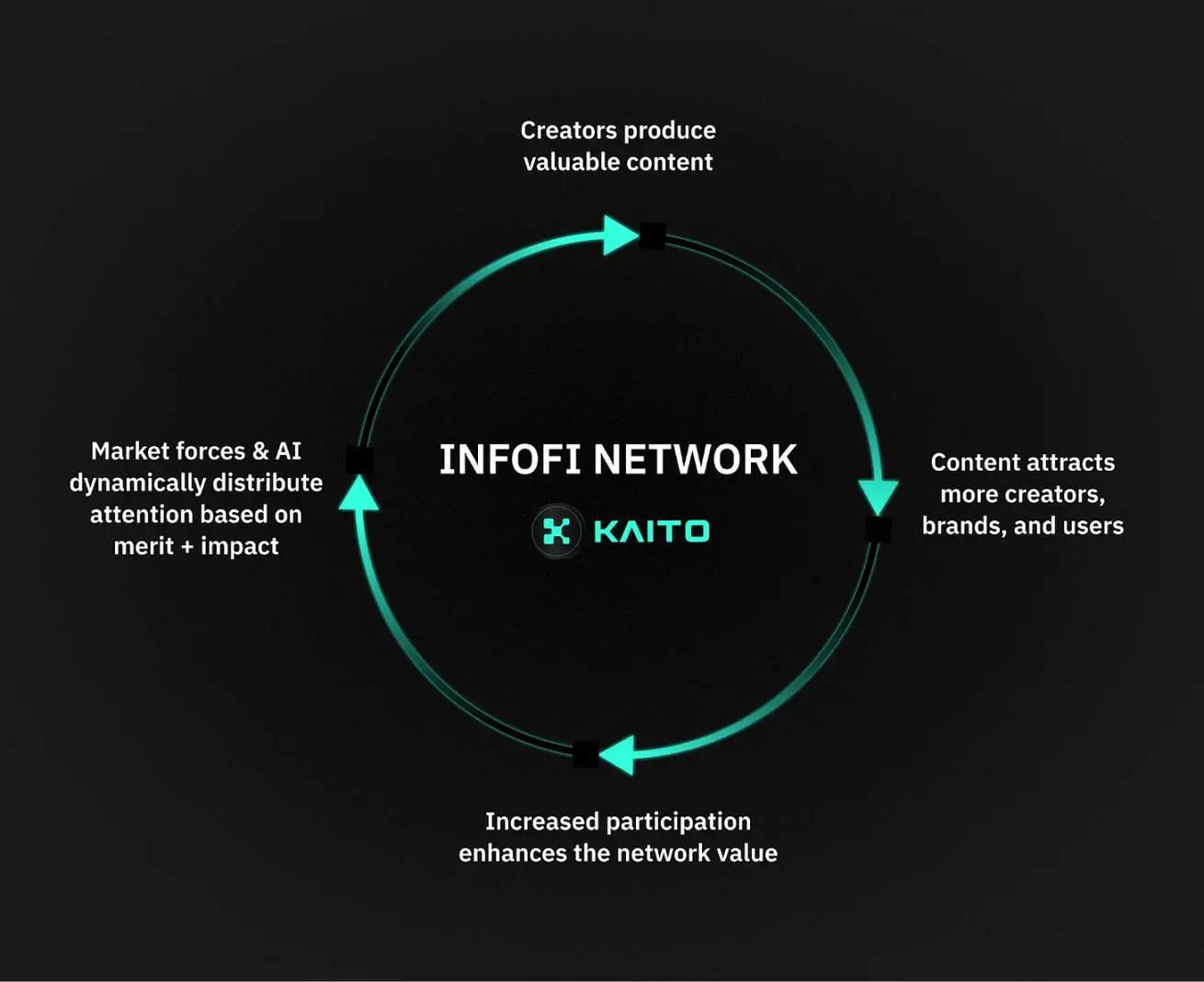
Kaito's InfoFi Network, Source: Kaito
InfoFi is an attempt to solve this problem. InfoFi combines information and finance, creating a mechanism that assesses user contributions based on content-generated attention (such as views, comments, and shares) and links it to token rewards. Kaito's success has widely spread this structure.
Kaito evaluates social media activities through AI algorithms, including posts and comments. The platform provides token rewards based on scores. The more attention the user-generated content attracts, the more exposure the project gains. Capital views this attention as a signal and makes investment decisions accordingly. As attention grows, more capital flows into the project, and participants' rewards increase. Participants, projects, and capital work collaboratively through attention data as a medium, forming a virtuous cycle.
The InfoFi model has made outstanding contributions in three key areas.
First, it quantifies user contribution activities with unclear evaluation standards. The point system allows people to structurally define contributions and helps users predict rewards for specific behaviors, thereby improving user participation sustainability and consistency.
Second, InfoFi transforms attention from an abstract concept into quantifiable and tradable data, shifting user participation from simple consumption to productive activity. Most existing online participation involves investment or content sharing, with platforms profiting from the attention generated by these activities. InfoFi quantifies users' market responses to this content and distributes rewards based on this data, rendering participants' behavior as productive work. This transformation gives users the role of network value creators, not just community members.
Third, InfoFi lowers the threshold for information production. Previously, Twitter influencers and institutional accounts dominated information distribution and captured most attention and rewards. Now, ordinary users can also receive tangible rewards after gaining a certain degree of market attention, creating more participation opportunities for users from different backgrounds.
Attention Economy Traps Triggered by InfoFi
The InfoFi model is a new reward design experiment in the crypto industry that quantifies user contributions and links them to rewards. However, attention has become an overly centralized value, and its side effects are gradually emerging.
The first problem is excessive attention competition and content quality decline. When attention becomes the reward standard, the purpose of creating content has shifted from providing information or encouraging meaningful participation to merely seeking rewards. With generative AI making content creation easier, batches of content lacking real information or insights are spreading rapidly. These so-called "AI Slop" contents are proliferating throughout the ecosystem, raising concerns.
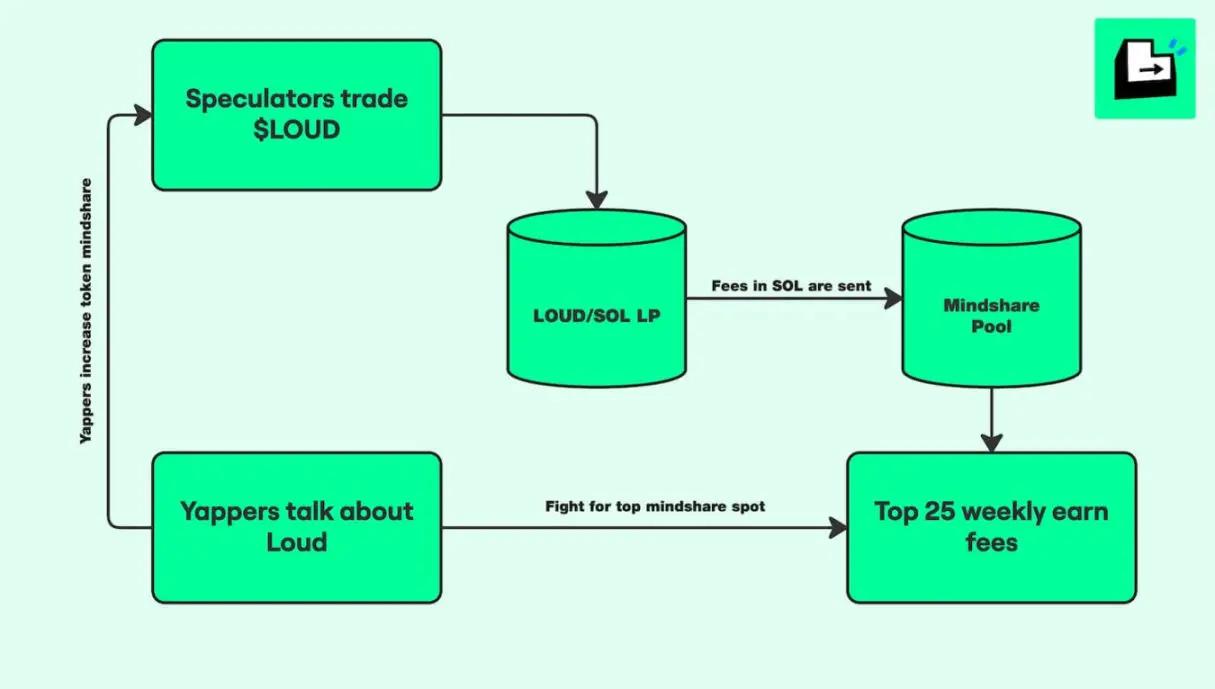
Loud Mechanism, Source: Loud
The Loud project clearly demonstrates this trend. Loud attempted to tokenize attention by allocating rewards to top users with the most attention in specific time periods. While interesting experimentally, attention became the sole reward criterion, leading to overheated competition among users and generating massive repetitive low-quality content, ultimately causing content homogenization within the entire community.
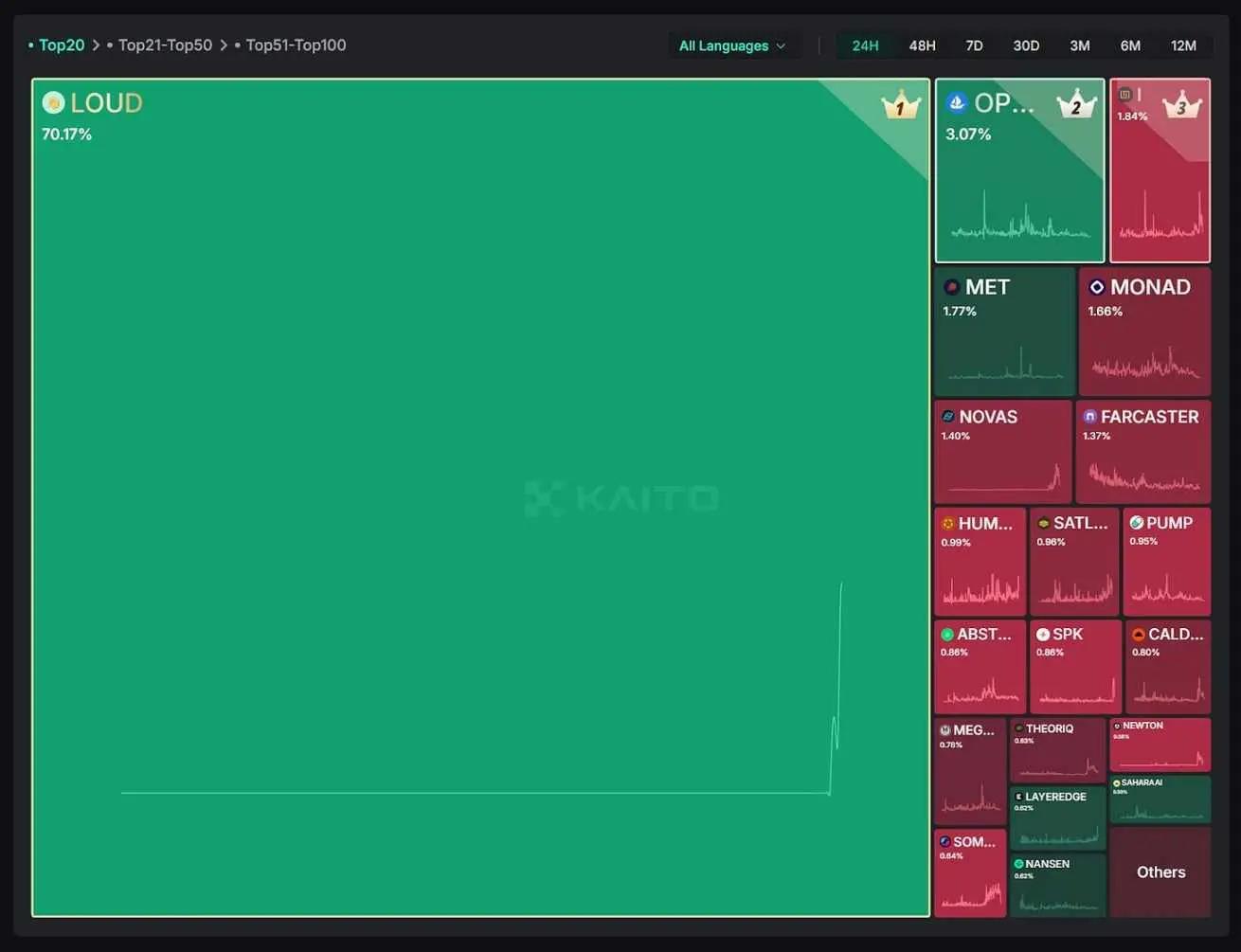
Source: Kaito Mindshare
The second problem is reward centralization. Attention-based rewards began focusing on specific projects or topics, with content from other projects actually disappearing or decreasing from the market, as Kaito's shared data clearly shows. Loud once occupied over 70% of crypto content on Twitter, dominating the ecosystem's information flow. When rewards focus on attention, content diversity declines, and information gradually emerges around projects offering high token rewards. Ultimately, the scale of marketing budgets determines ecosystem influence.
Structural Limitations of InfoFi: Evaluation and Distribution
4.1. Limitations of Simple Content Evaluation Methods
The attention-centered reward structure raises a fundamental question: How should content be evaluated, and how should rewards be distributed? Most current InfoFi platforms base content value judgments on simple metrics like views, likes, and comments, assuming that "high engagement equals good content".
High-engagement content may indeed have better information quality or transmission effect, but this structure mainly applies to very high-quality content. For most mid-to-low-end content, the relationship between feedback quantity and quality remains unclear, causing repetitive formats and overly positive content to receive high scores. Meanwhile, content presenting diverse perspectives or exploring new topics struggles to receive due recognition.
Solving these issues requires a more comprehensive content quality assessment system. Pure engagement-based evaluation standards are fixed, while content value changes with time and context. For instance, AI can identify meaningful content, and community-based algorithmic adjustment methods can be introduced. The latter can allow algorithms to adjust evaluation standards based on periodic user feedback data, helping the assessment system flexibly respond to changes.
4.2. Reward Structure Centralization and Balance Needs
The limitations of content evaluation coexist with reward structure issues, and the reward structure further aggravates information flow bias. The current InfoFi ecosystem typically runs separate leaderboards for each project, using their own tokens for rewards. In this structure, projects with large marketing budgets can attract more content, and user attention often concentrates on specific projects.
To solve these problems, the reward allocation structure needs to be adjusted. Each project can retain its own rewards, and the platform can monitor content concentration in real-time and use platform tokens for adjustments. For example, when content is too concentrated on a specific project, platform token rewards can be temporarily reduced, while topics with relatively low coverage can receive additional platform tokens. Content covering multiple projects can also receive extra rewards. This will create an environment with diverse topics and perspectives.
Assessment and rewards constitute the core of the InfoFi structure. How content is evaluated determines the information flow of the ecosystem, and who receives what rewards is crucial. The current structure combines a single standard assessment system with a marketing-centered reward structure, which accelerates the dominance of attention while weakening information diversity. The flexibility of assessment criteria is essential for sustainable operation, and the balanced adjustment of allocation structures is a key challenge facing the InfoFi ecosystem.
Conclusion
The structured experiment of InfoFi aims to quantify attention and transform it into economic value, converting the existing one-way content consumption structure into a producer-centered participatory economy, which is of extraordinary significance. However, the current InfoFi ecosystem faces structural side effects in the process of attention tokenization, including content quality decline and information flow bias. These side effects are more like inevitable challenges in the initial design phase rather than model limitations.
The assessment model based on simple feedback has exposed its limitations, and the reward structure influenced by marketing resources has also revealed problems. There is an urgent need to improve systems that can correctly assess content quality, as well as community-based algorithmic adjustment mechanisms and platform-level balancing mechanisms. InfoFi aims to create an ecosystem where members can receive fair rewards by participating in information production and dissemination. To achieve this goal, technological improvements are needed, along with encouragement of community participation in design.
In the crypto ecosystem, attention operates like tokens. InfoFi is an important experiment in designing and operating new economic structures. Its potential can be fully realized when it develops into a structure where valuable information and insights are shared. The results of this experiment will accelerate the development of the information quantification economy in the digital age.