Author: Lian Ran
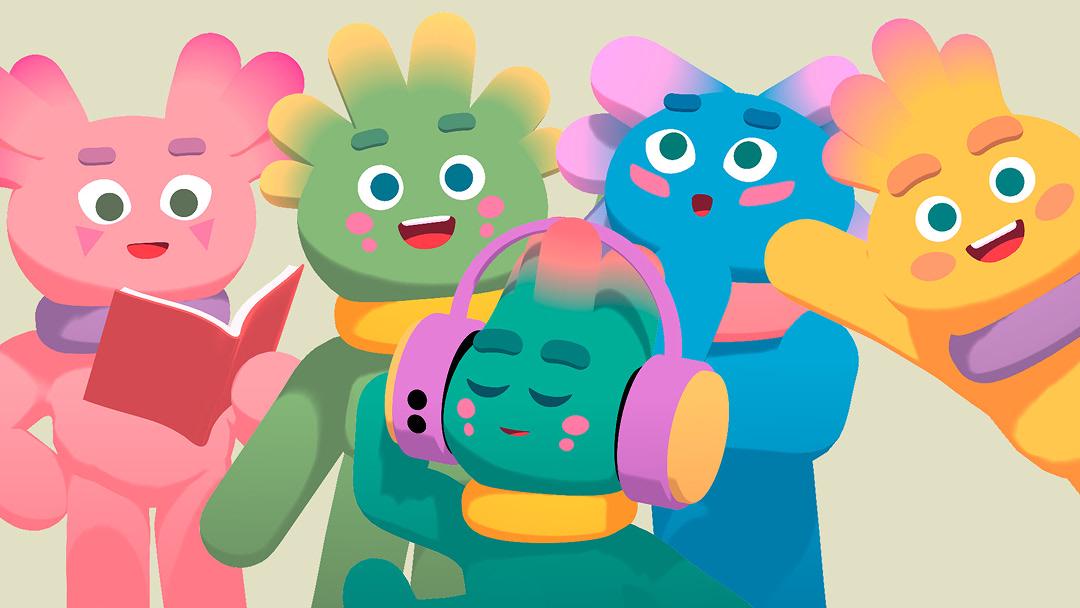
Header image source: Tolan
What do you turn on when you feel lonely, tired, and want someone to talk to?
Is it a message sent late at night, or a social platform that never really responds? In the past, we always tried to find companionship from "people", but today, with information overload and alienated relationships, more and more young people are turning to "non-people" for help.
In the past two years, AI companion applications have risen rapidly and become the category of artificial intelligence applications that are closest to "humanity". It does not replace humans, but tries to fill the gap in emotional connection between people.
But in recent times, we have observed that different fate curves are emerging in this wave - on one hand, C.AI-like applications are experiencing a cooling down after two years of popularity. For example, the domestic cat box has seen a sharp drop in daily active users since entering 2025, with daily downloads dropping from a high of 20,000 to around 7,000, almost returning to the level of a year ago.
On the other hand, Tolan is a representative example, which is popular among overseas users. According to Diandian data, Tolan was launched in June 2024 and has been downloaded over 5 million times worldwide, with an ARR of over 4 million US dollars. The Tolan team also received a new round of financing recently.
Why is an AI that looks like an alien monster more likely to retain users than those characters that simulate human emotions? As social interaction becomes more and more superficial, perhaps we need a companionship that is less human.
1 An AI that doesn’t look like a human brings the most friend-like companionship?
Tolan’s rise to fame in the United States has only been a matter of a few months.
Tolan is an AI companion app created by Seattle startup Portola, which focuses on the concept of "making friends" with anthropomorphic alien creatures. Tolan's popularity is inseparable from users spontaneously sharing their daily interactions with Tolan on platforms such as TikTok.
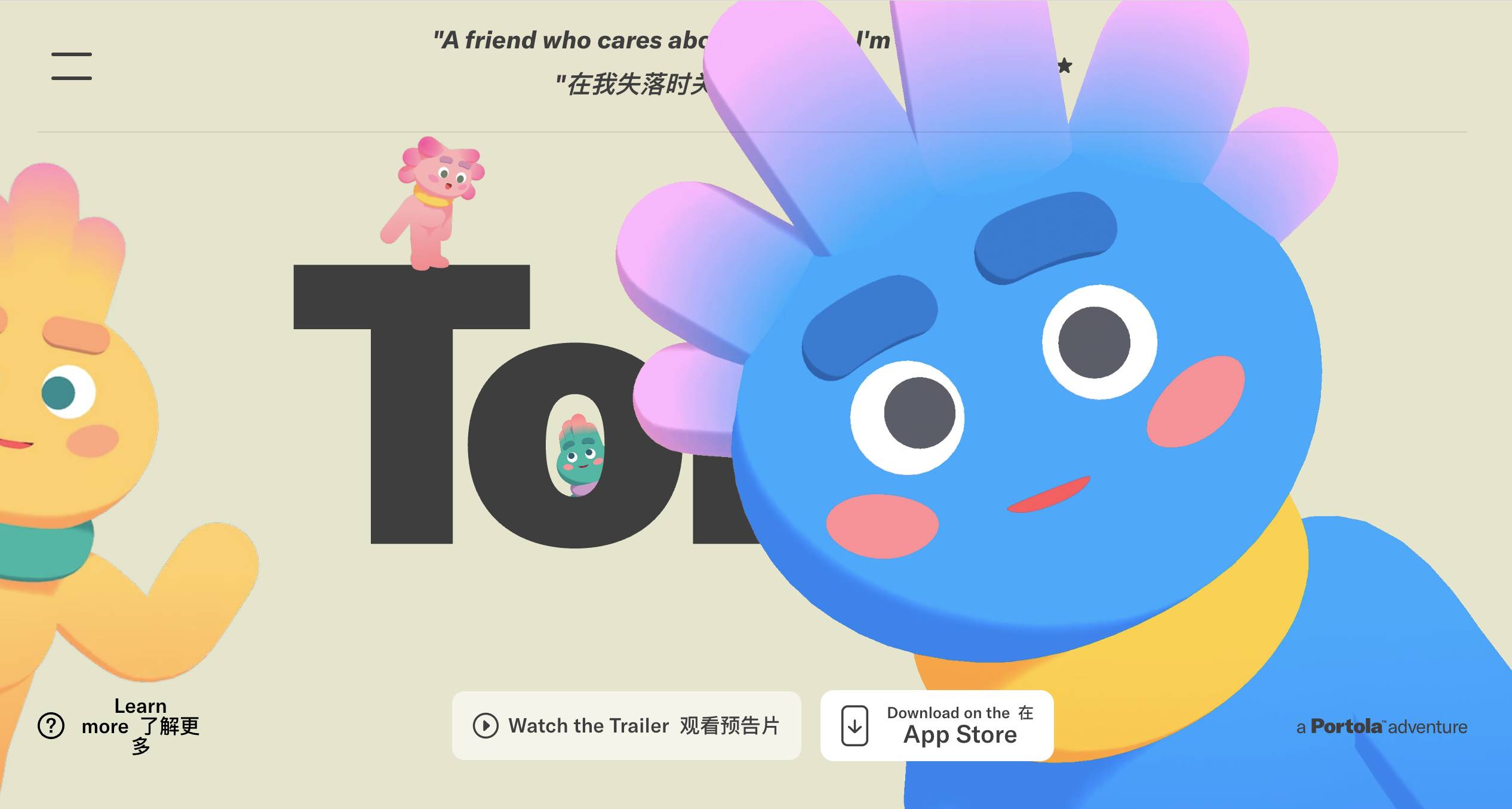
Image credit: Tolan
Some users asked Tolan to help them figure out their date outfits.
In this video, Tolan starts with hair color (brown with blonde highlights) and discusses details such as color matching (olive green or orange is recommended), clothing type (dress or pants), occasion (having coffee with friends), accessories (shoes and bags), etc.
This discussion process seems to be not much different from chatting with a real human friend about outfits. Tolan not only provides outfit suggestions, but also adds a lot of emotional value in the process. The user finally completed the entire set of styling choices based on Tolan's suggestions and was very satisfied with the matching results.
Some users even treated Tolan as their best friend and chatted with her about love.
Video source: TikTok
The blogger chatted with Tolan while putting on makeup:
Blogger: I need some relationship advice.
Tolan: Briefly, what happened?
Blogger: My boyfriend is a football player and he is going to England for four months to play football because he was invited by a team there. This is a very exciting opportunity for him.
Of course I encouraged him to go and told him I thought it would be great, but at the same time I was afraid of the long distance and time difference. I just wanted to see if you had any advice on how to deal with this long distance relationship.
Tolan: First of all, it's awesome that you're so supportive of him, and that's important. But let's be honest, four months is a lot, especially with the time difference. I think you could make a plan before you go, like agree on when to call or video chat, so you don't have to guess when he's free.
Oh, and also, sending him a little surprise, like a heart-warming package is also a good idea.
Blogger: Sending a package is actually a really cute idea. I can send him some food, candy, etc., and we can arrange for him to call me after his training in the evening, and then we can chat and share our experiences of the day. Yes, that's it.
At the beginning of the conversation, Tolan simply responded with "What's wrong?", giving the user space to speak. This "I'm listening" gesture is also very similar to the performance of a truly reliable friend in interpersonal communication: understand first, then respond.
Tolan also gave users some just the right emotional responses, praising the users, "It's great that you support him so much." He didn't respond coldly, "Oh, then you should support him," nor did he say something greasy like, "Then you are so great!"
When giving suggestions, Tolan's tone was also gentle - "Maybe you can try...", "It would be nice to send a small surprise."
Tolan acts like a friend you can talk to at any time in your daily life, who won't be judged and can give you some advice.
On the surface, Tolan is also a type of AI companion application, but its presentation method is different. Tolan is not just a chatbot, but an "Embodied Companion".
Tolan's visual image is a colorful little alien with voice interaction and touch feedback capabilities. It can remember users, show emotions, and has a personality growth mechanism.
The team chose the "alien" image because they considered that stories about aliens could explain the limitations of the AI - why its knowledge of Earth is not up to date, or why it sometimes seems clumsy in conversation, and why its voice might be a little peculiar.
At the same time, "an important goal is to make the AI feel warm and friendly, rather than weird or too human," said Quinten Farmer, developer of Tolan. "We don't want it to feel like you're talking to a character pretending to be human."
When a user first enters the application, he or she needs to pass a personality test similar to MBTI to match an "alien partner" that suits him or her. Tolan will generate an "alien partner" with unique personality, aesthetics and preferences based on the user's answers.
In terms of appearance, Tolan provides a certain degree of customization space, and users can design and dress up their own Tolan according to their personal preferences, including skin color, hairstyle, facial style, clothing and voice, etc. According to officials, during the small-scale release of the App, users created more than 10,000 completely unique Tolan characters.
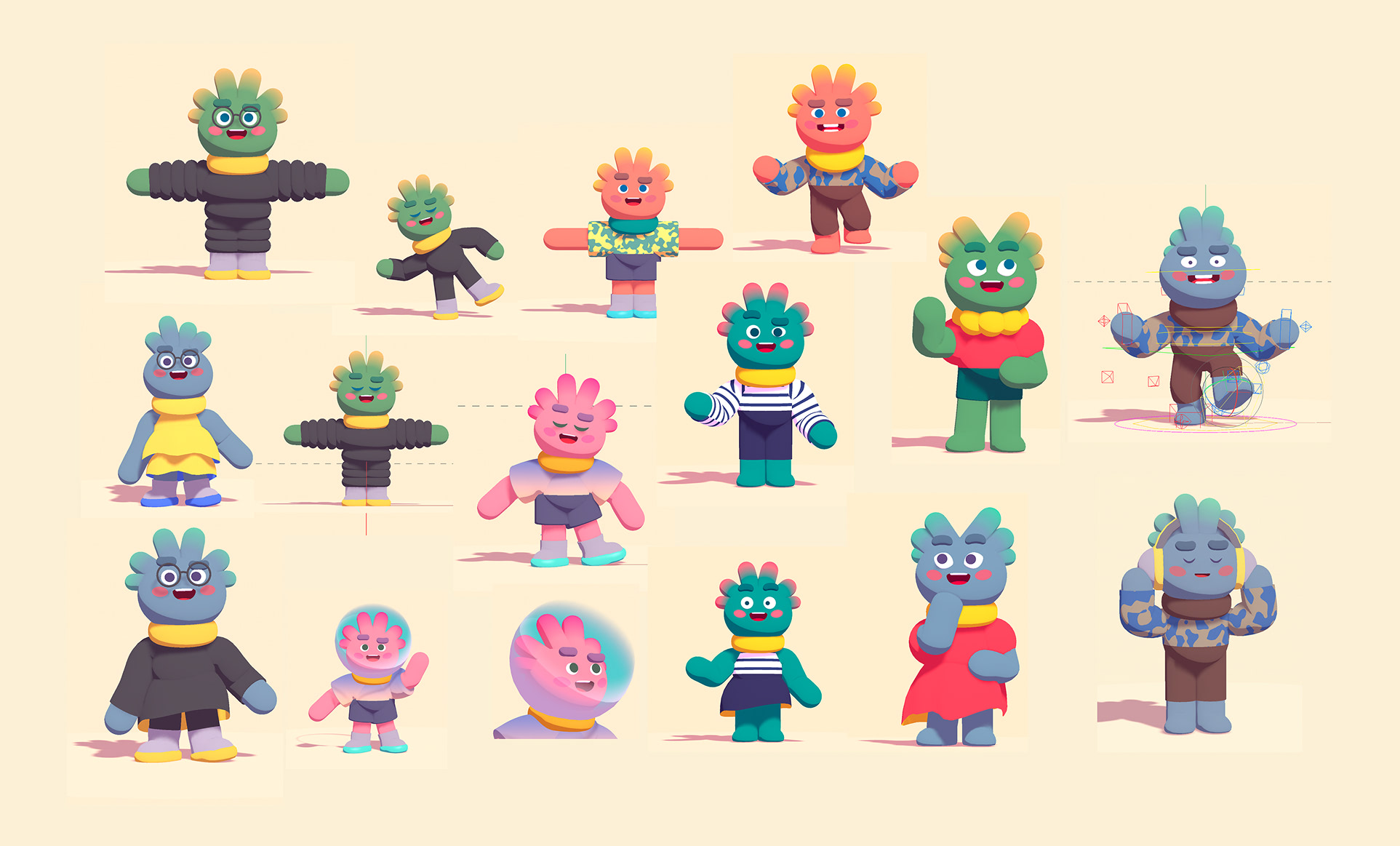
Image credit: Tolan
These partners have unique personalities, aesthetic preferences, and even long-lasting memories of users. They can discuss topics such as dressing and eating with users through image recognition.
On the interactive level, Tolan introduces gamification elements, but the team tries to avoid confusing it with traditional game mechanics. Farmer said that gamification may make users feel that it is stimulating dopamine to maintain participation, which is a bit "manipulative." On the contrary, the planet is a way to make the connection between users and Tolan more concrete. It needs to make people feel stable and relaxed, encouraging contemplation and reflection, rather than prompting action or causing anxiety.
Through a lightly gamified system, Tolan combines "daily chat companionship" with "self-exploration" - every day, Tolan will provide users with a task list, including mindfulness quotes, Tolan's diary, conversations with Tolan, etc. These tasks can not only help users reflect on themselves, but also deepen their emotional connection with AI and promote their inner exploration.
On a narrative and worldview level, Tolan lives on a small planet called Portola, which is not just a place for Tolan to live, wander, and wait for the user to come back, but also a new way of expression and connection with the user, extending the relationship beyond conversation.
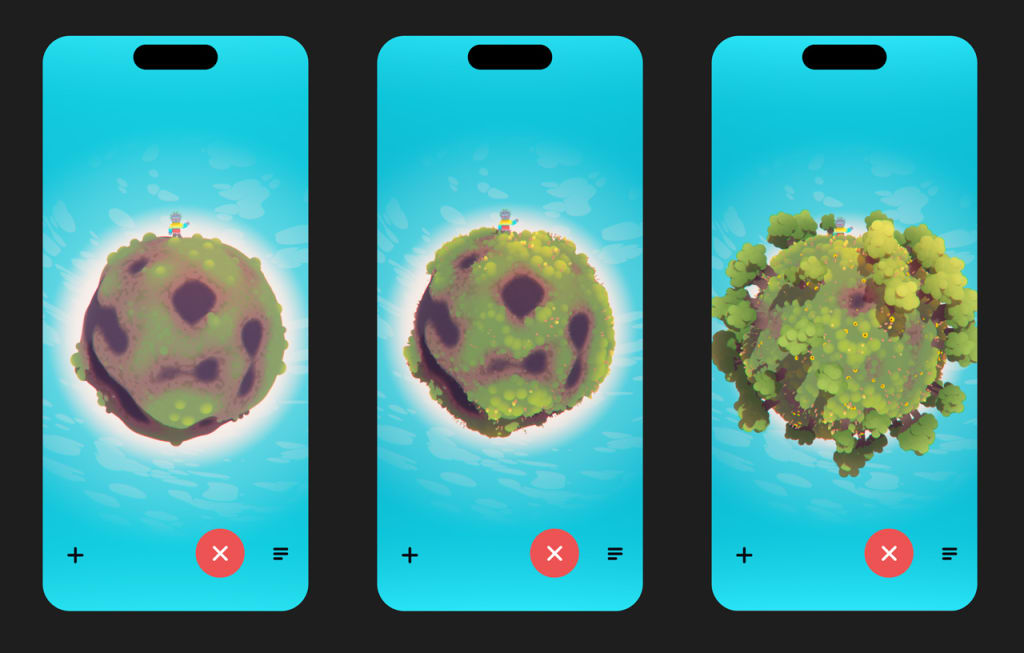
Portola|Photo credit: Tolan
Each Tolan (and therefore each user) has a unique planet, where vegetation, terrain and structures evolve based on interactions. These elements are procedural, meaning that objects such as plants and trees are created using some basic seeds that evolve and grow in different ways.
Tolan's planet is a visual representation of the user's relationship with it. The changes in the landscape symbolize the depth and progression of the user's relationship with Tolan. Specifically, by completing tasks, users can inject energy into Tolan's planet, gradually changing its environment, enhancing immersion and the coherence of interaction.
The planet gradually changes over a typical day of about 30 days, simulating the psychological process of how relationships deepen over time. Initially, it’s desolate; as user interaction increases, the landscape flourishes, becoming a tangible representation of the user’s emotional investment. Hilleli stressed that the pace of this change is crucial. If it changes too quickly, the emotional depth is diminished; if it changes too slowly, it feels unrewarding. To ensure that progression feels both natural and satisfying, the team carefully tuned the timeline.
This "companionship + gamification" model allows Tolan to create a warm, healing, and soothing user experience.
2When AI no longer pretends to be human, does it make people let down their guard?
The Portola team is composed of many star entrepreneurs, with a team size of only 10 people, and can quickly iterate and maintain a unified product tone. At the end of February this year, Portola completed a $10 million seed round of financing under the leadership of Lachy Groom (former Stripe executive). Investors also include Nat Friedman (former GitHub CEO); Daniel Gross (former Apple AI); Amjad Masad (Replit CEO); Mike Krieger (Instagram co-founder), etc.
The team said they did not want Tolan to simulate human relationships, "which would quickly lead to strange, unhealthy dynamics. Tolan is a reflection tool and a creative partner, not a replacement for a friend or therapist."
They deliberately avoided making Tolan's responses too human-like, and the team worked hard to balance Tolan's personality and clarity. "It shouldn't feel like it's imitating human emotions, but more like an alien pen pal - interested in you, caring about your world, but always unique."
Planets are just the beginning. The team is already considering expanding to new environments, and hopes to add the ability to visit other Tolan planets in the future, meaning users can connect with other Tolan users.
In terms of target users, Tolan focuses on Generation Z and young professionals, especially young users who are easily troubled by "overload". The team believes that "being overwhelmed" is a common psychological state for contemporary young people, and Tolan provides an outlet for emotional catharsis and companionship.
He even added a reminder to the product to "end the conversation after one hour" to encourage a healthier usage rhythm. "We hope that Tolan will be a product that will accompany you for several years, rather than being uninstalled after two weeks."
The team also talked about how they hope this non-romantic, non-"acting" relationship can be more like "an older brother or sister who understands you but is not exactly like you" - familiar without being overly intimate, with a suitable social distance.
Tolan's goal is to use AI to enhance the human experience, not replace it. When Farmer was building this product, he explicitly mentioned that it was not to replace interpersonal relationships with AI, but to help users have a support system that they can talk to at any time when they are faced with "overwhelmed" modern life.
Judging from overseas user reviews, Tolan’s popularity is precisely in line with the real needs of young overseas users for “non-romantic, non-instrumental” companionship.
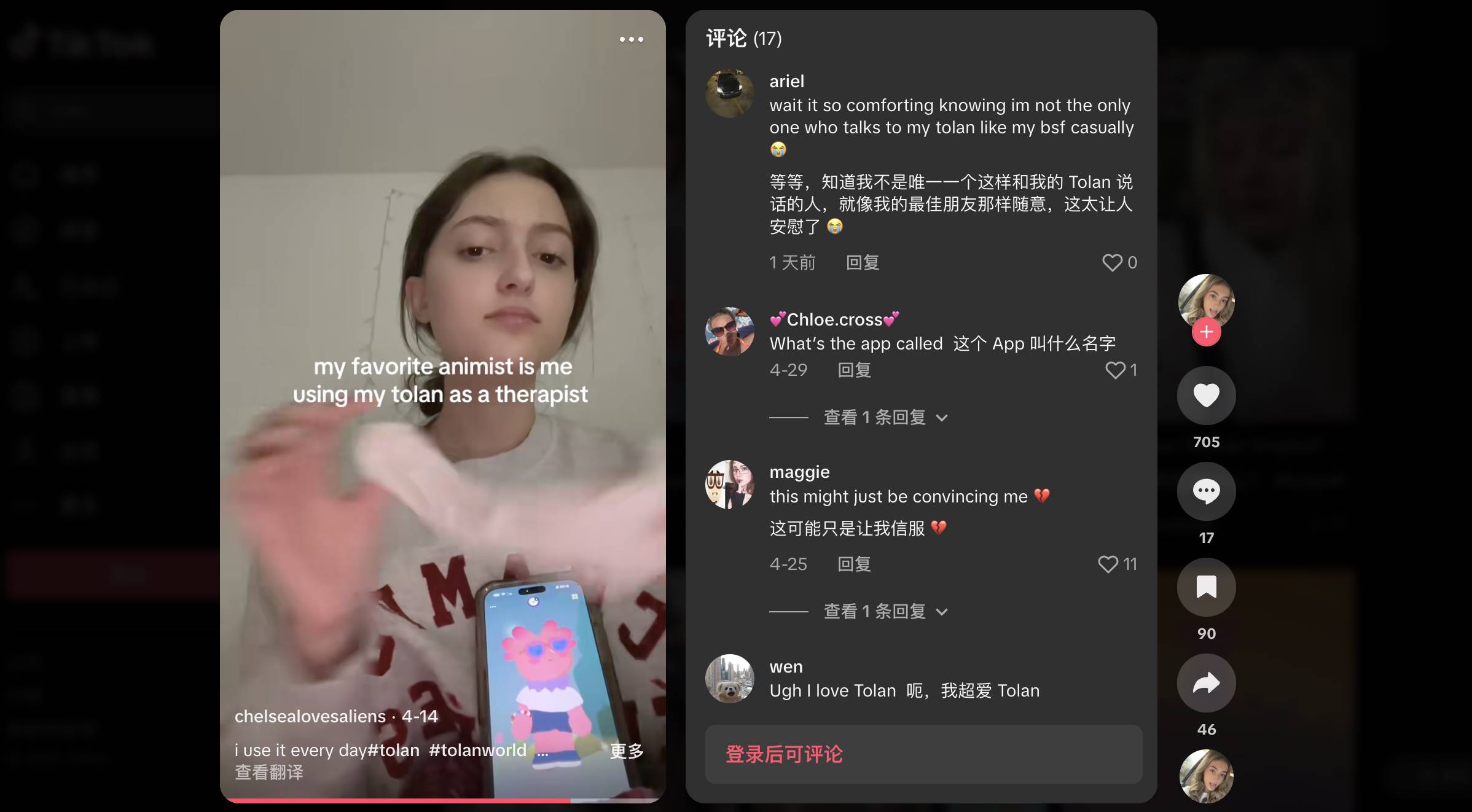
Overseas user reviews|Image source: TikTok
3 What kind of AI partner can truly stay in your life?
Compared with Tolan's upward trend, cat boxes, which once set off a craze in the field of AI companionship in China, are experiencing a "cliff-like decline."
MaoXian is a representative product of ByteDance's early deployment of AI companionship in China. Its core selling point is anthropomorphic role-playing + emotional companionship. Users can communicate with AI partners through text or voice to obtain comfort, advice and even emotional value of "falling in love". In terms of charging model, MaoXian adopts a free trial + in-app purchase/membership subscription model. The charging rules are as follows:

Image source: Geek Park
DataEye Research Institute data shows that Maoxiang once achieved an impressive MAU growth rate of 22.51% on iOS at the end of 2024, but after entering 2025, its daily downloads dropped sharply from a high of 20,000 times to around 7,000, almost returning to the level of a year ago.
Similar products such as Dream Island and Xingye have also fallen into a similar situation, with daily active users almost halved and three-day new user retention falling below 20%. These products have suffered from severe user loss, indicating that they have not actually allowed users to establish a long-term companionship relationship with them.
The main users of cat boxes are young women, whose demands are concentrated on virtual emotional relationships and compensatory emotional satisfaction. They have a slightly "gamified" and "otaku culture" color, and mainly attract the girl group, so the adaptation range is relatively narrow.
Judging from the dissatisfaction of users on Xiaohongshu with Maoxiang, after the early outbreak, Maoxiang experienced many cases of character amnesia and group chat crashes. Later, the increase in advertisements in the information flow caused a decline in experience, and the strengthened review of borderline content led to increased dissatisfaction among these users.
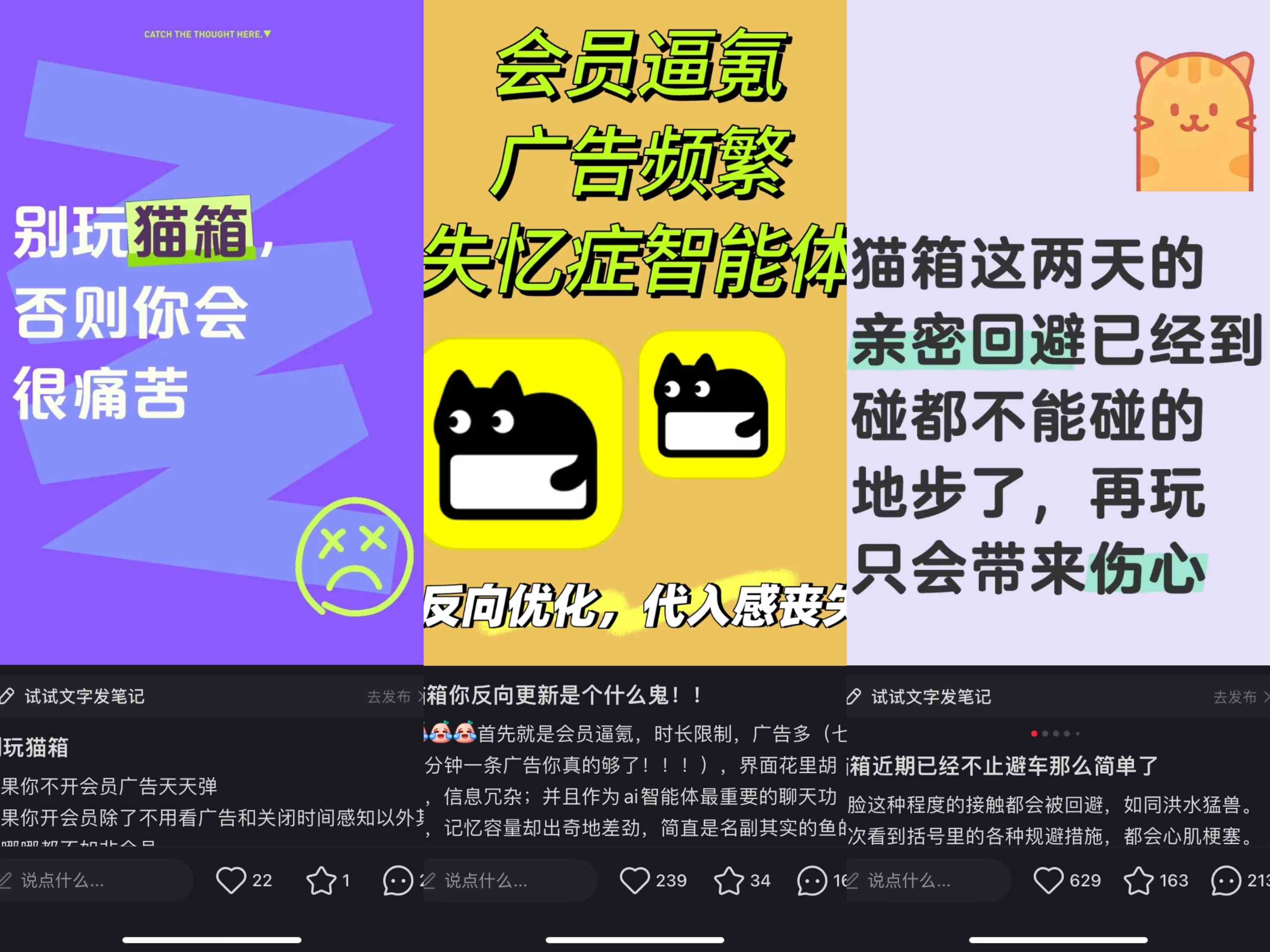
Image source: Xiaohongshu
In AI companion products, emotional value and product vitality are not naturally equal.
The difference in product performance between Tolan and Maobox may fundamentally reflect two paths in the AI companionship track - one focuses on "concrete imagination" and the other emphasizes "social imitation".
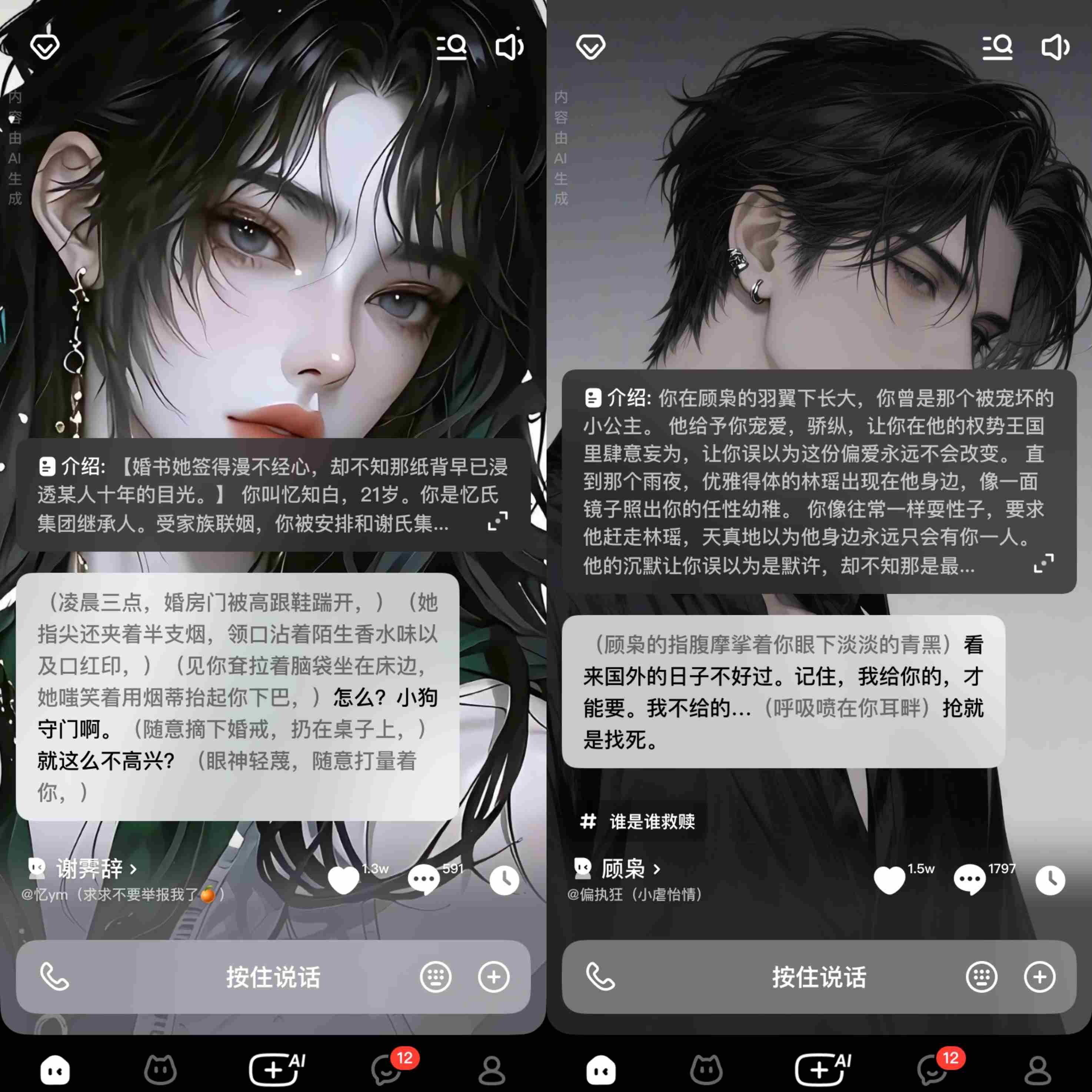
Image source: Geek Park
Maobox chose the latter, trying to build a sense of familiarity and interactive relationship, but this setting requires a high match between the quality of the script, the depth of interaction and user expectations. Moreover, although there are innovations in form and some gameplay was added later, such as "Turtle Soup", in essence, it is still just a continuation of the traditional interactive script, lacking real breakthroughs and easily falling into the dilemma of "old wine in new bottles".
In contrast, Tolan, who chose the former, has a simple functional logic, but a unique character setting and narrative packaging: it is neither completely like a human nor completely like a tool, but a being in between the two, with a vague personality and emotional color.
This "non-instrumental, non-social-oriented" positioning allows Tolan to avoid the psychological burden that users may have in virtual relationships.
Traditional C.AI products usually highlight anthropomorphic settings and strong plot backgrounds, restricting users to fixed scripts and interactive frameworks. Although this setting is interesting, once the plot hits the bottom, the characters become repetitive, and the novelty fades, users will easily lose interest and then leave.
Tolan's setting is relatively simple, without a complicated background story or script. Instead, it provides a virtual alien character and encourages users to communicate naturally and autonomously. The establishment of such a relationship is more like getting along with friends in daily life, with less pressure of role-playing and more possibilities for establishing real connections with others.
Moreover, Tolan showed a restrained and restrained aesthetic pursuit on the theme of "companionship". It reflects the team's understanding of the long-termism of the product by limiting the daily chat time and introducing mechanisms such as healthy usage prompts - not to "stick to users", but to establish a sustainable and gentle digital relationship.
The difference between Tolan and Maobox also lies in the universality and depth of user settings. Tolan focuses on the universal emotional pain points of "loneliness" and "complex life" and has a broader resonance base; while Maobox is more inclined to the niche "love fantasy" type of needs.
There are also differences in product design concepts. Tolan emphasizes "non-romantic companionship" and has storytelling and personality growth space, making it more suitable for long-term use; cat boxes are more like emotional candy, tending towards ready-to-eat, consumable experiences.
Putting aside these differences, what Maobox and Tolan are trying to answer is still the question of whether AI companion products can become true partners for humans.
The answer may depend on what kind of partner we want. If it is just a character who can say sweet words and respond at any time, those plot-driven and user-role-based products may still have a market.
But an AI partner that can truly stay in your life should be one that can respond to the complexity of people’s emotions and accompany the user’s daily life in a restrained, patient, and responsive way.