As the wheels of history roll forward, there are always some seemingly inconspicuous nodes that, when looking back from the future, turn out to be pivotal points of an entire era. On June 12, 2025, when news spread that Ant Group planned to apply for a stablecoin license in Hong Kong, China, many people's first reaction might have been "another giant is entering the market". However, the capital market provided a more dramatic and honest answer.
After the news broke, Yunfeng Financial (0376.HK), considered one of the core "Jack Ma concept stocks", saw its stock price soar like a rocket, rising nearly 99% intraday. Although it subsequently fell back, this almost crazy surge was like a drop of hot oil falling into a blazing fire, instantly igniting the market's imagination about the entire new era of digital finance. This was not based on a rigorous financial report analysis, but a release of emotion, a "trust vote" cast with real money. The market's logic was simple and brutal: Ant's massive ship turning its helm towards the new blue ocean of stablecoins represents such enormous potential that the entire ecosystem would be bathed in a golden halo.
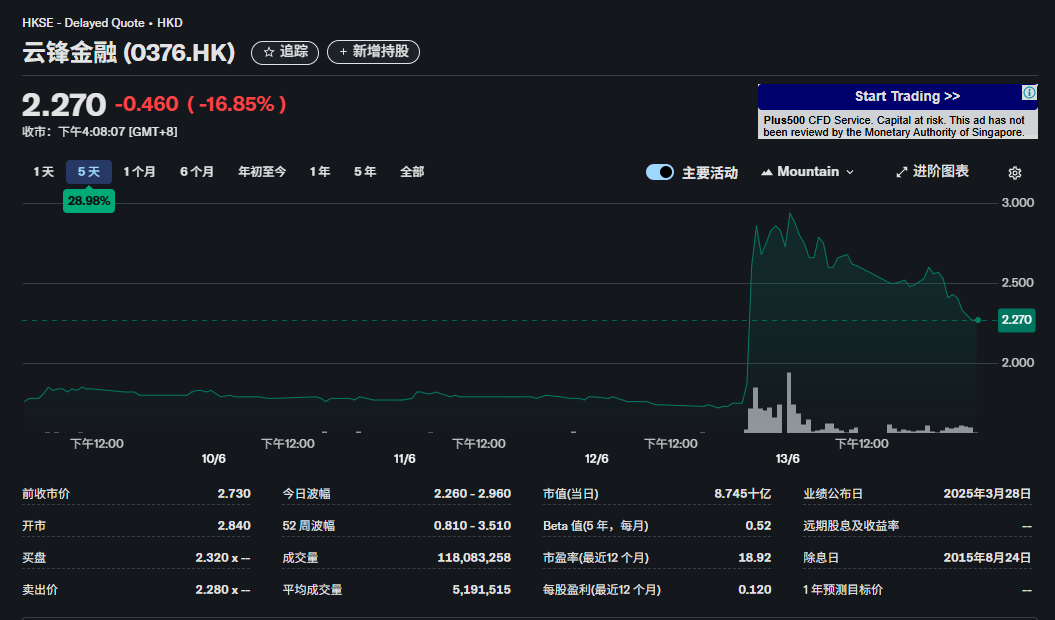
The stock price fluctuation of Yunfeng Financial is the best proof of the impact of this "heavyweight bomb". It eloquently demonstrates that Ant's entry into stablecoins is far from just an industry news, but a strategic signal capable of leveraging massive capital and triggering a market landscape transformation. This gunshot may mark the official beginning of a brand new financial infrastructure era.
This is no longer a story about "coin speculation", but a prelude to how payment, trade, assets, and trust are being reshaped globally. The protagonists have also transformed from those early crypto pioneers with a geek flavor to the tech giants and mainstream financial forces we are familiar with.
Hong Kong's "Positive Strategy": From Regulatory "Sandbox" to Global Digital Finance Hub
To understand why Ant is pulling the trigger at this moment, we must first look at the stage where the story unfolds - Hong Kong, China. This city is paving a clear, compliant runway for the future of digital assets with astonishing determination and efficiency.
After nearly two and a half years of brewing and formal enactment, the landing of the "Stablecoin Regulations" sent an unmistakable signal to the world: what Hong Kong wants to do is not to block or prohibit, but to embrace and lead. Unlike many regions globally still arguing about how to regulate crypto assets, the Hong Kong Monetary Authority (HKMA) has developed a combination of "kindness and might". On one hand, by establishing a strict licensing system requiring issuers to have robust capital strength, comprehensive risk control systems, and 100% reserve fund support, keeping "inferior coins" and potential risks out. On the other hand, through the "Stablecoin Issuer Sandbox Program", actively inviting and cultivating promising "good coins".
This approach can be called a "positive strategy". It cleverly transforms regulation from a restriction into an empowerment. For stablecoins, their lifeline is "stability", and the foundation of stability is trust. A government-endorsed regulatory framework is precisely the most solid cornerstone for building this trust. It tells the market: stablecoins issued here have traceable anchored assets, guaranteed redemption, and protected investor rights.
Before Ant, JD.com's JD Coin Technology, Yuan Coin Technology, and international banking giant Standard Chartered had already entered the sandbox as "first crab eaters". This itself depicts a future landscape: tech companies provide scenarios and technology, financial institutions provide compliance and fund management expertise, jointly constructing the stablecoin ecosystem. Hong Kong's ambition is not merely to become another crypto trading center, but to seize stablecoins as a key "connector", transforming itself into a global core hub connecting traditional finance with the future digital economy. When global capital, technology, and talent converge in Victoria Harbour due to this certainty, a brand new international financial center story has already begun.
Ant's "Two-Front War": Overseas Payment and Asset Tokenization Strategy
On the stage set up in Hong Kong, Ant Group's appearance is particularly eye-catching. More intriguing is that what emerged was not Ant Group itself, but two independent elite troops under its command: Ant International and Ant Digital Technologies. This is not a simple internal horse race, but a carefully laid out "two-front war", with two seemingly parallel lines achieving perfect synergy at the strategic high ground of stablecoins.
The first front, led by Singapore-based Ant International, focuses on "overseas payment". Ant International encompasses core businesses like Alipay+ and WorldFirst, essentially a massive global payment and fund clearing network. According to public information, its processed global transaction volume has reached trillion-dollar levels. For such a giant handling massive cross-border transactions, the existing traditional cross-border payment system based on correspondent banking model has numerous pain points like high costs, slow speed, and opaque processes.
Stablecoins are the "silver bullet" to solve these pain points. Imagine a Chinese SME using WorldFirst services paying a European client. In the traditional model, this payment would require clearing and currency exchange through multiple banks, taking days with costs at each step. In the future stablecoin landscape, this payment could be completed near-instantly and at extremely low cost through point-to-point blockchain settlement. Stablecoins play the role of an efficient, low-cost value settlement medium. Ant International's stablecoin license application is precisely to transform this future vision into reality, equipping its massive payment network with a more powerful "engine". Previously, Ant International becoming the first client of HSBC's tokenized deposit settlement service has clearly foreshadowed its ambition in revolutionizing fund flow efficiency.
The second front, handled by Hong Kong-headquartered Ant Digital Technologies, focuses on "asset tokenization". If Ant International is concerned with the flow of "money", Ant Digital Technologies is concerned with the digitization of "things". Spun off from Ant Chain, its core competitiveness lies in combining blockchain technology with physical industries. Its Real World Assets (RWA) business is a concentrated embodiment of this strategy.
In August 2024, Ant Digital Technologies collaborated with Lanxin Group to complete China's first RWA project based on new energy physical assets in Hong Kong. In this case, future revenue rights of charging piles were packaged, divided, and transformed into digital certificates (Tokens) on the blockchain, enabling broader investor ownership and trading. This greatly activates the massive assets deposited in the real economy, providing them with unprecedented liquidity.
However, in the grand narrative of RWA, a key missing link has always existed: what should these digitized physical assets be priced and traded in? Using volatile cryptocurrencies like Bitcoin or Ethereum would undoubtedly introduce massive risks, deterring institutional investors. Stablecoins are precisely the perfect answer to this problem. A compliant, stable digital dollar or digital Hong Kong dollar is the ideal trading medium and pricing unit for the RWA market.
At this point, Ant's "two-line battle" logic has formed a closed loop: Ant Technology uses technology to move massive real-world assets (RWA) onto the blockchain, creating a brand new digital asset "shelf"; while Ant International provides a reliable "price tag" and efficient "checkout counter" through issuing and operating compliant stablecoins. The two lines support each other, jointly constructing a complete digital financial ecosystem from asset side to funding side. This is far beyond a simple payment or technological layout, but a deep reconstruction of future financial market infrastructure.
Beyond Ant: A "New Continent" Race Gathering Giants
When we zoom out the lens from Ant, we'll find this track is already crowded with heavyweight players. This is not Ant's solo performance, but a global "New Continent" discovery race involving both new and old giants.
In mainland China, another tech giant JD, alongside Ant, has already secured a place in the Hong Kong Monetary Authority's stablecoin sandbox through its JD Blockchain Technology. Its test scenarios directly point to cross-border payments, investment transactions, and retail payments, showing its recognition of stablecoins' huge potential in e-commerce and financial ecosystems. Subsequently, Xiaomi's Xinxing Bank announced cooperation, unveiling the prelude of internet giants' strategic alliances around Web3. Lianlian Digital, which has been deeply cultivating the payment field for years, not only holds 65 global payment licenses but has also obtained the Hong Kong Virtual Asset Trading Platform (VATP) license. The news of establishing a dedicated stablecoin project team signals a full-chain closed loop of "payment + trading + stablecoin" is brewing.
Globally, the race's intensity is no less. Payment giant PayPal has long launched its USD stablecoin PYUSD and actively expanded its application in payment and remittance scenarios. Credit card organizations Mastercard and Visa have also explored integrating digital currency settlement capabilities into their vast global merchant networks by collaborating with stablecoin issuers. Meanwhile, countries like the United States, Singapore, Luxembourg, and South Korea are accelerating the improvement of their stablecoin regulatory frameworks.
This global race clearly reveals a trend: stablecoins are undergoing a profound "identity transformation". From being a "chip" used for hedging and trading within the early crypto world, they are evolving into "digital cash" widely recognized by mainstream finance and technology, capable of carrying real-world economic activities. Their core value is no longer speculation, but the enormous potential as a financial tool in improving efficiency, reducing costs, and creating new markets.
From this perspective, whether it's Hong Kong's "Stablecoin Ordinance" or Ant and JD's eager entry, these are not isolated events. They are inevitable products of the global financial system's digitalization and intelligentization wave. The core of this wave is reshaping trust mechanisms with technology and building a more efficient value network through code. In this grand transformation, whoever first establishes a compliant, efficient, and application-scenario-rich stablecoin ecosystem will occupy the most advantageous position in the next-generation global financial competition.
Epilogue: When Droplets Merge into the Ocean
Looking back at the summer of 2025, Ant Group's application for a Hong Kong stablecoin license is like a stone thrown into a calm lake, with ripples far beyond initial imagination. What it signals is the digital asset's farewell to the "wild era" and entry into the construction phase dominated by "regular troops".
This is no longer just about a company's or a technology's breakthrough, but about the evolution of the entire financial paradigm. When this stablecoin bridge is firmly established, we will see trillions of physical assets awakened and gaining unprecedented liquidity; global small and medium enterprise owners will enjoy near-zero-cost instant cross-border settlement services; ordinary investors will be able to participate in global asset allocation more safely and conveniently.
The ultimate form of stablecoins might seamlessly integrate into the capillaries of daily economic activities like today's electronic payments, becoming an indispensable water and electricity in the digital economy era. Ant, JD, PayPal, and other pathfinders are laying the first cornerstone for this future. This new continent built by code, assets, and trust might be far more vast and fertile than we can imagine today. The historical preface has been written. The magnificent main text awaits all of us to witness and participate.