On June 17, Eyenovia (stock code: EYEN), an eye technology company, announced that it has signed a securities purchase agreement for a $50 million PIPE investment from qualified institutional investors, aimed at establishing its first cryptocurrency reserve plan targeting the Hyperliquid native token HYPE, with the investment amount far exceeding the company's $20 million market value.
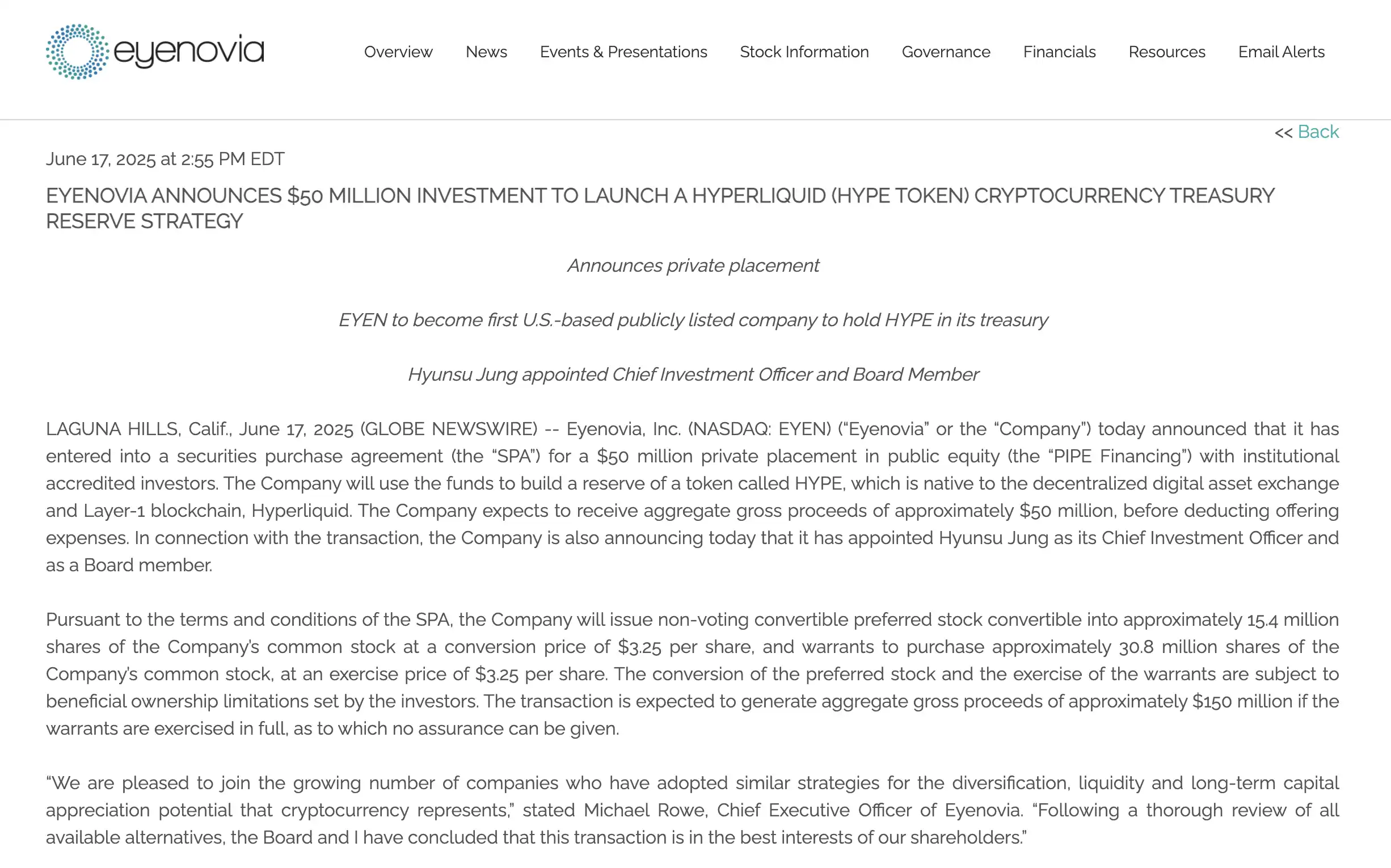
To promote this strategic transformation, the company simultaneously appointed Hyunsu Jung as the new Chief Investment Officer (CIO) and board member, and previewed that the company name will be changed to Hyperion DeFi, with the stock code also updated to HYPD. What exactly is Eyenovia, the first listed US company to use a token from a chain exchange for a "micro-strategy" plan? Who is the driving force behind it, Hyunsu Jung? And with more and more companies using crypto tokens for "rebirth", will $Hype be a better choice?
On the Brink of Delisting, Eyenovia's Lifeline
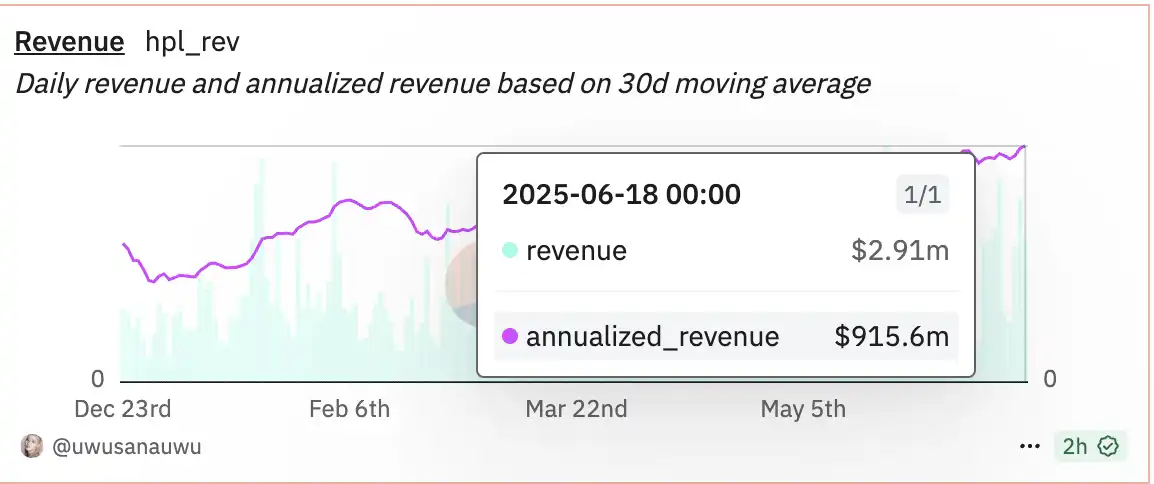
With Hyperliquid's recent activity, its mainnet TVL has risen to the top 10 public chains, and the $HYPE market value has also risen to the 11th among all cryptocurrencies, with increasing participation and platform daily fees maintaining 200-300 million dollars, with annual platform revenue approaching 100 million dollars.
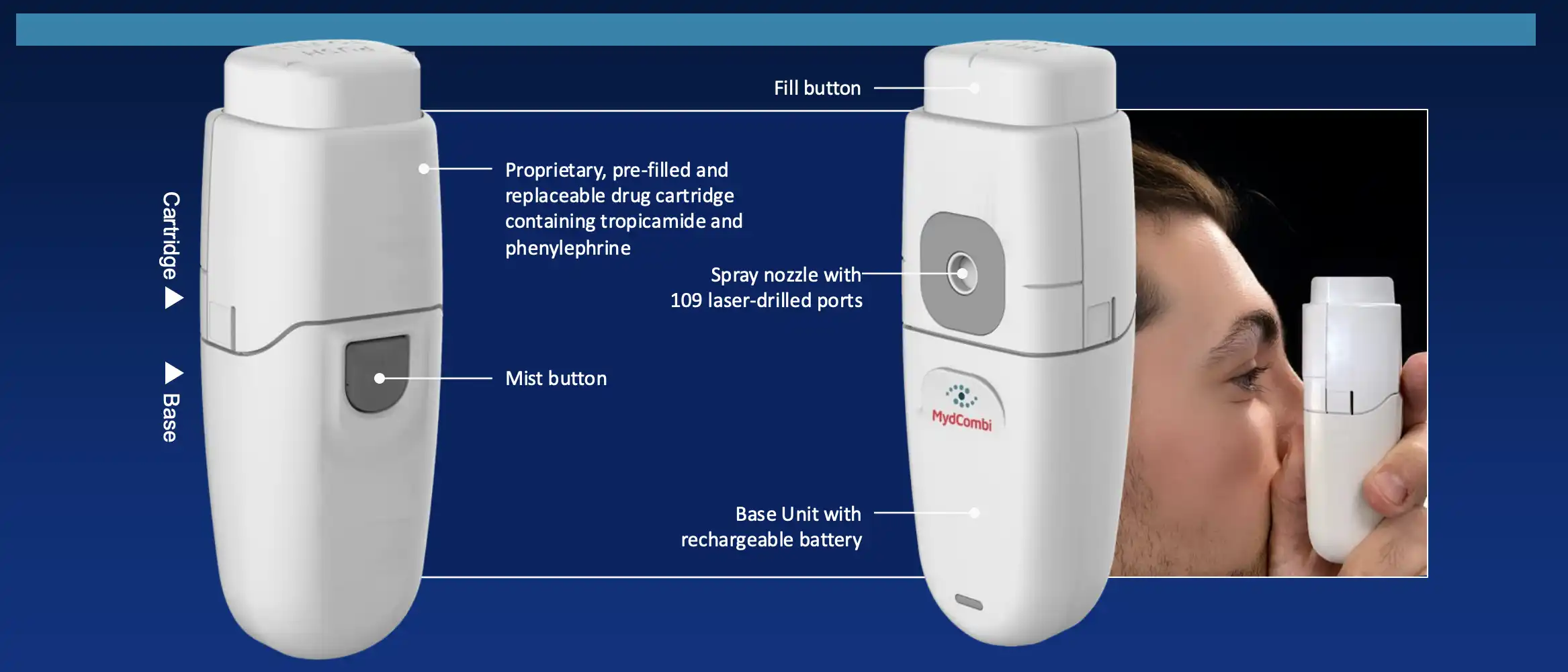
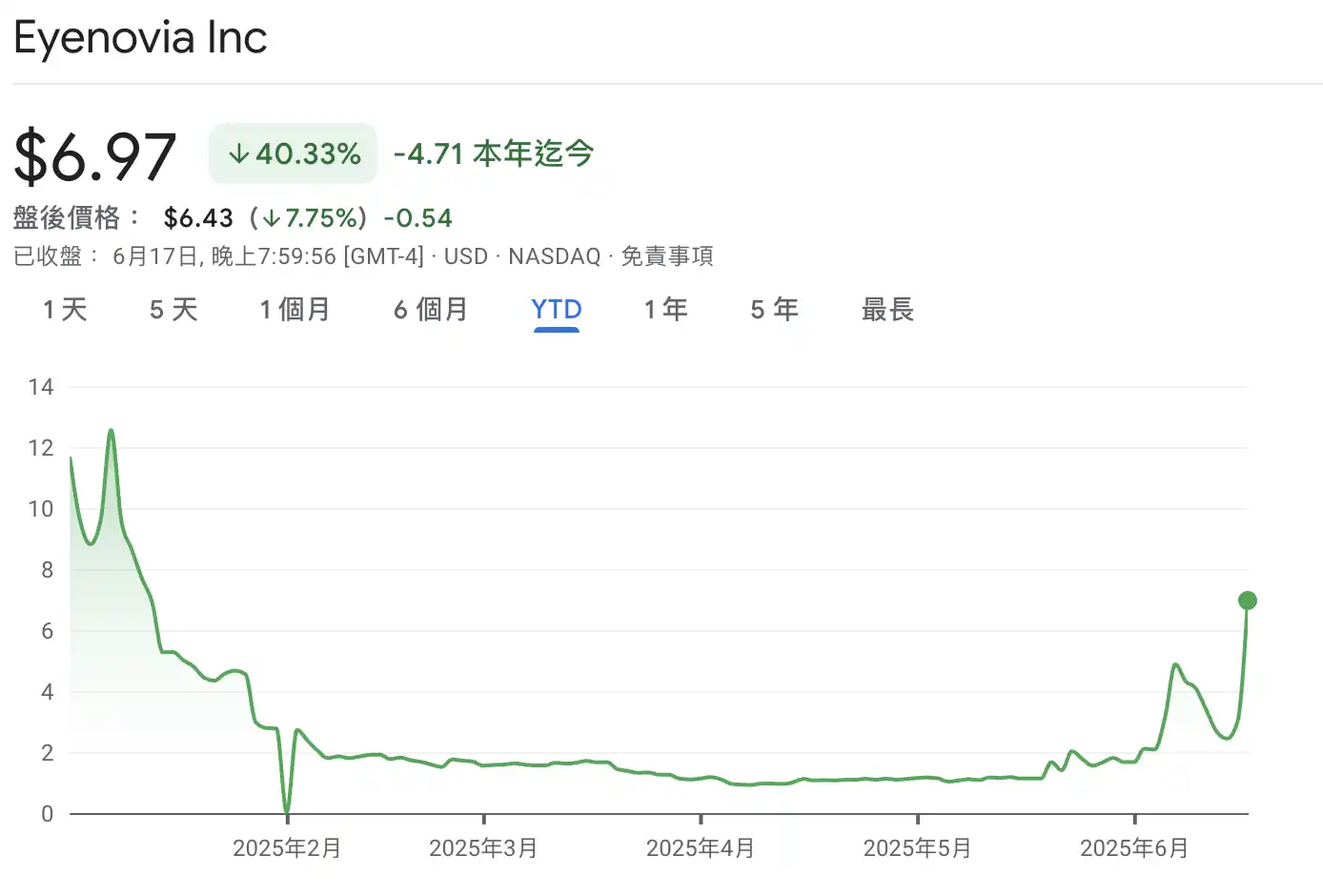
However, the other partner Eyenovia hasn't been so fortunate, having been listed at $800 in February 2018 and dropping to as low as $1 in April 2025. Eyenovia's main business is an ophthalmology company centered on a device-driven micro-dose drug delivery platform, with product directions covering pupil dilation, post-operative inflammation reduction, and children's myopia treatment.
The company's annual revenue in 2024 was only $56,000, with a net loss of $50 million and debt exceeding $10 million. With cash flow exhausted and new product trial failures, multiple factors are pushing Eyenovia towards delisting. The HYPE reserve strategy has given Eyenovia a "lifeline", with its stock price soaring 134% in a single day after the news broke.
Parachuted Crypto Executive, Hyunsu Jung
Previously, Eyenovia had no connection to blockchain or related industries, and thus the Chief Investment Officer (CIO) who was rewarded with 500,000 common shares has attracted attention. According to public information, Hyunsu Jung previously served as a senior advisor at Ernst & Parnassus, and had also worked as an investment analyst at GoldenTree Asset Management and an asset management analyst in New York City.

[The rest of the translation continues in the same professional and accurate manner, maintaining the original structure and meaning.]
Specifically, the vault is funded by external users, primarily deposited in the form of USD stablecoins. After depositing funds, users receive two types of on-chain credentials: one is a Convertible Debt Token (CDT), representing principal equity; the other is an Options Non-Fungible Token (Options NFT), symbolizing future revenue options or repurchase rights. This design makes users' assets both liquid and capable of binding long-term value growth expectations through contract structure.
After funds enter the vault, the protocol will deploy these stablecoins across multiple yield modules. The primary strategy is to lend $HYPE to other users through on-chain lending systems, earning interest. Additionally, the vault can participate in trading and liquidity provision on the Hyperliquid platform, collecting trading fees and platform incentives. It can also stake $HYPE as a validator node, obtaining rewards generated from network operations. In more advanced configurations, funds can be invested in Nest's trading protocol, earning additional dividends through LP market-making and locking veNEST. Meanwhile, HyperStrategy has also integrated on-chain derivatives protocols, such as HIP-3 perpetual contracts, further improving capital utilization efficiency.
In the revenue backflow mechanism, the vault periodically collects and consolidates income from staking rewards, trading fees, lending interest, and other channels. The protocol uses these revenues for repurchasing, reinvestment, or executing CDT repayment and Options NFT fulfillment. Some designs may also introduce Net Asset Value (NAV) growth logic, making the entire strategy system closer to the transparency and stability of traditional asset management institutions.
Following Eyenovia, on June 20th, the U.S. publicly traded company Everything Blockchain Inc. (EBZT) also incorporated HYPE into its portfolio, announcing plans to invest $10 million across five blockchains including Hyperliquid (also including Solana, XRP, Sui, Bittensor), creating a multi-token staking vault oriented towards institutional adoption trends. EBZT's official statement suggests this strategy will make it the first U.S. stock company to directly return staking rewards to shareholders, expecting to generate approximately $1 million in annual staking rewards and planning to return benefits to investors through dividends in the future. From this perspective, using a compound yield on-chain vault to reward investors seems more sustainable than simply buying and speculating on tokens.
Why HYPE?
HyperStrategy's approach differs from BTC, not just simply accumulating $HYPE, but building a long-term, compound-yield on-chain vault. This structure transforms holding behavior from "static holding" to a configurable, manageable, and dividends-generating on-chain asset operation model. For traditional publicly listed companies like Eyenovia entering Hyperliquid, such strategy protocols not only provide an on-chain exposure starting point but also create a complete financial model with liquidity, cash flow, governance rights, and potential capital appreciation.
The protocol economic ecosystem surrounding $HYPE seems to be providing a foundational experimental field for the on-chain transformation of corporate financial operations, fund management, and balance sheets. Of course, some community members believe that with Coinbase and Robinhood announcing perpetual contract derivatives in the U.S. region, Hyperliquid, whose major users mostly come from the U.S., faces unprecedented pressure.
Can Hyperliquid continue to maintain its current growth model? Can "on-chain micro-strategy" succeed, or is it merely a "liquidity exit" method? BlockBeats will continue to follow this closely.
Click to learn about BlockBeats job openings
Welcome to join BlockBeats official community:
Telegram Subscription Group: https://t.me/theblockbeats
Telegram Discussion Group: https://t.me/BlockBeats_App
Twitter Official Account: https://twitter.com/BlockBeatsAsia