Beyond the stablecoin craze, equity tokenization is also becoming a new market narrative. On June 27, Web3 startup Jarsy announced the completion of a $5 million Pre-seed funding round led by Breyer Capital. More than the funding amount, what truly caught market attention was the problem they are trying to solve: Why do the early growth dividends of top private companies always belong only to institutions and ultra-high-net-worth individuals? Jarsy's answer is to reconstruct participation methods using blockchain technology - "minting" private equity of unlisted companies into asset-backed tokens, allowing ordinary people to bet on the growth of star enterprises like SpaceX and Stripe with a $10 threshold.
After the funding disclosure, the market immediately focused on the topic of "private equity tokenization" - this alternative asset class, which originally only existed in VC meeting rooms and high-net-worth circles, is being packaged into blockchain assets and expanding its territory on-chain.
Private Equity Tokenization: The Next Stop for Asset Chaining
If there is still an underexplored financial opportunity in this era, the private market is undoubtedly the most representative asset island.
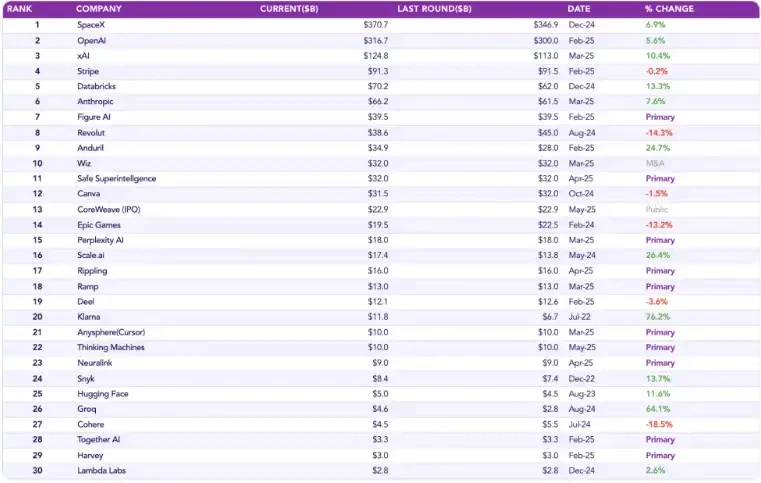
Jarsy has built an indicator system covering the 30 most traded and active unlisted companies in the private market, the "Jarsy 30 Index", used to measure the overall performance of top Pre-IPO enterprises. The index focuses on star companies like SpaceX and Stripe, representing the most imaginative and capital-focused part of the private market. Data shows that these companies have sufficiently attractive return rates.
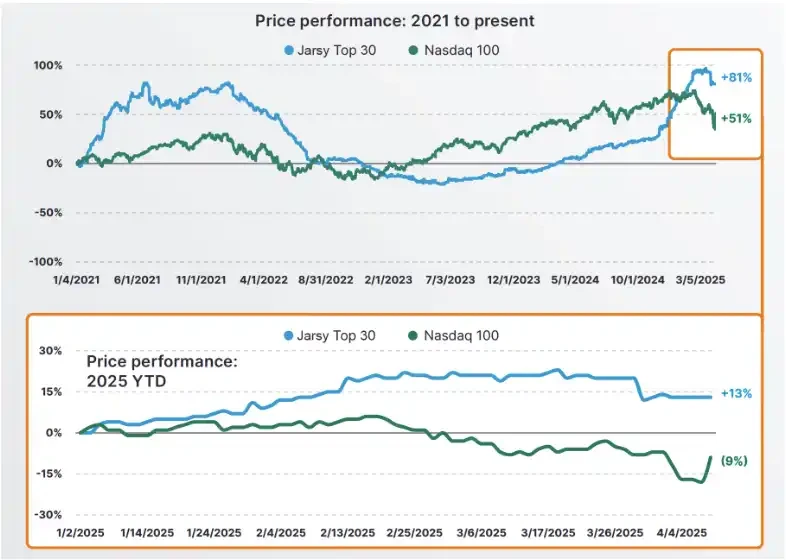
From early 2021 to the first quarter of 2025, the Jarsy 30 Index has cumulatively risen by 81%, far exceeding the Nasdaq 100 Index's 51% in the same period. Even in the first quarter of 2025, when the overall market was declining and the Nasdaq index dropped by 9%, these unlisted top companies still rose by 13% against the trend. This strong contrast is not just an affirmation of the companies' fundamentals, but also a market vote on the growth space before IPO - these assets are still in the most valuable stage of valuation mismatch.
The problem is that this "value capture window" belongs only to a few. An asset market with an average transaction size of over $3 million, complex structure (mostly requiring SPV), and lack of public liquidity is completely a "spectator zone" for most retail investors.
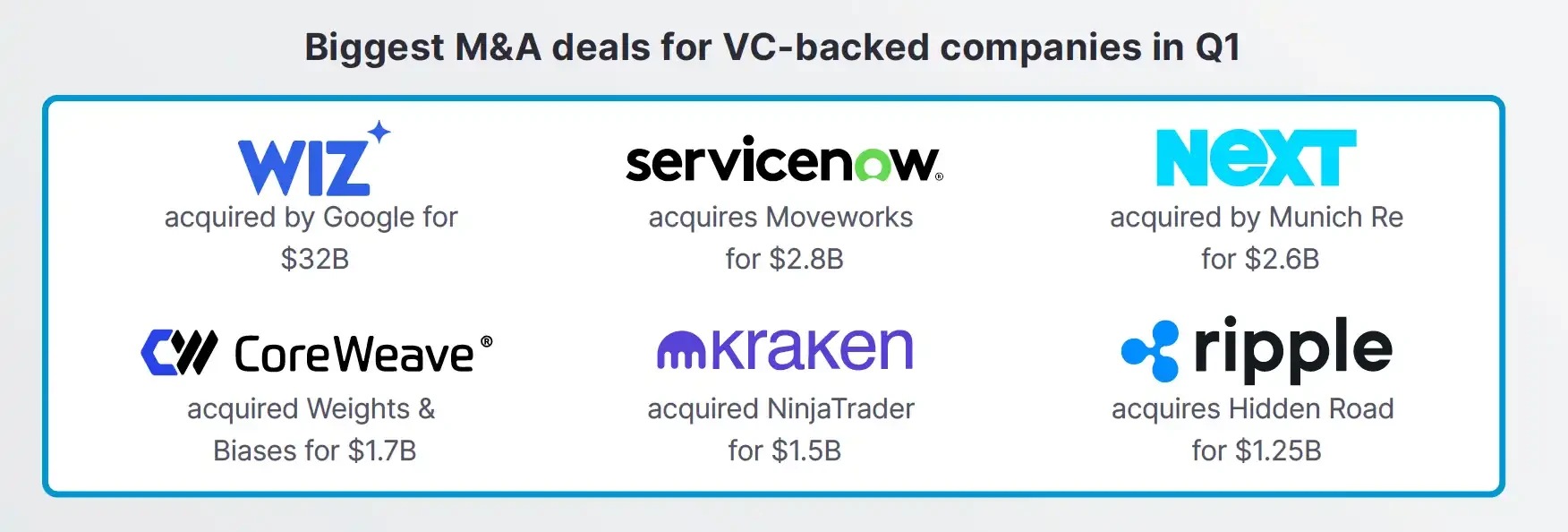
Moreover, the exit paths for these companies are often not limited to IPOs, with acquisitions becoming a more mainstream option, further raising the entry barrier for retail investors. In the first quarter of 2025 alone, the acquisition scale of venture capital-backed enterprises hit a historical high of $54 billion, with Google's acquisition of cybersecurity unicorn Wiz accounting for $32 billion.
Thus, we see a typical traditional financial landscape where the most high-quality growth assets are locked within the circles of high-net-worth individuals and institutions, with ordinary investors excluded.
"Private equity tokenization" is precisely breaking this structural inequality, decomposing originally high-threshold, low-liquidity, and opaque private equity into native on-chain assets, lowering entry barriers, compressing the $3 million entry ticket to $10, transforming lengthy and complex SPV agreements into on-chain smart contracts, and simultaneously enhancing liquidity, allowing assets originally locked in long cycles to potentially be priced around the clock.
Bringing the 'Capital Feast' of the Primary Market into Everyone's Digital Wallet
Jarsy
As a blockchain-based asset tokenization platform, Jarsy aims to break down the walls of the traditional financial world, making Pre-IPO assets exclusively enjoyed by high-net-worth groups accessible to global users. Its vision is clear: to remove investment restrictions imposed by capital thresholds, geographical barriers, or regulatory labels, and redistribute financial opportunities to the masses.
Its operating mechanism is straightforward yet powerful. Jarsy first completes the actual equity acquisition of target companies through the platform, then chains these equity portions through tokens in a 1:1 form. This is not a simple securities reflection, but a substantial transfer of economic rights. More importantly, the total issuance, circulation paths, and holding information of all tokens are transparently chained and open for any user to verify in real-time. On-chain traceability combined with off-chain physical assets structurally achieves a technological reconstruction of traditional SPV and fund systems.
At the same time, Jarsy does not push retail investors into the "deep waters" of professional complex processes. The platform proactively takes on due diligence, structural design, legal custody, and all "dirty and tiring work", allowing users to build their own Pre-IPO investment portfolio starting from as low as $10 using a credit card or USDC. The complex risk control and compliance processes are "imperceptible" to users.
In this model, token prices are highly linked to company valuation, and users' returns come from the real enterprise's growth curve, not the platform's hollow narrative. This structure not only enhances investment authenticity but also opens up the long-controlled revenue channel between retail investors and the primary market at the mechanism level.
Republic
On June 25th, Republic, an established investment platform, announced the launch of a new product line - Mirror Tokens, with its first product rSpaceX using the Solana blockchain, attempting to "mirror" one of the world's most imaginative companies as a publicly purchasable on-chain asset. Each rSpaceX is linked to the expected value trend of SpaceX, a space unicorn valued at $35 billion, with a minimum investment threshold of just $50, supporting Apple Pay and stablecoin payments. This opens the temple doors of the primary market for global retail investors.
Unlike traditional private equity investments, Mirror Tokens do not grant voting rights, but they designed a unique "tracker" mechanism: Republic's issued tokens are essentially debt instruments dynamically pegged to the target company's valuation. When SpaceX goes public, gets acquired, or experiences other "liquidity events", Republic will return corresponding stablecoin earnings to investors' wallets proportional to token holdings, potentially including dividends. This is a new structure of "earning dividends without holding shares", minimizing legal barriers while retaining core earnings positions.
Of course, the mechanism is not without thresholds. All Mirror Tokens will be locked for 12 months after initial issuance before circulating in the secondary market. In terms of regulation, rSpaceX is issued under US Regulation Crowdfunding rules, open to all global retail investors without identity restrictions, but specific qualifications will be dynamically filtered according to local laws.
More excitingly, this is just the beginning. Republic has previewed subsequent Mirror Tokens anchored to Figma, Anthropic, Epic Games, xAI, and other star private enterprises, even allowing users to nominate the next "unlisted unicorn" they want to bet on. From structural design to distribution mechanisms, Republic is creating an on-chain private equity parallel market that doesn't require waiting for an IPO.
Tokeny
Tokeny, a Luxembourg-based RWA asset tokenization solution provider, is also entering the private market securitization track. In June 2025, Tokeny partnered with local digital securities platform Kerdo, aiming to reshape European professional investors' participation in private markets (such as real estate, private equity, hedge funds, and private debt) through blockchain infrastructure.
Its core advantage lies in: standardized product structure, embedded compliance logic, and the ability to quickly replicate and expand across different jurisdictions using Tokeny's white-label technology. Tokeny focuses on endowing assets with "institutional-level legitimacy" - the ERC-3643 standard it uses allows tokens to embed KYC and transfer control logic throughout the generation and transfer process, ensuring product legality and transparency, and allowing investors to self-verify safety without relying on platform endorsement.
Against the backdrop of increasingly strict regulatory frameworks like MiFID II, European market demand for such "compliant on-chain assets" is accelerating. Tokeny is filling the trust vacuum between institutional investors and on-chain assets in a highly technical manner. Behind this collaboration also reflects a trend: RWA track competition is no longer just about on-chain technical implementation, but about who can master the combination of regulations + standardized product structure + multi-jurisdiction issuance channels. The Tokeny and Kerdo partnership is a typical example of this trend.
Conclusion
The rise of private equity tokenization signals a new stage of structural transformation in the primary market driven by blockchain technology. However, this path is still filled with real-world resistance. It may have reshaped access rules but finds it difficult to break the deep-seated structural barriers between retail and institutional investors. RWA is not a "magic key", but more like a long-term game about trust, transparency, and institutional reconstruction, and the real test has only just begun.