Pi Network has introduced two important updates on Pi2Day 2025: Pi App Studio and Ecosystem Directory Staking.
While Pi App Studio was welcomed as a tool for developers to build applications, the Ecosystem Directory Staking feature has caused confusion and controversy in the user community, especially due to the lack of rewards for participants.
What is Pi Network's new staking feature?
The Ecosystem Directory Staking mechanism allows users to stake Pi Coin on the main blockchain to enhance the ranking of selected applications in the Pi ecosystem. This voluntary system increases visibility for quality applications and community participation.
This is quite different from traditional staking models in the cryptocurrency space. In traditional staking, participants typically lock a cryptocurrency in the network to support its operations (such as network security or transaction validation) in exchange for rewards, such as additional cryptocurrency. This difference from standard staking practices has confused Pioneers.
"Pioneers! There is a misunderstanding about this new staking feature. You WILL NOT receive Pi rewards when staking to rank applications! Read carefully, as always! When staking ends, you will get your Pi back minus transaction fees," a user posted.
Moreover, the lack of clear communication from Pi Network's core team has increased confusion. Many users pointed out that the non-reward aspect was not clarified at the time of announcement.
"A new section was added to the Pi Blog, clearly stating that there are no rewards for staking Pi. If this point had been emphasized multiple times from the beginning, many would have understood more easily," another Pioneer added.
 Clarification on Pi Network Staking. Source: Pi Network
Although staking does not provide Pi rewards at the protocol level, there are provisions for incentives from developers. Developers can encourage users by providing incentives such as application improvements, in-app rewards, or promotions. Furthermore, the team noted that users will get back their original Pi after the staking period ends.
"When you stake, your Pi is locked (cannot be used for shopping). For example: You stake 200 Pi for 60 days. After 60 days, you will get back exactly 200 Pi—no bonus, no interest. 212 Pi is only used to help increase the ranking of applications in the ecosystem. Staking is a way to support the ecosystem, not to make money. Choose consciously," a user explained.
Despite disappointment, Pioneers emphasized that the new staking mechanism could benefit the network. According to one user, this encourages meaningful participation and prioritizes applications that users value enough to financially support.
Moreover, the system also reduces the circulating supply of Pi, which could affect its availability and price.
"Circulating supply is decreasing – because all Pioneers staking Pi are locking it, so it will not be available in the market," a post stated.
The supply reduction, combined with potential increased demand, could theoretically push prices higher. With PI's recent performance, it might need any catalyst to increase its value or visibility. BeInCrypto had previously reported that despite major updates, price performance has been quite disappointing.
Pi Coin's value has decreased by 3.57% in the past day. At the time of writing, it is trading at 0.48 USD, just 20.5% away from its All-Time-Low.
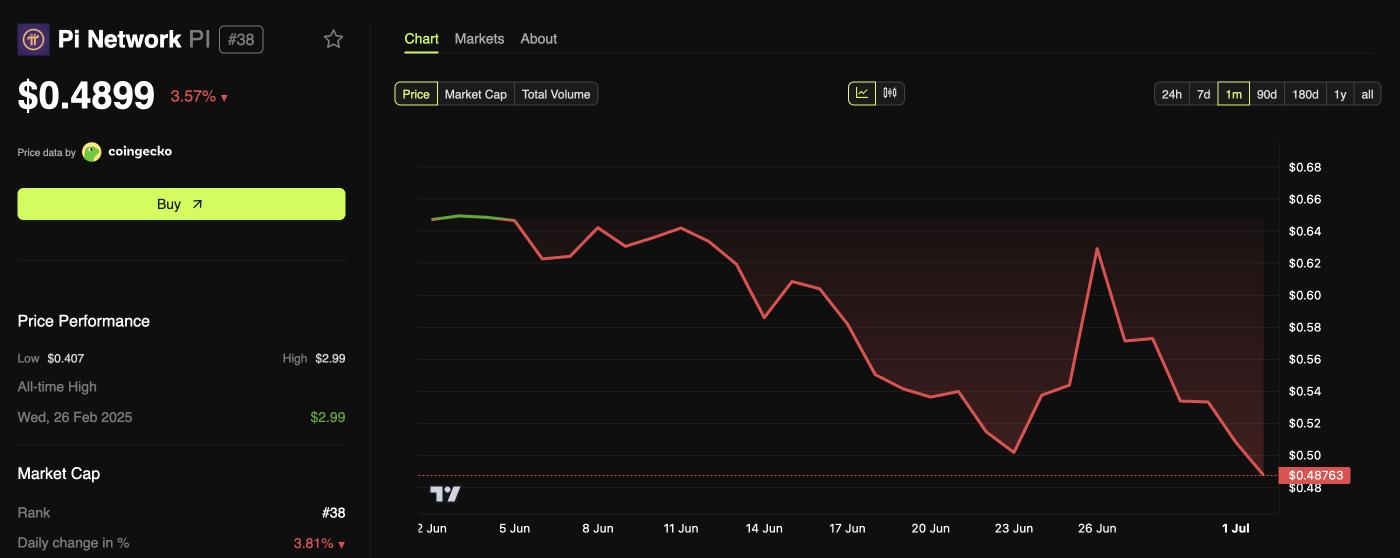 Pi Network Price Performance. Source: BeInCrypto
So, while Pi Network's approach to application development and ecosystem participation is notable, the staking feature emphasizes the need for transparent communication to maintain user trust. Currently, the long-term impact on Pi Coin's value, if any, and user participation remains uncertain.