Will the Soft Rug Scandal Affect the Enthusiasm for Stock Tokenization?
Written by: Bright, Foresight News
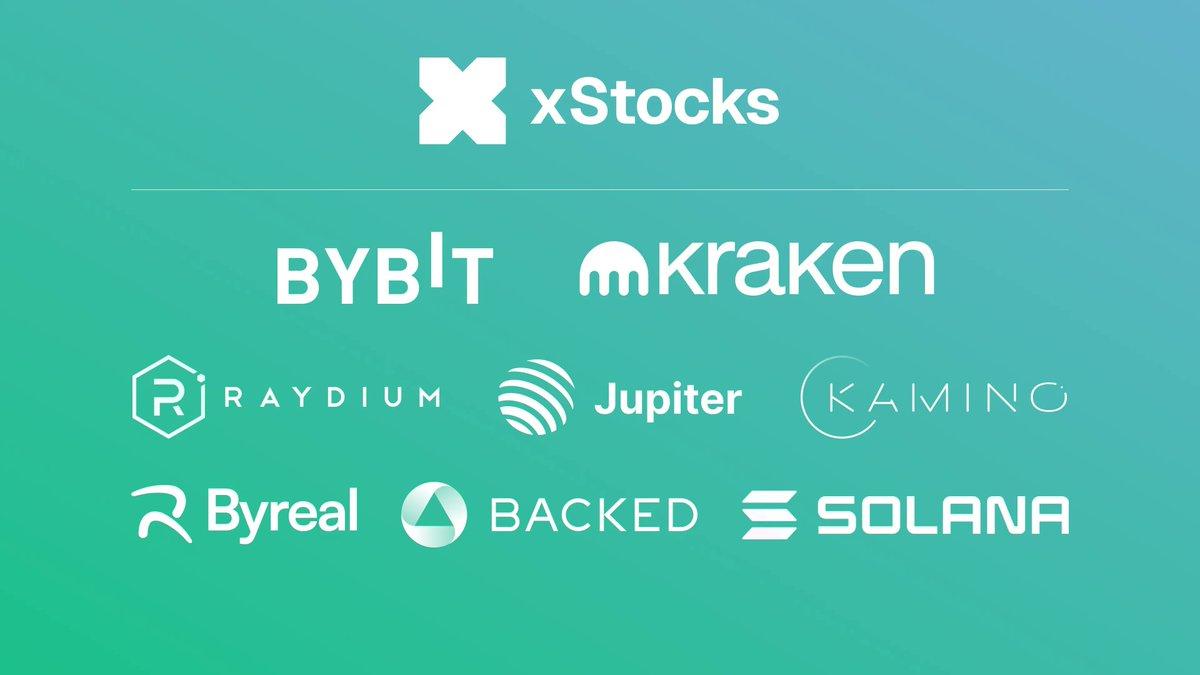
As Robinhood, Kraken, and Bybit successively announced their layout in US stock tokenization, and major ecosystems like Chainlink and Jupiter announced support for tokenized stock trading of Apple, Tesla, and NVIDIA, this "wall-breaking" concept has suddenly become popular in the crypto market. Among them, crypto native exchanges Kraken and Bybit chose to use xStocks' stock tokenization platform based on Solana's underlying architecture, while digital broker Robinhood chose Arbitrum as the token issuance chain.
Just as each ecosystem's enthusiasm was at its peak, the market received a "cold water" message. According to LinkedIn data, the three co-founders of the stock tokenization platform xStocks' Israeli company Backed Finance - Adam Levi Ph.D., Yehonatan Goldman, and Roberto Klein - have been confirmed to have previously worked at the now-bankrupt DAOstack.
Among them, Adam Levi Ph.D. served as a co-creator to provide endorsement, Yehonatan Goldman was DAOstack's Chief Operating Officer, and Roberto Klein was responsible for legal and regulatory work at DAOstack.
ICO Drops data shows that DAOstack raised approximately $30 million through multiple financing rounds from the fourth quarter of 2017 to May 2018, and closed due to fund exhaustion at the end of 2022. The DAOstack team was accused of a "soft Rug Pull".
According to crypto KOL @cryptobraveHQ, DAOstack issued the $Gen token in 2019 and let the token "free fall" after the 2021 bull market. "The team was too lazy to even file a small lawsuit, and just let the token go to zero."

xStocks Operating Mechanism
However, in terms of operating mechanism, xStocks currently provides an operable path.
xStocks is operated by the parent company registered in Switzerland, with the issuer Backed Assets actually controlled in Jersey. Backed Assets purchases stocks in the US market through IBKR Prime under Interactive Brokers, then transfers and places them in an isolated account of Clearstream, a depository institution affiliated with the German Stock Exchange.
After the "buy - transfer - deposit" three-step operation is completed, the issuer Backed Assets will trigger the contract deployed on the Solana chain, issuing corresponding stock tokens, meaning for every 1000 Tesla stocks bought and deposited, 1000 TSLAx tokens will be minted 1:1 on-chain. The token contract control address belongs to the issuer Backed. Afterward, third-party exchanges like Kraken, Bybit, and Jupiter can directly list these tokens for spot and contract trading.
If investors or market makers actually buy 1 or more TSLAx tokens, they can apply to Backed for conversion into actual Tesla stocks from the broker. Meanwhile, dividends will be automatically airdropped as more tokens of the same type after a snapshot.
During market closure, the network-wide stock token prices will reference Chainlink's oracle. If significantly deviating from US stock prices, arbitrageurs can profit by buying and selling tokens on xStocks platform or Kraken and Bybit, thereby driving prices back to a reasonable range.
Potential Concerns
However, besides the founders' previous "soft Rug Pull" history mentioned earlier, community users still report many shortcomings of xStocks that are difficult to substantially improve. Some users frankly state: "On-chain stock tokens are just a castrated version of stocks designed to avoid taxes."
For instance, users generally believe that xStocks' liquidity is very thin, with only 6000 tokens currently available for each stock, already showing significant fluctuations on-chain compared to real US stock situations.
Secondly, transaction fees are extremely high. On-chain tokenized stocks on xStocks have a destruction fee of up to 0.50% and an annual management fee of 0.25%, making holding US stocks on-chain more expensive than holding actual shares.
Additionally, some community members believe that the stock collateral being custody by off-chain custodians lacks public audit and poses a risk of collapse. The fact that on-chain stocks lack shareholder voting rights and are essentially unsecured notes also causes concern. The slow actual experience of purchasing and redeeming has made users find it unbearable.

Borrowing a KOL's comment about xStocks founders' scandal, "An Israeli web3 project with the 'Buddhist' quality of European projects and the capitalization operational capability of American projects; in summary, it's completely irresponsible to users from start to finish."