A recent JPMorgan report has made a cautious forecast for the stablecoin market, predicting that the market size will only reach $500 billion by 2028.
This new forecast is significantly lower than the optimistic predictions from some organizations, which forecast market capitalization could reach $2.5 trillion.
JPMorgan's Lack of Optimism Towards the Stablecoin Market
According to JPMorgan's prediction, the development of stablecoins is limited due to limited adoption outside of cryptocurrency transactions.
The report points out that 88% of the current demand for stablecoins comes from activities within the cryptocurrency ecosystem, such as trading, decentralized finance (DeFi), and reserves of cryptocurrency companies. Meanwhile, only 6% is used for payments, equivalent to about $15 billion.
These numbers show that stablecoins have not yet become a popular payment tool in the real economy.
JPMorgan also rejects the possibility of stablecoins replacing traditional currency in the short term. The reasons given include lack of attractive yields and barriers in converting between fiat and cryptocurrency. However, a survey shows that 49% of 259 global institutions surveyed are currently using stablecoins for payments, while 41% are in the testing or planning stage.
Furthermore, the bank believes that models such as the expansion of China's digital yuan (e-CNY) or the success of Alipay and WeChat Pay are not templates for the future development of stablecoins.
However, some other forecasts are more optimistic about the future of the stablecoin market. U.S. Finance Minister Scott Bessent previously predicted that the USD-backed stablecoin market could exceed $2 trillion by 2028, thanks to clear regulations such as the GENIUS Act, passed by the U.S. Senate in June 2025.
Another report from BeInCrypto also predicts that the stablecoin market size could reach $2.5 trillion, driven by increasing interest from financial institutions and the integration of stablecoins into commercial transactions.
The Stablecoin Market Continues to Grow
This difference reflects different views on the potential of stablecoins, raising questions about the ability of this digital asset to integrate into the traditional financial system. However, the stablecoin market is still witnessing unprecedented growth, with market capitalization exceeding $264 billion.
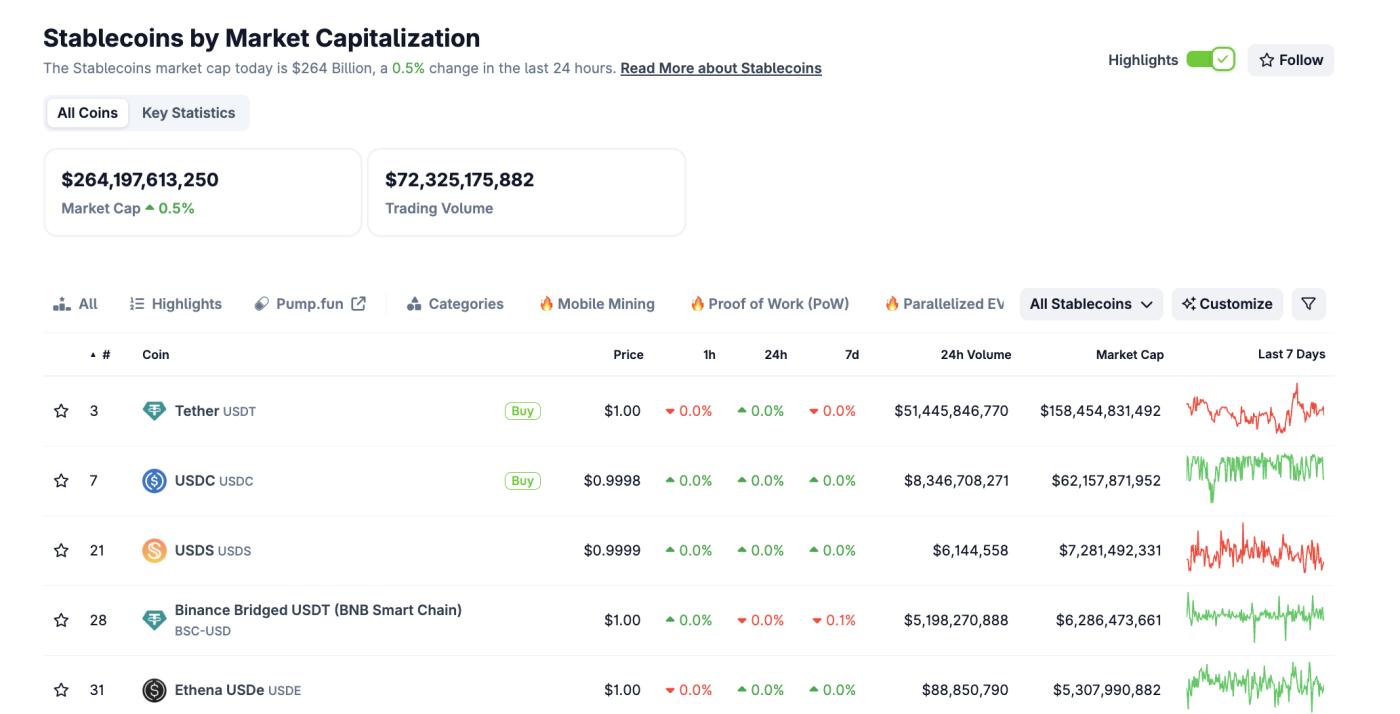 Stablecoin market capitalization. Source: CoinGecko
The dominance of stablecoins in over-the-counter (OTC) cryptocurrency trading is also a positive sign. According to Finery Markets, stablecoins currently account for 74.6% of total OTC trading volume for institutions in the first half of 2025, a significant increase from 46% the previous year and only 23% in 2023.
"The true potential of stablecoins is unlocked by seamlessly connecting issuance with deep secondary markets. For stablecoins to achieve widespread utility and trust, they must have high liquidity, be easily tradable, and be legal across diverse liquidity sources and various secondary venues." The Finery Markets report adds.
This indicates that stablecoins are increasingly becoming an important tool in financial transactions, especially cross-border transactions and quick payments.