Original Author: Jack Kubinec, Blockworks
Original Translation: TechFlow
Original Title: Slower Blocks, More Money? Solana Faces Validator Reward Arbitrage Challenge
As Solana's code issues have been gradually resolved over the past few years, block time (the time required for the network to generate new transaction blocks) has significantly decreased, even falling below its nominal 400 milliseconds.
However, an interesting trend has emerged in the past month: the median block time (a key performance indicator in blockchain networks, reflecting the speed of processing transactions and generating blocks) has surged, and Solana's speed of adding new transactions to the blockchain has slowed down. The reason lies in a new validator strategy, suggesting that slower block generation might be more profitable. According to Blockworks, Anza, Jito, and Marinade are considering addressing this issue.
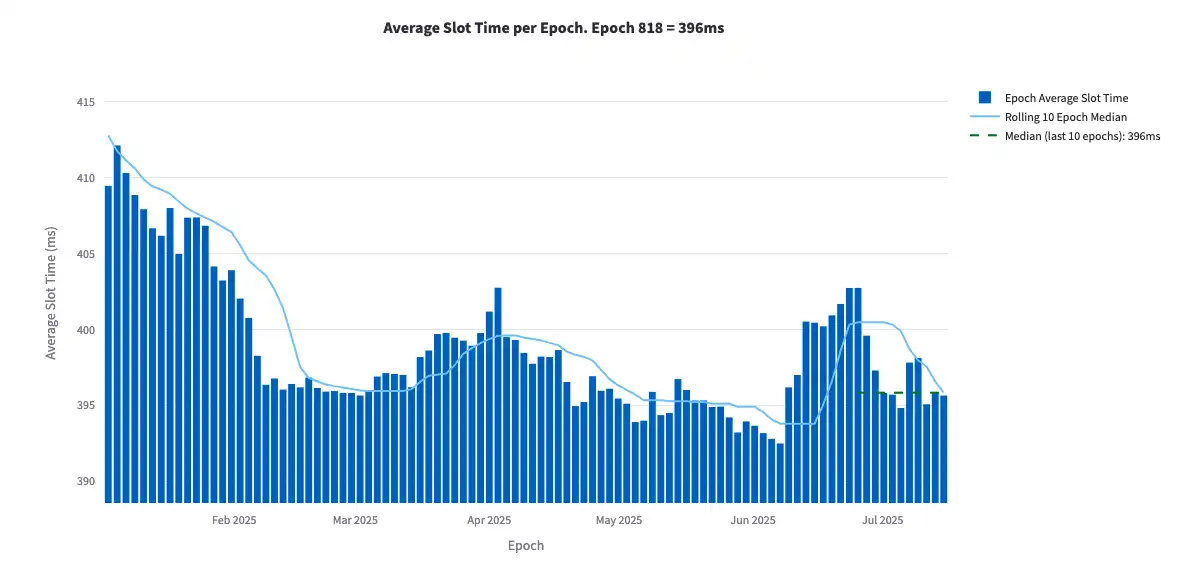
Each Solana block has a validator serving as a leader—responsible for collecting transactions, creating blocks, and broadcasting them to the network. Leaders collect transaction fees by creating blocks. More order flow means more fee opportunities, so validators might choose to process transactions in 500 milliseconds instead of 300 milliseconds to increase rewards.
At a fundamental level, some Solana validators seem to be waiting as long as possible to pack more transactions into a block, thereby maximizing rewards. This behavior has led to increased cycle lengths in Solana.
For a network aiming to be as fast as NASDAQ, this is clearly not ideal. Moreover, reduced cycles mean fewer compound staking rewards opportunities, a point raised by Max Kaplan, CTO of Sol Strategies.
Solana provides a mechanism called "grace ticks," a delay period that still allows leaders to successfully submit blocks. This mechanism aims to prevent unfair penalties for validators in remote locations but also opens the door for validators to deliberately delay block submission.
Additionally, Solana's alternative client Frankendancer recently released a revenue-maximizing scheduler.
According to Kaplan, validators running this client seem to be packaging blocks slightly slower than normal. However, Kaplan added that compared to more severe delays, Frankendancer's delays are negligible, and he does not consider it a "bad thing". Furthermore, block delays are not a new concept in proof-of-stake blockchains. However, Firedancer's upgrade might make this strategy more prominent on Solana. Jump has not commented on this.
Interestingly, Firedancer software engineer Michael McGee described this phenomenon on this week's Lightspeed podcast. He mentioned: "One thing we're seeing in the current validators is...[validators] tend to create more profitable blocks by delaying transaction execution."
Blockworks Research analyst Victor Pham pointed out that Solana validators with more obvious block delays typically run modified versions of the Agave-Jito client.
For example, in the 802nd cycle in mid-June, the median block times for Galaxy and Kiln both exceeded 570 milliseconds. According to Solana Compass data, some untagged validators also ran slowly, with Temporal's validators having a median block time of 475 milliseconds.
Kiln co-founder Ernest Oppetit acknowledged that their validators—the sixth-largest staking validator on the Solana network—had delayed block slots for a period but stated they have now stopped this behavior.
"At Kiln, we pride ourselves on providing the highest staking APY in the market while not compromising security. We have been researching different parts of our tech stack, including time strategies, and maintaining continuous discussions with clients, client teams, and the foundation. Currently, we follow the specification and no longer delay blocks, but many other validators are still doing so. We believe that ultimately, the incentive issue needs to be addressed at the protocol level (rewards decrease with fast block generation)," Oppetit said.
Temporal's Engineering Director Ben Coverston, when asked about his validators apparently participating in the slow block trend, said: "I can say that we are not the reason for this phenomenon."
A Galaxy spokesperson stated: "As a service provider, we support validator configurations that can prioritize maximizing customer staking rewards. On Solana, this might mean proposing slightly slower blocks to ensure higher reward capture. Galaxy has also been responsive to community feedback and has adjusted block times to an acceptable range."
However, the Solana validator community generally believes that slowing down the network is inappropriate, and slow validators are currently facing strong public opposition.
They may soon face more substantial penalties. According to Blockworks, Jito plans to blacklist slow validators from its staking pool, which is the largest in the Solana network.
Jito Foundation Chairman Brian Smith stated that the organization is "drafting a governance proposal that empowers a committee to remove laggards from the JitoSOL delegation set. This proposal should be open for community discussion in a few days."
Marinade co-founder Michael Repetny said that the staking pool provider is "considering submitting this to a governance proposal to discuss the pros and cons of treating [slow validators] as a hard rule/delegation strategy violation."
Protocol-level solutions are also being advanced. Anza's GitHub repository shows a new proposal suggesting halving Solana's grace ticks period. Additionally, the proposed consensus mechanism reform by Solana is expected to address this issue.
"Alpenglow will solve this problem by enabling skip voting functionality," said Brennan Watt, Anza's VP of Core Engineering.
Watt revealed in a recent Lightspeed podcast that Anza hopes to bring Alpenglow to the mainnet before the Solana Breakpoint conference in December.