Source: insights4.vc, compiled by Shaw Jinse Finance
The week of July 17-24, 2025, saw landmark moves in the United States’ digital currency policy. Congress advanced three major measures: the GENIUS Act, which established a unified federal framework for stablecoin issuance and reserves; the CLARITY Act, which clarified the jurisdiction of the Securities and Exchange Commission (SEC) and the Commodity Futures Trading Commission (CFTC) over crypto assets; and a provision in the FY2026 National Defense Act that prohibits the Federal Reserve from issuing a central bank digital currency (CBDC) without explicit congressional approval. This article analyzes the terms and timelines of each bill, assesses its immediate impact on major stablecoin and money markets with a market capitalization of more than $250 billion, and examines the systemic risks highlighted by regulators—from the “singleness” of currencies and run dynamics to illicit financial activity and monetary sovereignty. We quantify stablecoin adoption trends across retail and institutional use cases (USDT vs. USDC dominance, EM FX usage, B2B and payments volumes), and explore strategic responses by banks, payments companies, merchants, and policymakers (including the BIS’s Project Agorá). We conclude with best-case, worst-case, and stress scenario forecasts for the coming year, assessing how these developments could shape global digital currency usage with influence from the United States and Europe.
1. Key provisions of recent U.S. digital asset legislation
Key provisions of recent U.S. digital asset legislation, the Guiding and Establishing National Innovation for Stablecoins in the United States Act (the “GENIUS Act”), was signed into law on July 18, 2025. The Act establishes the first nationwide regulatory regime for payment stablecoins (digital tokens designed to maintain a stable value with fiat currencies). Key requirements include: 100% reserve backing in safe, liquid assets (US dollars, Federal Reserve deposits, short-term U.S. Treasury bills, repurchase agreements, and money market funds), and monthly disclosure of reserve composition by public accountants. Issuers must maintain at least a 1:1 reserve ratio and strictly limit rehypothecation (reuse of collateral) to ensure stability. The definition of an issuer is very strict: only regulated entities can issue stablecoins in the United States, such as licensed bank subsidiaries approved by banking regulators, federal stablecoin issuers chartered by the Office of the Comptroller of the Currency (OCC), or state qualified issuers that meet equivalent regulatory standards. This effectively excludes unregulated or offshore issuers: after the bill is phased in, any stablecoin issued by a non-“permitted” U.S. issuer or approved foreign issuer will not be treated as cash or cash equivalents for accounting purposes and may not be used as collateral in regulated markets. Notably, issuers may not pay interest to stablecoin holders, preventing the emergence of bank-like yield products. In the event of an issuer’s bankruptcy, stablecoin holders’ redemption claims take precedence over other creditors, adding a layer of consumer protection. The bill also requires issuers to comply with financial crime laws: stablecoin operators must register, implement a Bank Secrecy Act anti-money laundering program, and have the technical ability to freeze or “destroy” tokens pursuant to a lawful order. Federal and state regulators are responsible for overseeing compliance: the Office of the Comptroller of the Currency will oversee the new federal stablecoin bank, while state regulators can oversee smaller issuers (with a token size of less than $10 billion) if their rules are deemed “substantially similar” to federal standards. Larger state issuers (or issuers whose states do not have equivalent rules) are subject to joint federal supervision to ensure that there are no regulatory gaps.
Timeline and implementation
The GENIUS Act has an effective date of January 18, 2027, or 120 days after federal regulators publish implementing rules, whichever is earlier. Until then, stablecoin issuance remains the status quo. From the effective date, new issuances must comply with the regulations (only approved issuers can issue), although existing non-compliant stablecoins will remain tradable until July 18, 2028 as a transitional period. By July 18, 2028, all stablecoins issued in the United States must come from regulated issuers, phasing out unregulated stablecoins from the U.S. market. This multi-year transition period reflects lawmakers’ weighing of innovation and risk: giving the current major stablecoins time to apply for a license or cease operations in the United States. The passage of the GENIUS Act with bipartisan support in the Senate suggests that stablecoins are now considered a mainstream part of the financial system and require federal standards. The bill aims to bolster confidence in stablecoins as trusted digital cash equivalents, thereby encouraging broader adoption (and, in the case of USD stablecoins, cementing the dollar’s dominance).
CLARITY Act - Division of regulatory powers between SEC and CFTC
In addition to the stablecoin law, the House of Representatives has also advanced the Digital Asset Market Clarity Act (CLARITY Act) to clarify regulatory jurisdiction over cryptocurrencies. The bill, which passed the House on July 17, 2025, resolves the long-standing ambiguity about when crypto tokens are securities (regulated by the SEC) and when they are commodities (regulated by the CFTC). The bill provides that most "digital commodities" - generally referring to crypto tokens that are intrinsically related to decentralized blockchains - are regulated by the CFTC even in the spot market. The bill also provides that tokens that were originally part of an investment contract (for example, a token sale used to raise funds) can become non-securities after sufficient decentralization or the network "matures." In effect, this provides a migration path for projects: projects can submit a notice to the SEC that their blockchain has reached a "mature" state (no controlling entity), at which point their tokens will be regulated as commodities rather than securities. The U.S. Securities and Exchange Commission (SEC) still has jurisdiction over initial investment contracts and any tokens that are still controlled by the issuer, and is responsible for anti-fraud enforcement, but the regulation of trading in truly decentralized tokens and commodity-like crypto assets must give way to the U.S. Commodity Futures Trading Commission (CFTC). The bill also creates new regulatory categories under the CFTC - digital commodity exchanges, brokers and dealers, similar to traditional securities intermediaries. These entities will register with the CFTC and comply with customer protection, reporting and custody rules tailored for the crypto market, bringing crypto trading platforms that are currently in a gray area into a clearer regulatory scope. In addition, the CLARITY Act strengthens the disclosure and protection rules for digital asset companies (e.g., requiring segregation of customer funds, requiring bankruptcy proceedings to protect customers, and conflict of interest disclosures) to prevent the abuse of customer assets like FTX.
Stablecoins under the CLARITY Act
The intersection of the bill and stablecoins is to confirm that payment stablecoins are neither securities nor commodities as long as they meet the regulatory requirements set out in the GENIUS Act. This clarity exempts compliant stablecoins from being identified as investment securities by the SEC, while also avoiding being considered a commodity by the CFTC, thereby establishing stablecoins as a new and unique category of regulated payment instruments.
The CLARITY Act passed the House with strong bipartisan support (294 in favor, 134 against) but is still awaiting Senate action as of late July 2025. The bill’s fate in the Senate is unclear; opponents argue that it could overly weaken the SEC’s investor protections. Still, the bill’s passage in the House reflects the industry’s strong desire for regulatory certainty. Observers note that agreement on a statutory framework could help the U.S. catch up with overseas comprehensive regulatory regimes such as Europe’s Markets in Crypto-Assets (MiCA) and keep crypto innovation at home. The bill’s proposal to establish the CFTC as the lead regulator of cryptocurrency trading would mark a significant shift in U.S. cryptocurrency regulation, limiting the SEC’s recent assertion of broad regulatory authority over digital assets. If the bill passes, the SEC and CFTC would have to work together on rulemaking and coordination, a challenging but potentially stabilizing development for market participants.
Anti-CBDC measures – blocking the “digital dollar”
The third development was the inclusion of an anti-CBDC provision in the National Defense Authorization Act (NDAA) for Fiscal Year 2026. House Republicans, led by Majority Leader Tom Emmer, pushed for the Anti-CBDC Surveillance State Act (HR 1919), which seeks to prohibit the issuance of a U.S. central bank digital currency without congressional consent. This reflects the political resistance to a retail “digital dollar.” The provision, which was eventually appended to the must-pass defense bill amid heated debate in the House, prohibits the Federal Reserve from issuing central bank digital currencies directly or indirectly to individuals and requires that any central bank digital currency project must be explicitly authorized by Congress, effectively preventing the Federal Reserve from unilaterally launching a “digital dollar.” The provision also states that the Federal Reserve may not use central bank digital currencies to implement monetary policy or control the money supply in new ways. Supporters see this as protecting privacy and freedom: critics argue that centralized central bank digital currencies, unlike decentralized cryptocurrencies, would enable governments to monitor and control private transactions.
The political context is worth noting: President Trump has issued an executive order prohibiting the federal government from working on central bank digital currencies, and the bill aims to codify that ban into law. Many Republicans believe that a central bank digital currency in the United States would threaten the role of the private sector and the anonymity of cash.
House leaders have attempted to tie the anti-CBDC bill to the NDAA to force its consideration. However, it is uncertain whether the measure will pass the House and Senate sessions. The Fed, for its part, has been cautious about advancing a digital dollar, repeatedly stating that it will not act rashly without clear congressional support. However, the House move sends a clear signal that the Fed will face severe legislative obstacles if it attempts to launch a central bank digital currency for the masses. This stance has prompted the US digital dollar efforts to turn to other alternatives (such as private sector stablecoins or bank-issued digital deposits), as detailed in Section 5. It is worth noting that the anti-CBDC provisions do not directly affect ongoing wholesale CBDC or payment system improvements (which the Fed continues to explore, such as the FedNow instant payment service). Its main role is to send a policy signal - making US law favor private innovation (and perhaps tokenized bank deposits) rather than centrally managed retail currencies. In the short term, this reassures stablecoin issuers and cryptocurrency advocates that government competitors are on hold, thereby maintaining the role of the stablecoin market in digital dollarization.
The combined effect of these three initiatives is to bring stablecoins into the regulated financial system while drawing a line under certain state-controlled digital currency models. The remainder of this article will assess how these changes are playing out in the market, and the risks and opportunities that arise from them.
2. The short-term impact of the GENIUS Act on stablecoins and financial markets
The direct impact of the GENIUS Act on major stablecoin issuers is huge. Tether (USDT), the largest stablecoin with about 60% of the market, faces a choice: comply with the new law or exit the US market. Tether’s issuer is based overseas and has historically operated with little transparency. Under the new law, by 2027, Tether will need to register an entity in the US (or work with a US-regulated issuer) and hold its reserves entirely in approved assets and be audited monthly. Otherwise, its USDT tokens will no longer be legally available to US users after the transition period ends. Tether has already withdrawn from some highly regulated jurisdictions (it withdrew from the EU rather than comply with new licensing requirements under Europe’s Markets in Crypto-Assets Regulation). It may similarly restrict its US operations if it deems compliance costs too high or exposes too much information. However, given that Tether is backed by the US dollar and has a large share of US Treasuries in its reserves, even overseas issuers will be indirectly affected by US policy. Tether will likely increase transparency and strengthen its reserves to maintain confidence — it has a strong incentive to demonstrate 100% reserve backing to avoid redemptions, especially since the bill explicitly states that non-compliant stablecoins cannot count as cash equivalents in regulated venues.
In contrast, Circle (USDC) is a US company that has been lobbying for regulatory clarity. Circle’s USDC already invests the majority of its reserves in short-term Treasuries and cash, and attests monthly. The GENIUS Act recognizes Circle’s approach and provides a path for it to become a federally approved issuer (possibly through a charter from the Office of the Comptroller of the Currency). As Circle seeks the much-sought-after federal license, its market position could be strengthened as an FCC (fully compliant token) that institutions may prefer. The fact that the bill prohibits interest payments means that stablecoin holders are not directly compensated; this preserves the current model where seigniorage revenue flows to the issuer. Today, Tether and Circle earn a significant amount of interest from reserve asset investments. In fact, Tether’s profits from reserve investments are now comparable to those of large financial institutions. With regulation, this revenue model is legitimized, but it also attracts competition from traditional finance.
Emerging Issuers and Banks
The stablecoin bill opens the door for banks and fintechs to join the fray. Large banks have been hesitant to issue their own stablecoins amid regulatory uncertainty. Now, banks (or their affiliates) can issue “payment stablecoins” with permission from federal regulators. We may see large custodial banks, payment firms, or technology companies (if permitted) launch stablecoins, subject to safety safeguards. Large tech companies are subject to one notable restriction: publicly traded non-financial companies may not issue stablecoins unless a high-level regulatory committee unanimously determines that they do not pose systemic risk and are subject to strict data privacy rules. This provision is clearly aimed at projects like Facebook’s past Libra/Diem plans. This means that it will be difficult for companies like Amazon or Meta to issue stablecoins directly, but rather to work with licensed issuers or banks.
In the short term, changes in market structure may include competition for GENIUS Act licenses, consolidation of small businesses, and the exit of non-compliant currencies from US platforms. For example, as the deadline approaches, offshore US dollar stablecoins or algorithmic tokens (which do not meet the definition of full reserves under the Act) may be delisted from US exchanges. Instead, tokens backed by US debt are expected to gain favor. Circle and Paxos (issuers of USDP) have positioned themselves as transparent, regulated brands, which may help them grab market share lost by Tether. Early data shows that the market is rebalancing: after falling in 2022, USDC's market share has rebounded to about 25% by mid-2025, stealing a few percentage points from USDT. In the coming months, we may see Tether reduce the risk assets in its reserve portfolio and shorten the investment period to comply with the restrictions of the Act (only highly liquid, short-term instruments are allowed). All issuers are likely to hold a larger proportion of US Treasuries, both for compliance and to signal their stability to investors.
Impact on Treasury and Money Market Interest Rates
The core premise of the GENIUS Act is that bringing stablecoins under regulation will increase demand for U.S. Treasuries, thereby entrenching the dollar’s reserve currency status. In fact, the mandatory requirement for backing by Treasuries and bank deposits makes stablecoins a significant source of demand for safe assets. There are now more than $260 billion in U.S. dollar stablecoins in circulation, with tens of billions of dollars held in short-term Treasuries. Analysis by the Bank for International Settlements shows that flows of stablecoin reserve funds can influence money market rates. One study found that an inflow of about $3.5 billion into stablecoins could reduce three-month Treasury yields by about 2 to 2.5 basis points over 10 days. These effects are temporary but noteworthy, highlighting the growing influence of stablecoins in short-term funding markets.
Conversely, large stablecoin outflows or redemptions can significantly increase yields, suggesting that a sudden run on stablecoins could quickly tighten money markets. This has practical implications: regulatory changes prompting large USDT redemptions could cause Tether to liquidate its Treasury holdings, causing yields to spike. The restrictions in the GENIUS Act are designed to reduce the risk of runs by ensuring that stablecoins are as good as cash. In the short term, money market investors are closely watching the flow of stablecoins. The passage of the bill has raised expectations of increased stablecoin issuance, which means more Treasury purchases, leading to a narrowing of Treasury yield spreads.
Seigniorage and competitive dynamics
The prohibition on paying interest to stablecoin holders ensures that issuers receive all seigniorage profits from investing reserves. With short-term U.S. Treasury rates around 5%, this profit is considerable. For example, USDT's approximately $130 billion in circulation invested in short-term Treasury bills generates approximately $6-7 billion per year, comparable to the profits of large financial institutions. In the short term, this dynamic incentivizes issuers to expand supply. We have observed Tether issuance reaching all-time highs, and Circle also repositioning to expand USDC after contracting in late 2024.
However, as regulated players such as banks join, the seigniorage spread may narrow if issuers adopt competitive strategies such as fee rebates to indirectly share in the benefits. Banks may argue that stablecoin issuers should face similar capital or deposit insurance requirements. This debate may affect regulatory rulemaking on stablecoin capital and liquidity requirements. Initially, after the bill was passed, market confidence in stablecoins increased significantly, and some stablecoins had tight pegs and small premiums. Short-term winners include Circle and US money market funds, which indirectly benefited from capital inflows. Losers or challenges include algorithmic stablecoins and coins that rely on riskier assets, which may force Tether to further cut non-compliant assets. If demand grows further, the demand for stablecoins may have an impact on the issuance of Treasury bonds. Overall, legislative clarity is converging crypto-dollar liquidity with traditional markets, affecting the behavior of issuers, the flow of funds for US Treasury bonds, and the layout of financial institutions entering the stablecoin field.
III. Systemic risk considerations: stability, currency uniformity and illegal financing
The rapid rise of stablecoins has triggered warnings from economists and central bankers about potential systemic risks. The Financial Times noted that despite their growing use, stablecoins are “no substitute for money” because they replicate some of the functions of money but lack comprehensive safeguards. This section will examine the key risk arguments put forward by the Financial Times and the Bank for International Settlements, including monetary unity (unified currency value), bank run dynamics, illicit finance, and monetary sovereignty, in light of the new US initiatives.
Currency Singularity and Fragmentation
A fundamental concern is that multiple private stablecoins could undermine the “foreign” fungibility of money. In a well-functioning monetary system, a dollar is worth the same whether it is a bank deposit or cash, and is always redeemable at par. However, stablecoins introduce fragmentation: a token from issuer A may not always trade 1:1 with a token from issuer B or actual dollars, especially under stress. Hyun Song Shin of the Bank for International Settlements likens today’s stablecoins to 19th-century wildcat notes, which often traded at different discounts depending on the creditworthiness of the issuer. He notes that stablecoins “often trade at different rates depending on the issuer, undermining the principle of central bank money foreclosure.” This lack of uniformity, or singularity, means that stablecoin holders bear the credit risk of the issuer. In fact, some small deviations have already occurred: USDT briefly traded below $1 during market panics, and USDC briefly depegged to around $0.90 in March 2023. GENIUS seeks to address the singularity problem by imposing redemption obligations and reserve transparency to ensure that each regulated stablecoin is reliably worth $1. The bill also prohibits misleading claims that any stablecoin is an official legal tender. However, singularity is only possible if stablecoins can be redeemed directly at the central bank, which is not currently provided. The BIS advocates a better solution: tokenized central bank currencies or bank deposits on a unified ledger, which guarantees singularity by design. Until then, stablecoins remain an approximation of currency, which carries the risk of currency fragmentation.
Operational dynamics and sell-off risk
Stablecoin runs are perhaps the most serious systemic threat. If holders doubt the asset reserves of a stablecoin, large-scale redemptions could force the issuer to quickly sell off reserve assets. Such sales could have repercussions for broader financial markets, especially when the reserve assets include a large amount of a specific asset. For asset-backed stablecoins like USDT and USDC, runs can translate into large sell orders for government bonds or bank deposits, exacerbating market pressures. The Bank for International Settlements explicitly warned that if a stablecoin collapses, its asset reserves could experience a "dumping." So far, stablecoins have generally shown strong resilience; even during the USDC decoupling in March 2023, the redemption process was relatively orderly. The bankruptcy provisions in the GENIUS Act give stablecoin holders priority claims, aiming to reduce the motivation for runs. The bill also requires issuers to develop suspension and liquidation plans and stipulates that highly liquid reserves must be held to meet redemption needs. However, a major issuer scandal or cyberattack could still trigger a wave of redemptions. In addition, if stablecoins are used as collateral for DeFi or settlement, instability could spread. U.S. regulations aim to reduce this risk through greater transparency, increased oversight, and clear redemption rights.
Illegal financing and financial integrity
Stablecoins raise concerns about money laundering, sanctions circumvention, and illegal transfers of funds due to their near-instant global liquidity. The Financial Times and the Bank for International Settlements point to the “opaqueness” of stablecoin arrangements and cast doubt on the integrity of reserves. The GENIUS Act requires issuers to implement a comprehensive BSA/AML compliance program and to strictly adhere to U.S. sanctions laws, including the technical ability to freeze tokens involved in illegal activity. Major issuers like Tether and Circle already maintain blacklists, though Tether has been criticized and fined by regulators in the past for inadequate controls. U.S. regulation through agencies like the Financial Crimes Enforcement Network (FinCEN) and the Office of Foreign Assets Control (OFAC) will increase transparency and compliance monitoring. However, if mainstream stablecoins become too transparent, illicit actors may turn to less regulated stablecoins or privacy-enhancing tokens. Overall, recent regulatory actions have strengthened financial integrity by making illicit finance harder to hide and easier to track.
Cross-border monetary sovereignty
Widespread use of foreign stablecoins could undermine national monetary sovereignty, especially in emerging markets. The Bank for International Settlements has warned that unregulated stablecoins pose risks to monetary sovereignty and could fuel capital flight. U.S. dollar stablecoins have been widely circulated in countries facing inflation or capital controls, effectively acting as unofficial dollarization. This weakens the monetary control of local banks and central banks. The GENIUS Act addresses this problem by imposing strict conditions on foreign currency stablecoin issuers to enter the U.S. market, in effect requiring major offshore issuers to accept U.S. regulation or be banned. However, U.S.-regulated stablecoins could still spread globally, strengthen the dominance of the U.S. dollar, and cause tensions abroad. Institutions such as the International Monetary Fund have suggested that emerging economies strengthen foreign exchange controls or consider issuing their own digital currencies. Overall, the new U.S. framework has promoted the global expansion of U.S. dollar stablecoins, which is beneficial to the influence of the U.S. dollar, but has also sparked debates on stability issues abroad.
4. Stablecoin adoption trends and usage indicators
In 2025, global stablecoin adoption continues to accelerate, with both market size and real-world applications reaching new highs. This section quantifies key trends: overall market capitalization, network distribution (Tron vs. Ethereum), usage in emerging markets (including P2P FX), corporate (B2B) transaction volumes, payment card integration, and cross-border payment metrics.
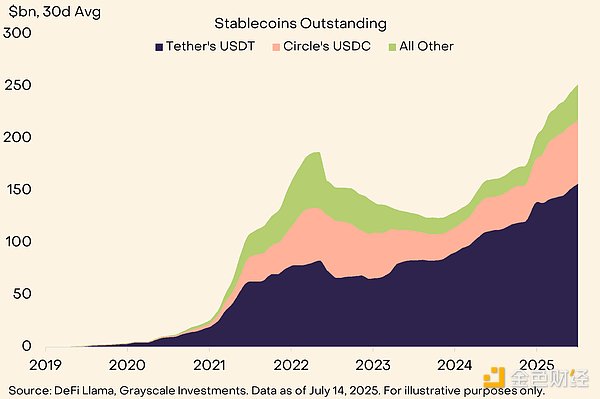
The total value of stablecoins in circulation now exceeds $250 billion, with the vast majority denominated in U.S. dollars (USD-backed stablecoins account for about 99% of the stablecoin market by value). This is more than double what it was two years ago and significantly higher than the roughly $160 billion at the beginning of 2024. According to Messari’s “State of Stablecoins 2025” report, released on July 22, 2025, the market value exceeded the $250 billion mark, driven by clearer regulation and rising demand for U.S. dollar liquidity. USDT remains the largest stablecoin (~60%-62% of total market cap). Circle’s USDC ranks second (~20%-25%), and although it lost ground in 2023, it has since stabilized. A notable new entrant is PayPal’s PYUSD (launched in 2023), although it still has a small share of the market. Other entities like TrueUSD (TUSD) and BUSD have had more volatile trajectories — for example, BUSD was scaled down in 2023 due to regulatory action. Legislative progress is expected to consolidate the top two (USDT and USDC) while encouraging the emergence of new regulated stablecoins. Messari noted that USDC's share has begun to rise again as Circle adapts to new regulations and some users prefer its regulated status. In the first half of 2025, the value settled in stablecoins through public chains exceeded $2.6 trillion, reflecting its high circulation velocity in use cases such as trading and arbitrage.
Tron and Ethereum (USDT and USDC)
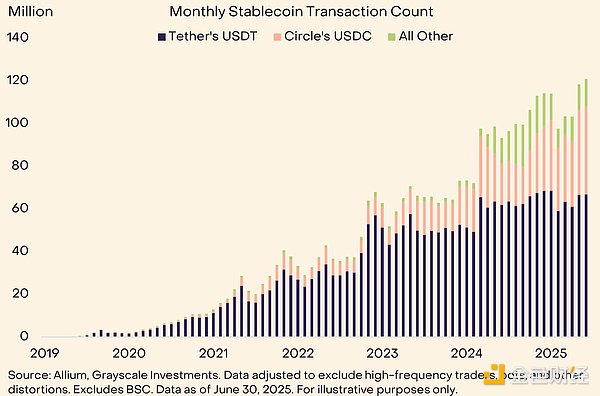
A notable pattern in stablecoin usage is the difference in preference for different networks. In many areas, USDT has become synonymous with the Tron blockchain, while USDC is primarily used on Ethereum and Layer2 networks. A May 2025 survey found that USDT accounted for 90% of stablecoin payment transaction volume, of which about 60% was processed by Tron. Tron offers faster and cheaper transactions than the Ethereum mainnet, which explains its popularity in high-volume, cost-sensitive applications. Tron now typically processes five times the USDT transaction volume per day as Ethereum. Retail users in emerging markets tend to use Tron-based USDT because of its near-zero transaction fees. Ethereum remains important in exchange settlement and decentralized finance. BSC and Polygon also carry stablecoin transaction traffic. Regulators have noticed these differences: Tron is more opaque and is primarily outside of U.S. jurisdiction. Regulatory actions may indirectly prompt migration to more compliant chains, but Tron is expected to continue to dominate USDT transaction volume in the short term. Circle is expanding USDC to networks like Arbitrum and Solana, both of which are expected to continue to grow and serve different user groups.
Stablecoins in Emerging Markets — Peer-to-Peer (P2P) FX Trading and Remittances
Stablecoins have had a profound impact on emerging markets, providing access to dollars outside the traditional banking system. Individuals in Africa, Eastern Europe, the Middle East, and Latin America use USDT or USDC to hold USD value or send money abroad through peer-to-peer trading platforms or over-the-counter brokers. Binance's peer-to-peer marketplace trades USDT in local currency with narrower FX spreads than banks or remittance services. In Nigeria, for example, the stablecoin market actually sets the actual foreign exchange rate. People working abroad send stablecoins home quickly and at a low cost, competing with traditional remittance channels, especially in Latin America. Local startups in places like Argentina offer fiat spending options for stablecoin balances to combat inflation. A significant portion of B2B payments involving emerging markets are now conducted through stablecoins, reducing FX slippage and bank fees. Stablecoin adoption has increased significantly in emerging markets for payroll, trade settlement, and savings. Chainalysis reports that in some emerging markets, stablecoins account for more than 30% of total cryptocurrency trading volume.
Business (B2B) and bank card payments
Stablecoin adoption is increasing in business-to-business (B2B) transactions and consumer payments. Annualized stablecoin payment volume is estimated at $72.3 billion by early 2025, covering categories such as B2B, B2C, person-to-person (P2P), card payments, and lending. Businesses use stablecoins to settle invoices, pay suppliers or contractors, and especially in cross-border transactions. Circle provides an API for businesses to integrate USDC into their financial operations. Payment cards associated with stablecoin wallets have emerged, allowing cryptocurrencies to be converted into fiat currency for spending at the point of sale via Visa or MasterCard debit cards. Coinbase and Crypto.com offer cards that use USDC or USDT balances. Stablecoin transaction volumes are already competitive with networks such as Visa and PayPal on some metrics, with millions of stablecoin transactions occurring daily. Visa and Mastercard themselves are also piloting stablecoin settlements, viewing stablecoins as complementary to traditional currency flows.
Cross-border payment indicators highlight the popularity of stablecoins, with cross-border flows of stablecoins growing rapidly, especially in high-cost corridors such as the United States, Mexico and Europe and Africa. The World Bank and central banks now track stablecoin remittances, recognizing their growing role. The premium on stablecoins in local markets suggests that people are in high demand for them for capital flight or savings purposes. Stablecoins have penetrated the field of foreign exchange trading and settlement, reducing the cost of currency exchange and remittances, and posing a challenge to traditional financial services.
5. Strategic responses by banks, payment service providers, large merchants and policymakers
This has prompted various players in traditional finance and policy to adjust their strategies. This section explores the responses of banks, payment service providers (PSPs), large merchants and policy institutions, including initiatives such as the Bank for International Settlements (BIS)'s Agorá project that provide alternatives.
Banks and Stablecoin Strategies
Initially, banks were cautious about stablecoins, viewing them both as a threat (to deposits) and an opportunity (to provide new services). With the GENIUS Act legalizing stablecoins, many banks are moving from watching to participating. There are several potential strategies for large US banks: (a) issuing their own stablecoins or deposit tokens; (b) working with existing issuers (such as acting as custodians or settlement banks); (c) integrating stablecoins into payment services without issuing them themselves. So far, some smaller institutions have been involved, such as Silvergate Bank (now defunct) which helped launch a token, Signature Bank using Signature Systems, and JPMorgan Chase which has launched JPM Coin (a private permissioned stablecoin for corporate clients) since 2019. But these attempts have been isolated and not widely used on public chains. The new law paves the way for specialized “narrow banks” focused on digital dollars by providing stablecoin issuers with a charter from the Office of the Comptroller of the Currency (OCC). Banks like Custodia, a digital asset bank registered in Wyoming, have faced lawsuits after the Fed denied them accounts, in part due to a lack of federal law — now they may have clearer grounds to reapply under the bill’s framework.
Traditional banks are also incentivized by the yields that stablecoins bring. If billions of dollars in interest income flow into Tether’s profits, banks think this could become their business, too (since they traditionally profit from deposits). We may see consortium efforts: indeed, in 2024, a group of banks and credit unions in the US explored a stablecoin called USDF, but stalled for regulatory reasons. Under the GENIUS model, such a consortium could become a government-approved issuer (backed by FDIC-insured members). Banks may find that stablecoins help increase interbank settlement speed and provide faster money movement for corporate clients. Many banks in Europe and Asia are already testing tokenized deposits — essentially blockchain-based representations of bank deposits. These are similar to stablecoins, but still on the bank’s balance sheet. Standard Chartered and HSBC, for example, have piloted such tokens for internal transfers. In the US, some experts advocate a “regulated liability network” model, where banks jointly issue interoperable tokens (think of it as each bank issuing its own stablecoin, 1:1 interchangeable). This regulatory divide (the Federal Reserve does not issue central bank digital currencies, but allows private, regulated cryptocurrencies) has led banks to lead innovation. JPMorgan Chase’s CEO once famously said that if a stablecoin gets big enough, banks will get involved — and this seems to be happening. Expect one or more large U.S. banks to announce the launch of a stablecoin (likely for institutional users first) or provide stablecoin services to fintech companies in the next year.
European influence: European banks, facing the Market Infrastructure Directive (MiCA) that allows them to issue “electronic money tokens”, are also exploring this area, and transatlantic consistency may encourage US banks to not lag behind. On the other hand, banks have also expressed risk concerns: they worry that stablecoins could lead to deposit outflows in a crisis (if people are worried about bank defaults, they may withdraw money from banks and put it into stablecoins, which is the opposite of the usual concerns about stablecoin runs). Therefore, they may push regulators to establish a level playing field, such as requiring stablecoin issuers to have similar capital buffers. We may see banks require stablecoin issuers to gain access to the Fed’s main account to safely store reserves (this is not required by law, but it is a real issue). If approved, this would bring stablecoins closer to the model of central bank digital currencies (CBDCs), but managed by private banks. In short, the strategic response of banks is to embrace and shape: they want to participate in the stablecoin game directly or through infrastructure support, while ensuring that the rules do not weaken their competitive position. This is a delicate balance - some smaller banks may support stablecoin innovation to win new business, while large banks may ensure that any such currency is under strict control of the banking industry.
Payment service providers and merchants
Payment companies (such as Visa, Mastercard, PayPal, Stripe) and large merchants are also adapting to this change. PayPal boldly launched its own US dollar stablecoin (PYUSD) in 2023, becoming the first major technology company to launch such a product.
While acceptance has been modest so far, PayPal’s move suggests that payment service providers (PSPs) view stablecoins as both a threat and a logical extension of their business. With legal clarity, PayPal can now apply for a federal license or work with an issuer (its stablecoin is actually issued by Paxos under New York State regulations and may transition to a federal framework in the future). Visa and Mastercard have been very active in connecting cryptocurrencies and traditional payments. Both companies are working with stablecoin companies to enable conversions at the point of sale. Visa’s head of cryptocurrency, McHenry, reiterated the company’s commitment to using stablecoins to settle transactions where it is advantageous to do so in 2025, essentially viewing stablecoins as a new settlement currency. These card networks are also developing messaging and identity authentication standards to attach to blockchain transactions.
— For example, Mastercard has launched “crypto-credentials” that mark blockchain transfers with verified information, which could make stablecoin transactions more commercially acceptable by reducing anonymity. Stripe and other payment processors have already integrated stablecoin payment capabilities: freelancers can now get paid in USDC through Stripe Connect, which is invaluable in countries where Stripe cannot easily send money. For large tech retailers (Amazon, Apple), they have not directly accepted cryptocurrencies so far, but Amazon is rumored to be exploring this aspect. If there is customer demand, the legislative environment may encourage them to accept stablecoins, because now they can be sure of consumer protection and legal status. We can perhaps imagine that large retailers will soon accept USDC or USDT for online purchases, possibly converted to fiat currency through third-party payment gateways. Starbucks and some chains have already experimented with accepting cryptocurrencies (mainly through conversion apps); stablecoins are easier to accept because of their lack of volatility. In addition, merchant acquirers—that is, companies that process credit card payments for merchants—may incorporate stablecoin payments as a payment method in their terminals. This could reduce fees for merchants if done outside of traditional credit card channels (cryptocurrency transaction fees can be much lower than credit card fees, especially for cross-border sales). For example, a merchant selling digital goods globally might prefer to accept stablecoin payments to avoid the 3% credit card fee and the hassle of currency conversion. Currently, adoption is low, but companies like Overstock (a US retailer) have accepted stablecoins for years, and some travel booking sites also accept USDC. As regulation improves, more mainstream companies may try to get involved in this space, perhaps starting with business-to-business (B2B) use cases (for example, paying suppliers with stablecoins to get early payment discounts).
Strategic logic: Merchants and payment service providers (PSPs) will eventually follow customers and cost advantages. If stablecoins can provide near-instant settlement and lower fees (no chargebacks, etc.), they can improve merchants' cash flow. But on the other hand, merchants accepting stablecoins brings foreign exchange considerations - European merchants accepting USDC will face dollar risk unless they immediately convert to euros. However, stablecoin infrastructure providers now provide automatic exchange and custody services to manage this risk. We have seen similar situations in Latin America: merchants in countries such as Venezuela have begun to informally accept USDT to purchase daily necessities because they trust this currency more than their own bolivars; in hyperinflationary economies, formal businesses may also begin to price in stablecoins. Payment giants do not want to be replaced by crypto networks, so their strategy is to "embrace and expand": incorporate stablecoins into their ecosystem, ensure that they remain a trusted brand that facilitates transactions, and may even use stablecoins to enter new markets (for example, 24-hour cross-border settlement that is currently difficult to achieve with banking networks).
Policy Institutions and CBDC Alternatives (Agorá Project)
On the public sector side, central banks and international institutions are developing responses to private stablecoins. With the US not considering launching a retail CBDC for the time being, the focus has shifted to improving existing systems and exploring hybrid systems. The Bank for International Settlements (BIS) has been leading projects through its Innovation Hub to demonstrate how the advantages of stablecoins (fast, programmable payments) can be achieved with sovereign currencies. The Agorá project, launched in 2024, involves seven major central banks (France/Eurozone, UK, Japan, South Korea, Mexico, Switzerland and the Federal Reserve Bank of New York) and more than 40 private financial institutions. The goal of the Agorá project is to create a "unified ledger" that can host different forms of tokenized currencies on an interoperable platform - tokenized central bank wholesale deposits, tokenized commercial bank deposits, and possibly tokenized bonds or other assets. In essence, this is a blueprint for a public-private coexistence system: banks will issue tokenized deposits (similar to stablecoins, but fully regulated by banks), central banks will provide wholesale central bank digital currencies (CBDCs) for interbank settlement, and the system will enable seamless cross-border payments in multiple currencies through a unified ledger and smart contracts. The project aims to tackle the fragmentation and trust issues of stablecoins head on - Agorá seeks to preserve the two-tier banking model (and thus the singularity of money) while enabling near-real-time cross-border settlement and programmability. As of mid-2025, Agorá is still in the design phase, but the involvement of large players (including the US through the Federal Reserve Bank of New York) indicates strong interest in this approach. If successful, this would allow for a network where, for example, a payment could consist of a series of transactions where a tokenized stablecoin-like deposit representing US dollars and a deposit representing euros could be atomically swapped, with the guarantee of final settlement backed by the central bank. The advantage is that it avoids a retail CBDC and leverages the strengths of the existing system (banks’ customer relationships and credit provision) while having cryptocurrency-like efficiencies. Other policy responses include strengthening domestic fast payment systems (the FedNow system launched in the US in 2023 provides instant bank transfers 24/7 - seen by some as a response to the need for a digital cash alternative). The EU is moving forward with a digital euro, but primarily for domestic use; however, the EU’s MiCA has already heavily regulated stablecoins (e.g., restricting the use of non-euro stablecoins for payments within the eurozone to preserve euro sovereignty). One can view the US approach (promoting private stablecoins) versus the EU approach (considering a public digital euro, tightly controlling private stablecoins) as two different responses to the same phenomenon. The IMF and World Bank are working with countries to modernize exchange controls and consider issuing their own national stablecoins, or CBDCs, to compete with dollar tokens. Nigeria, for example, launched eNaira, but adoption has been low; meanwhile, a group of African technologists are working on launching African stablecoins. China’s digital yuan is being rolled out, perhaps aiming to provide an alternative to dollar stablecoins in Belt and Road trade. The Bank for International Settlements (BIS) position in its 2025 annual report is that the tokenization of official currencies combined with the regulation of cryptocurrencies is the best path forward. BIS General Manager Agustín Carstens urged central banks to “go boldly on tokenization” to gain efficiency gains while maintaining control. The Agorá project embodies this philosophy. In the next 12 months, we may see Agorá launch prototypes or pilot transactions—perhaps cross-border settlements between participating central banks using tokenized deposits and wholesale CBDCs. There are also projects such as Icebreaker (a smaller BIS pilot project that aims to connect retail CBDCs for cross-border transactions) and mBridge (connecting multiple Asian CBDCs for trade settlement). These all suggest that policymakers are taking a cautious approach: even if the development of retail central bank digital currencies is hindered, work on wholesale and cross-border central bank digital currencies is still moving forward at full speed to ensure that if stablecoins or foreign digital currencies become too influential, central banks have ready alternatives to offer.
Regulators such as the Financial Stability Board (FSB) and the International Monetary Fund (IMF) have also proposed relevant frameworks. In July 2023, the FSB issued recommendations on global stablecoin regulation, many of which have been adopted by the US GENIUS Act (e.g. redemption rights, prudential standards). The IMF is developing a concept for an interoperable central bank digital currency platform to prevent incompatible systems across countries or a dominance of private currencies.
In summary, the strategic responses all revolve around one theme: the public and private sectors leverage each other. Banks and payment companies are incorporating stablecoins into their business models to prevent business marginalization by providing a trust and compliance layer. Policymakers are on the one hand strengthening the regulation of stablecoins, and on the other hand accelerating projects such as Agora to provide the next generation of payment infrastructure, which may one day reduce the importance of current stablecoins. In the meantime, we may even see a hybrid model, such as central banks allowing or supporting full-reserve stablecoins issued by banks (some call them "synthetic CBDCs").
Notably, the House majority’s alignment with the “anti-CBDC” position has not stopped the Fed and its allies from innovating in the wholesale space. The likely equilibrium, at least for the next few years, is one where regulated private stablecoins are used for retail and central bank tokenized currencies are used for wholesale, with the two hopefully becoming interoperable.
Large merchants and businesses will benefit from lower costs — many are neutral on this and will adopt the most efficient technology, whether it’s Circle’s USDC, JPMorgan’s deposit tokens, or the Fed’s product. The July 2025 legislative choice moves the U.S. firmly toward a model where retail innovation is driven by the private sector, while regulation is in place — a stance that is consistent with U.S. financial traditions but will also prompt regulators to remain vigilant to ensure that the public interest (stability, inclusion, sovereignty) is protected while private digital currencies flourish.
VI. Conclusion
The likely path forward lies somewhere between the baseline and best-case scenarios. Legislative progress in July 2025 enables the United States to leverage private innovation while addressing the clear risks present in stablecoin and cryptocurrency markets. If executed properly, these laws will make stablecoins a reliable part of retail and wholesale finance—speeding up transactions, expanding access to the dollar globally, and keeping the United States at the forefront of fintech innovation.
However, regulators still need to remain vigilant: stablecoins blur the line between public and private currencies, so careful supervision is needed to ensure that the unity and stability of currency are maintained and that the development of fintech does not exceed the regulatory framework of traditional finance. In the coming year, the world will pay attention to the progress of the US experiment. Successful experiments may accelerate the arrival of a new era of digital finance led by a strong US dollar ecosystem; failures or mistakes may trigger a crisis and strengthen those who warn that stablecoins are "dangerous" tools and need stricter supervision. For global financial markets and monetary systems, the risks are enormous.