
Article source: Between the Lines
At the beginning of this month (July), some friends were still asking me if ETH has a chance to break $3,500 this year. As a result, in less than two weeks, we have already seen Ethereum at $3,600.
Looking back at the bull market over the past two years, for many ETH holders, the process has been quite torturous. They not only had to face ETH's inability to break its historical high, but also had to deal with the impact of people's FUD.
To be honest, Ethereum's breakthrough and rise in these two weeks was somewhat unexpected to me. According to my original expectation (guess), it might have taken until the end of the third quarter or the fourth quarter to see some new opportunities. However, the current result is still very good for my position, and I'm happy to see ETH rise beyond my expectations.
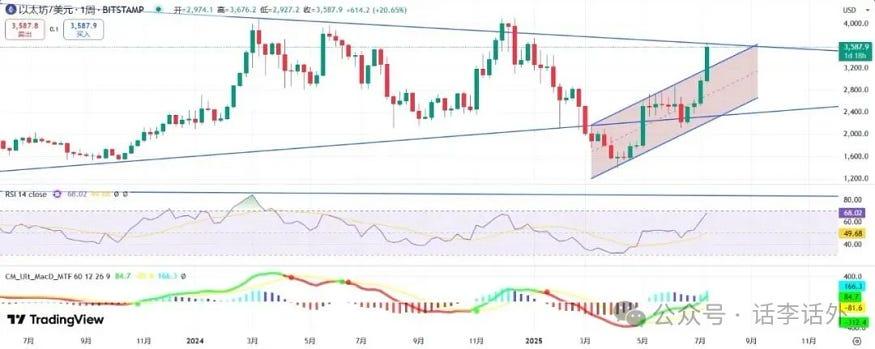
These days, I've noticed that the mood in some groups seems to have improved compared to before, and many E-guards seem to be excited again. But at the same time, a new question arises: What is driving ETH's rise in this stage? How long can this upward momentum last?
People tend to find reasons to convince themselves when prices rise, and similarly when prices fall. This seems to be the norm for many. Some bloggers also like to catch these hot topics, such as turning bearish when prices drop and bullish when prices rise, as this can better match people's reading preferences.
However, summarizing reasons after each rise is somewhat like being a Monday morning quarterback. Let's discuss this in two parts:
First, let's briefly review our perspectives on Ethereum since the beginning of the year, which is also a witness to the emotional fluctuations.
In the article on January 14th, we discussed: From yesterday (January 13th) to now, many friends have been FUDing Ethereum. Perhaps Ethereum's performance so far has disappointed many. However, for myself, I still remain optimistic about Ethereum. Looking ahead, after all, ETH is currently the only cryptocurrency besides BTC to have a spot ETF, and perhaps we still need to be patient with Ethereum.
In the article on January 21st, we discussed: Recently, ETH has been heavily criticized online. Today, I even saw a friend share an interesting image comparing Ethereum to the A-share market, mocking its breakthrough of the $3,300 mark. However, jokes aside, we maintain our previous view on Ethereum: we continue to be optimistic about its performance, and $4,000 is likely not the end of ETH's current bull market.
In the article on February 1st, we discussed: For a period of time, many people have been continuing to FUD Ethereum, with "Ethereum" seemingly becoming "Ethereum Pit". You may not like ETH, but institutions like WLFI and BlackRock are buying. You may find BTC expensive, but companies like MicroStrategy are buying. The development of things always goes through stages, and we cannot focus only on the climax while ignoring the potential mess afterward. For projects seeking long-term development and stable operation, ETH still appears to be the best choice.
In the article on February 5th, we discussed: The market is ruthless and has no emotional color. Only humans are affected by emotional fluctuations. I remain optimistic because I still believe in the existence of cyclical laws and that the market can only rise again after most people have lost money. If you don't believe in this law, choosing your personal suitable time to exit is the best choice for you. Just like Zhang San is bullish on ETH while Li Si is not, Zhang San stays, Li Si exits, and each pays for their own choice.
In the article on February 10th, we discussed: In the past week, ETH's price seemed to show no signs of recovery. When BTC rebounded, ETH remained stagnant, and when BTC dropped, ETH followed. Many people's patience was gradually worn down. At the time of writing, ETH was hovering around $2,600, which is about 46% lower than the peak of the previous bull market. Perhaps institutions are playing a big game, or perhaps they are preparing for a potential downturn, and they won't help retail investors until they have accumulated enough chips (bargaining power).
In the article on March 20th, we discussed: Many people anchor to the $4,100 price and therefore consider the current $2,000 Ethereum to be low-priced. But if you anchor to the lowest $800 in 2022, the conclusion might be completely different. The same goes for selling at high prices. If you believe Ethereum will eventually reach $10,000, then what is there to be pessimistic about when holding Ethereum at $2,000 or being trapped at a $3,000 cost basis?
In the article on April 24th, we discussed: If I'm not mistaken, we haven't specifically discussed ETH for over a month because previously, articles mentioning ETH (being bullish) would typically receive abusive comments. But with changes in regulatory policies, the partial recovery of DeFi, deep involvement of traditional financial institutions, and continuous development of Ethereum's network and ecosystem... we believe Ethereum is still worth attention and respect.
In the article on June 10th, we discussed: I remember Ethereum dropped to around $1,300 in April, and the online criticism seemed endless. However, with a few green candles "rescuing" it last month (early May), ETH's price doubled in less than a month, and the criticism seems to have diminished. Today (June 10th), ETH's price has returned to around $2,700, and recent news about Ethereum seems to be continuously positive.
In the article on June 15th, we discussed: If we simply review the past, we can see that whenever the market encounters unexpected events, people are always driven by panic. In contrast, some institutions and whales often use these black swan events to operate opposite to retail investors. For example, in our previous article, we mentioned that BlackRock alone accumulated about 220,000 ETH in the past 30 days. On one side, retail investors are selling their chips due to various news, while on the other side, some institutions or whales are continuously buying and accumulating. Isn't this interesting?
Secondly, let's continue to think about the previous question: What is driving ETH's rise in this stage, and how long can this upward momentum last?
In terms of market price factors, a rigorous statement would be that ETH's price increase is due to a surge in demand from multiple comprehensive factors. However, such a vague explanation might not mean much to many people.
Therefore, we need to be more specific. For the current stage of growth, a direct summary would be that institutional interest in ETH is currently surging, as many people (institutions) were amazed but missed out on BTC's past performance. Recently, with the passage of some cryptocurrency-related bills in the United States, ETH, as the only project besides Bitcoin that has passed an ETF, seems to be becoming a new focus of attention.
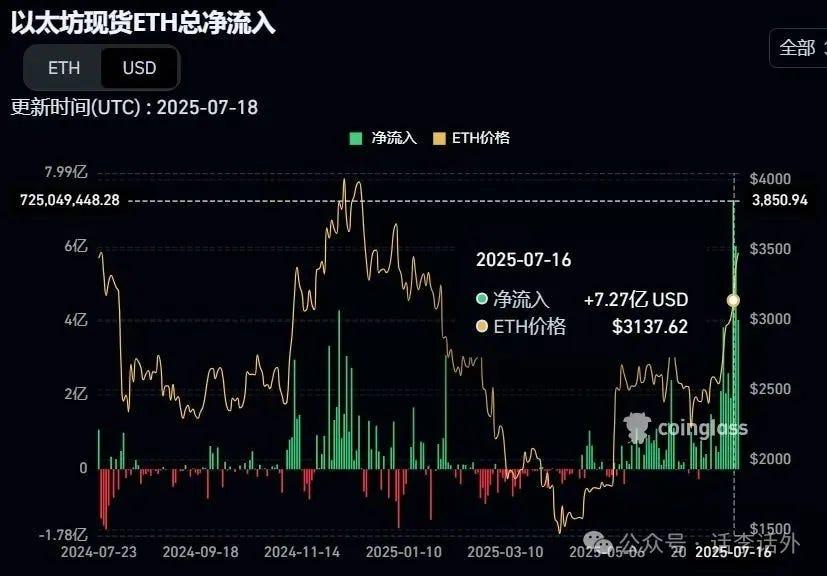
For example, in terms of ETH ETF fund inflows/outflows, the daily inflow on (7.16) recently set a new historical record, reaching $727 million, as shown in the following image.
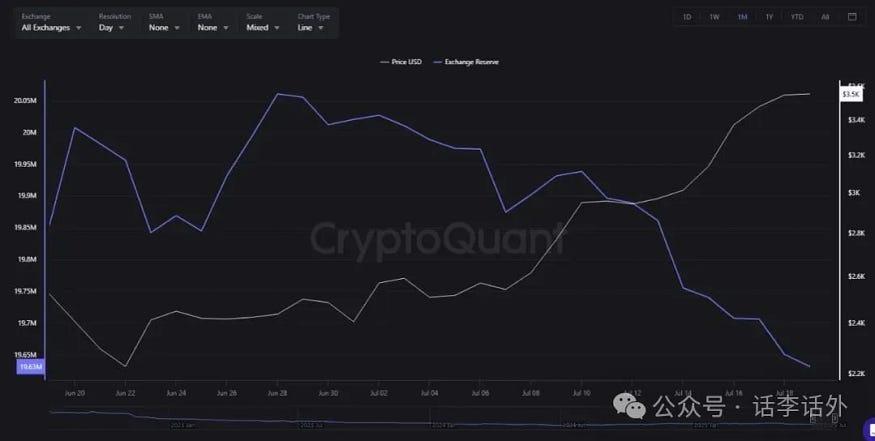
Moreover, in terms of ETH balance on exchanges, according to on-chain data, the ETH balance on exchanges has dramatically decreased in the past 30 days, reaching a new low level. As shown in the following image. The reduction in exchange supply is usually viewed as a bullish signal, as it theoretically means a decrease in the number of tokens ready to be sold.
In short, with some institutions recently beginning to actively buy ETH, leading to a change in stage-specific market demand, this seems to have become the main driving factor for ETH's rapid rise in this stage.
So, how long can ETH's current upward momentum continue?
As we mentioned earlier, prices are often determined by multiple factors. For Ethereum, as the only project besides Bitcoin to pass an ETF, the largest crypto base ecosystem project, the king of Altcoins, and the current best choice for RWA narrative... these are all factors influencing ETH's price changes.
Here, we might as well first exclude other price influencing factors and simply reference the situation of MicroStrategy with Bitcoin:
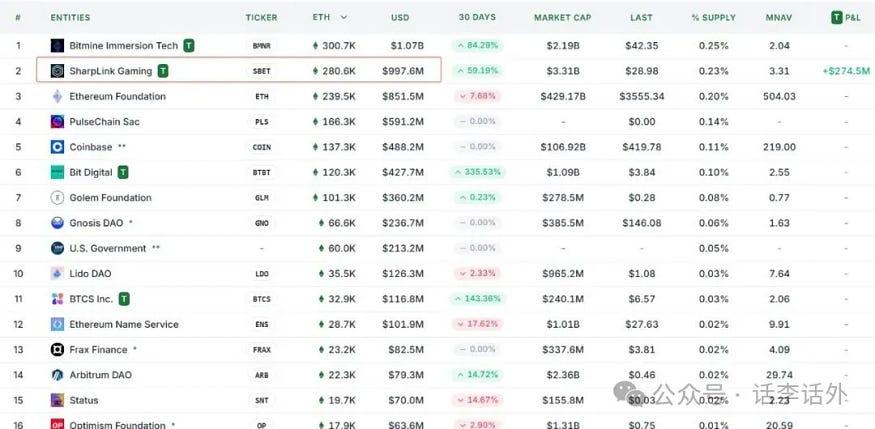
In terms of mimicking MicroStrategy's approach, the Nasdaq-listed company SharpLink Gaming has recently become a highly watched star institution. Since announcing ETH as its primary financial reserve asset in May this year, its stock (SBET) has risen by over 25 times, from $3 to a high of $79.
As of the time of writing, SharpLink Gaming has accumulated ETH worth over $990 million (the institution purchased ETH worth approximately $213 million in the week from July 7 to July 13 alone), not including ETH purchased by other TradFi investors through spot ETH ETF. And according to the institution, they do not plan to stop this behavior soon and will continue to buy more ETH. As shown in the following image.
It can be foreseen that as more institutions like SharpLink Gaming continue to buy ETH, this will likely continue to create more buying pressure.
As for whether institutions might encounter problems with this approach, what problems might arise, and when - we have discussed specific methods in previous articles (such as the articles on February 10th and February 28th) regarding MicroStrategy. Interested readers can search and review those historical articles for further insights.
To summarize briefly: as long as the stock trading price of companies like SharpLink Gaming remains higher than the value of their ETH holdings, they can continue to play out this strategy.
While I can't predict long-term outcomes, in the medium to short term, strategies like MicroStrategy with Bitcoin and SharpLink Gaming with Ethereum will generally benefit BTC and ETH prices, because the highest-level price play is actually about forming bubbles, and what a big bull market needs most is more bubbles. MicroStrategy has accumulated over $71 billion worth of Bitcoin with this genius approach, and we have witnessed Bitcoin continuously breaking historical highs. If no new black swan events occur in the macro environment, ETH and some Altcoins will likely continue to rise.
Of course, since it's a bubble, there will ultimately be a day of bursting, and the process from bubble formation to final burst is often accompanied by repeated scripts. It's not as simple as buying today and getting rich tomorrow, just as Bitcoin has risen from $15,000 to $120,000 in this cycle, but this upward process was not smooth sailing. Therefore, we need to strictly adhere to our position management plan, as we discussed in our previous article (7.15): a bull market is a great retreat.
Investment/speculation can be summarized as grasping the bubble cycle: embracing the bubble, enjoying the bubble, staying away from the bubble, and continuing to look forward to the formation of a new bubble.
According to our previous article expectations, there might be another opportunity to enjoy a larger bubble before the end of this year. Before officially staying away from the bubble, we need to focus on these two major aspects:
1) Macro and economic aspects
This year, we are mainly focusing on the Federal Reserve's interest rate cuts and changes in the U.S. Dollar Index (DXY), both of which will significantly impact risk assets.
Based on current market expectations, the Federal Reserve might cut rates twice this year, and the timing of these cuts has become the current key catalyst. If the Federal Reserve cuts rates in September, based on past experience, the market (smart money) typically starts digesting rate cut expectations 3-6 months in advance. Theoretically, the rise since April seems reasonable, and July might also signal that some Altcoins will or are already entering an acceleration mode.
2) Regulatory and institutional aspects
Here, we are mainly focusing on two things: cryptocurrency/crypto market bills and ETF and institutional capital.
For example, we previously mentioned the GENIUS bill, which, in the long term, will certainly promote mainstream stablecoin adoption. Not only will major institutions launch stablecoin-related businesses, but more users (in USD) can also more conveniently participate in DeFi services.
Take the ETF issue, for instance. With the approval of Bitcoin and Ethereum spot ETFs, the route for top Altcoin ETFs seems to be becoming clearer. Based on past situations, the fourth quarter of this year (around October) might become a historical turning point for crypto ETFs, as we mentioned in previous articles. At that time, more Altcoin ETFs might be approved, which will inevitably bring more external liquidity.
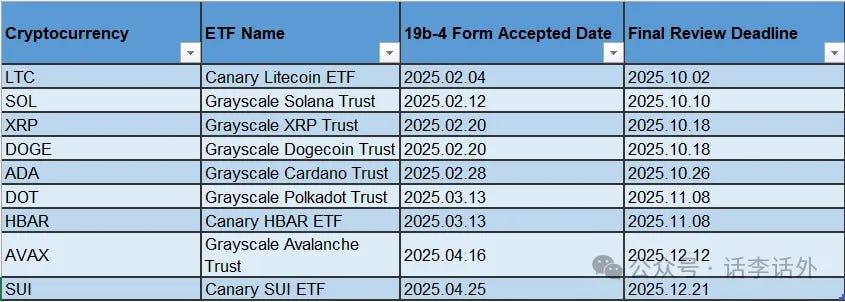
Although this crypto bull market continues to follow some historical and cyclical patterns, it also has many different structural changes, such as different speculative attributes of retail investors, different market driving forces (increasing institutional deep participation), different liquidity risk distribution (external liquidity brought by ETFs), different narrative sustainability (more narratives, shorter sector rotations)... and so on.
In the past, getting rich in the crypto field seemed like a simple matter, sometimes you could make money by buying blindly. Now, making money is becoming increasingly difficult. We not only need to study various changes within the crypto field but also simultaneously pay attention to macro, economic, political, and U.S. stock market changes.
Although many crypto indicators are still valuable and meaningful, we need to start learning to change some existing concepts. For example, regarding the "Altcoin season" issue, many people often use BTC.D (Bitcoin dominance) as an important reference indicator. However, we now need to understand that the decline of BTC.D is merely a result, not a cause.
The future narrative of the crypto market will be driven more by institutional adoption, stablecoin development, tokenization processes (such as RWA)... and other external liquidity capital, meaning that the demand in the crypto market is undergoing some essential changes. Especially for crypto veterans or crypto natives who have always strictly followed historical experience, many current so-called problems seem to precisely indicate that crypto is moving towards a new maturity, and we need to recognize this as soon as possible.
That's what we'll discuss today. The sources of images/data mentioned in the text have been supplemented in the Notion, and the above content is just a personal perspective and analysis, solely for learning and communication purposes, and does not constitute any investment advice.