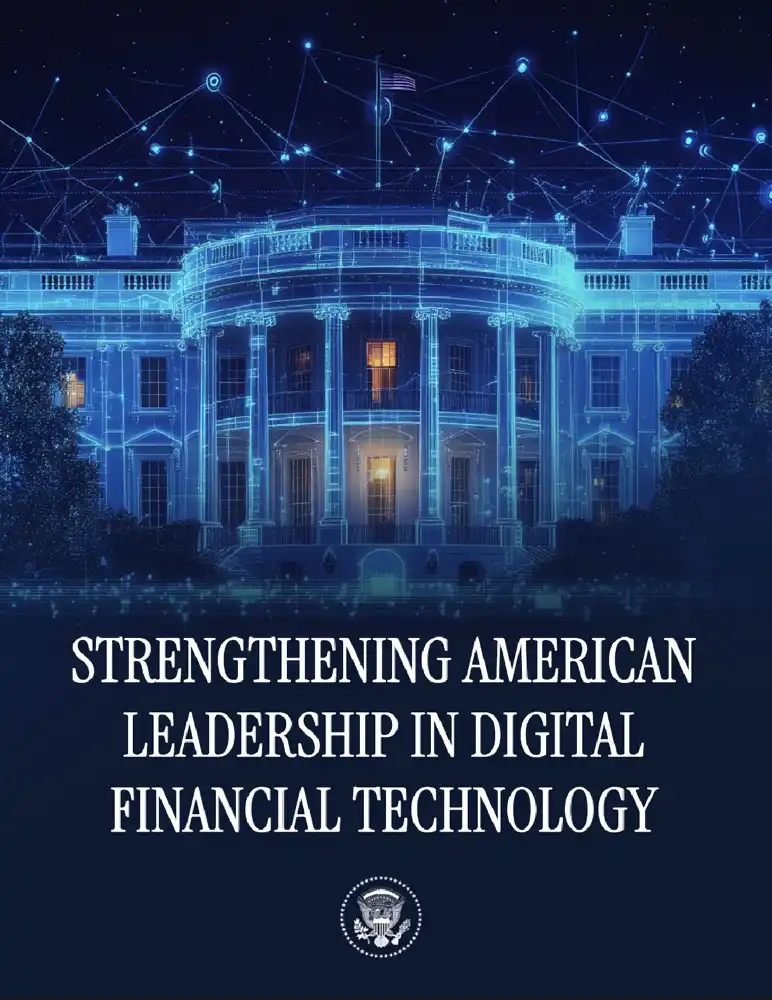
A 166-page document quietly lies on the White House's official website. Its title - "Strengthening U.S. Leadership in Digital Financial Technology" - sounds like a policy document filled with clichés that any government agency might release. However, for Wall Street trading halls, Silicon Valley startup garages, and the global crypto community, this document led by White House Crypto and AI Affairs Director David Sacks and Executive Director Bo Hines is nothing short of a starting gun.
It is not just a report, but a carefully designed strategic blueprint aimed at forging blockchain technology, once viewed as a toy for anarchists, into a new-century tool for maintaining and expanding U.S. financial hegemony. Interestingly, the report's release came with a touch of geek-like ceremony: encrypting Trump's presidential promise from the White House Crypto Summit earlier this year with a hexadecimal hash value - "Make America the World's Bitcoin Superpower and Global Crypto Capital".
This is not merely symbolic. It heralds a turning point: the iron curtain of regulation is being drawn back, and a grand script led by the U.S. to construct a "global unified crypto financial market" has begun.
Trinity: The Perfect Closed Loop of Stablecoins, RWA, and DeFi
Focusing solely on its 'crypto regulation' label would overlook the report's true ambition: it is not about drawing market boundaries, but about sketching a new strategic map guiding global capital flows. Its core is not to manage Bitcoin or Ethereum in isolation, but to penetrate the dollar's gravity into every corner of global finance through building a "trinity" financial flywheel.
The first pillar is the already landed compliant U.S. dollar stablecoin. Before the report's release, the Trump administration had already signed the GENIUS Act (Payment Stablecoin Transparency Act). This law is profoundly significant, providing a clear legal status for U.S. dollar stablecoins at the federal level, defining them as neither securities nor commodities, but under the wings of the Treasury and state banking regulators. This means stablecoins issued by licensed institutions, strictly audited and with 1:1 USD cash and equivalent reserves, have become "compliant digital dollars". This not only provides consumer protection but, more importantly, finds a perfect proxy for the dollar in the global digital economy, effectively countering discussions about sovereign digital currencies (CBDC) and avoiding potential threats to privacy and financial freedom.
The second pillar is the booming tokenization of Real World Assets (RWA). If compliant stablecoins are the blood, RWA is the muscle and skeleton on which this new system survives. While the industry was still discussing its possibilities, Wall Street giants had already entered. BlackRock, with asset management of $10 trillion, has issued a tokenized money market fund "BUIDL" on Ethereum, surpassing billions of dollars. Another giant, Franklin Templeton's similar fund FOBXX, is already running on multiple blockchains. Their core business is tokenizing the most high-quality "risk-free" assets like U.S. Treasury bonds, enabling frictionless 24/7 trading on the blockchain. Boston Consulting Group (BCG) once predicted that the global non-liquid asset tokenization market could reach $16 trillion by 2030. When highly liquid digital dollars meet high-credit tokenized U.S. bonds, a massive value closed loop is formed.
And this White House report has ignited the third, and most crucial pillar - Decentralized Finance (DeFi). The report explicitly proposes to "embrace DeFi technology" and suggests that Congress establish a completely new, technologically neutral regulatory framework for "truly decentralized" protocols. This is not simple "deregulation". The report proposes a sophisticated distinction: for protocols that are open-source, non-upgradeable, and where no one can unilaterally control assets, their direct compliance burden will be significantly reduced. The regulatory focus will shift from the protocols themselves to the centralized "intermediaries" interacting with them, such as exchanges and wallet service providers.
As venture capitalist David Sacks, one of the report's authors, has consistently advocated, to replace "enforcement-style regulation" with "clear rules". The signal of this transformation could not be clearer: the U.S. not only welcomes DeFi but will provide it with a compliant soil, making it a powerful "yield engine" for the aforementioned compliant stablecoins and tokenized U.S. bonds. A user can use compliant digital dollars to purchase tokenized U.S. bonds and earn yields in a compliant DeFi protocol - all components of this perfect storm are now in place.
Farewell to Gray Areas: A Carefully Planned "Recruitment"
Another core of this report is formally ending the U.S. crypto regulation's years-long "gray area" and inter-departmental "power game". For a long time, the U.S. Securities and Exchange Commission (SEC) and Commodity Futures Trading Commission (CFTC) have been arguing about who should regulate the spot market for digital assets, with SEC Chairman Gary Gensler's "enforcement-style regulation" driving many innovators and project teams away.
The report clearly supports the 21st Century Financial Innovation and Technology Act (FIT21 Act, also known as the CLARITY Act) currently under congressional review, which aims to grant CFTC clear jurisdiction over the spot market for non-security digital assets (i.e., digital commodities). This is actually adopting the crypto industry's long-standing call: manage the initial issuance phase of digital assets (similar to IPO) as securities under SEC, and once the network becomes sufficiently "decentralized" and mature, its token should be viewed as a commodity and managed by the more commodity market-familiar CFTC.
"This administration is committed to ending the 'Kafkaesque' enforcement environment and providing certainty for the U.S. digital asset ecosystem," commented Republican Congressman and key digital asset figure French Hill. This is not just a redistribution of power, but an active "business attraction". Through the dual push of legislation and executive orders, the White House is inviting global developers, entrepreneurs, and capital: come back to the U.S., where clear rules and innovation support await.
The Other Side of the New Order: Non-Nationalization Narrative and Multi-Chain Reality
When U.S. dollar stablecoins serve as tools to penetrate capital controls, meeting high-yield products provided by RWA and DeFi, a grand narrative begins to circulate in the crypto world: the non-nationalization of capital. Theoretically, capital from anywhere in the world can seamlessly convert to digital dollars and enter this global unified financial market to chase yields, thus escaping geographical and sovereign restrictions. Some view this as the beginning of "non-nationalization" for capitalists, enterprises, and even individuals.
However, calm analyses from institutions like the International Monetary Fund (IMF) provide an important balanced perspective. The IMF has repeatedly mentioned the "decentralization illusion" in its reports, pointing out that many so-called DeFi protocols still have governance rights and liquidity highly concentrated in the hands of a few whales and development teams. Seamlessly integrating these systems with traditional finance without establishing sufficient firewalls might amplify rather than eliminate systemic risks. Brookings Institution analysts also warned that while cheering innovation, one must not forget the numerous collapses and investor losses caused by regulatory gaps in recent years. Behind this report lies powerful industry lobbying forces, and whether their focus on consumer protection is sufficient remains to be tested by time.
Moreover, the intuitive judgment that "a huge benefit to DeFi is a huge benefit to Ethereum" may oversimplify the complexity of the market. As the current largest DeFi ecosystem, Ethereum will undoubtedly be a core beneficiary. However, the reality is that the future of RWA is multi-chain. BlackRock's BUIDL fund has already landed on multiple networks including Ethereum, Solana, and Avalanche; Franklin Templeton has even reached a cooperation with supply chain public chains like VeChain. The nature of capital is to seek profit and diversify risks, and it will flow to any value network that is efficient, deep, and secure. Therefore, what this transformation is more likely to bring is a comprehensive boost to all high-performance smart contract platforms, rather than a solo performance by a single public chain.
Ultimately, this White House report is less a surrender to crypto idealism and more a clever "co-optation". It skillfully stripped away the parts of crypto technology that directly challenge sovereign currencies (such as algorithmic stablecoins and anonymous coins), while incorporating the remaining parts—especially those deeply bound to the US dollar and high-quality US assets—into a new financial framework defined and led by the United States.
This is a carefully considered move. The United States did not choose to build a high wall to block the flood of the crypto world, but instead chose to dig a canal to guide this flood towards a direction that can irrigate its own financial hegemony. The competition about the future form of finance has entered a brand new chapter. Code is being written into law, and the game of power will unfold in a unprecedented way across global blockchain nodes.