A mature "hunting chain" has quietly taken shape, and manufacturers' improved verification mechanisms and users' security awareness urgently need to be closed-loop.
Written by: Web3 Farmer Frank
Imagine that you are a patient holder who has survived a long bear market and finally transferred the BTC you have painstakingly accumulated from a CEX to a hardware wallet just purchased, feeling secure that your assets are firmly in your own hands.
Two hours later, you open the App, and your wallet is empty.
This is not a hypothetical scenario, but a real event that just occurred: An investor bought a hardware wallet on JD.com and stored 4.35 BTC, unaware that the device had already been pre-initialized by scammers, who generated a seed phrase and inserted a fake instruction manual to guide users through a trap-like process of connecting to a mobile App.
In other words, at the moment the user activates the wallet, it already belongs to the hacker.

Unfortunately, this is not an isolated incident. Recently, there have been multiple cases of users being scammed or having their assets completely wiped out after purchasing hardware wallets on platforms like Douyin, JD.com, and Amazon. If one carefully dissects recent similar security incidents, one would discover that a mature "hunting chain" targeting the hardware wallet sales process is quietly taking shape.
I. The "Second-hand" Gray Chain Hunting Newbies
Hardware wallets, as devices that generate private keys in a "completely offline environment", are theoretically almost at the pinnacle of security as long as the seed phrase is properly backed up, which is the most common popular science narrative that most Web3 players encounter daily.
However, in reality, the risks often lie not in the device itself, but in the purchase and activation stages.
After long-term promotion, many investors easily form a simple cognitive formula: "Hardware wallet = absolute safety", and this psychological suggestion causes many people to ignore several key preconditions after obtaining the device:
Whether the device packaging is intact, if the seal is abnormal; whether the seed phrase must be generated by oneself; whether the activation information is verified as "first use"... As a result, many users rush to transfer assets as soon as they get the hardware wallet device, unknowingly giving scammers an opportunity.
Whether it was the previous Douyin hardware wallet purchase that led to 50 million in crypto assets being looted, or the latest JD.com purchase of an imKey hardware wallet resulting in BTC being wiped out, without exception, all problems occurred during the purchase and activation stages.

A mature gray industrial chain has emerged in the hardware wallet sales on domestic e-commerce platforms.
In theory, China has always maintained a high-pressure stance on cryptocurrencies. As early as 2014, e-commerce platforms directly banned cryptocurrency sales, and the "Announcement on Preventing Risks of Token Issuance Financing" jointly issued by the People's Bank of China and six other ministries on September 4, 2017, clearly required domestic platforms not to provide services involving cryptocurrency transactions, exchanges, pricing, or intermediation.
Literally, "intermediary services" is broad enough that hardware wallets for storing private keys are theoretically in a gray area of banned sales. Therefore, platforms like Taobao, JD.com, and Pinduoduo have never supported searches for any "crypto-related" keywords.
But the reality is completely different.
As of July 29, the author searched for five hardware wallet products - Ledger, Trezor, SafePal, OneKey, and imKey (imToken) - on Taobao, JD.com, Pinduoduo, and Douyin platforms, and found that sales channels were quite smooth.
Among them, the Douyin platform was the most comprehensive, with stores selling Ledger, Trezor, SafePal, OneKey, and imKey.

Next was JD.com, where Ledger, Trezor, SafePal, and OneKey hardware wallets could be found, while imKey-related stores had likely been removed due to the security incident.

Taobao was relatively strict, with only one store selling imKey found, and while Xiaohongshu lacks direct store searches, second-hand private sales and agency purchases are everywhere.
Undoubtedly, except for a few authorized dealers, most stores are unofficial small retailers that have neither obtained brand authorization nor can guarantee the safety of the device circulation process.
Objectively speaking, hardware wallet agency/distribution systems exist globally, including brands with high popularity in the Chinese-speaking area like SafePal, OneKey, and imKey, with roughly similar sales systems:
Official direct purchase: Products can be ordered on the official website; E-commerce channels: Domestic platforms usually use Youzan micro-stores, while overseas rely on official Amazon entries; Regional distributors: Authorized agents in each country/region provide localized purchasing channels and can verify authenticity on the official website, such as SafePal providing a global agent query page.

However, in the domestic e-commerce ecosystem, the vast majority of users still purchase through unofficial, unverifiable channels, naturally providing fertile ground for the gray industry's "preset seed phrase trap".
Many devices may be "second-hand/third-hand circulation" or even "counterfeit devices", and it cannot be ruled out that some devices are opened, initialized, and have seed phrases preset during resale, so once the user activates the device, assets naturally flow directly into the scammer's wallet.
So the most critical point is, beyond the sales end, can users verify and protect against risks for hardware devices they've purchased, ensuring all related risks are eliminated?
II. User-side Vulnerabilities and "Self-Verification" Mechanisms
Put simply, these hardware wallet traps repeatedly succeed not because of technical defects in the devices themselves, but because the entire circulation and usage process exposes multiple exploitable vulnerabilities.
From the perspective of domestic e-commerce and agent circulation chains, the main risks are concentrated in two points:
Second-hand or multi-hand circulation devices: Gray industries complete opening, initialization, and preset seed phrases or accounts during second-hand device circulation, and once users directly use the device, assets will be imported into the scammer's wallet. Counterfeit or tampered devices: Non-official channels might introduce fake devices that could even have built-in backdoors, and users transferring assets will face the risk of total theft;
For experienced Degen users familiar with hardware wallets, these traps are almost ineffective because they naturally perform security verification during purchase, initialization, and binding processes. However, for first-time buyers or inexperienced hardware wallet newbies, the probability of being trapped skyrockets.
In the latest security incident, scammers pre-created wallets and specifically prepared fake paper instructions to guide purchasers to unpack and activate the second-hand imKey using a fake process, thereby directly transferring assets, and according to conversations with industry professionals, there have indeed been increasing instances of opened products being sold with fake instructions.
After all, many newbie users often overlook product integrity (whether packaging is unsealed, anti-counterfeiting stickers damaged), fail to compare item lists, and are unaware that device verification for "new/old machines" can be completed within the official App. If these details are correctly cross-checked, most traps can be identified immediately.
It can be said that whether hardware wallet product design can comprehensively and proactively support user-side self-verification is the most critical gate to breaking the gray industry's attack chain.

Taking SafePal's Bluetooth X1 hardware wallet as an example, its user-side self-verification path is relatively comprehensive:
First Binding Reminder: When activating a hardware wallet and binding the App, a prompt will appear "This device has been activated, is it a personal operation"; Historical Activation Information Display: Subsequently, it is understood that SafePal's related interface will also synchronously display the device's first activation time and whether it is the first binding on this phone, helping users quickly determine if the device is brand new or has been initialized by others;
In addition, based on the author's actual usage experience, whether it is the SafePal S1, S1 Pro using QR code interaction mechanism, or the SafePal X1 using Bluetooth for information interaction, they allow users to view the hardware wallet's SN code and historical activation time at any time after binding the SafePal App (as shown in the following image), to further confirm the device's origin and usage status.
This is due to SafePal's hardware wallet writing an SN for each device during manufacturing, and binding the device's hardware fingerprint information with this SN and saving it in the SafePal backend to further confirm the device's origin and usage status.
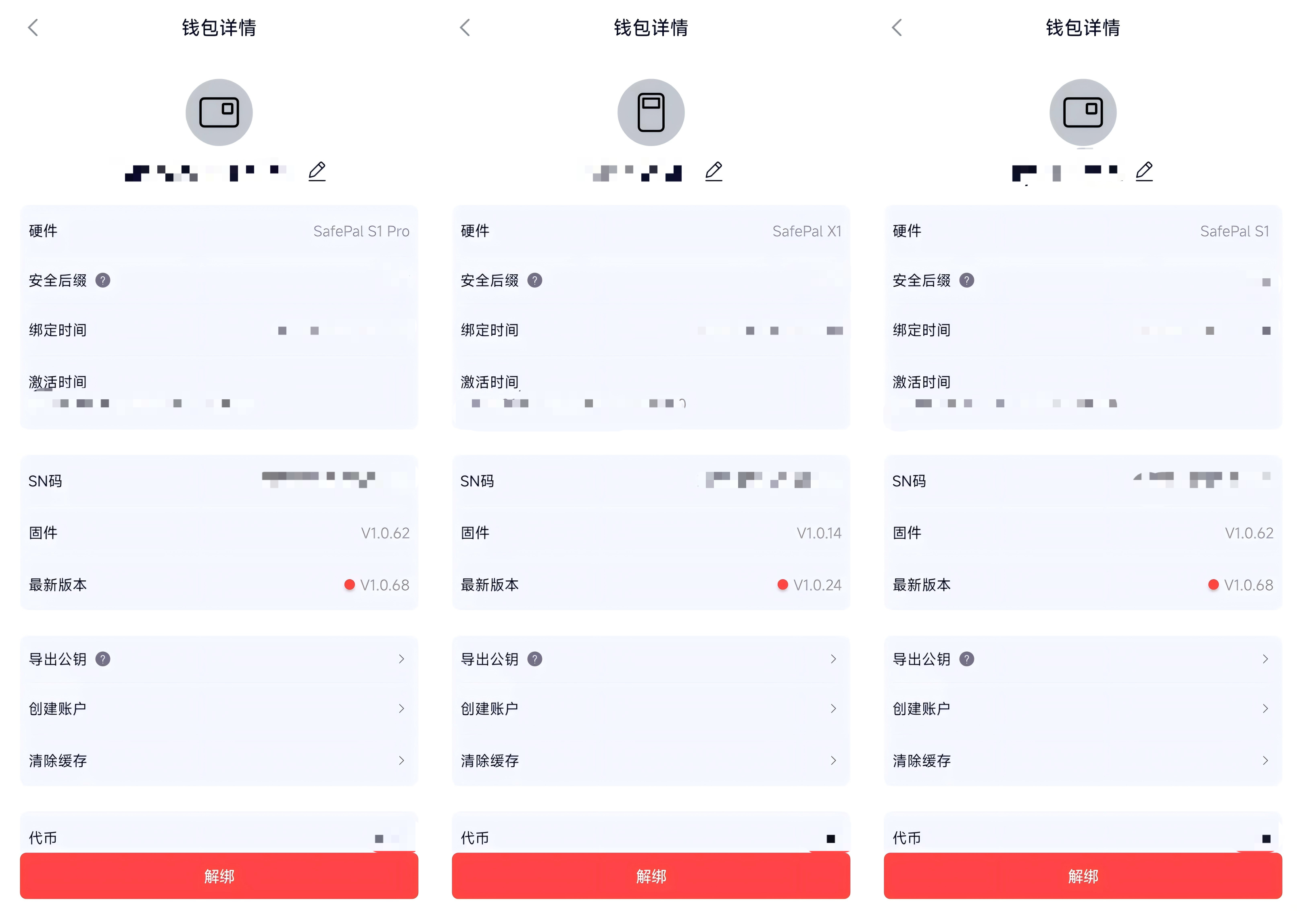
This means that when users first use this hardware wallet, they need to activate it before creating a wallet. During activation, the mobile App will transmit the hardware wallet's SN and fingerprint information to the SafePal backend for verification. Only when both match will the user be prompted that the hardware wallet can continue to be used, and the activation time will be recorded.
When other mobile devices subsequently bind this hardware wallet, they will also prompt the user that this hardware has been activated and is not the first use, and request a second confirmation.
Through these verification steps, users can almost identify second-hand traps or counterfeit devices upon first contact, thereby cutting off the first step of the gray industry's common attack chain.
For novice users who are first-time hardware wallet users, SafePal's visualized and traceable verification mechanism is easier to understand and execute compared to pure instructions or text warnings, and better meets the actual needs of fraud prevention.
III. Hardware Wallet "Full Process" Security Manual
Overall, for users first encountering hardware wallets, it does not mean that just buying a hardware wallet guarantees asset safety.
On the contrary, hardware wallet security is not completed with a one-time purchase, but is built by the security awareness of three stages: purchase, activation, and usage. Any negligence in any stage could become an opportunity for attackers.
1. Purchase Stage: Only Recognize Official Channels
The hardware wallet's security chain begins with choosing a purchase channel, so it is recommended that everyone purchase directly from the official website.
Once choosing e-commerce platforms/live streaming channels or second-hand platforms for purchase, such as Taobao, JD, Douyin, and other non-official channels, it means being exposed to extremely high risks—No cold wallet brand sells products through Douyin live streaming or Kuaishou links, these channels are almost the main battleground for gray industries.
The first step after receiving the goods is to check the packaging and anti-counterfeiting labels. If the packaging is unsealed, the anti-counterfeiting sticker is damaged, or the inner packaging is abnormal, one should immediately be vigilant and preferably check each item according to the official website's list to quickly eliminate some risks.
The more careful this stage is done, the lower the subsequent security costs will be.
2. Activation Stage: Not Initializing is "Giving Away Money"
Activation is the core stage of hardware wallet security and also the stage where gray industries most easily set traps.
A common method is for gray industries to pre-open the device, create a wallet and write in the seed phrase, then stuff in a forged manual to guide users to directly use this ready-made wallet, ultimately capturing all subsequent transferred assets. The recent JD imKey fraud case is such an example.
Therefore, the primary principle of the activation stage is to initialize independently and generate a brand new seed phrase. In this process, products that can perform device status self-check and historical activation verification can significantly reduce users' passive exposure risks, such as SafePal mentioned earlier, which will prompt during first binding whether the device has been activated and display historical activation time and binding information, allowing users to identify abnormal devices immediately and cut off the attack chain.
3. Usage Stage: Protect Seed Phrase and Maintain Physical Isolation
During daily use, the core security of hardware wallets is seed phrase management and physical isolation.
Seed phrases must be handwritten, not photographed or screenshot, and especially not stored via WeChat, email, or cloud storage, because any online storage behavior is equivalent to actively exposing the attack surface.
During signing or transactions, Bluetooth or USB connections should be short-term and on-demand, prioritizing QR code signing or offline data transmission, avoiding prolonged physical contact with network environments.
It can be said that hardware wallet security is never "completely safe upon purchase", but a defense line jointly constructed by users across three stages:
Eliminate second-hand and non-official channels in the purchase stage; independently initialize and verify device status in the activation stage; protect seed phrases and avoid long-term network exposure in the usage stage;
From this perspective, hardware wallet manufacturers urgently need to provide users with a "full process" mechanism design like SafePal, with first activation reminders, activation date and binding information display, only then will the attack chain that gray industries rely on truly become ineffective.
In Conclusion
Hardware wallets are a good tool, but never an ultimate protective talisman that guarantees complete safety.
On one hand, major hardware wallet manufacturers need to promptly perceive market environment changes, especially designing more intuitive and easy-to-operate verification mechanisms in product design and usage processes for new users who are easily targeted by "hunting chains", allowing every user to easily determine the authenticity and safety status of their device.
On the other hand, users themselves must develop good security habits, from legitimate purchase to initialization activation, and then to daily seed phrase management, without skipping any step, developing security awareness throughout the entire usage cycle.
Only when the wallet's verification mechanism forms a closed loop with user security awareness can hardware wallets move closer to the goal of "absolute safety".