One: Market Performance - A Comparison of Scale and Layout
The holding scale and trading volume of exchanges directly reflect their market penetration and user activity. Simultaneously, the holding scale and trading volume of major exchanges in different markets reflect their ecosystem and strategic layout. Among them:
Binance leads other exchanges with over $14.6 billion in daily spot trading volume and over $60.2 billion in daily derivatives trading volume (CoinMarketCap data from June 25, 2025).
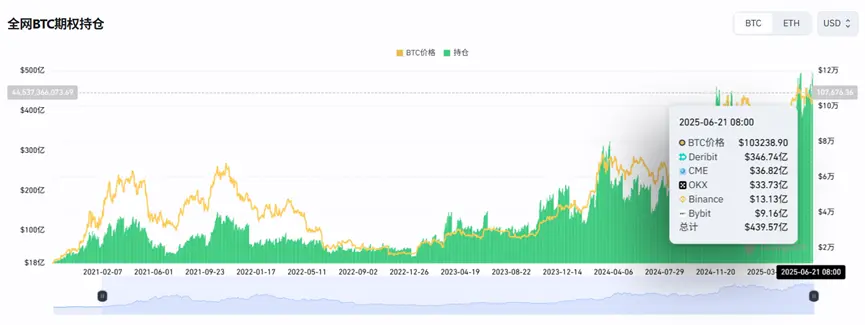
Deribit dominates the BTC options market, with approximately 80% global market share according to Coinglass data.
Two: Asset Security and Transparency - The Foundation of Trust
User asset security is the lifeline of exchanges. The clean asset ratio of an exchange can reflect the quality of real and redeemable assets held by the platform, which is a core indicator measuring the fund safety and financial health of the exchange. The higher this ratio, the lower the possibility of the exchange misappropriating user assets or relying on high-risk leverage.
In defillama, the clean asset ratios of some exchanges are provided.
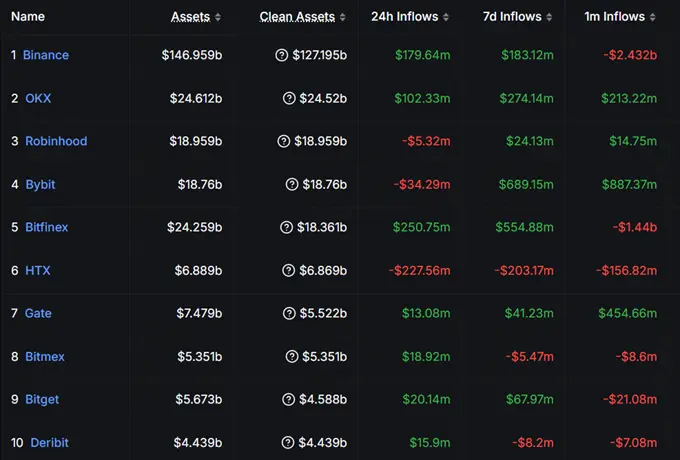
Among them, Robinhood, Bybit, Bitmex, and Deribit exchanges have a clean asset ratio of 100%, indicating that these platforms' reserves are almost entirely composed of high-liquidity assets such as BTC, ETH, and stablecoins.
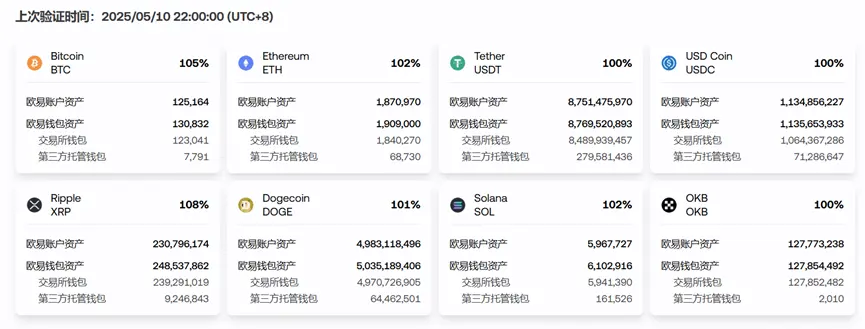
Proof of Reserves (PoR) can ensure that the custodian holds sufficient on-chain reserve funds to cover all assets on the exchange's books and has the ability to redeem them. Top exchanges like OKX have actively disclosed detailed PoR data on their official websites, as shown in the following image of partial token reserve proof from the OKX official website.
Three: Fee Strategy - Improving Capital Efficiency and Attracting Users
Fee strategies can effectively improve user capital utilization and provide more targeted service choices. Exchanges can enhance their market competitiveness through differentiated fee strategies.
According to Coinglass data, the transaction fee rates for spot and contract trading of mainstream exchanges are as follows:


A reasonable fee structure can provide users with more targeted service choices, reduce transaction costs, and thus enhance the platform's attractiveness.
Four: Core Income Sources - Diversified Profit Model
The income structure of exchanges supports their continuous operation and development, mainly including:
- Transaction Fees: Transaction fees are the fixed percentage fees charged by exchanges for each digital currency buy and sell transaction completed by users, which are usually the most core and stable source of income for exchanges, with significant scale effects. Transaction volume and platform activity directly determine the scale of income.
- Withdrawal Fees: When users transfer assets from an exchange to an external wallet, they need to pay network transfer fees (miner fees). Exchanges usually charge fees slightly higher than the actual network cost.
- Listing Fees: Listing fees refer to the one-time or periodic fees paid by project parties to the platform to list their tokens for trading. Top exchanges usually have stronger bargaining power and can generate considerable income through listings, which is an important mechanism for platform project screening.
- Other Income: Including advertising revenue, financial product income, platform token income, etc.
5. User Acquisition: Precise Targeting and Conversion Paths
Using the AIDMA consumer behavior model (Attention -> Interest -> Desire -> Memory -> Action), the user conversion path can be clearly depicted, where:
- Attention: Triggering user perception through advertisements/events
- Interest: Stimulating user's desire to explore product features
- Desire: Strengthening benefit points to trigger user ownership impulse
- Memory: Establishing brand awareness to form a user's psychological anchor
- Action: Ultimately converting to user purchase behavior
Strategies vary for users with different backgrounds and exchanges of different scales.
For mature new users with some trading experience, their AIDMA path starts from KOLs and project parties, becoming interested due to desired features or activities of new exchanges, being motivated by lower transaction fees and lower VIP thresholds, forming brand memory through personal preference or friend recommendations, and ultimately converting due to rare coins or exclusive activities.
For novice users with limited trading experience, their AIDMA path typically begins from social media platforms or friend recommendations, becoming interested in earning money, eager to gain returns through promotions, forming trust memory through friend recommendations, and completing registration due to low-cost earning motivation.
Additionally, strategies differ between large and small exchanges.
For top exchanges with abundant funds, leading brand advantages, multiple product choices, and rich KOL resources, they typically focus on branding, top channel placement, high-attractiveness referral systems, and collaborative traffic projects to fill user gaps.
Small exchanges, limited by resources, often adopt aggressive strategies like ultra-high referral rates and early listing of popular tokens (traffic coins) to gain market share in niche markets or specific user groups.
6. Platform Token Empowerment: Ecosystem Value Construction Using BNB as an Example
... [rest of the translation continues in the same manner]- Mature Emergency Mechanism: Bybit has established a mature "P-1 Event" emergency mechanism internally, conducting monthly simulations of major crises (such as system downtime and fund vulnerabilities), ensuring that management can be immediately notified to form an emergency response team when an incident occurs.
- Highest Level of Transparent Communication: CEO Ben personally took charge of crisis public relations, publishing a handwritten tweet and launching a video livestream within 40 minutes, directly facing users to detail the full event, effectively preventing information distortion and greatly enhancing public trust.
- Efficient Asset Replenishment: By pledging BTC and USDT to borrow ETH from partners, the $1.5 billion gap was filled in just 3 days, avoiding potential ETH price surge that could result from direct market purchases.
- Systematic Security Reinforcement: Comprehensively strengthening the security system afterward, deepening anti-hacking ecosystem cooperation, and reducing dependence on third-party components to fundamentally enhance defensive capabilities.
Summary
To establish a foothold and achieve differentiated development in the fierce crypto competition, exchanges must build multi-dimensional comprehensive competitiveness: ensuring leading trading scale and market layout at the foundational level, and using asset security and transparency as the trust cornerstone; at the operational level, design attractive fee strategies and precisely position target user groups while optimizing customer acquisition paths; at the value level, deeply empower platform tokens to become the core value carrier of the ecosystem; at the risk level, establish comprehensive crisis warning and response mechanisms. Only by continuously innovating and forming unique advantages across multiple key dimensions can exchanges win user trust and secure a place in the rapidly changing market.