Source: OKX
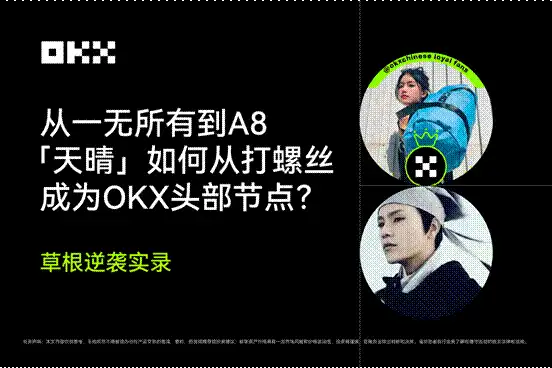
He is the top node "Tianqing" of OKX.
He had also been a KTV waiter, worked in a factory tightening screws, and traveled around doing manual labor across various industries.
During the 2021 pandemic, a video of Musk shilling Dogecoin became the unexpected starting point for him entering the crypto.
He used 200,000 yuan saved from working to buy an Ethereum mining machine, diving headfirst into a world that seemed paved with gold.
Reality was far more brutal than imagined: exchanges running away, contract liquidations, Altcoins plummeting...
One setback after another followed, but he persevered and never left the market.
Over five years, through stable node operations on OKX and a rational trading system,
He gradually transformed from a grassroots trader to a top trader earning millions annually.
He is not an overnight success story, but the most authentic type of person in crypto:
Slow, but determined; not flashy, but piercing through darkness.
This issue features Mia from OKX interviewing top node "Tianqing", taking you deep into the real growth journey of this underdog.
Mia: Do you do any other trading besides being a node?
Tian Qing: Yes, I do. I have a special fondness for ETH. I've been an "Ethereum soldier" for many years. I believe in ETH's long-term value and potential. My trading strategy is relatively slow and steady. I don't pursue those high-risk, high-return trades. Instead, I focus on gradually accumulating assets and buying the dips when the market is down.
For example, when ETH was at its lowest point, around $1,000, I started buying. I didn't go All In at once, but gradually increased my position. My principle is to buy a little when the price drops, which helps me lower my average cost. This is different from most people in the crypto who like to shill or chase quick profits. I prefer a more stable approach to asset growth.
My trading philosophy is: don't be too greedy, focus on long-term value, and maintain a calm mindset. Whether in a bull or bear market, I stick to my strategy of slow and steady accumulation.
Tianqing: Of course. Actually, in this industry, I feel the deepest connection with Ethereum. My name even includes "ETH", which is kind of advertising for Ethereum. I'm an "E Guard". I remember most clearly when Ethereum dropped to around 800U during a live stream, and I watched it fall right before my eyes. I was stunned, and the viewers were asking, "Why aren't you speaking? What happened?" At that time, I had bought Ethereum at over 1500U, which was nearly halved. Most people had lost confidence, but I still thought - I must persist, I must hold on.
Eventually, I did persist. Not long after, Ethereum rebounded to 2000. Because I initially entered the crypto by mining Ethereum, I have deep feelings for it. I had a teacher who used to trade futures, who taught us about contracts. He especially emphasized "momentum", telling us: don't look at the price, look at the momentum. Because you can't predict rises and falls, you can only judge when a momentum wave ends or begins. This is how we trade. I feel this is much more reliable than just guessing prices.
Mia: Did you mainly learn trading from this futures teacher? What other self-learning methods do you have?
Tianqing: I've learned so much myself, basically all the schools of thought searchable online. But I think the most useful is the big cycle approach, simplicity is the ultimate sophistication. The shorter the cycle, the harder it is to predict trends because there are too many variables. For example, guessing the price 10 minutes from now is impossible. But looking at long-term trends for quality assets like BTC and ETH, their trend is generally upward. Of course, they may have many short-term fluctuations, but long-term trends are easier to judge. So I always believe "slow is fast" - slow means effective accumulation, fast doesn't necessarily mean effective accumulation. I use most funds for spot trading and strategies, but also play with contracts.
[The translation continues in this manner, maintaining the specified translations for specific terms and preserving the original structure and meaning.]So I would advise new friends, including my fans or group members, to first settle down and think clearly about which path they want to take. I often say in my live streams, "Plan before acting" - first think about what you want to do, then consider how to do it, breaking it down step by step. But most importantly, stay true to your original intention and don't get jealous when you see others making money. You only see others making money, but you can't see what they've been through. Many big shots become famous overnight, but few understand what they did in the previous years.
Money-making Opportunities: Waiting for Cycles, Airdrop Tasks, and Becoming an Agent
Mia: What money-making opportunities do you think exist in Web3 now?
Tianqing: I think the most stable money-making opportunity is waiting for cycles. For example, when the price is high, can you look at shorting with low multiples in the long term? Or when the price hits bottom, can you start a long-term position? In fact, many people have made money this way, including myself. For instance, I bought ETH at 800U, 1500U, and 2100U, and I also told my fans to buy, but they didn't believe in it at the time. Now I've sold a large part of my ETH spot. They now call me stupid, saying how could I sell when it's rising so much? But when it was falling, they said I was foolish for daring to buy. But ultimately, facts and results speak for themselves. Those who called me stupid when I shilled have basically left the crypto.
You can have an emotional trade occasionally, but if you trade emotionally every day, you definitely won't survive long. When making a decision, we should do less, not more. We should collect enough information, like A, B, C, D, E five clues, letting them collectively promote a decision. This decision is of high quality. For example, these five clues make me decide to buy here, and then it rises; when new clues appear, I sell at another position. This is a relatively good decision. But some people make 20 decisions and 20 trades a day, with no theoretical support. How can the decision quality be high? In the end, they don't even know what position they're opening.
Mia: Besides trading, what other ways can newcomers participate?
Tianqing: Of course, like airdrop tasks. I'm not very good at it, but some brothers in my group who are short on money do some airdrop tasks to earn money and then return to trading. They earn a bit here and there, ultimately returning to trading. For newcomers, the most important thing is to stay true to yourself, slowly try various products on exchanges, and understand what scenarios each function suits. Many people see others making money or a coin rising several times, get excited and register an account with cross margin deposit, ending up either losing money or feeling scammed. But actually, they made these decisions without any theoretical support, so the decision quality is naturally poor and likely to fail.
Mia: You mentioned earlier that the money you made from being an agent was even more than trading. Would you recommend newcomers do agency work?
Tianqing: If you have resources, I definitely recommend becoming an agent. I feel everything went smoothly after joining OKX, and the obstacles I encountered were basically not on OKX's side. This is also why we can sit here today. I quite like this exchange.
[The translation continues in the same manner for the rest of the text.]Sunny Day: People should find positive feedback and not blindly persist in a negative feedback environment, which is foolish persistence. One should find things beneficial to oneself, continuously research and optimize, in order to go further. Some people say persistence is just blind persistence. Are you currently screwing in bolts because you're better at it than others? Do you have a path for advancement? If yes, then that is your path. But if you've been doing something for a year without progress, and optimization yields no results, then don't persist. This is not your talent.
Disclaimer
This article is for reference only. The article represents only the author's views and does not represent the position of OKX. This article does not intend to provide (i) investment advice or recommendations; (ii) an offer or solicitation to buy, sell, or hold digital assets; (iii) financial, accounting, legal, or tax advice. We do not guarantee the accuracy, completeness, or usefulness of such information. Holding digital assets (including stablecoins and Non-Fungible Tokens) involves high risks and may fluctuate significantly. You should carefully consider whether trading or holding digital assets is suitable for your financial situation. For your specific circumstances, please consult your legal/tax/investment professional. You are responsible for understanding and complying with local applicable laws and regulations.
Click to learn about BlockBeats job openings
Welcome to join the official BlockBeats community:
Telegram Subscription Group: https://t.me/theblockbeats
Telegram Communication Group: https://t.me/BlockBeats_App
Official Twitter Account: https://twitter.com/BlockBeatsAsia