This article is machine translated
Show original
Here's the translation:
Taking Marinade @MarinadeFinance as an example to discuss the buyback model of protocol value.
Community members have been asking me to write an article about token economics protocol as a valuation basis for early projects. This article focuses on the DeFi track to discuss the valuation system.
The earliest YFI governance rights could guide liquidity, which was also the earliest way governance rights participated in income distribution.
Governance rights can participate in protocol-level decisions. When prices start to fall, governance cannot maintain demand long-term, which has been verified countless times. UNI has always been criticized for not empowering.
Currently: Marinade $MNDE token's current uses include governance and validator voting rights, capturing value through the "Stake Allocation Market", then shifting towards validator stake cap influence, with direct value capture decreasing.
Now: Preparing to use Marinade's income to repurchase MNDE in the market by September 2025.
So can buybacks support the project's long-term development?
Hype, Aave, dYdX, Jup, and scam soon projects use protocol revenue to buy and burn tokens from the market. Why do some stabilize prices while others sell during good news?
Hyperliquid is the most successful here.
Hyperliquid's uniqueness lies in buybacks being an indispensable part of its economic model.
These are based on hype fundamentals and transparent buyback mechanisms through fundamentals.
How about $MNDE?
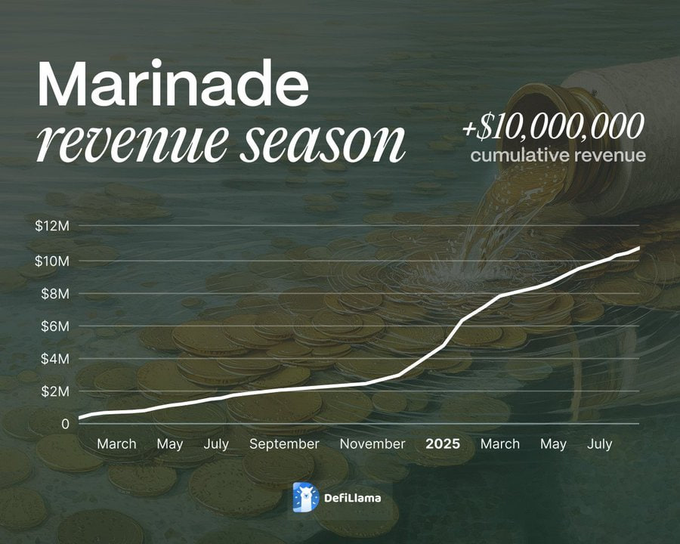
Protocol Value: Marinade's Total Value Locked (TVL) is 11 million SOL (approximately $2.1 billion at $195/SOL), with native staking and liquid staking each accounting for about 50%. The protocol can generate over $10 million in annual income, while MNDE's current market value is only about $45 million.
Compliance: Marinade is designated as the exclusive staking service provider for the first US Solana ETF (Canary), and has been integrated with BitGo (SOC2 certified, managing assets over $100 billion).
In summary: With good fundamentals and currently undervalued, new governance proposals are repairing MNDE's value capture issues.
For projects with real income, buybacks are an improvement in fundamentals, just like UNI doesn't need to turn on a revenue-sharing switch.
Every innovation in DeFi token economics is an exploration of token rights and the distribution of holder benefits.
Synthetix initiated liquidity mining.
Compound granted governance rights to its token.
YFI token is used to guide liquidity through liquidity mining and possesses protocol governance rights.
Helium uses a multi-token model to distinguish between speculation and utility.
When ETH broke 4000, continuing such a Ponzi scheme to drive flywheel-level innovation.

From Twitter
Disclaimer: The content above is only the author's opinion which does not represent any position of Followin, and is not intended as, and shall not be understood or construed as, investment advice from Followin.
Like
Add to Favorites
Comments
Share