※This article is automatically translated. For accurate content, please refer to the original text.
Summary
A7A5 is a Russian ruble-backed token issued by the Kyrgyz company Old Vector. Old Vector was sanctioned on August 14, 2025. A7A5 is backed by deposits from the sanctioned Russian bank Promsvyazbank (PSB) and has significantly increased its transaction volume, processing over $5.17 billion in total transactions. Grinex was also designated by OFAC on the same day and has become the primary platform for A7A5 transactions. This token operates within a limited ecosystem of Russia-related financial services and platforms, with transactions concentrated from Monday to Friday. This suggests that A7A5 is not a retail token but used as an internal settlement tool between businesses. Decentralized exchanges (DEX) that enable swapping A7A5 to mainstream stablecoins act as a "bridge" for A7A5 to flow into mainstream crypto asset services, raising concerns about sanctions evasion. Grinex's initial A7A5 token liquidity was provided via Garantex, with clear on-chain links between the two services. The emergence and usage of A7A5 align with recently enacted Russian legislation and demonstrate a deliberate effort to build alternative financial infrastructure to mitigate Western sanctions. On August 14, 2025, in a major sanctions enforcement, the US Treasury's Office of Foreign Assets Control (OFAC) announced sanctions re-designation of the crypto asset exchange Garantex, its successor Grinex, and companies related to the Russian ruble-backed token A7A5. Among these, the Kyrgyz company Old Vector was sanctioned for collaborating with Garantex and Russian company A7 LLC and its subsidiaries in creating and distributing A7A5 tokens. A7A5 is backed by Russian rubles and designed as a cross-border settlement platform to circumvent international sanctions. [The rest of the translation follows the same professional and accurate approach, maintaining the specified translations for specific terms.]A7A5 trading is currently available on the following Russian-based services.
Grinex is registered in Kyrgyzstan and is considered the successor to the sanctioned Russian exchange Garantex. Grinex began addressing the issue immediately after the shutdown, allowing Garantex customers to transfer funds through Federation Tower (details to follow).
Bitpapa is a P2P exchange designated by OFAC, which facilitated payments of millions of dollars to OFAC-designated Russian crypto-asset related companies such as Garantex and Hydra.
Meer was officially registered in Kyrgyzstan during the A7A5 launch period and was one of the first services to promote the token's trading.
In addition to A7A5 being available only on limited services, the weekly trading patterns also reveal restricted use within a closed ecosystem. A7A5 trading is primarily concentrated from Monday to Friday, with the highest trading volume at the beginning of the week and very low activity during weekends.
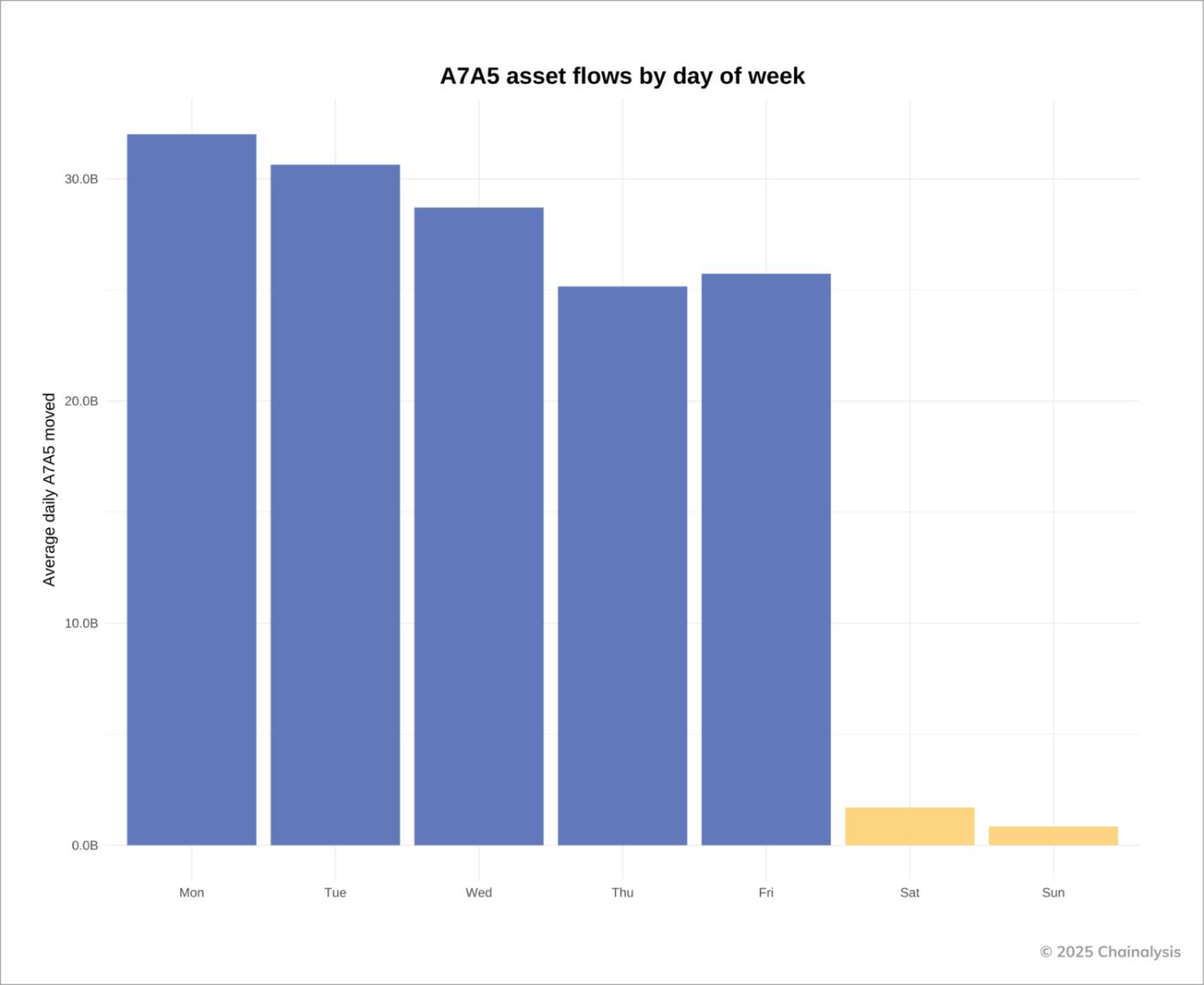
These trading patterns suggest that A7A5 is mainly used by businesses operating on weekdays, in line with Russia's legislative policy aimed at facilitating international transfers through crypto assets.
What is A7A5 DEX?
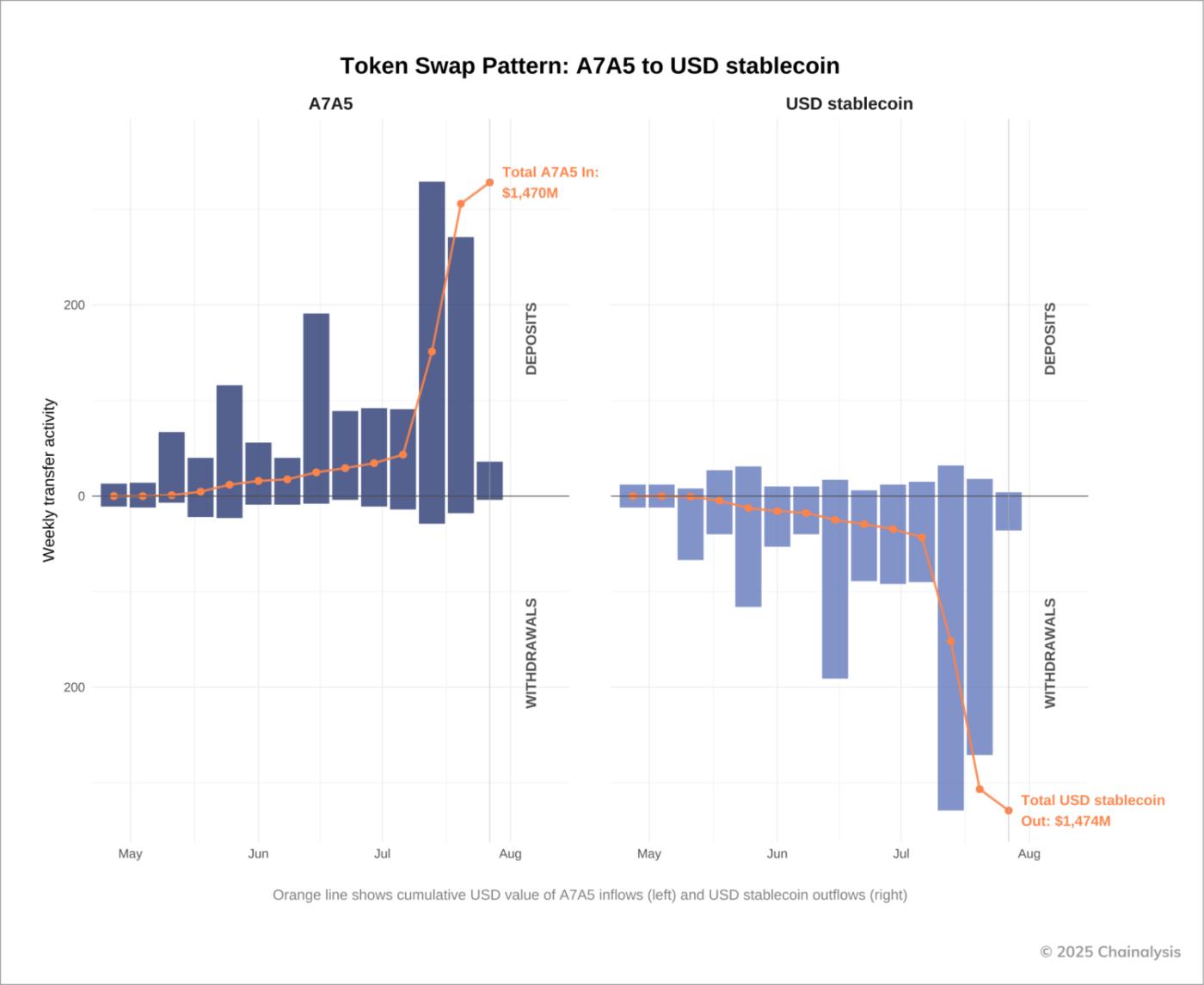
While A7A5's circulation and use are limited to a closed ecosystem, A7A5 DEX opens the path for A7A5 to flow into the external crypto asset ecosystem by enabling swaps from A7A5 to mainstream stablecoins. A7A5 DEX utilizes the balance sheet of the operators' A7A5 and other stablecoins to enable swaps between A7A5 and mainstream stablecoins. New liquidity provision is announced daily on social media. Unlike typical DEXs where exchange rates are determined by the market, A7A5 DEX adopts centrally managed exchange rates.
Assets totaling $1.46 billion related to A7A5 have been moving through decentralized exchanges (DEX). Subsequently, funds, primarily in stablecoins, flow to various services including major crypto asset services, exchanges without KYC, and Russian-related payment providers, further expanding A7A5's scope of influence.
What is the relationship between A7A5, Garantex, and Grinex?
As mentioned earlier, the use of A7A5's native token is limited to a few services, with the highest trading volume occurring on Grinex. Let's examine these relationships in detail.
With the suspension of Garantex (March 2025), its domain and servers were seized, and illegal funds exceeding $26 million were frozen. Immediately after, users were confused about whether Garantex account funds were available or how they could be withdrawn.
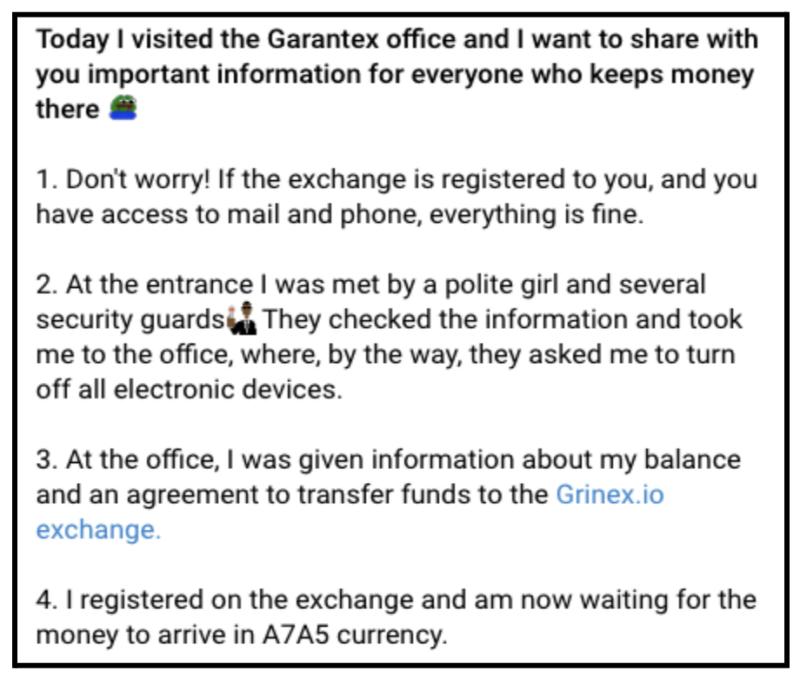
Multiple social media posts claim that users could transfer funds to the new service Grinex by visiting Garantex's office (Federation Tower).
Furthermore, Garantex founder Sergey Mendeleev was also sanctioned on the same day and promoted Grinex on his social media immediately after Garantex's suspension, joking that "all coincidences are accidental".
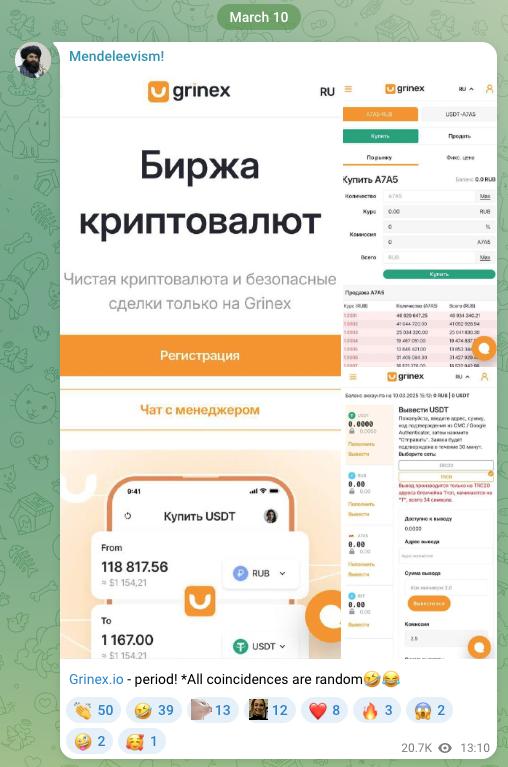
Additionally, the Grinex platform's appearance is almost identical to Garantex, with only the color scheme differing.
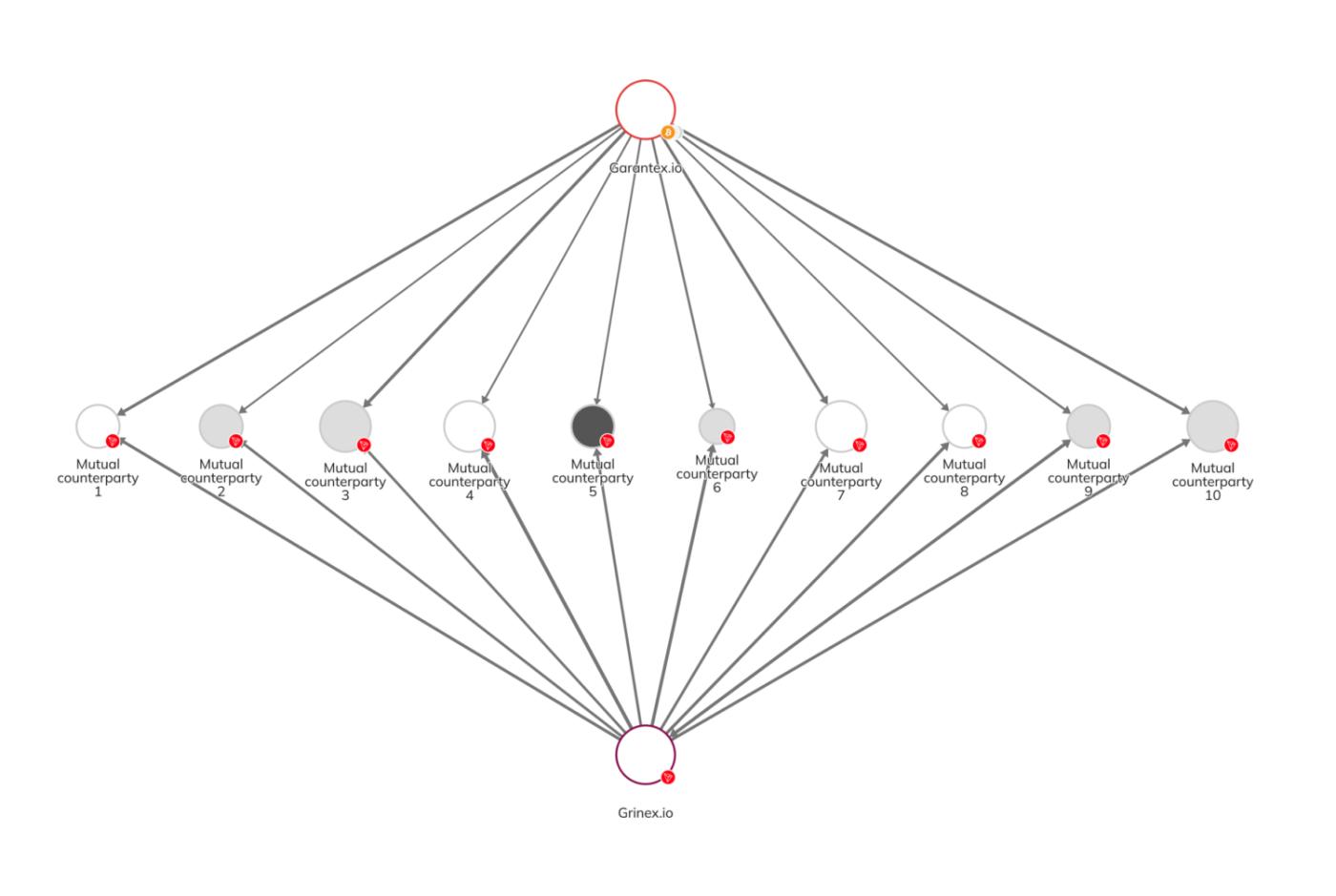
These off-chain information suggested signs of rebranding, and on-chain data also showed a strong relationship between the two services. Users who previously sent funds to Garantex began withdrawal processing on Grinex after Garantex's suspension. The following Chainalysis investigation tool graph shows an example of a representative user.
Another on-chain link is the movement of A7A5 tokens from Garantex to Grinex via Old Vector (a sanctioned Kyrgyz company) after Garantex's suspension. Garantex had been receiving newly issued A7A5 tokens since February (the A7A5 contract was created in late January), and after its suspension on March 6th, a large amount of A7A5 tokens were transferred from Old Vector to Garantex and burned on March 10th.
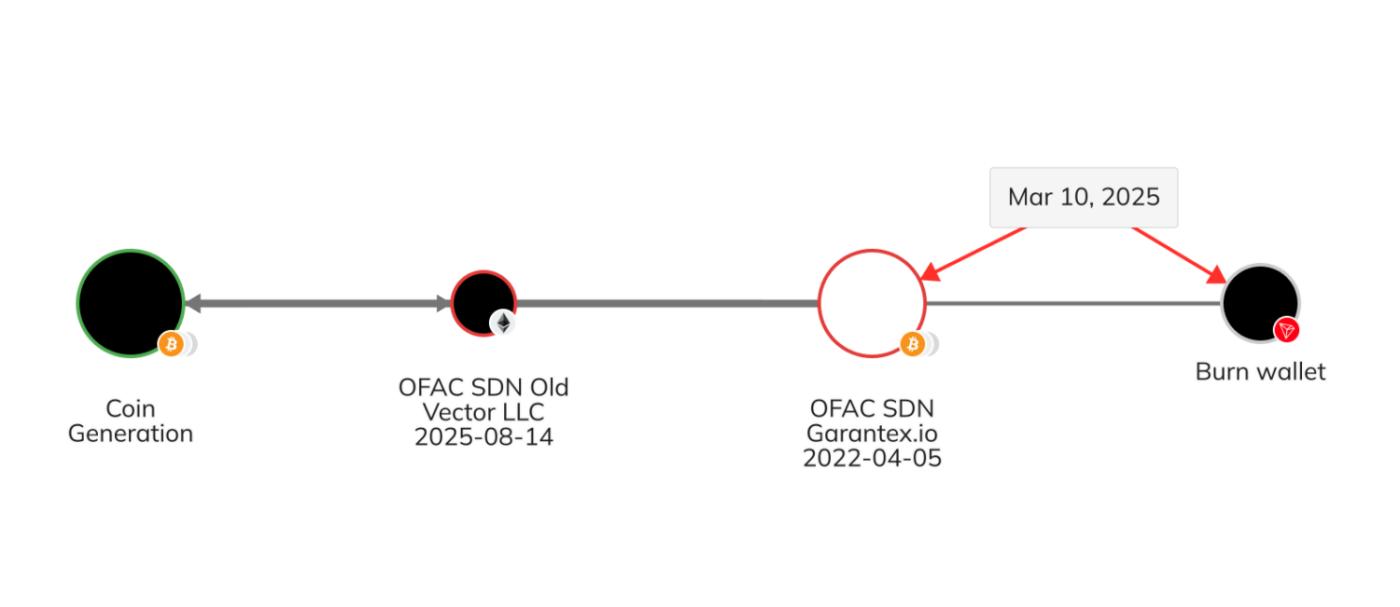
On the same day, a new token of the same amount burned by Garantex was issued and deposited into Old Vector-related wallets. These funds were ultimately transferred to Grinex, supplying new A7A5 liquidity. In other words, the tokens burned by Garantex were likely re-issued to supply the new brand Grinex.
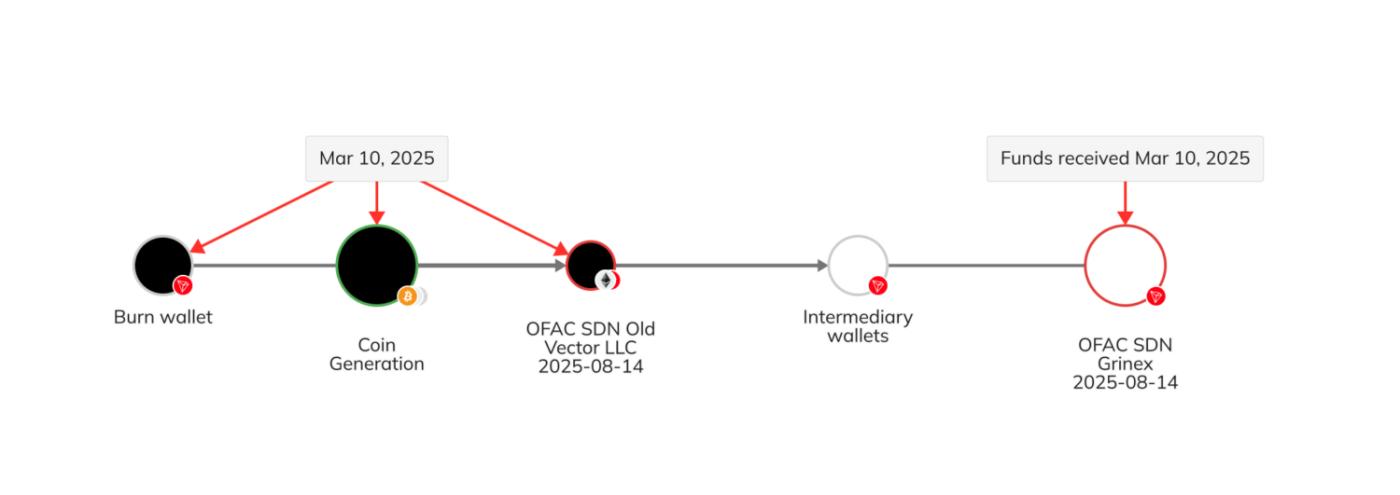
While the off-chain relationship was suggested, the immutability and transparency of the blockchain further strongly proved the connection between the two services. This sanction designation officially confirms these inseparable relationships.
Impact on Sanctions Compliance and Monitoring
Over the past year, Russia has deliberately worked on building financial infrastructure aimed at easing sanctions pressure, such as legalizing crypto asset mining and legalizing crypto asset use in international payments. On-chain analysis also reveals that this policy is being utilized across various ecosystems, including sanctioned Russian crypto exchanges, money laundering services, military procurement networks, and weapons and commodity trading. These networks involve high-value transfers and provide liquidity between crypto assets and from rubles to crypto assets. This enables sanctions evasion through cross-border transactions outside the traditional financial system. This sanction designation further emphasizes Russia's promotion of sanctions evasion by leveraging crypto asset payment rails. However, blockchain transparency also provides opportunities for identifying and blocking these networks.
The emergence of the sanctioned A7A5 network demonstrates that Russia is operating alternative payment rails. By the end of July, A7A5 processed over $51.17 billion in transactions, with activity patterns suggesting usage by businesses operating on weekdays. By being backed by sanctioned Russian institutions, A7A5 provides a new cryptocurrency-based bypass to counter strengthened sanctions against Russia. While it remains unclear whether A7A5 will expand to a broader retail market, a new service has been launched on the A7A5 official website allowing the purchase of A7A5 tokens using PSB bank cards.
By leveraging Chainalysis solutions, organizations can monitor and detect exposure to these high-risk sanctioned activities (such as cryptocurrency addresses for Garantex, Grinex, and Old Vector). Moreover, our cross-chain monitoring capabilities enable real-time tracking of A7A5, and Chainalysis Sentinel can analyze risk exposure across more than 35 categories, monitoring daily transactions to provide a comprehensive view of token ecosystems like A7A5. Chainalysis will continue to monitor these developments and support partners and governments in identifying new risks and maintaining global compliance standards.
This website contains links to third-party sites that are not under the control of Chainalysis, Inc. or its affiliates (collectively "Chainalysis"). Access to such information does not imply association with, endorsement of, approval of, or recommendation by Chainalysis of the site or its operators, and Chainalysis is not responsible for the products, services, or other content hosted therein.
This material is for informational purposes only, and is not intended to provide legal, tax, financial, or investment advice. Recipients should consult their own advisors before making these types of decisions. Chainalysis has no responsibility or liability for any decision made or any other acts or omissions in connection with Recipient's use of this material.
Chainalysis does not guarantee or warrant the accuracy, completeness, timeliness, suitability or validity of the information in this report and will not be responsible for any claim attributable to errors, omissions, or other inaccuracies of any part of such material.
The post OFAC Sanctioned Russian Crypto Asset Network: Garantex Rebranding, Grinex, A7A5 Tokens and Legislative Sanctions Evasion appeared first on Chainalysis.