A new study from Satoshi Action Education predicts a 75% chance that Bitcoin will exceed $4.81 million in April 2036.
The study, led by economist Murray A. Rudd, uses an updated probability model to examine how supply and demand constraints from institutions could affect long-term valuation.
Bitcoin Supply Shock and Price Scenarios
The updated results show a 75% probability of a price exceeding $4.81 million in April 2036. The 25% overrun reaches $10.22 million, while the 95% upper limit ranges from $11.89 million to $14.76 million, depending on simulation parameters. In the most extreme 1% of simulations, the price peak could reach nearly $50 million. The average forecast is around $6.55 million to $6.96 million for the same date.
Bitcoin's 21 million supply limit and an estimated circulation of nearly 3 million BTC form the supply foundation. Long-term storage, corporate pledging, DeFi activities, and Layer 2 networks are expected to continue reducing tradable supply. The basic and medium scenarios maintain circulating supply from 6.55 million to 6.96 million BTC in April 2036, adjusting extreme predictions.
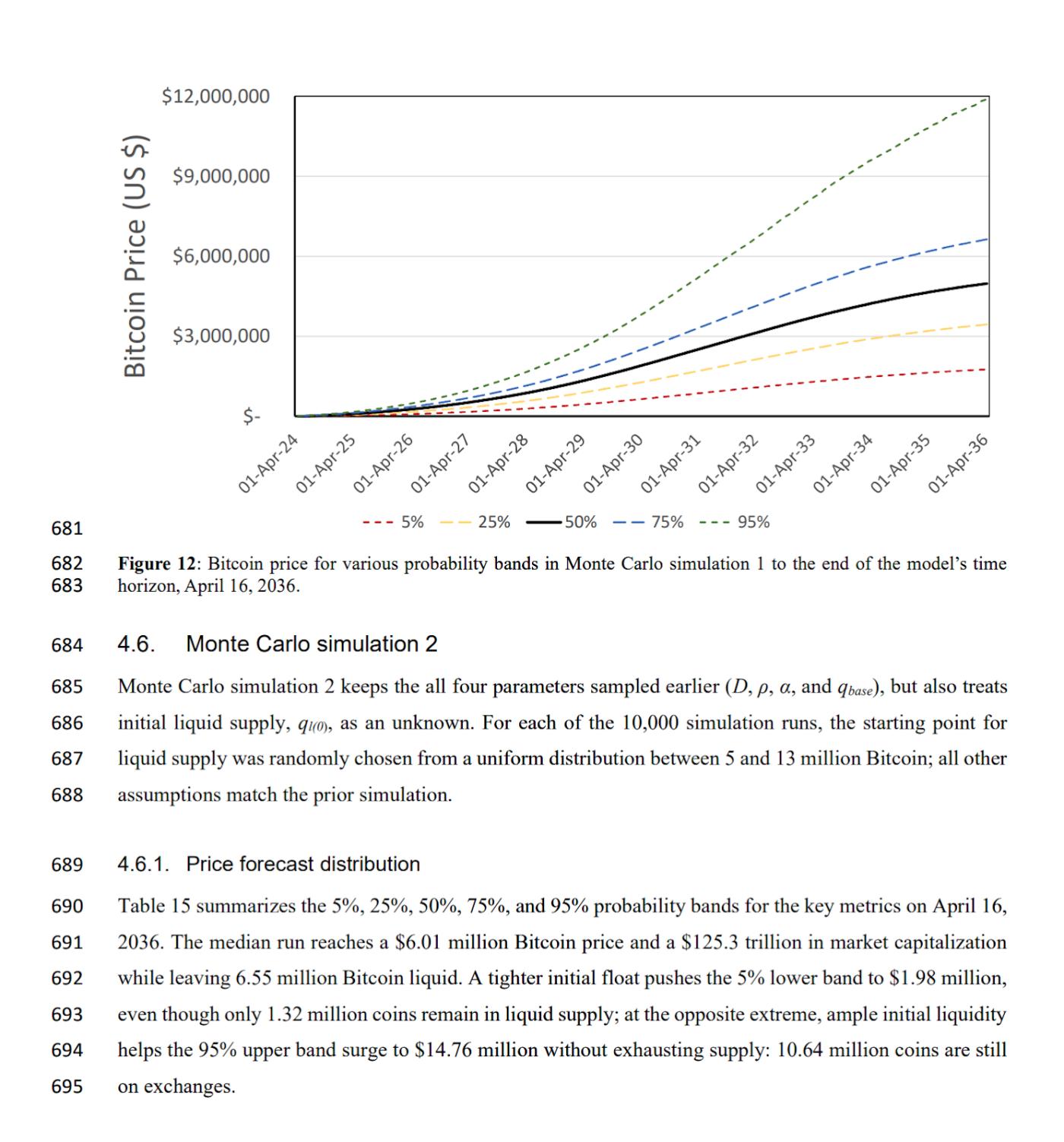
Stress simulation paths illustrate how continuous withdrawals from exchanges can accelerate scarcity. If circulating supply drops below 2 million BTC with low contraction sensitivity, the model shows prices could rise rapidly. In the worst 1% depletion path, circulating supply drops below 2 million BTC on 19/01/2026, and below 1 million BTC on 07/12/2027.
The updated model forecasts significantly higher prices compared to the January report, using more conservative assumptions about adoption and liquidity. Researchers attribute this to supply-demand imbalance after 2026 and structural constraints limiting available supply. The model incorporates institutional accumulation patterns, reduced purchases during price increases, and increased buying under stable conditions.
The study notes that investor perception of liquidity risk will be crucial as adoption increases. It emphasizes a narrow margin between sustainable scarcity and destabilizing depletion, with the latter potentially causing significant volatility.
Portfolio Investment Strategic Implications
These findings have implications for investment portfolio strategies and policies. For long-term allocators, the steep tail of the price distribution supports strategies that account for asymmetric advantages while respecting liquidity constraints. Policy planners may need to address custody concentration and cross-border capital flows as corporate treasuries, national reserves, and crypto initiatives increase pressure on circulating supply.
Combining macro-level adoption curves with micro-level liquidity events, the Monte Carlo framework and Epstein–Zin utility specification provide a more comprehensive view than simpler forecasting models. Multiple constraint factors are integrated to simulate how Bitcoin prices might develop under various market and policy conditions.
According to BeInCrypto's report, Bitcoin entered uncharted territory on Thursday, surpassing $124,000 to establish a new ATH. Prices increased nearly 8% over the past week. Analysts point to the convergence of positive chain signals suggesting the price surge may still have room to continue.