For institutions, the dawn of new DeFi native financial assets is breaking.
The early integration of Pendle and Terminal Finance is more than just another "yield opportunity".
It marks the arrival of a new financial era:
TradFi <> DeFi native financial assets merging at the most fundamental level.
This is the harbinger brought by Converge: establishing strategic partnerships with Ethena and Securitize facing TradFi, paving the way for institutional funds to enter.
As TradFi begins to recognize the powerful synergies released by DeFi, driven by new theories of institutional adoption, this financial transformation is being propelled.
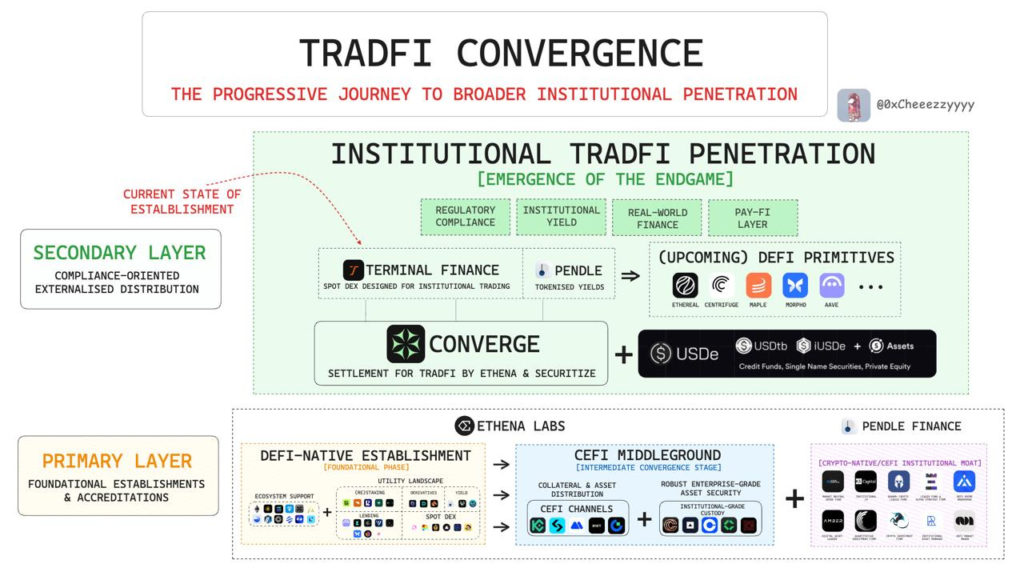
Led by Terminal Finance, combining the front-end technologies of Ethena and Pendle, the Converge ecosystem brings together the most institution-friendly forces in the DeFi field.
Its credibility comes not just from market speculative appeal, but also from a carefully designed financial architecture:
- DeFi native infrastructure with deep integration and high composability
- Powerful CeFi external distribution capabilities
- Closed-loop institutional participation model
All of these together constitute a solid underlying structure, laying the foundation for broader institutional fund entry into the DeFi realm.
Next Stage: Second Layer Formalization
This stage marks the final externalization of the Converge ecosystem, aiming to create a system fully aligned with traditional finance (TradFi), with core cornerstones including:
- Traditional financial strategic distribution channels
- Compliance regulatory framework
- Institutional-level liquidity coordination mechanism
Through a bottom-up design, Terminal Finance becomes the liquidity hub core facing traditional finance in Converge, tailoring the entire financial architecture for institutional trading.
The entire spirit of defining early DeFi's "Money Legos" is built on one principle: composable liquidity.
However, without deep, reliable, and accessible liquidity, composability cannot be discussed. This is precisely the key gap that TerminalFi, as the cornerstone of the Converge ecosystem, fills.
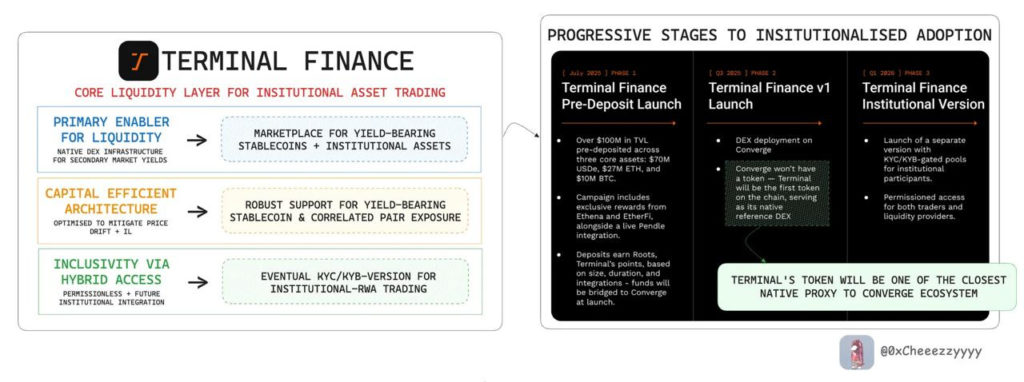
It is not just an ordinary decentralized exchange (DEX), but an innovative platform designed for institutional needs:
- Ecosystem core driver: creating a powerful secondary market for institutional-level assets and yield-bearing stablecoins
- Capital efficiency priority: reducing price drift and Impermanent Loss (IL) through optimized design, enhancing liquidity provision returns
- Inclusive accessibility: supporting both permissionless trading and gradually launching institutional-level real-world asset (RWA) trading compliant with KYC/KYB regulations
Evidently, TerminalFi, as an institutional-level financial native component, offers a unique and highly attractive value proposition.
However, with Converge yet to launch its token roadmap, TerminalFi effectively serves as the closest native proxy for capturing Converge's potential growth value.
Strategic Dual Synergy: Pendle x Ethena
TerminalFi's YBS (Yield-Bearing Stablecoin) theory prompts its strategic choice of sUSDe as the core base asset, further solidifying this strategic direction with Pendle's simultaneous launch.
This is no coincidence.
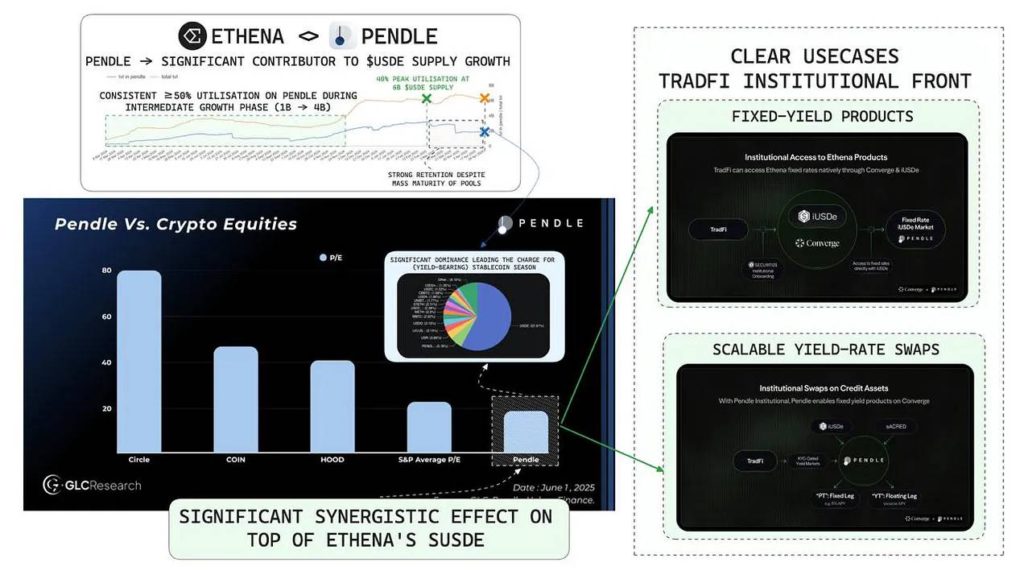
@ethena_labs achieved a supply scale of over $6 billion in less than a year, with Pendle Finance playing a crucial role in this growth:
- During the supply surge from $1 billion to $4 billion, over 50% of sUSDe supply was tokenized through Pendle.
- When the supply reached $6 billion, peak utilization reached 40%.
The high sustained utilization on Pendle proves the market adaptability of fixed and floating income tokenization in DeFi native portfolios. More importantly, this further highlights the powerful synergy between Ethena and Pendle: mutually driving, forming a lasting compound network effect loop that brings profound impact to the entire ecosystem.
But the synergy does not stop here.
Ethena and Pendle's goals extend far beyond DeFi users. They are jointly targeting larger institutional market opportunities:
- Fixed Income Products: A market with a scale of $190 trillion in traditional finance
- Interest Rate Swaps: An even larger market segment, reaching $563 trillion in scale
Through Converge's certified and regulated distribution channels, the key bridge connecting institutional asset allocators has been successfully built. This breakthrough provides institutions with extensive opportunities to access crypto-native yield sources, characterized by faster, composable, and yield-centric design.
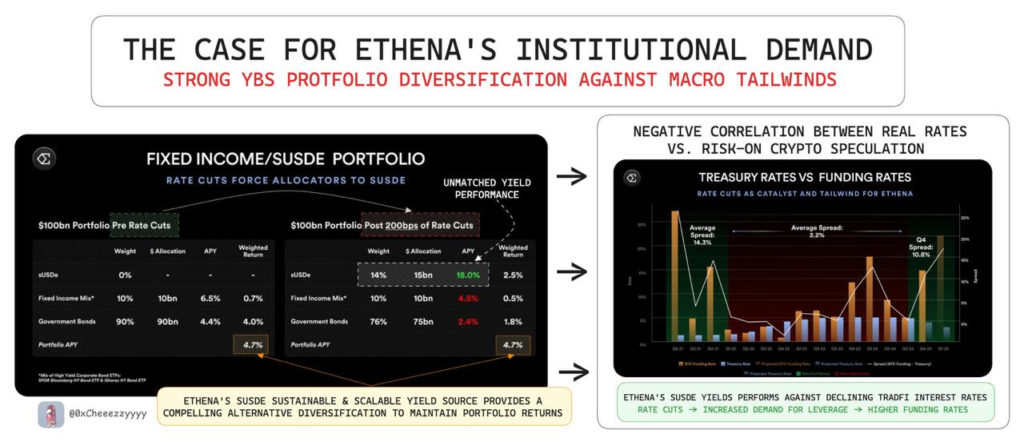
The successful establishment of this theory depends on innovative financial native assets and appropriate design for the upcoming macroeconomic tailwinds to take effect, and Ethena's sUSDe perfectly meets this requirement:
sUSDe's yield is negatively correlated with global actual interest rates, which is entirely different from other debt instruments in traditional finance.
This means that sUSDe can not only survive in changing interest rate environments but also benefit and thrive from them.
Current interest rates (around 4.50%) are expected to decline, and institutional portfolios will inevitably face yield compression challenges - further solidifying sUSDe's positioning as a logical alternative for maintaining portfolio returns.
In 2020/21 and the fourth quarter of 2024, BTC financing spreads exceeded actual interest rates by over 15%.
What does this mean?
From a risk-adjusted yield perspective, sUSDe and its extended version iUSDe (traditional finance packaging) have significant structural advantages. Additionally, with capital costs significantly lower than traditional finance (TradFi), this brings potential 10x yields to underdeveloped traditional finance areas.
Dual Synergistic Growth Effect: Pendle's Key Role
Next Stage: Convergence
Clearly, Ethena and Pendle are strategically aligned and moving towards the same ultimate goal: traditional finance (TradFi) convergence.
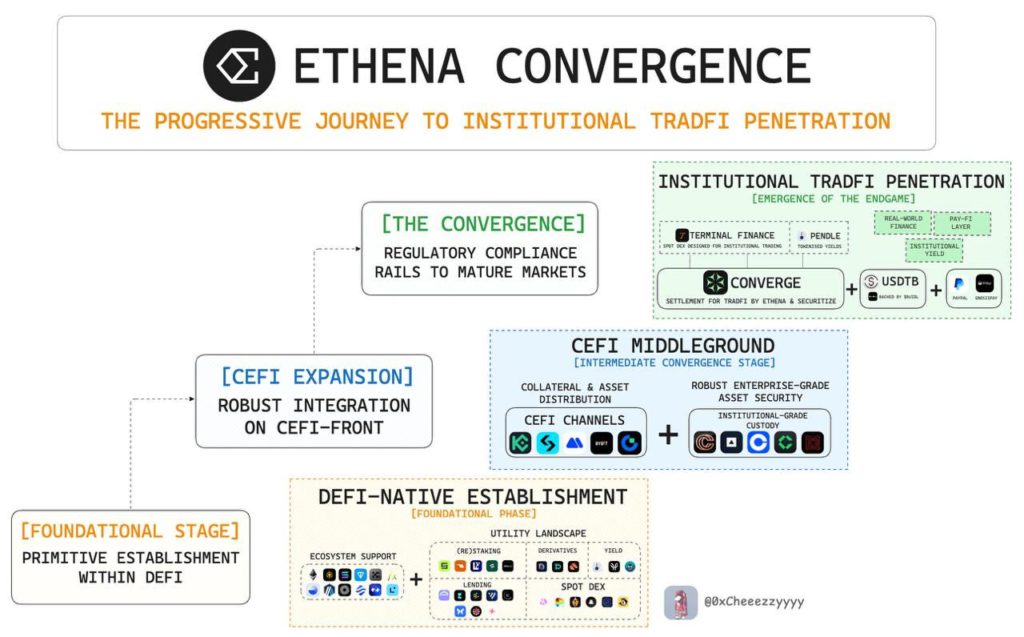
Since its establishment in the first quarter of 2024, Ethena has successfully consolidated its position in the DeFi native domain + CeFi intermediate zone with its robust infrastructure:
- USDe and sUSDe assets cover over 10 ecosystems + top DeFi integrations
- Multiple CeFi distribution channels through CEX for perps adoption + collateral utility
- Payment layer integrations, such as PayPal and Gnosis Pay
This solid foundation lays the cornerstone for the final stage of institutional traditional finance (TradFi) penetration, and the birth of Terminal Finance becomes the core anchor of Converge, driving the development of a TradFi liquidity hub for institutional trading.
Undoubtedly, Pendle's participation unleashes the financial potential of YBS native assets. Meanwhile, Pendle has also launched LP token pre-deposit functions for initial pools:
- tUSDe: sUSDe/USDe pool
- tETH: wETH/weETH (provided by EtherFi) pool
- tBTC: wBTC/eBTC (provided by EtherFi) pool
* These pools are specifically designed for single-side beta positions + simultaneously minimizing Impermanent Loss (IL) risk to attract committed and long-term liquidity providers.
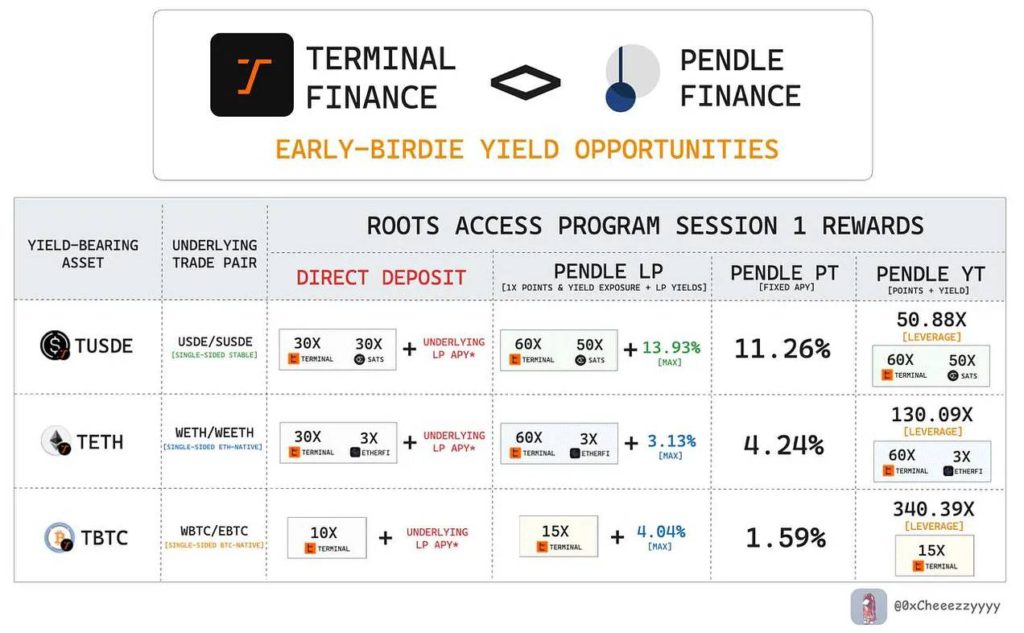
About Early Opportunities: Roots Access Program Phase One
The early guidance phase is accompanied by Pendle's exclusive multiplier rewards, which are time-sensitive:
- Terminal points: 15x to 60x multiplier rewards (compared to 10x to 30x direct deposits)
- tUSDe rewards: 50x Sats multiplier
- tETH rewards: 3x EtherFi multiplier
- LP Annual Percentage Yield (APY): Up to 13.93%, including yield and point rewards under single-side position and negligible Impermanent Loss
- Fixed Annual Percentage Yield: tUSDe offers 11.26%
- Highly capital-efficient YT positions: Total yield and points can reach 51% to 340%
Clearly, no other pathway can offer such strategically significant opportunities in the early emerging institutional native asset domain.
Final Thoughts:
Looking at the broader perspective, Converge's establishment marks the birth of the financial operating system for the next generation of economic native assets.
If you haven't yet seen this trend:
- Ethena provides yield-bearing dollars
- Pendle builds the yield structuring layer
- Terminal leads institutional market access
Together, they form the core framework of a unique on-chain interest rate system with composability, expandable toolkit, and the ability to meet the demand for higher yields from trillions of dollars in the global fixed income market.
This is truly opening the box of institutional-grade DeFi.
And this transformation has already begun.