1. How Much Bitcoin Does BlackRock Own?
BlackRock entered the Bitcoin market through the iShares Bitcoin Trust (IBIT), marking a new era of institutional Bitcoin accumulation.
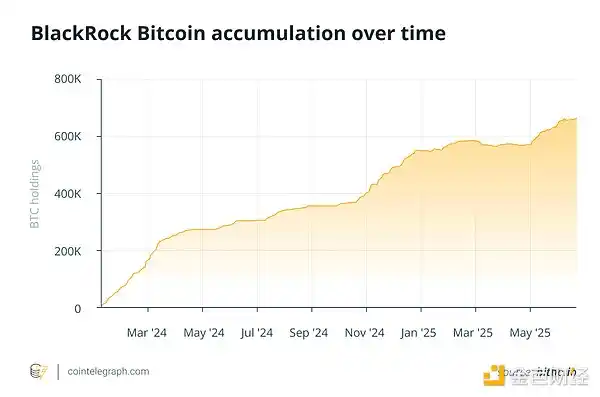
Since its launch on January 11, 2024, IBIT's growth has been unprecedented, surpassing other ETFs. As of June 10, 2025, BlackRock holds over 662,500 Bitcoins, representing more than 3% of the total Bitcoin supply. At current prices, this equates to a Bitcoin exposure of $72.4 billion, which is a staggering figure by any standard.
In comparison, the SPDR Gold Shares (GLD) took over 1,600 trading days to reach $70 billion in assets under management. IBIT achieved this goal in just 341 days, becoming the fastest-growing ETF in history. This is not only a milestone for BlackRock itself but also indicates the maturing interest of institutional investors in Bitcoin.
BlackRock's Bitcoin holdings now exceed those of many centralized exchanges and even large corporate holders like Strategy. In terms of original Bitcoin holdings, only Satoshi Nakamoto is estimated to hold around 1.1 million Bitcoins, and this lead is narrowing.
If inflows continue at the current pace, IBIT may ultimately become the largest single Bitcoin holder, which would significantly change Bitcoin's supply distribution and ownership concentration.
BlackRock's Long-Term Bitcoin Accumulation
Did you know? Coinbase Custody (not BlackRock) holds the BTC private keys in IBIT, securely storing customer assets offline and backed by commercial insurance.
2. Why Is BlackRock Making a Big Bitcoin Bet in 2025?
Behind BlackRock's massive allocation is a shift in strategic perspective: they now view Bitcoin as a legitimate component of a long-term, diversified portfolio.
BlackRock's Bitcoin Strategy
BlackRock's internal argument is: accept Bitcoin's volatility in exchange for its potential upside. Through IBIT (iShares Bitcoin Trust), they bet that broader adoption will gradually stabilize this asset, improve price discovery, enhance liquidity, and narrow the bid-ask spread.
In their view, Bitcoin is a long-term bet on monetary evolution and digital asset infrastructure. This perspective from the world's largest asset management company sends a strong signal to peers. It shifts the institutional discussion about Bitcoin from "whether to participate" to "how much to allocate".
Institutional Logic for Bitcoin Accumulation
BlackRock's key factors for being bullish on Bitcoin in 2025 include:
· Scarcity Design: Bitcoin's total supply is capped at 21 million, with issuance controlled by halving mechanisms, similar to gold's scarcity but backed by a digital infrastructure. Some estimates suggest that a large portion of existing Bitcoins are lost or inaccessible, making the actual circulating supply even tighter.
· Alternative to Dollar Hegemony: Against a backdrop of sovereign debt inflation and geopolitical fragmentation, Bitcoin's decentralized nature offers a hedge against fiat currency risks. It is positioned as a neutral reserve asset, resistant to government intervention and monetary manipulation.
· Part of Digital Transformation: BlackRock views Bitcoin as a proxy for a macro trend—the shift from "offline" to "online" value systems, encompassing finance, commerce, and intergenerational wealth transfer. They believe this trend is "super-driven" by demographic changes, especially the rising influence of younger investors.
These factors combine to give Bitcoin risk-return characteristics that traditional asset classes cannot replicate. BlackRock's statement is that Bitcoin provides an "additional source of diversification", offering a compelling argument for its entry into mainstream investment portfolios.
BlackRock's Crypto Portfolio Integration
BlackRock advocates a cautious approach: allocating 1-2% of Bitcoin in a traditional 60/40 stock-bond portfolio. While this percentage may seem small, for institutional-level portfolios, it's enough to make an impact and gradually help conservative allocators accept Bitcoin.
They also compare Bitcoin's risk profile to high-volatility tech stocks (like the "Seven Giants") to demonstrate its reasonable position in standard investment models.
Interestingly, the "dust" in IBIT's internal Bitcoin transactions includes small amounts of other tokens. BlackRock typically segregates these tokens or donates them to charities to avoid tax complexities.
3. Market Impact of Bitcoin ETFs
By holding over 3% of the total Bitcoin supply through IBIT, BlackRock has created a turning point for Bitcoin in terms of perception, trading, and regulation.
Bitcoin has been known for its volatility, stemming from fixed supply, sentiment fluctuations, and regulatory uncertainty. Historically, due to thin market liquidity, large trades often caused severe impacts. With IBIT absorbing hundreds of thousands of BTCs, the question is whether institutional capital will stabilize or further complicate the market.
ETF supporters argue that institutional investment helps reduce volatility. With regulated institutions like BlackRock participating, Bitcoin will become more liquid, transparent, and resistant to abnormal fluctuations.
BlackRock explicitly states that broader participation can improve price discovery, deepen market liquidity, and ultimately create a more stable trading environment.
However, critics (including some academics) warn that large-scale institutional participation will bring traditional market risks to Bitcoin: such as leveraged trading, algorithm-triggered flash crashes, and price manipulation through ETF flows.
In other words, the financialization of Bitcoin might replace its original retail-driven FOMO with another type of volatility (systemic, leverage-driven risks). Moreover, as ETF influence grows, Bitcoin's correlation with other financial assets may increase, undermining its "non-correlated hedge" value.
4. Institutional Accumulation Grants Bitcoin Mainstream Legitimacy
Undoubtedly, BlackRock's crypto strategy has pushed Bitcoin from a marginal asset to a mainstream investment tool.
For years, Bitcoin was ignored or even disparaged by large financial institutions. BlackRock's deep positioning indicates a changed attitude. The launch of IBIT (and its rapid growth to become one of the world's largest Bitcoin holders) grants Bitcoin more legitimacy than any whitepaper or conference.
ETFs like IBIT provide a familiar, regulated investment channel, particularly suitable for institutions hesitant about the technical complexity or custody risks of directly holding crypto assets. BlackRock's participation reduces other institutions' reputational risks, driving Bitcoin's adoption in traditional portfolios.
Retail investors also benefit: without dealing with wallets, seed phrases, and gas fees, they can gain Bitcoin exposure with just a click from their broker.
Fun fact: Mubadala, the sovereign wealth fund in Abu Dhabi, holds a significant portion of IBIT, with filing documents showing an investment of approximately $409 million.
5. BlackRock Holding 3% of Bitcoin: The Centralization Paradox
Bitcoin was originally designed as an alternative to fight centralized finance. Yet now, when the world's largest asset management company buys over 600,000 BTCs through centralized tools, a paradox emerges: a decentralized asset is gradually being controlled by centralized institutions.
Today, most users rely on centralized exchanges (CEX), custodians, or ETFs. These platforms offer more convenient operations, with features like insurance and cold storage, while meeting regulatory requirements (KYC, AML). In contrast, decentralized tools like DEXs or self-custodial wallets present high barriers, low liquidity, and lack of protection.
Therefore, even though Bitcoin remains decentralized at the technical level, most people actually interact with it through centralized channels. BlackRock's Bitcoin accumulation is a typical representation of this phenomenon. Some believe this deviates from Satoshi Nakamoto's vision, while others view it as a necessary compromise - a "centralization at the access layer" that allows Bitcoin to truly go global. This is the core of the Bitcoin centralization debate: how to find a balance between ideological purity and practical adoption.
Currently, the market seems to have accepted a hybrid model: decentralized underlying infrastructure + centralized access layer.
6. The Regulatory Catch-up Game
BlackRock's ability to launch IBIT stems from a key decision: the SEC's approval of a spot Bitcoin ETF in early 2024. This broke the years-long deadlock and opened the floodgates for institutional funds. However, the broader regulatory environment remains inconsistent and even contradictory.
One of the biggest challenges is asset classification. The SEC continues to waver, such as whether Ethereum (ETH) and Solana (SOL) are securities. This regulatory gray area has delayed the development of staking ETFs or Altcoin ETPs and left investors, developers, and issuers confused. Commissioner Caroline Crenshaw has pointed out that the SEC's current stance creates "murky waters", leading to passive enforcement and suppressing innovation. This directly affects whether institutions dare to invest beyond Bitcoin.
Currently, Bitcoin enjoys a relatively clear regulatory path. However, to mature the broader crypto market (such as Ethereum ETFs, DeFi-linked products), establishing a more consistent and globally coordinated regulatory framework is crucial.
Institutions are ready - but they need trustworthy rules.
Click to learn about BlockBeats job openings
Welcome to join the BlockBeats official community:
Telegram subscription group: https://t.me/theblockbeats
Telegram discussion group: https://t.me/BlockBeats_App
Twitter official account: https://twitter.com/BlockBeatsAsia