Author: Jaleel Jialiu
Original title: How does Variational, produced by Columbia University and with zero transaction fees, generate revenue?
While most perp DEXs are trying to be faster and cheaper than Hyperliquid, Variational has taken a different approach, devising a fundamentally different business model. Rather than engaging in an arms race on speed and fees, they've fundamentally rethought the question of how a perpetual contract trading platform should operate.
From CEXs to DEXs, whether spot or futures trading, traditional trading platforms make money in a straightforward way: by charging fees. Binance charges 0.1%, Hyperliquid 0.025%, and this seems to be an industry ironclad rule. However, Variational has achieved true zero fees, and its revenue is quite lucrative. Their OLP achieved an annualized return of over 300% between April and July 2025, with cumulative trading volume exceeding $1.2 billion. What's the reason behind this?
While most Perp DEXs are still struggling to attract market makers and figure out how to balance the interests of traders and liquidity providers, what new solutions has Variational provided? What is the background of the team?
BlockBeats, BlockBeats will provide an in-depth introduction to Variational, a project that redefines the rules of the perp DEX game, to see how they perfectly combine "technological innovation, business model, and risk engineering" to create a perpetual contract trading platform that achieves zero transaction fees while maintaining high returns.
The business philosophy behind zero transaction fees
When it comes to 0-fee perp dex, most people probably think of lighters. However, lighters primarily rely on fees from large traders and fees from early liquidation mechanisms, which still leans towards a traditional revenue model.
Variational Omni completely changed this model. They turned themselves into the only market maker and made profits by internally digesting all market making profits.
When you submit a quote on the platform, their OLP (Omni Liquidity Provider) will give you a quote that includes the bid-ask spread. This spread you pay goes into their pockets, not a commission.
Previous DEXs had to pay external market makers to provide liquidity while also charging traders fees to maintain operations—costs were incurred on both ends. Variational's clever approach is to act as its own market maker, keeping all the spread profits for itself and naturally offering zero fees to users. This is somewhat similar to Robinhood's "payment for order flow" model in stock trading, only moving it on-chain is more transparent and efficient.
How does OLP make money?
OLP's profit formula looks simple: Net profit = user payment difference – external hedging cost.
When you open a position on Omni, OLP will immediately go to CEXs such as Binance and Bybit or on-chain DEXs such as Hyperliquid for reverse transactions to hedge the risk.
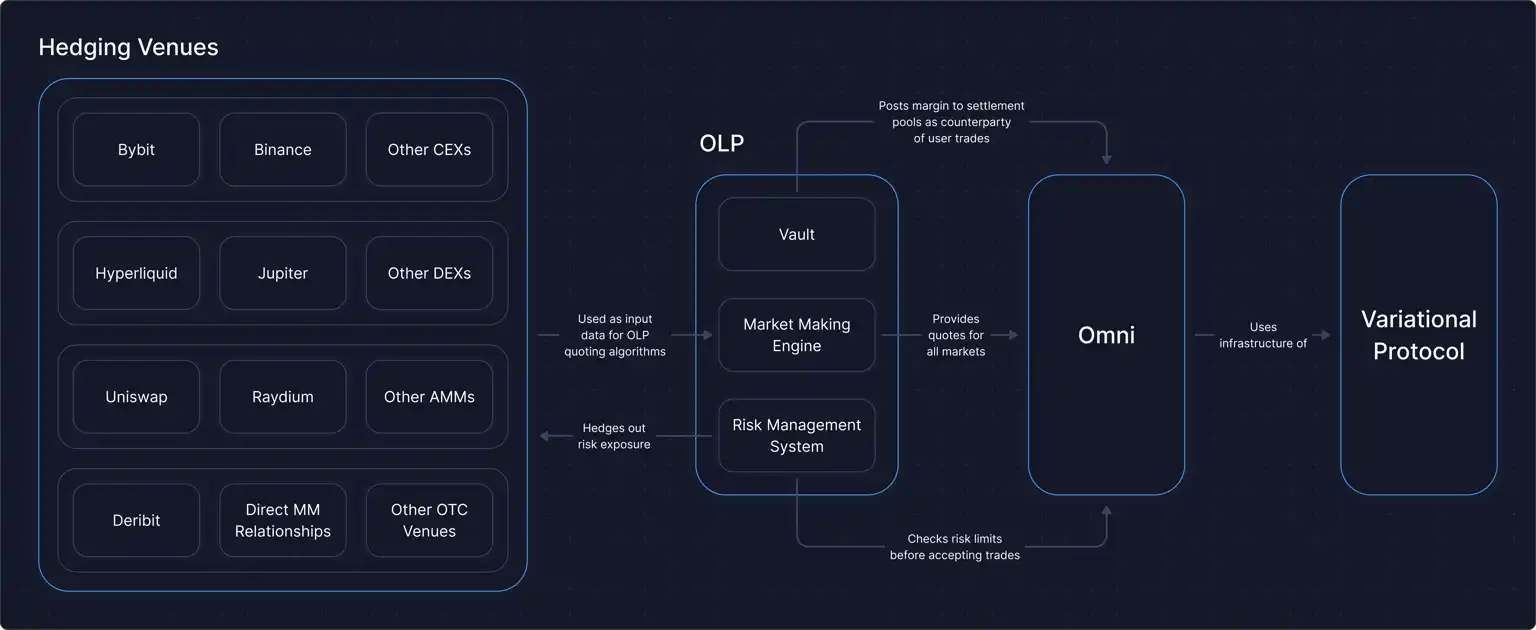
Because the Variational team has institutional-level trading volume and VIP rate advantages, its hedging costs are usually only 0-2 basis points, significantly lower than the 4-6 basis point spread charged to users, thus ensuring a stable profit margin.
According to data released by the platform, OLP achieved an annualized return of over 300% between April and July 2025. This astonishing return was primarily due to three factors: a small initial vault size, rapid growth in trading volume, and an efficient hedging strategy.
However, the sustainability of this return is a question. With a large vault, intense market competition, or extreme market conditions, hedging costs can exceed the spread income. Therefore, they have implemented a host of risk control mechanisms, such as a "last-look" rejection mechanism, independent settlement pools to isolate risks, and an algorithmic dynamic hedging system.
What are the benefits for users?
While the vault isn't officially open to the public yet, Variational's product is already preparing a feature for users to deposit USDC into the OLP vault. 90% of the returns go to depositors, with the remaining 10% reserved for protocol operations. Of course, OLP hedging failures could result in principal loss, leading to liquidity crises during extreme market volatility, and the centralization risks of a single market maker model. Therefore, Variational is also considering implementing a loss reimbursement mechanism for the vault later.
Variational has also launched a refund mechanism for trading losses. When a user closes a losing position on the Omni platform, the system automatically triggers a random lottery process, giving the user up to a 5% chance of receiving an immediate, 100% refund in USDC.
These funds come directly from the spread income of OLP, and one-sixth of the OLP spread income will be allocated to a dedicated "Loss Refund Pool" smart contract.
The platform also offers incentives such as spread discounts and volume rebates, similarly returning a portion of market-making profits to active traders. Once the $VAR token is officially issued, the platform plans to use 30% of the protocol revenue to repurchase and burn tokens, completing the value capture cycle.
Automated Coin Listing: A Paradise for Long-Tail Assets
Variational's automated Listing Engine is also one of their killer features.
Traditional DEXs require coordinating with external market makers and waiting for liquidity providers to create markets for new assets, a process that often takes days or even weeks. Variational eliminates this coordination delay with external market makers through internal market making through OLP. New assets receive immediate liquidity support once they pass automated review. The system's intelligent security review mechanism significantly reduces the risk of malicious contracts like "honeypot perps" through automated contract bytecode analysis and distribution analysis, enabling the platform to securely support a large number of long-tail assets.
As of now, Variational supports 515 tradable tokens, which is basically the perp dex with the most listed tokens.
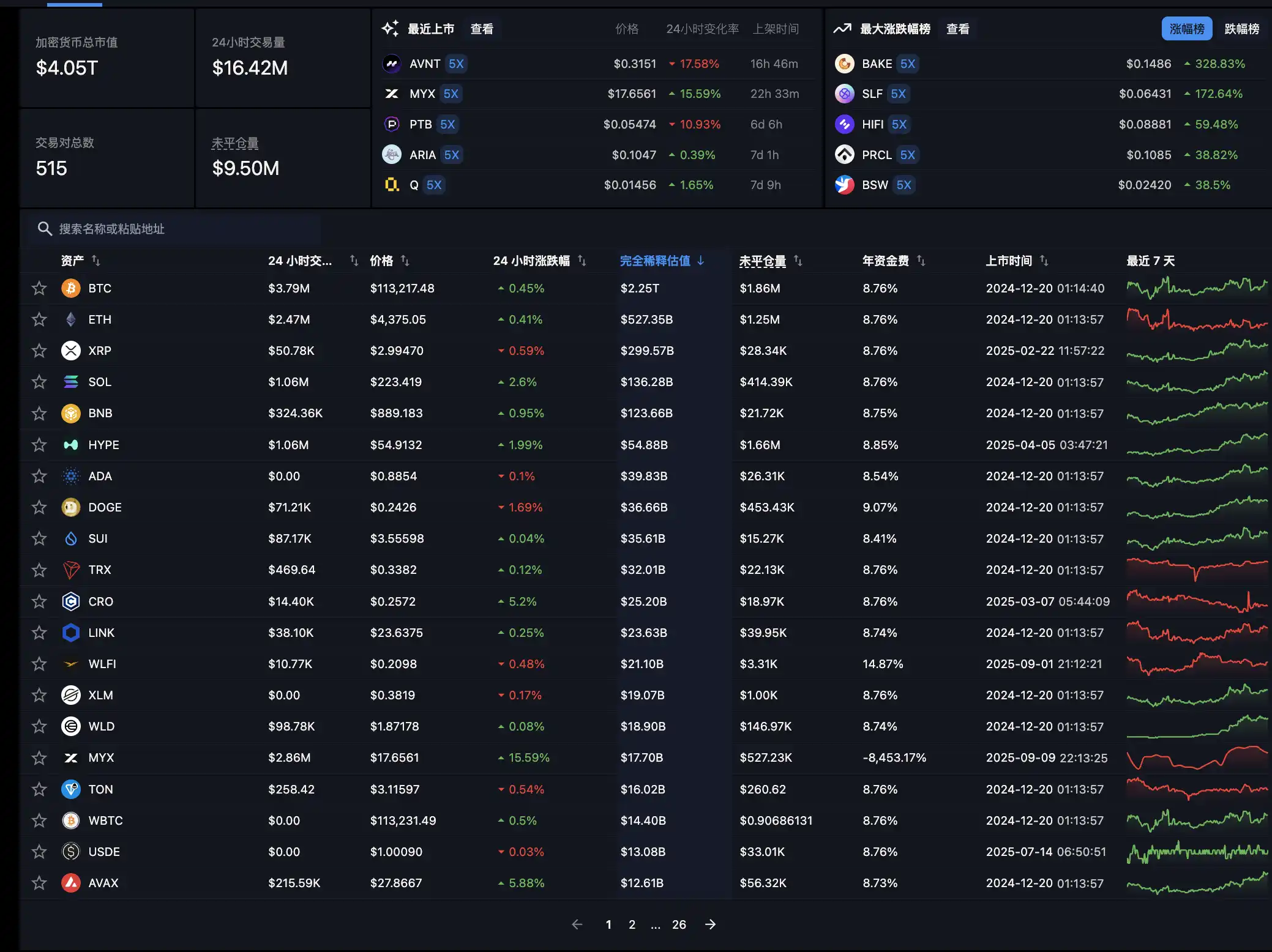
Traditional platforms implement the principle of "listing and mining", which requires the participation of external market makers; Variational's principle is "listing and liquidity", and with OLP as the sole market maker, bids can be placed in the new market within seconds.
At the same time, Variational has also designed a complete listing-delisting closed-loop mechanism to continuously monitor asset indicators. When an asset falls below the maintenance indicator, it will trigger automatic delisting, closing the position and delisting at the EWMA settlement price to prevent zombie contracts from occupying resources for a long time.
The story of the core team
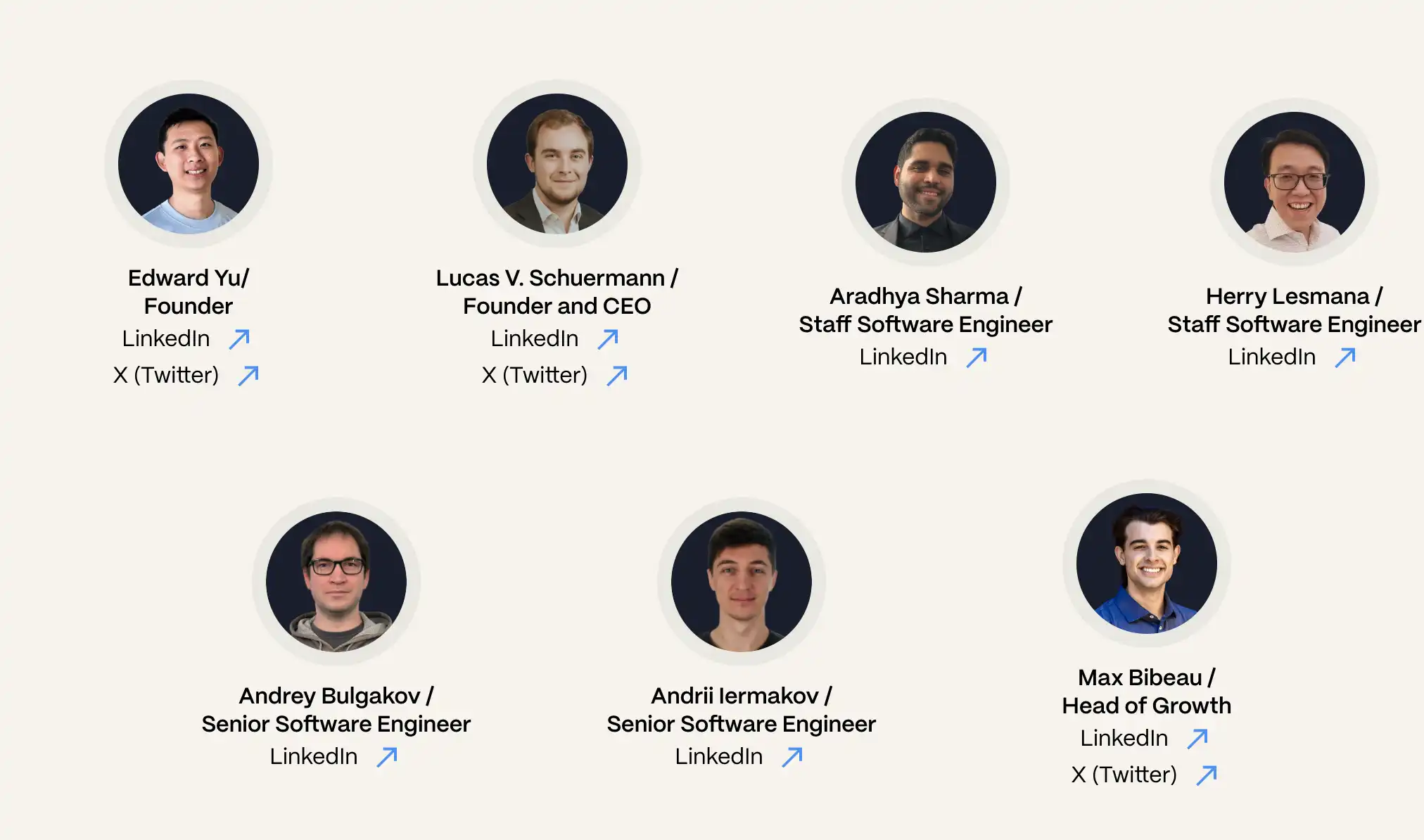
The collaboration between the two core founders of this perp DEX, Lucas Schuermann and Edward Yu, dates back to their days on the campus of Columbia University.
Lucas, the head of the Founder Technology Institute, studied at Columbia University's School of Engineering and graduated in 2019 as an Egleston Scholar (an honor usually awarded to the top 1% of students in the school). He studied both computer science and mathematics in his undergraduate studies.
Edward, the head of quantitative research, also graduated from Columbia University. He majored in applied mathematics and has a foundation in Bayesian statistics. His actual research focus has gradually shifted to quantitative trading.
In 2017, after meeting at Columbia University, they co-founded Qu Capital, a small quantitative investment and research firm registered in New York that specializes in exploring inefficient opportunities in the digital asset market. Its technology route is "self-developed high-speed trading infrastructure": more stable exchange connections, smarter intelligent order routing and more sophisticated execution tools.
This small but specialized team was acquired by Genesis Trading on September 19, 2019 (this was Genesis's first external acquisition; the valuation was undisclosed). Of Qu Capital's three co-founders, Lucas and Edward subsequently joined Genesis in core technical and quantitative roles. To understand why they chose to rewrite the perp DEX using RFQ + OLP (Order-Level Protection) + segregated settlement pools as the foundation, we must further examine Genesis Trading.
Founded in 2013, Genesis Trading is a subsidiary of Barry Silbert's Digital Currency Group (DCG). It was one of the earliest Bitcoin OTC market makers serving institutional clients. Taking 2019, its most robust year, as an example, its lending business disbursed $746 million in Q2, bringing its total disbursement to $2.3 billion. It has long provided liquidity to major institutions such as Circle and Gemini, serving as a crucial gateway for traditional finance to enter the crypto market and is considered a leader in OTC liquidity.
But after the FTX debacle, Genesis's fortunes plummeted. In 2022, Genesis's substantial exposure to Three Arrows Capital (3AC) and FTX triggered a liquidity crunch. On January 19, 2023, its lending arm filed for bankruptcy protection. In May 2024, the court approved a liquidation plan, which envisioned returning approximately $3 billion to customers.
How does the combination of concentrated exposure and settlement risk amplify into a systemic shock in extreme market conditions? For Lucas and Edward, who have experienced this firsthand, this is a problem that needs to be solved, and it also forms the basis of Variational's design philosophy.
After leaving Genesis in 2021, Lucas and Edward co-founded Variational, where they continued to iterate on machine learning, quantitative market making, and decentralized derivatives design. In 2024, Variational was officially established and completed a $10.3 million seed round of funding, led by Bain Capital Crypto and Peak XV Partners, with participation from Coinbase Ventures and Dragonfly Capital.
In July 2025, Edward appeared on the "Flirting with Models" podcast, systematically expounding on "How to Put OTC Derivatives on the Blockchain" and the design philosophy of Variational. This was a long and public talk on how he integrated the Bayesian framework, market-making theory, and on-chain mechanisms. His personal website, quant.am, also regularly updates his research on this topic. Similar content can also be found on Lucas's personal website (lucasschuermann.com).
Summarize
Variational moves elements that have been verified in institutional scenarios to the chain, but it does not simply "put the matching into the smart contract". Instead, it redesigns the structure of the perp based on the first principles of business model and risk engineering.
This allows them to avoid Genesis-style concentrated risks at the mechanism level, managing each risk channel in separate warehouses, pools, and limits - making it easier to implement targeted stop-losses and auditable provisions even in extreme situations.
Beyond the technical path, the more important aspect is the closed business loop: Variational vertically integrates the market maker role, merging the traditional exchange's two revenue lines of "fees + spreads" into a "single-line spread" income. Leveraging institutional-level hedging capabilities to cover system costs and extreme tail risks, Variational transforms "zero-fee trading" into a cash flow-generating business rather than a subsidy game.
This model ties system design, market microstructure, and risk budget into a flywheel, achieving both "faster/more stable/more scalable" at the engineering level and "more sustainable" at the business level.
Returning to the "human" level, Lucas's engineering obsession and Edward's Bayesian thinking are the most stable cornerstones behind this architecture: the former, starting from distributed systems and scalable software architecture, emphasizes making latency, jitter, and throughput into "measurable, regressive, and grayscale" engineering assets; the latter, starting from statistical decision-making and market-making games, emphasizes making risk limits, hedging paths, and strategy drawdowns into "explainable, auditable, and autonomous" governance assets.
The two switched back and forth between Qu Capital's "small workshop-style optimization", Genesis's "industrial-level assembly line", and Variational's "mechanism-level redesign", gradually forming the underlying character of today's perp DEX, which is also one of their most difficult to replicate moats.
Twitter: https://twitter.com/BitpushNewsCN
BitPush TG discussion group: https://t.me/BitPushCommunity
Bitpush TG subscription: https://t.me/bitpush