
(This article includes a classic case analysis: Weibo_WB.)
1. Weekly Market Review: (September 22-26)
The index opened at 6654.28 this week, hit a low of 6569.22 on Wednesday, reached a high of 6699.52 on Friday, and finally closed at 6643.70, with a weekly range of 1.96% and a drop of 0.31%. The weekly line formed a bearish "doji" candlestick pattern, closing above the 5-week moving average, setting a new record high for the S&P 500. Intel ranked first in the S&P 500 gainers and losers this week, with a 20.01% increase, and Chemex ranked last with a 23.22% increase. The average share price of the constituent stocks rose or fell by 0.07%, and the average share price of all US stocks rose or fell by -0.72% this week.
From April 7 to September 26, the index has risen for 25 consecutive weeks, a total of 120 trading days, with the maximum cumulative increase of about 38.56%.
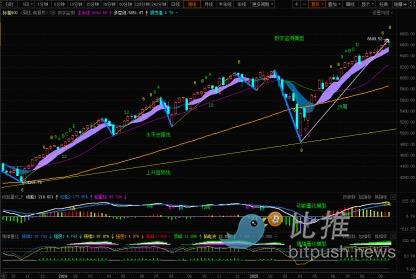
S&P 500 Weekly Chart: ( Momentum Quantitative Model * Sentiment Quantitative Model)
(Figure 1)
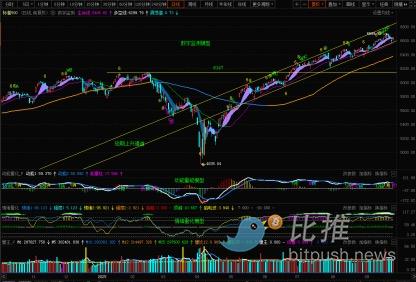
S&P 500 daily chart:
(Figure 2)
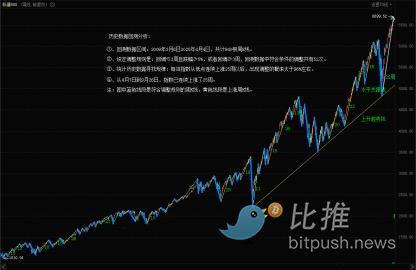
S&P 500 Weekly Chart: (Historical data backtest: March 6, 2009 to April 4, 2025)
(Figure 3)
Last week, I wrote an article titled "Hold stocks above the lifeline, be wary of wide single-day fluctuations!" In it, I made a prediction for this week's index based on the resonance of multi-period technical indicators and backtesting over a decade of historical data.
In terms of index trends:
The index is still trading within the rising channel formed after May 2nd, so be wary of wide intraday fluctuations. Upward pressure is near the upper band of the channel; downward support is near the lower band, with secondary support around 6300-6340 points, and key support between 6200 and 6147 points.
In terms of operational strategy:
1. Although the momentum blunting signal of the index at the weekly level has disappeared, the downside risk index is still relatively high at the daily level and other indicators, and the rising cycle has lasted for 24 consecutive weeks, so we should remain cautious in operations.
2. Total position: Long holdings increase to around 70%. If the index falls below the lifeline channel, the position must be reduced to below 30%.
2. For short-term investors, you can take out about 20% of your chips from your position and make "short-term differences" based on support and resistance levels.
Now let’s review the actual trends this week:
The index opened slightly lower on Monday and then fluctuated upward. The trading volume shrank rapidly compared with the previous day, and the index closed with a small green candle with a 0.44% increase.
The index opened flat on Tuesday and continued to fluctuate slightly around 6690 points after the opening. In the second half of the trading session, the index fell rapidly, and then fluctuated slightly at a low level until the close. The trading volume did not change significantly, and the index closed with a small negative line of 0.55% on the day, closing above the 5-day moving average.
On Wednesday, the index opened slightly higher and then continued to fluctuate. After running for about two hours, it began to fall rapidly. It rebounded in the late trading and closed with a small negative line of 0.28%, closing below the 5-day moving average.
On Thursday, the index opened lower and fell throughout the day, followed by a slight rebound. In the second half of the trading session, impacted by market news, the index experienced a rapid decline, finding support when it fell to the lower track of the channel, reaching the lowest point of the week at 6569.22 points. The index then quickly rose again, closing the day with a bearish "doji" candlestick with a drop of 0.50%, closing below the 10-day moving average.
On Friday, the index opened slightly higher and then fluctuated upward. Although there were ups and down fluctuations during the session, the amplitude was not large. The index closed with a small green candle with a 0.59% increase on the day, and returned to above the 10-day moving average.
This week, the index fell to the lower track of the channel for the sixth time and received support, once again confirming the important supporting role of the lower track of the channel.
Next, the author will analyze the changes in the current index based on multi-model technical indicators.
(1) Quantitative model signal analysis:
1. Weekly perspective (see Figure 1):
①. Momentum Quantization Model: The high-level passivation signal has disappeared, indicating that the weekly momentum divergence of the index will not form in the coming period. Currently, the two momentum lines are slowly rising, and the volume (red) column has decreased compared to the previous week.
Model suggests downside risk index: neutral
② Sentiment Quantification Model: Sentiment 1 Intensity is approximately 4.74 (range: 0-10), Sentiment 2 Intensity is approximately 4.97, and the Peak Signal Indicator is 11.90. This model data suggests that after this week's sharp market fluctuations, long sentiment has eased.
Model suggests shock risk index: high
③. Digital monitoring model: No signal is displayed this week.
2. Daily perspective (see Figure 2):
①. Momentum quantification model: After the market closed on Thursday this week, a kinetic top divergence formation signal was issued, the two kinetic energy lines death cross at a high level, and the volume column turned from red to green.
The model suggests that the daily level kinetic energy top divergence of the index has formed, and the downside risk index is high.
②. Sentiment quantification model: After Friday's close, the intensity of the two sentiment indicators was 0, the peak signal indicator was 5.63, and the index began to fall out of the high risk area and gradually decline.
Model suggests downside risk index: high
③. Digital monitoring model: After the close of Monday, the monitoring signal is "D" (signal range A~E). The number does not change in the following days, indicating that the index will send a daily top turning point signal on Monday this week.
Model suggests downside risk index: high
(2) Trend Time Series and Historical Data Backtesting Analysis (Figure 3):
1. The data backtesting model developed by the author:
①. Backtest data range: March 6, 2009, to April 4, 2025, a total of 840 weekly K-lines.
②. Set adjustment rules: callback ≤ 2 weeks and decline ≥ 5%, or callback ≥ 3 weeks. There are 52 adjustments that meet the conditions in the backtest data.
2. Use historical data to find patterns: Whenever the index rises from a low point for 25 consecutive weeks, the probability of an adjustment is greater than 96%.
3. In the model I backtested, the largest rising cycle occurred from July 19, 2017 to January 26, 2018. After the index rose for 29 consecutive weeks, it fell by 13.43%. There were two other times when there were large adjustments after rising for 26 weeks.
4. From April 7 to September 26, the index has risen for 25 consecutive weeks.
2. Market forecast for next week: (September 29th to October 3rd)
1. At the daily level, the two models have issued momentum top divergence signals and top inflection point signals respectively. At the same time, the historical data backtest model shows that the probability of an adjustment after the index has risen for 25 consecutive weeks is greater than 96%. Currently, multiple sets of data are superimposed together to form a resonance, so the author reminds investors to be vigilant about the risk of index decline.
2. The index received support near the lower track of the channel on Thursday this week. The effectiveness of this support will remain to be observed next week.
3. The upward pressure level of the index is near the upper track of the channel; the first downward support level is near the lower track of the channel, the second support level is near 6300 to 6340 points, and the important support level is in the 6200 to 6147 point area.
3. Next week's operation strategy: (09.29~10.03)
1. Total position: 70% of long positions; if the index falls below the lifeline channel, the position must be reduced to below 30%.
2. For short-term investors, you can take out about 20% of your chips from your position and make "short-term differences" based on support and resistance levels.
3. When operating in the short term, it is recommended to switch the analysis period to a smaller period of 60 minutes or 120 minutes to obtain more accurate buying and selling points.
4. Individual stock trading can also refer to the above operation strategies.
4. Special tips:
For swing trading of individual stocks, whether buying long or short, set an initial stop-loss immediately after opening a position. When the stock price gains 5%, immediately move the stop-loss level to near the cost line (i.e., the break-even point) to ensure a loss-free trade. When the profit reaches 10%, raise the stop-loss level to 5% of the profit. Thereafter, each time the profit increases by 5%, the stop-loss level will be raised by the same amount to dynamically protect realized profits. (The question of setting the 5% profit level is left to the discretion of the investor.)
IV. Classic Case Analysis: (As a case analysis only, not as an investment recommendation)
1. Weibo (Stock Code: WB): (Long)
Weibo (WB) daily chart:
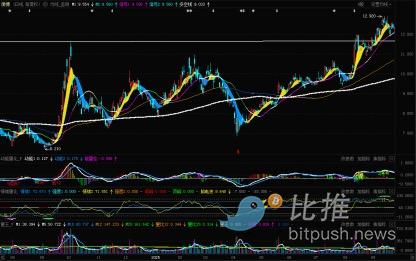
1. Buying conditions (long order): The purchase price is $11.50-12.00, the initial stop loss is $10.80, the first target is $14.5-15, and the trading is in swing trades.
2. From a weekly perspective, the stock has been trading within a range of $6.20 to $11.58 since September 2023, a period lasting approximately two years. Earlier this month, the stock broke through the upper edge of the range on heavy volume. If the stock retreats to the upper edge on light volume without breaking through, a long position may be considered.
3. This week, the stock opened at $12.33, reached a high of $12.58, a low of $11.94, and closed at $12.33, marking a weekly decline of 1.60% with a bearish "doji" candlestick pattern. On Tuesday, the stock price bottomed out at around $11.94, triggering a buy point I recommend. On Wednesday, the stock price fluctuated upward, with a maximum gain of around 4.5%. It then surged and retreated over the next two days, closing on Friday with a "T-shaped" candlestick pattern that tested the bottom and rebounded. I'm holding the stock for potential price increases next week. (If the stock price gains more than 5% next week, I'll raise my stop-loss to around $12.)
As market news changes rapidly, the author will adjust the operating strategies and suggestions in a timely manner. If investors want to obtain the latest information in a timely manner, please follow the link below.
The above models are the trading rules I follow when operating and do not constitute any basis for buying or selling. They are personal opinions and are for reference only.
By Cody Feng
Twitter: https://twitter.com/BitpushNewsCN
BitPush TG discussion group: https://t.me/BitPushCommunity
Bitpush TG subscription: https://t.me/bitpush