Kalshi's trading volume surpassed Polymarket, proving that compliance is not a constraint but a core competitive factor.
By c4lvin, Four Pillars
Compiled by Luffy, Foresight News
TL;TR
- The growth of prediction markets has made compliance a key competitive advantage, as exemplified by the rapid rise of Kalshi. While Polymarket was blocked from the US market due to sanctions imposed by the Commodity Futures Trading Commission (CFTC), Kalshi, with its official license, has taken the lead through aggressive marketing and market expansion.
- The fragmented global regulatory landscape has hindered the expansion of prediction markets, with conservative attitudes in Asian countries being a major obstacle. While the US has shown signs of loosening regulations under the Trump administration, countries like South Korea, Singapore, and Thailand have either classified prediction markets as illegal gambling or outright blocked access.
- Decentralization and demonstrating the social value of prediction markets may be the key to resolving regulatory challenges faced by conservative countries. By mitigating the risk of market manipulation through inter-subject decision-making protocols like EigenLayer, while emphasizing their practical value as academic research tools and economic hedging instruments, a clear distinction can be drawn between prediction markets and gambling.
Regulation reshapes the prediction market landscape
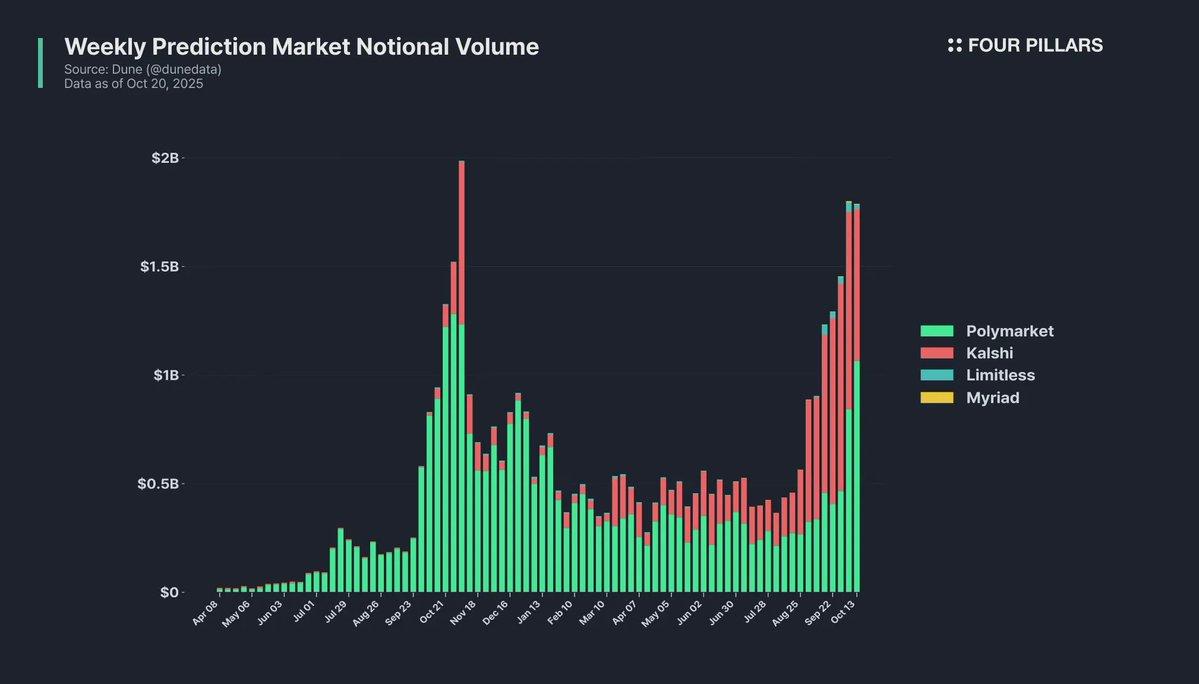
Data source: Dune
One of the most notable changes in the prediction market ecosystem this year has been the rapid rise of Kalshi. As of March, Kalshi's trading volume was only about one-tenth of Polymarket's. However, since August, its trading volume has surpassed Polymarket, making it the market leader.

There's an entire episode of South Park about people trading on Kalshi.
A direct catalyst for Kalshi's growth was its appearance on the popular animated series "South Park." In September of this year, the show aired an episode satirizing the prediction market industry, featuring Kalshi and showing characters using the Kalshi mobile app. Following the episode, Kalshi's market share surged, demonstrating that public attention can translate into actual user growth.
However, the fundamental reason this aggressive marketing campaign was possible was Kalshi's regulatory compliance. While Polymarket was prohibited from providing services to US users due to CFTC sanctions, Kalshi, with its legitimate license, enjoyed a monopoly on the US market. At this point, compliance was no longer simply a means of mitigating legal risks; it became a strategic asset supporting aggressive marketing and collaboration.
Kalshi's case demonstrates that compliance in prediction markets is not a constraint, but a core competitive element. However, discussion within the community regarding prediction market regulation remains limited. This article aims to analyze the complex regulatory landscape of prediction markets and the efforts required to address it.
Prediction market regulation and mainstream platform response strategies
Current regulatory framework for prediction markets
In the United States, prediction markets are regulated by the CFTC and are subject to the Commodity Exchange Act. The services provided by prediction markets are legally classified as event contracts or binary options—essentially derivatives where the payout depends on whether the underlying event occurs, ultimately resulting in either a fixed amount or zero payout.
The current prediction market needs to meet multi-dimensional compliance requirements:
- Compliance with the Commodity Exchange Act: Fair governance mechanisms, supervisory systems, and anti-fraud measures are required. All exchanges must submit a detailed rulebook and obtain approval to ensure the implementation of core principles.
- Event type restrictions: Markets involving terrorism, assassination, war, gambling, or illegal activities are prohibited; economic indicators and weather-related contracts are generally allowed.
- Regulatory Oversight Committee: A Regulatory Oversight Committee must be established, whose members must have no record of illegal activities and will be responsible for overseeing regulatory procedures, personnel management, and the preparation of annual reports.
- Transaction data storage: According to CFTC regulations, all transaction data must be stored in an accessible database for a period of not less than 5 years.
- Preventing market manipulation: The Commodity Trading Law strictly prohibits non-competitive trading, wash trading, spoofing, front-running, and other behaviors. Platforms must build sophisticated systems to detect and prevent such operations.
In addition, all prediction market transactions need to establish a disciplinary committee and an appeals committee to ensure a fair process; at the same time, a market outcome determination mechanism must be established to clarify the method for confirming event results.
In terms of the result determination mechanism, Kalshi and Polymarket take different paths:
- Kalshi adopts a centralized model: the final decision is made by its own result review committee.
- Polymarket adopts a decentralized model: it introduces a system called UMA Oracle and adopts an optimistic judgment mechanism - if there is no dispute within the 2-hour questioning period, the proposed result will automatically take effect; if there is a dispute, it will be resolved by voting by UMA token holders.
Regulatory gray area
Classifying prediction markets as gambling has led to blurred regulatory boundaries. The conflict between the Unlawful Internet Gambling Enforcement Act (UIGEA) and CFTC regulation is particularly prominent: while the UIGEA excludes CFTC-regulated activities from its scope of sanctions, it also creates room for regulatory arbitrage, allowing platforms to circumvent state-level gambling regulations and taxes.
In October 2025, the Pennsylvania Gaming Control Board warned Congress about the conflict between federal derivatives laws and state-level gaming regulatory authority, highlighting the potential risks of federal-state regulatory conflicts.
Regulatory conflicts in sports and entertainment markets are even more acute. In January 2025, after Kalshi launched a sports prediction market, six states, including Nevada, New Jersey, and Maryland, immediately issued cease-and-desist orders, claiming that Kalshi's services constituted unlicensed gambling and violated state gambling laws. Kalshi responded by citing the principle of federal preemption, arguing that federal regulation takes precedence over state regulation.
Regulatory challenges facing prediction market platforms
Polymarket
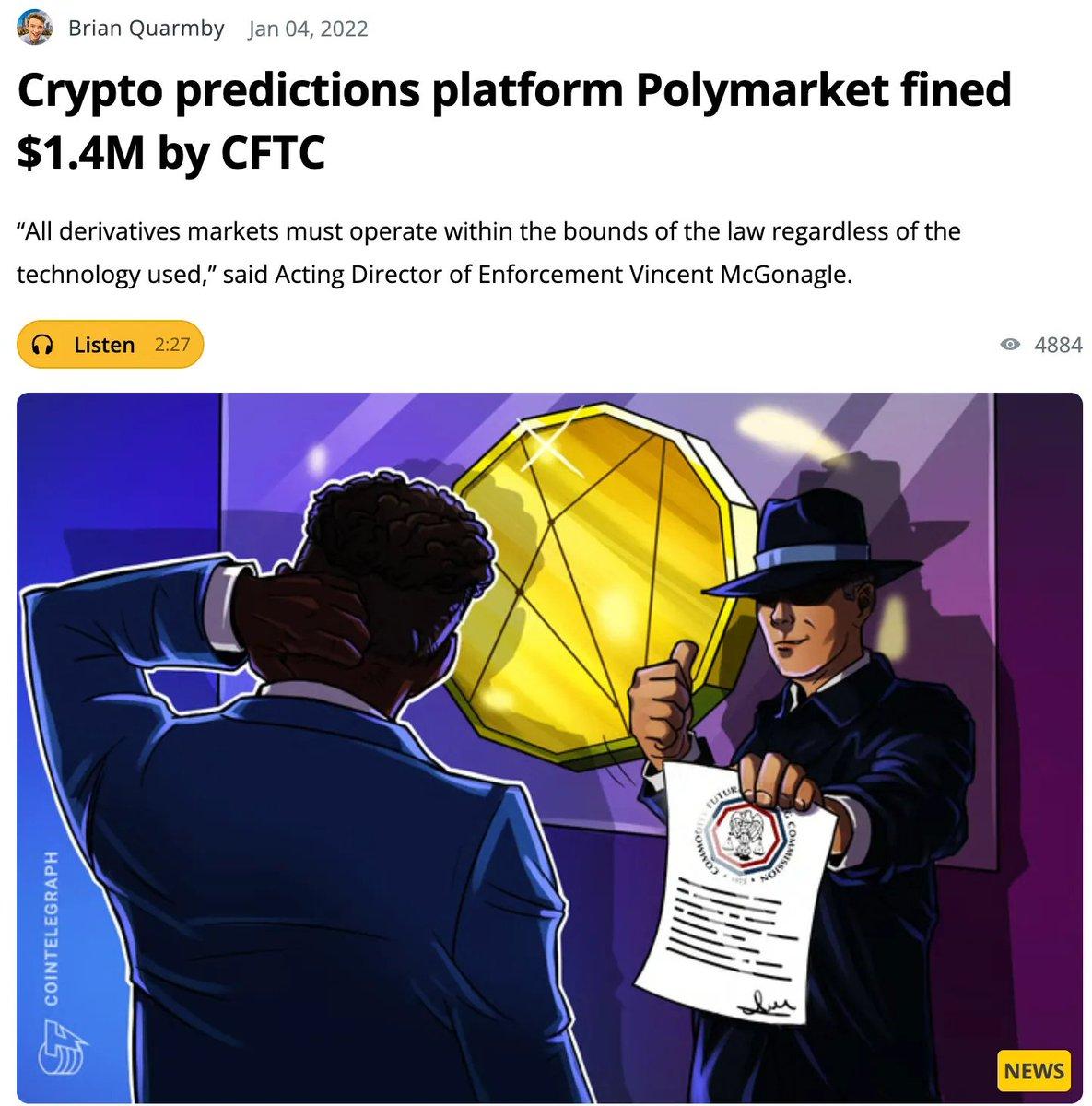
Source: Cointelegraph
Polymarket experienced rapid growth after its June 2020 launch, but in January 2022, it received a severe penalty from the CFTC: a $1.4 million fine for failing to register as an exchange and a ban on providing services to US users. For the following two years, Polymarket was restricted to non-US locations.
The CFTC determined that Polymarket’s services constitute swaps under the Commodity Exchange Act, which can only be traded on registered exchanges such as designated contract markets (DCMs).
In November 2024, the FBI raided the home of CEO Shayne Coplan, suspecting Polymarket was still offering services to US users. However, in July 2025, the situation reversed, with Polymarket acquiring QCX LLC, a CFTC-licensed derivatives exchange, thereby obtaining both Derivatives Clearing Organization (DCO) and Derivatives Clearing Organization (DCM) licenses. In September of the same year, Polymarket received a no-action letter from the CFTC regarding "swap data reporting and recordkeeping requirements," officially returning to the US market.
Kalshi
Unlike Polymarket, Kalshi has chosen a fully compliant approach from the outset. On November 5, 2020, Kalshi became the first platform in US history to be approved as a DCM by the CFTC, focusing solely on event contracts trading.
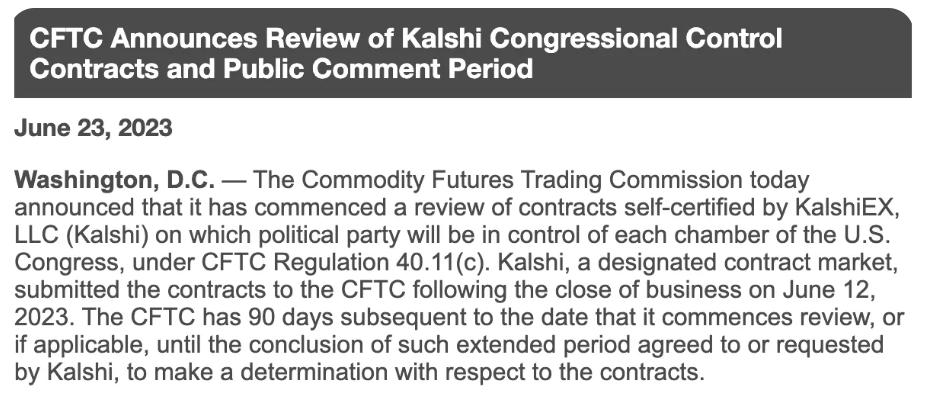
Source: CFTC
However, in June 2023, after Kalshi self-certified and launched a "Congressional Control" market, the CFTC objected, arguing that such a market constituted betting on sports events, violated state law, and was not in the public interest. Kalshi filed a lawsuit in federal court in November of that year and prevailed in September 2024. The CFTC withdrew its appeal, completely clearing Kalshi of this regulatory hurdle.
After winning the lawsuit, Kalshi aggressively expanded its sports prediction market: in January 2025, it launched markets related to the National Football League (NFL), National Hockey League (NHL), National Basketball Association (NBA), and National Collegiate Athletic Association (NCAA) in all 50 states. During March Madness (the NCAA basketball tournament) alone, trading volume exceeded $500 million. However, six states, including Nevada and New Jersey, subsequently issued cease-and-desist orders. Kalshi, citing federal preemption, responded and received support from a New Jersey federal court in May 2025.
Other platform cases
In addition to Polymarket and Kalshi, several prediction market exchanges are regulated by the US government:
- PredictIt: Originating from a research project at Victoria University of Wellington, New Zealand, in 2014, it received a no-action letter from the CFTC, subject to strict restrictions (maximum bet per contract $850 and a maximum of 5,000 traders per contract). In August 2022, the CFTC withdrew its no-action letter and ordered its closure. After a protracted legal battle, PredictIt prevailed in July 2025 and received a DCM license in September of the same year, officially becoming a regulated derivatives exchange.
- Crypto.com: After obtaining a margin derivatives brand license in September 2025, it launched sports prediction markets in 16 states through a partnership with Underdog, but faced state-level challenges (such as losing a lawsuit in Nevada court).
- Railbird: An emerging prediction market platform, which received a no-action letter in August 2025, allowing it to operate within the narrow scope of B2B risk hedging.
The atmosphere of deregulation in the US prediction market
Although the US government once regulated prediction market platforms with extremely strict standards, the regulatory environment has undergone a fundamental change since the Trump administration took office:
- Trump himself posted Polymarket odds on Truth Social, showing personal attention;
- Donald Trump Jr. serves as a paid advisor to Kalshi and is also a board member and investor in Polymarket. His company, 1789 Capital, has invested tens of millions of dollars in Polymarket.
- On September 29, 2025, Paul Atkins, Chairman of the U.S. Securities and Exchange Commission (SEC), and Caroline Pham, Acting Chair of the CFTC, announced a "comprehensive coordination plan," stating that they would review the development opportunities of event contracts across jurisdictions and prevent regulatory loopholes.
Fragmented global regulatory environment
While prediction markets are gradually moving toward legalization in the United States, other regions are moving in the opposite direction. This regulatory fragmentation poses significant challenges to global platforms, with the conservative attitude of the Asian market being particularly constrained in the global expansion of prediction markets.
Asian countries’ attitudes towards prediction markets
South Korea: Strictly prohibited and considered illegal gambling
South Korean regulators take an extremely conservative approach to prediction market platforms: all betting markets are regulated by the National Sports Promotion Act. Only Sports Toto, operated by the Korea Sports Promotion Corporation, is a legal betting platform. All other betting sites are illegal, and both users and operators may face penalties.
Legal Sports Toto only allows betting on a very limited number of sporting events and is strictly regulated by the government, with the maximum single bet being only 100,000 won (about US$70).
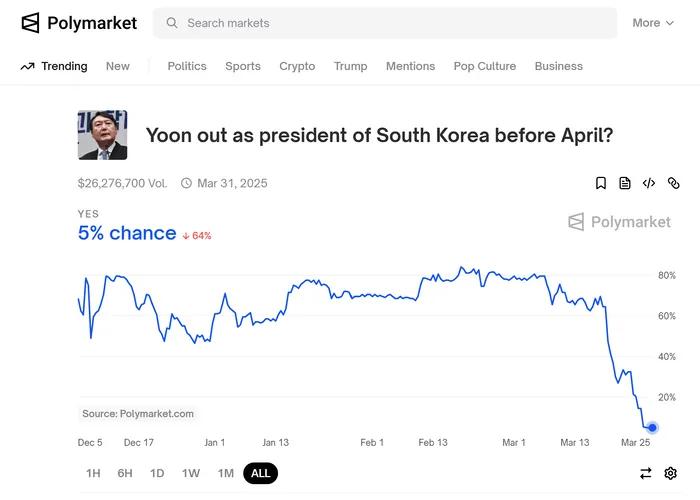
Source: South Korean media "Daily Economic News"
During the impeachment crisis surrounding former President Yoon Seok-yeol in early 2025, a large number of contracts related to South Korean political events appeared on Polymarket, sparking widespread public and media attention to prediction markets. South Korean media outlets consistently characterized Polymarket as an illegal private Toto platform and emphasized that under current South Korean law, citizens who participate in prediction market betting could be subject to punishment for gambling.
Singapore: Banning platforms and heavily fining users
Singapore similarly classifies prediction markets as gambling. In January 2025, the Singaporean government took tough measures, completely banning Polymarket and classifying it as an unlicensed online gambling operator under the Gambling Control Act. Under this law, users of unlicensed gambling platforms can be fined up to S$10,000 (approximately US$7,200) and face up to six months in prison.
Thailand: Ban on cryptocurrency use
In January 2025, Thailand's Technology Crime Suppression Bureau announced at a press conference that it was preparing to ban Polymarket on the grounds that the platform used cryptocurrency, which violated gambling laws.
It can be seen that Asian countries still take an extremely conservative attitude towards prediction markets. Considering Asia’s share of the cryptocurrency market, this will become a key constraint on the future expansion of prediction market platforms.
Regulatory cases in Western countries
France: Polymarket will be banned in November 2024. The French National Gaming Authority determined that Polymarket provided online gambling services without a French license and clarified that "gambling activities are still illegal in France, even if cryptocurrencies are used."
Canada: Prediction markets are prohibited under a 2017 regulation prohibiting retail investors from trading binary options with a maturity of less than 30 days. In April 2025, the Ontario Securities Commission reached a settlement with companies related to Polymarket. Polymarket admitted to violations in Canada and was required to pay a fine of 200,000 Canadian dollars (approximately US$150,000).
UK: A relatively open attitude. The UK Financial Conduct Authority is in discussions with Robinhood about introducing prediction markets to the UK. Robinhood stated that the UK and Europe have the strongest demand for prediction market products.
Conclusion: Predicting the future of the market and breaking through regulatory barriers through decentralization
In summary, the global regulatory environment for prediction markets is highly complex due to regional policy differences and diverging legal interpretations. This fragmentation not only restricts the global user expansion of prediction market platforms but also impacts their stable operations.
Although decentralized prediction market protocols attempt to achieve borderless transactions through blockchain technology, regulators in various countries still prioritize domestic laws and restrict platform operations and user access through methods such as "domain name blocking" and "direct sanctions on operators."
While platforms like Polymarket and Kalshi have successfully expanded into the US market, the potential of global markets like Asia cannot be ignored. Without access to the Asian market, which accounts for a significant portion of cryptocurrency trading volume, the true globalization of prediction markets will remain elusive.
To achieve global expansion of the prediction market, at least the root cause of strict regulation needs to be addressed, and it can even be piloted in a regulatory sandbox.
The main reasons why prediction markets are currently facing strict regulation are:
- Market manipulation risk: This problem exists in most current prediction markets. The real-time disclosure of voting results may trigger a herd effect, and large capital holders may dominate the initial trend. In addition, if the results are controlled by a few people or lack transparency, the risk of manipulation cannot be ruled out.
- Possible distortion of public opinion: If large sums of money are injected into the market to manipulate probabilities, the prediction market may distort public opinion and indirectly affect the actual outcome of events. This is particularly sensitive in political and social events.
- Blurred boundaries with gambling: Since prediction markets are essentially betting on the probability of events, many regulators directly classify them as gambling.
It's worth noting that, aside from the blurred boundaries with gambling, the first two issues can be partially addressed through decentralization. For example, decentralized oracle systems that utilize inter-subject decision-making protocols like EigenLayer can significantly improve the transparency and resistance to manipulation of outcome determination. By using economic incentives to encourage multiple validators to report truthfully, while simultaneously using penalty mechanisms to combat malicious behavior, the risk of market manipulation can be significantly reduced. While the fairness of existing governance-based decision-making mechanisms like the UMA protocol remains questionable, EigenLayer offers a more equitable solution to the problem of suspected manipulation through measures such as a challenge and penalty mechanism and a forkable token system.
The boundary between prediction markets and gambling requires a long-term strategic response. Technological solutions alone cannot solve the problem, and the social value of prediction markets must be demonstrated. For example, academic prediction markets like the Iowa Electronic Market and the Good Judgment Project have demonstrated greater accuracy in political and economic forecasts than traditional polls. Building on these successes, we must continue to convey the core message: prediction markets are not simply gambling, but rather information aggregation mechanisms that leverage collective wisdom.
Since the birth of Chicago grain futures in 1848, the derivatives market has steadily expanded from agricultural products to financial assets. In the age of social media, classifying personal opinions and predictions as a new asset class and launching event contracts based on them may be a natural evolution of this market. As Kalshi co-founder Mansour puts it, prediction markets democratize hedging—providing individual investors and small and medium-sized enterprises with accessible, low-cost risk hedging tools.
The future of prediction markets depends on constructive dialogue and collaboration between regulators, platform operators, and technology developers. What is needed is not an outright ban, but a balanced regulatory framework that embraces innovation while protecting consumers. In the long run, countries that completely ban prediction markets and those that foster them within a compliant framework will see significant competitive differences in information efficiency and financial innovation.
We hope that prediction markets can break away from the label of being a mere speculative tool and become the core infrastructure for managing uncertainty and leveraging collective wisdom in the modern economy.