As competition among Ethereum Layer-2 chains intensifies, Startale Group is positioning Soneium as a compliance-first platform rooted in Japan. With partners such as SBI and Sony, the company aims to blend financial infrastructure with entertainment-driven adoption.
CEO Sota Watanabe spoke to BeInCrypto about the long-term vision, growth metrics, decentralization, and regulation. The project seeks to stand out globally.
Background: Can a Japan-Born L2 Compete?
L2BEAT listed Soneium with methodology notes and governance risks. OKLink confirmed heavy on-chain throughput. Blockscout records ERC-4337 account-abstraction operations, providing a transparent log of user-level interactions. Together, these signals show that Soneium is already operating at real scale under external scrutiny. They demonstrate that a Japan-born Layer-2 can meet transparency benchmarks set by global leaders.
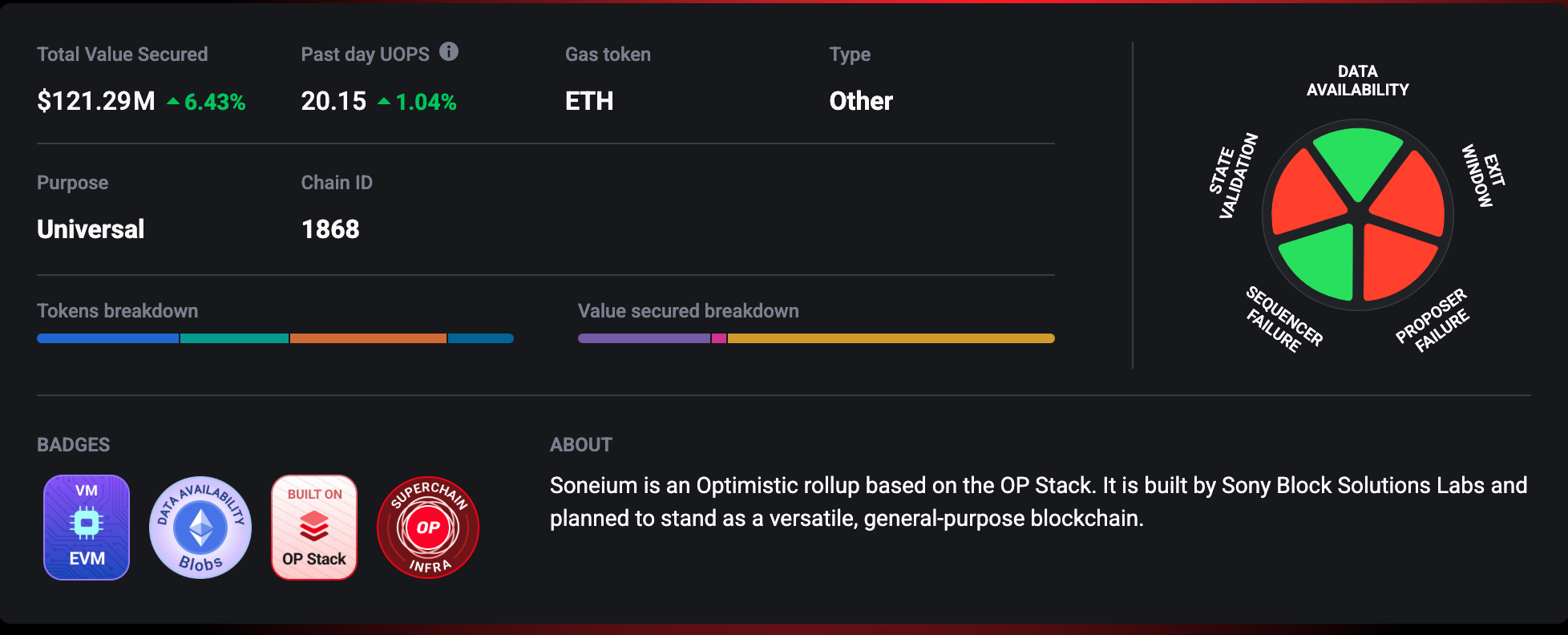
Sony set up a JV and incubator in 2023. It announced Soneium development in 2024 and launched mainnet in 2025. Meanwhile, SBI Holdings published joint-venture plans to connect Soneium with capital markets. Together, these alliances signal how entertainment and finance are converging in Japan’s blockchain landscape.
Mission and Global Vision: Can Japan Lead?
Startale’s medium- and long-term goals focus on building a global position beyond 2025. The company aims to prove how a Japan-born blockchain can compete at the highest level. With Soneium, the SBI joint venture, and other initiatives, Startale is extending its presence across both technology and finance.
However, as projects multiply, the vision is not always clear. Watanabe said the firm was founded to prove Japan could deliver enterprise-grade blockchain infrastructure. Therefore, compliance and reliability, not speculation, remain the top priorities.
“We believe that the next iteration of the internet will be built on blockchains. I want to see Japan take a lead on that. That’s the reason we founded Startale. We aimed to show Japan can develop world-class blockchain infrastructure. This isn’t just for crypto enthusiasts. It’s for enterprises. It’s for companies like Sony, SBI, and other global conglomerates that demand reliability, compliance, and security.”
Mission: Bring the World Onchain.
— Sota Watanabe (@WatanabeSota) September 18, 2025
How: Utilize distribution channels and traditional assets.
What: Build chains to apps vertically starting with Sony and SBI.
Why: Easier for existing companies to acquire crypto users than for crypto to acquire existing users.
That’s us.
He added that the long-term vision is for Japan to stand as a global leader in blockchain. Just as the country exported manufacturing and culture, Startale aims to export blockchain infrastructure. To achieve this, the firm is building a team that blends engineering expertise with business development and partnerships.
Investment Story: Resilience Amid Headwinds?
The broader Layer-2 market is seeing slowing capital inflows. Existing tokens also struggle to sustain investor appeal. How Soneium is perceived therefore matters. Watanabe noted that scale and composability are now baseline features. Consequently, Startale aims to stand out through distribution channels and new user segments.
“The industry has been maturing. Competition has shifted beyond existing crypto users to entirely new user segments who have never engaged with crypto before. The number of companies moving on-chain in 2025 makes this clear. Startale and Astar have worked on this since 2023. We are good at securing distribution channels, and that becomes a moat.”
He cited activity data: as of September 2025, Soneium had processed over 295 million transactions (OKLink showed 297.16 million). It averaged roughly 90,000 daily active addresses and more than 4.8 million addresses in total. It also recorded over 350,000 account-abstraction operations. These figures, therefore, demonstrate scale.
However, L2BEAT’s Total Value Secured rankings show Arbitrum and Base securing tens of billions in assets, underscoring the gap. Moreover, academic research such as Optimistic MEV in Ethereum Layer 2s highlights how MEV extraction and spam loads vary across Arbitrum, Base, and Optimism. This frames Soneium’s growth not only in raw numbers but also in the quality of usage.
At the same time, Flashbots analyzed spam loads across OP-Stack rollups, reminding observers to weigh quality alongside throughput. Asked which metrics matter most—TVL, user base, or application growth—he instead pointed to distribution channels. In his view, securing new pipelines for adoption is a more durable moat than chasing raw numbers.
Token Design: Sustainability or Sticking Point?
Soneium currently uses ETH as gas. But questions remain about native tokens and sustainable revenue. Watanabe acknowledged that a native token could arrive later, an issue tied to U.S. SEC scrutiny of Layer-2 “independence.”
For now, he stressed that sustainable revenue must come from sequencer fees, joint ventures, and compliance-driven services. Token incentives, by contrast, are short-lived. The U.S. Securities and Exchange Commission issued KPI-disclosure guidance that calls for clarity on growth and value creation. Therefore, Watanabe emphasized reinvesting sequencer revenues, joint-venture income, and account-abstraction activity back into the ecosystem instead of relying on quick token incentives.
“The Layer-2 ecosystem has matured quickly. Differentiators like scale, composability, and protocol-level innovation are now baseline requirements. Simply launching with a bridge or a DEX isn’t enough. Our approach is to secure distribution, expand into new user bases, and reinvest sequencer and JV revenues into the ecosystem to support long-term growth.”
Sony’s Edge: Catalyst for Native Demand?
Soneium’s TVL still leans on bridged assets. DeFiLlama shows this reliance clearly, in contrast to the more diversified liquidity profiles of Arbitrum and Optimism.