
The current code agent landscape in academia and industry remains highly distributed. Existing solutions often lack open source accessibility, require significant human supervision, or are limited to narrow functionality such as multi-repository search, multilingual processing, and limited issue resolution.
Delicium is pleased to announce a formal partnership with Dr. He Ye of the Department of Computer Science, University College London (UCL) to revolutionize software engineering through an open-source, fully autonomous, multilingual, and cost-effective AI coding standard.
Leveraging Delicium's expertise in resource organization, architecture design, and optimization of large-scale language models (LLMs), the collaboration has launched Prometheus, a multi-agent system that transforms entire code repositories into a unified knowledge graph, guiding contextual discovery for issue resolution (arXiv: www.arxiv.org/abs/2507.19942). Prometheus is now available for review on the world-renowned SWE-bench benchmarking platform (www.swebench.com).
The core goal of this partnership is to dramatically reduce the operating costs of large-scale language models (LLMs) by releasing publicly trained models to the Delisium community. Delisium will also collaborate with EuniAI (the UCL SSE team) and key industry partners to jointly develop next-generation AI coding standards through a unified codebase knowledge graph, and to continue producing top-tier research papers and other impactful results.
A new approach that maximizes efficiency
Building on a strategic partnership to advance AI coding standards, Delicium and Dr. He Ye's team are accelerating the development of an innovative software engineering framework for large-scale, multilingual codebases. This framework centers around building a unified knowledge graph (KG), pioneering a graph-based approach for problem solving across diverse code repositories.
This paradigm shift transformed massive, heterogeneous code assets—from directory hierarchies and complex syntax to related documentation and embedded annotations—into intelligent, interconnected graphs. As a result, Delicium and Dr. He Ye's team designed a cohesive knowledge graph abstracting code repositories. This, coupled with the open-source multi-agent system Prometheus, achieved the goal of enhancing effective contextual information retrieval (arXiv: www.arxiv.org/abs/2507.19942).
Prometheus features a language-independent, general-purpose architecture, making it an intelligent framework for integrating multilingual and multi-repository projects. It unlocks a deeper level of understanding, enabling automated tools to clearly analyze and reason about code.
Designed to operate at enterprise scale, Prometheus is designed to handle and interpret even the most complex software ecosystems, laying the foundation for next-generation intelligent development solutions. This innovative framework transcends the limitations of existing technologies, delivering unparalleled situational awareness and automated problem identification capabilities.
Explore the Prometheus system: https://github.com/EuniAI/Prometheus
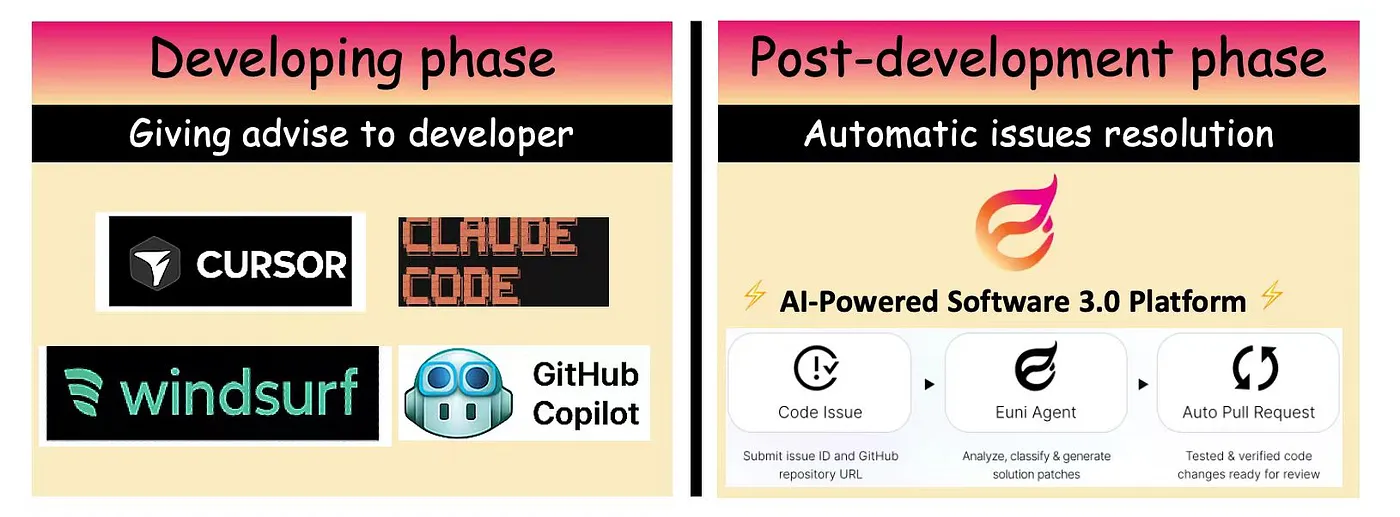
euni.ai is a clear example of Prometheus technology already adopted by the industry, demonstrating how Prometheus-based innovations create real value.
Built on Prometheus within UCL, euni.ai leverages Prometheus capabilities to provide next-generation code analysis and automated bug resolution. By deeply understanding code, euni.ai proactively identifies and resolves issues, empowering developers to build superior software faster and more efficiently.
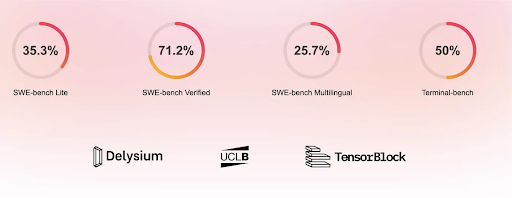
Automated AI coding problem-solving capabilities
The cutting-edge multi-agent system, a collaboration between Delicium and Dr. He Ye's research team, is designed to address a wide range of software issues, including bugs, feature requests, and discussions, and accommodate multiple content formats, including text, images, and video.
At the heart of this cutting-edge system are two powerful frameworks specifically designed to manage the complex and diverse challenges inherent in modern software engineering. This approach automates the entire problem-solving lifecycle, transcending the limited scope of traditional bug-fixing mechanisms to encompass a comprehensive range of development requirements.
The output steps are as follows:
- All issues are entered into the system
- The issue classification agent classifies the issue type.
- Issues are routed to the appropriate workflow/agent (bug, feature, documentation update, etc.)
- A context search agent accesses the knowledge graph and extracts relevant context (code, documents, etc.)
- A specialized solution agent handles specific resolution processes.
- The response generation agent creates the final expert response to be published on the relevant platform.
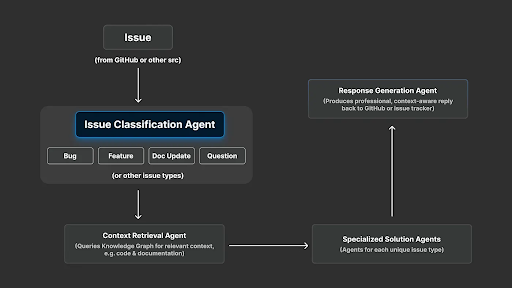
1. Deep contextual understanding
At the core of the system is a dynamic knowledge graph (KG), meticulously designed to provide a comprehensive understanding of all reported issues. This KG is systematically constructed by extracting deep contextual information from the codebase itself, including file structures, abstract syntax trees (ASTs), and text documents. By mapping these diverse data sources into an interconnected graph, the system provides comprehensive coverage of both code and related materials.
Orchestrating this process is a dedicated context discovery agent. This agent explores the knowledge graph to surface accurate and semantically rich information. From pinpointing relevant code snippets to identifying key documents, this agent ensures that all subsequent actions and decisions are robust and context-based.
2. Adaptive Workflow
Designed to accommodate the multifaceted nature of software development, this system's workflow significantly surpasses the limitations of existing bug-centric solutions. It begins with an advanced triage mechanism, where issue triage agents evaluate and categorize all submissions, including bug reports, feature suggestions, documentation updates, and technical inquiries. This strategic evaluation allows the system to dynamically assign specialized agents and customize resolution strategies based on the needs of each unique scenario.
This adaptability allows the system to handle a wide range of developer requirements, from reproducing complex bugs to defining new feature specifications. Ultimately, all investigation and resolution efforts are integrated through a response-generating agent, which synthesizes clear and contextual responses to the original GitHub issue, effectively conveying the underlying analysis, actions taken, and resolutions achieved.
AI Coding: Active and Direct Problem Solving
While research on code agents like SWE-agent and OpenHands is making progress on benchmarks like SWE-bench, commercial products remain expensive and operate opaquely. Claude Code, a prime example, requires multiple queries, such as Claude-Opus-4-based agents (estimated to cost approximately $1,500 for 500 SWE-bench evaluations), which consumes a significant amount of tokens and slows down response times.
Interestingly, mainstream systems heavily favor Python while offering little support for other programming languages. Most industrial solutions focus solely on bug fixes, excluding categories like feature requests, documentation, and Q&A. While IDE extensions (e.g., GitHub Copilot), specialized platforms (e.g., Cursor), and basic models (e.g., ChatGPT) currently dominate the market, AI-based coding assistants significantly enhance the development workflow only during the coding phase. Developers still need to review suggestions, making autonomous resolution difficult.
Contextual limitations are another major obstacle: search strategies tend to operate at the single-file or repository level, making cross-repository reasoning and dependency analysis difficult for complex systems. Efficiency and cost further exacerbate these challenges. Queries can be slow and expensive, and agent tasks can be resource-intensive.
Despite rapid advancements in AI tools for programmers, progress is hampered by fragmented language support, limited issue types, high operational costs, and the lack of solutions that can comprehensively explore context across vast codebases.
The current state of AI coding is briefly summarized as follows.
merit
Increased efficiency
AI tools provide smart code suggestions
Automating repetitive programming tasks
Accelerate your coding workflow
Reduce manual work when writing code
Increase developer productivity
Possibility of autonomous issue management
Commercial AI agents (e.g., Claude Code) provide partial automated resolution capabilities.
Platform Accessibility
Extensive integration support (IDE plugins, Copilot, Cursor, and other dedicated platforms)
disadvantage
Context restrictions
Searches are usually limited to a single file or repository.
Lack of advanced cross-repository reasoning and dependency analysis capabilities required for complex codebases.
Language support bias
Major support for Python
Minimal support for other programming languages
Lack of issue diversity
Most research and products focus solely on bug fixing.
Relatively few feature requests, documentation, or Q&A types.
Cost and efficiency issues
Agent consumes a lot of tokens
Slow response times and high costs (Claude-Opus-4: e.g. $1,500 for 500 requests)
Commercial solutions are expensive and lack open source transparency.
From the lab to the industrial field
University College London (UCL) is one of the world's leading AI research universities and is renowned for its pioneering academic collaborations, including a comprehensive partnership with DeepMind. This collaboration has spawned a series of influential deep learning courses for AI. The UCL Department of Computer Science consistently ranks among the world's leaders in AI, software engineering, systems, and multimodal research, demonstrating outstanding publications in top-tier journals and interdisciplinary impact.
Dr. He Ye leads the innovative AI & SSE team within the UCL Department of Computer Science, dedicated to achieving system-level breakthroughs in automated software engineering. The team's research focuses on codebase context discovery, enhancing the capabilities of large-scale language models, automating problem solving, and developing efficient memory architectures for code agents. These core technologies have been successfully validated through open-source collaboration with Deliciumum, achieving state-of-the-art performance on the SWE-bench benchmark, demonstrating both rigorous methodology and production-grade engineering excellence. These core technologies have been successfully validated through open-source collaboration with Deliciumum, achieving state-of-the-art performance on the SWE-bench benchmark, demonstrating both rigorous methodology and production-grade engineering excellence. GPT-5 + Pass@1 achieved Top-2 on SWE-Bench, and Prometheus ranked 8th globally (just behind OpenHands) with a 71.2% resolution rate.
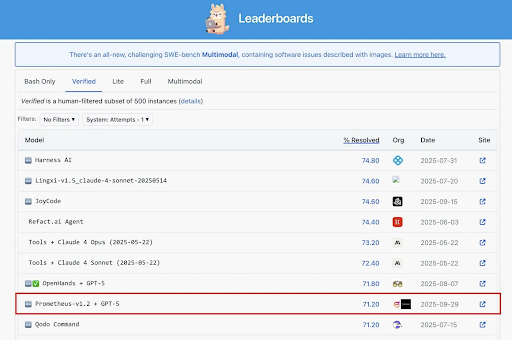
From an industrial perspective, Delicium has established itself as a pioneer in blockchain-based AI agent networks since 2022. Key initiatives include Lucy (https://www.lucyos.ai), an agent operating system for the cryptocurrency space that allows users to create, deploy, collaborate, and distribute agents using natural human language. Delicium also launched the "You Know I Love You" (YKILY) network, a digitally native financial infrastructure for AI agents. This network supports multi-agent, API, external services, and model-to-model MCP aggregators within an open, composable, and highly scalable ecosystem.
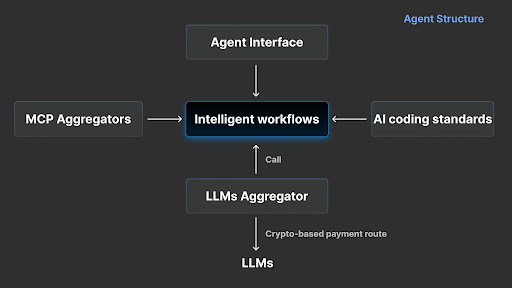
As a key partner, Delicium is committed to enhancing the problem-solving capabilities of AI agents and strengthening the evaluation of use cases across the AI and cryptocurrency sectors. By establishing this framework and co-developing AI coding standards with UCL, Delicium will provide Lucy with foundational capabilities, enabling general agents to operate in a wider range of scenarios.
This includes agent-based cryptocurrency coding and development, agent-driven trading, an LLM portal supporting cryptocurrency payments, and an MCP aggregator for traditional and cryptocurrency servers. Together, we are making progress toward building the "YKILY (You Know I Love You) Network," a digital native infrastructure specifically designed for AI agents.
At the threshold of a new era in software engineering, the collaboration between Delicium and Dr. He Ye represents not only technological convergence but also a harmonization of vision, philosophy, and commercial acumen. In an environment prone to fragmentation by proprietary silos and academic abstractions, this alliance aims to create an open, autonomous, multilingual, and cost-effective tapestry. Here, code agents don't simply propose solutions; they deliver solutions.
Harmonizing UCL's academic rigor with Delicium's pioneering work on blockchain AI agent networks lays the foundation for the next generation of digital transformation. The work being done is not simply for the present, but for the future, where autonomous agents emerge as creative partners, freeing developers from the arduous task of debugging and driving high-level innovation.
Delicium
Delicium ($AGI) is building a blockchain-based collaborative network for AI agents, including Lucyos (www.lucyos.ai) - an agent operating system, and the You Know I Love You (YKILY) network - a digital native financial infrastructure for AI agents.
Delicium is supported by leading AI industry leaders such as Microsoft, Google, and NVIDIA, as well as globally renowned institutions such as Y Combinator, Galaxy Interactive, Republic Crypto, Immutable, Polygon, AntAlpha Ventures, GSR, and Blockchain Coinvesters.
- Delysium website: https://www.delysium.com
- Delisium White Paper V2: https://delysium.gitbook.io
- X (formerly Twitter): https://x.com/The_Delysium
- Telegram: https://t.me/TheDelysium
- Discord: https://discord.gg/thedelysium
[This content is a press release from a company unrelated to the TokenPost article.]
Copyright © TokenPost. Unauthorized reproduction and redistribution prohibited.