The rise of generative AI is profoundly changing how the digital world is produced. Whether it's model training, inference, or personalized fine-tuning, AI operations place unprecedented demands on data access speed, integrity, and access control. Every call is a real-time collaboration of computing power, data, and value. However, the infrastructure supporting all of this remains lagging—the vast majority of AI applications still run in highly centralized cloud environments, such as AWS or Google Cloud. These platforms provide stable computing services but suffer from structural flaws in ownership, revenue sharing, and auditing: closed access control systems, unverifiable authorization processes, and a lack of direct correlation between contributors' rewards and data usage. As a result, the value creation process of the AI ecosystem is highly dependent on platforms, yet struggles to achieve a fair distribution of value.
Meanwhile, explorers in the Web3 world are also attempting to solve this dilemma through decentralized methods. Protocols like Arweave and Filecoin have given data verifiable and tamper-proof "storability," but this capability is still significantly different from "assetization." Key aspects such as data ownership, licensing, profit sharing, and governance remain fragmented and lack unified standards. This forces a vast amount of potentially valuable data and model assets to remain passively dormant in the storage layer, unable to enter the real market. In other words, we can now store data securely, but we cannot yet ensure its secure use, settlement, and distribution.
This structural disconnect is becoming the biggest bottleneck for the next generation of AI data economy. Developers struggle to securely and flexibly manage access permissions across different platforms, creators cannot obtain transparent revenue distribution based on actual usage, and businesses lack a trustworthy, fair, and traceable AI data market. Data is highly active in the production process but locked in the economic process; models can generate unlimited content but cannot benefit data contributors. The entire system's value cycle is therefore incomplete.
To truly unlock the value of data in the AI era, storage and blockchain alone are far from sufficient. Only when ownership confirmation, access control, programmable licensing, and automated settlement are systematically integrated can data and models transform from passive resources into active assets, driving the entire AI industry from "computation-driven" to "value-driven."
It is against this backdrop that CodexField was born. With "decentralized storage + AI collaboration + blockchain ownership verification" as its core technologies, the project attempts to restructure the assetization process of data and models, providing developers, creators, and enterprises with an open, verifiable, and revenue-sharing public platform. In the CodexField system, data is no longer merely stored; it can be securely accessed, automatically settled, and continuously governed. Every interaction between content and models leaves a record of ownership verification and value return on the blockchain, creating a complete economic cycle of creation, use, and revenue.
To achieve this goal, CodexField has built five core product modules, covering the entire chain from content generation, ownership confirmation, trading to revenue distribution. This system not only gives content and models in the AI ecosystem real asset attributes, but also lays the foundation for the next stage of the digital economy—a decentralized value network driven by intelligence, composed of creation, and supported by data governance.
Codex's five product segments
1. Gitd
Gitd (“Git for CodexField”) is the underlying storage and version control module of the CodexField ecosystem, which can also be understood as “decentralized storage of Git”. It is fully compatible with traditional Git in terms of functionality and user experience, allowing developers to directly use their familiar Git commit process, branch management, and collaboration mechanisms. The difference is that Gitd stores code and content versions on the decentralized network Greenfield, thereby ensuring that development results are tamper-proof, traceable, and have true ownership on the blockchain.
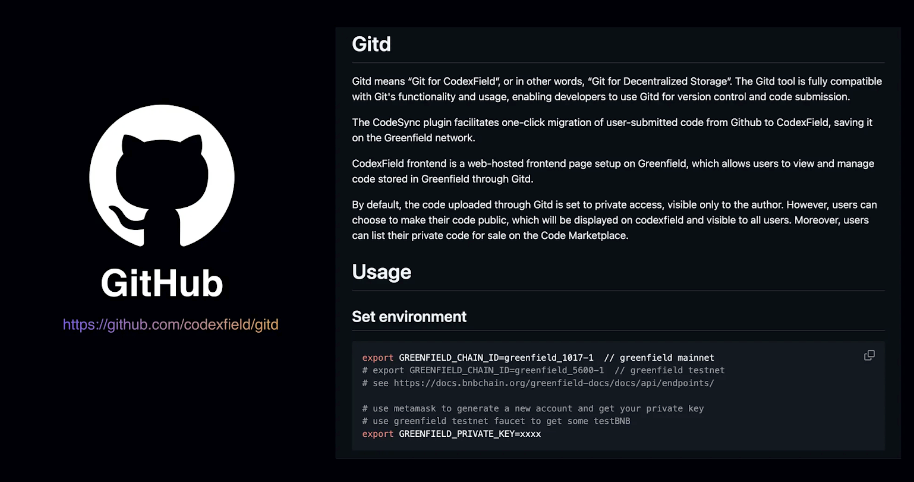
Through Gitd, CodexField migrates version control from centralized repositories to a decentralized environment, building upon this foundation with intelligent synchronization and migration capabilities. For example, the CodeSync plugin allows developers to synchronize GitHub repository content to the CodexField network with a single click, achieving a seamless transition and persistent storage. Simultaneously, CodexField also provides a web-based front-end interface hosted by Greenfield, enabling developers to directly view, manage, and publish their project repositories within a browser.
Gitd by default sets uploaded content to private, visible only to the creator. Users can also proactively grant access, publicly displaying their code or selling it through CodexField's Code Marketplace, thus realizing the assetization and monetization of code. This mechanism gives developers the possibility of ownership and value circulation for every commit and every line of code, making Gitd not only a version control tool but also the underlying asset carrier layer of the entire CodexField ecosystem.
2. CodexField Wallet
CodexField Wallet is the core entry point to the entire ecosystem and a unified account layer connecting users with on-chain assets, protocol modules, and AI systems. It's not just a Web3 wallet; it's the "control center" of the CodexField ecosystem, handling multiple functions including asset management, cross-chain interaction, staking participation, and ecosystem access. Whether participating in Proof of Access (PoA) verification, purchasing on-chain assets, or calling AI models, users complete account authorization and operations through the Wallet, achieving unified management of identity and assets.
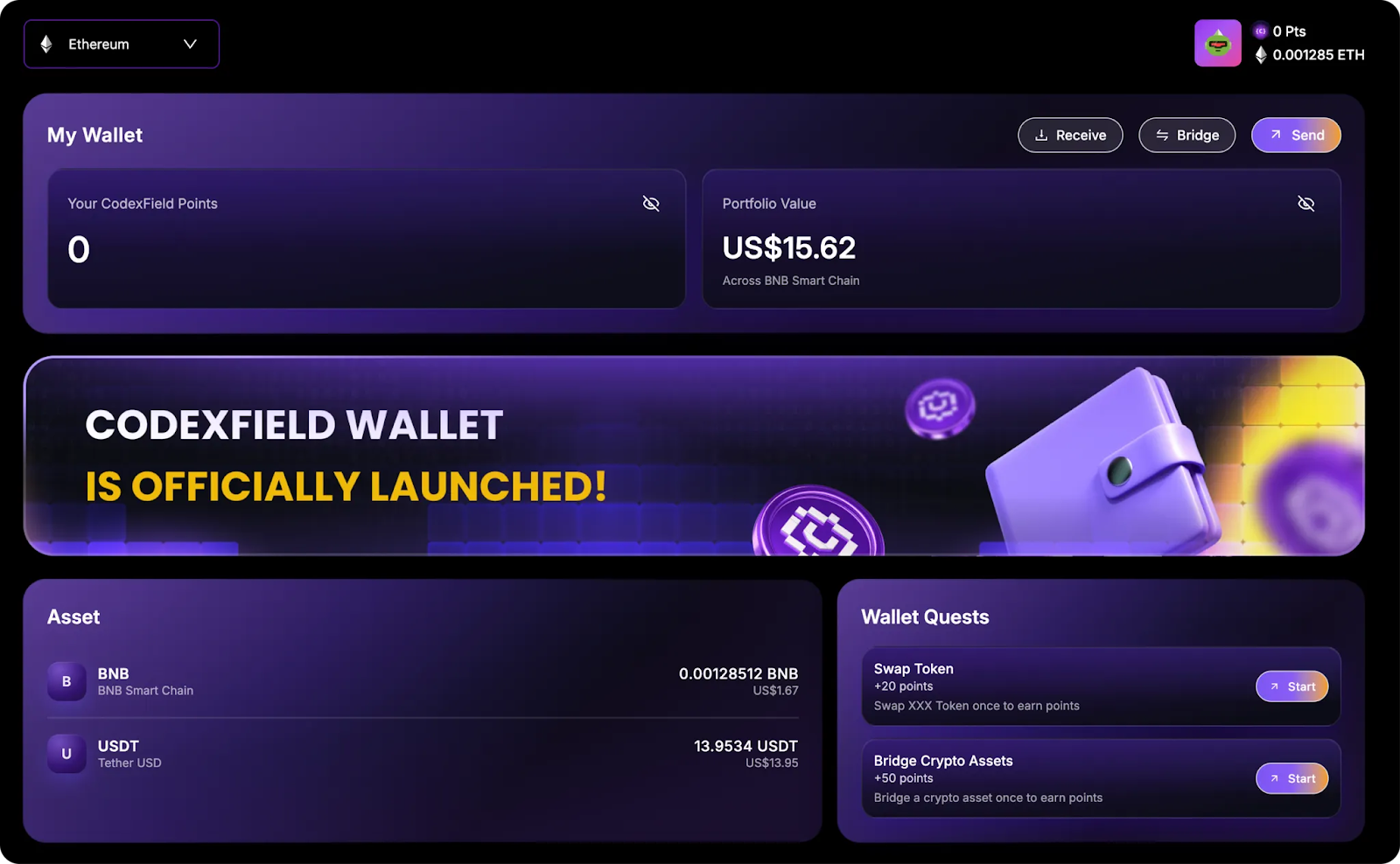
Unlike traditional wallets, CodexField Wallet was designed from the outset as an infrastructure for multi-chain and multi-asset collaboration. It supports major public chains and token assets such as Ethereum, BNB Chain, Solana, and Polygon, and plans to expand to ecosystems like Tron, Avalanche, Mantle, Base, Arbitrum, Sui, and Aptos in future versions. Furthermore, its built-in cross-chain bridge functionality enables secure and efficient asset migration, allowing users to switch freely between different networks and maintain consistent liquidity.
Meanwhile, the Wallet account serves as CodexField's on-chain identity, directly connecting to core modules such as Gitd, Marketplace, and AI Playground for a truly integrated experience. Users can not only stake and view returns within the wallet, but also participate in subsequent DeFi modules' return aggregation, liquidity management, and strategy trading functions through a unified account.
Currently, CodexField Wallet has completed its web prototype and DApp launch, supporting basic token sending and receiving and cross-chain transfers. Future versions of CodexField Wallet will focus on integrating the Mantle mainnet and DeFi modules, and introduce an account abstraction mechanism to further improve the unified multi-chain account system, providing users with a seamless Web3 + DeFi asset experience.
3. AI Playground
AI Playground is the core of the CodexField ecosystem for creation and innovation, providing developers and creators with an open platform that integrates model invocation, AI application generation, content creation, and secondary development. It deeply integrates with the underlying Gitd and Greenfield networks, enabling users to directly access computing power and invoke models within their browsers, and achieve real-time storage and ownership verification of their work on the blockchain. Whether generating text and images or building complete AI applications, users can complete creation, testing, and publishing within the same environment, forming a closed-loop process from inspiration to platform availability.
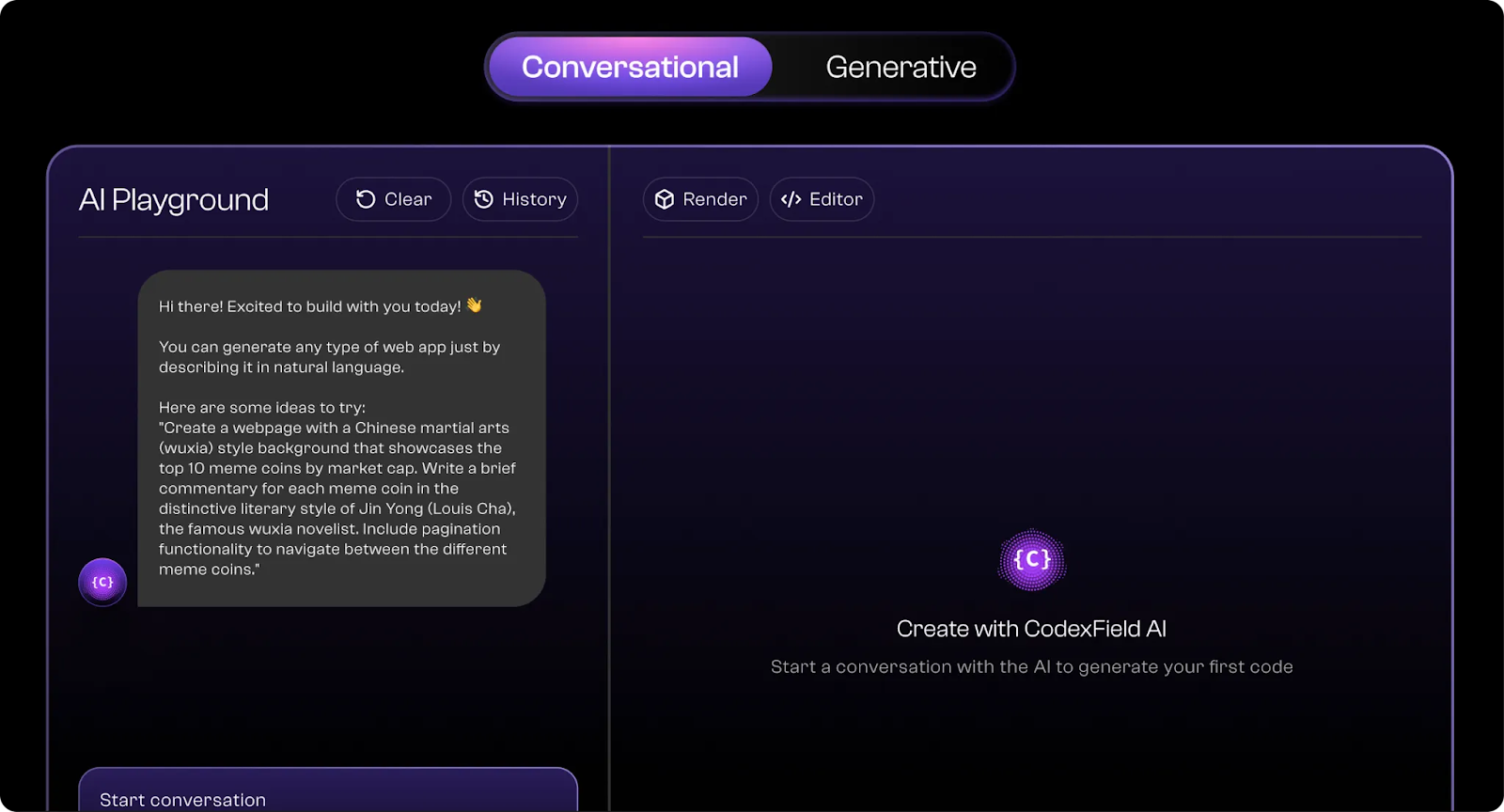
The AI Playground is designed to significantly lower the barrier to entry for AI, enabling anyone to participate in the creation and redevelopment of intelligent content in a modular way. The platform provides a visual interface for quickly building AI applications or plugins, and supports remixing and extending existing models, encouraging secondary creation and ecosystem co-creation. Completed projects can be directly synchronized to the Marketplace for display, distribution, or trading, allowing creators to earn revenue based on real-world usage, thus forming a sustainable content economy cycle.
Future versions of AI Playground will evolve into a central layer for agent collaboration and generation. Agent Studio will allow users to customize agents, build automated workflows, and design independent task logic and reward paths for them. Simultaneously, the team is developing an AI App Builder and open API interfaces, enabling external developers to seamlessly embed CodexField's AI capabilities into their own products.
Currently, Playground has launched basic text and image generation functions and completed initial integration with Wallet and Marketplace. In Q1–Q2 of 2026, CodexField will officially launch Agent Studio and a creator incentive mechanism, injecting new growth momentum into the entire AI content ecosystem.
4. Codex Marketplace
Codex Marketplace serves as the asset aggregation and trading hub of the CodexField ecosystem, handling the display, circulation, and monetization of creative works after they are uploaded to the blockchain. The platform covers various types of digital assets, including AI applications, model resources, code modules, multimedia materials, and RWAs. It is not only a trading market but also a key entry point connecting the AI Playground and Remix creative experiences, helping developers and creators seamlessly transition their work from the creation stage to the trading and reuse stage, thus extending and circulating its value.
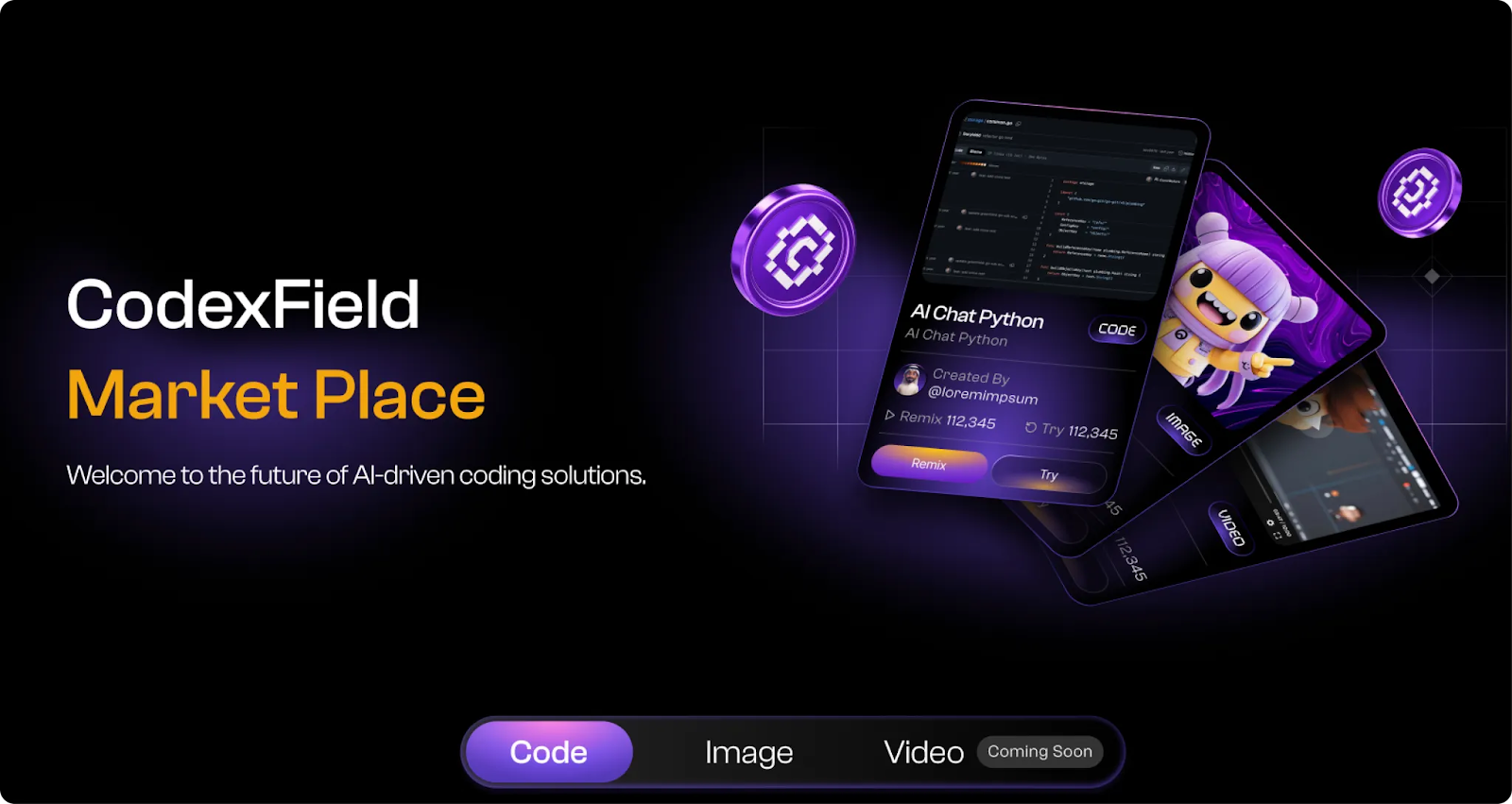
Within the Marketplace, all content and model assets are presented in a standardized format, allowing users to directly browse, experience, purchase, or create derivative works based on existing assets. Through seamless integration with the AI Playground, creators can publish their work with a single click and make it available for remixing; developers can select suitable models, code, or plugins to quickly build new AI applications. Simultaneously, the Marketplace's built-in creator homepage and revenue system record the transactions and usage of works, enabling creators to transparently view revenue distribution, on-chain licensing, and ecosystem contributions, thus forming a self-incentivizing creative economy.
In the future, Codex Marketplace will further expand into a comprehensive AI asset circulation layer, supporting various transaction models such as direct purchase, leasing, subscription, or royalty sharing. It will also introduce computing power sharing and model licensing mechanisms, enabling assets not only to be traded but also dynamically used in different scenarios. Currently, the platform has completed front-end prototype development and asset aggregation display functions, and is undergoing internal testing of transaction logic and settlement contracts.
5. Quest & Rank
The Quest & Rank module is CodexField's incentive system designed for user growth and long-term ecosystem activity. It integrates on-chain and off-chain behavioral data into a unified task system, allowing users to earn quantifiable incentives and level progression at every step of their ecosystem participation. Whether it's completing on-chain staking, trading, creating content, or engaging in social interactions, these behaviors will be recognized by the system and recorded in points and rankings, building a dynamic reward mechanism centered on genuine contributions.
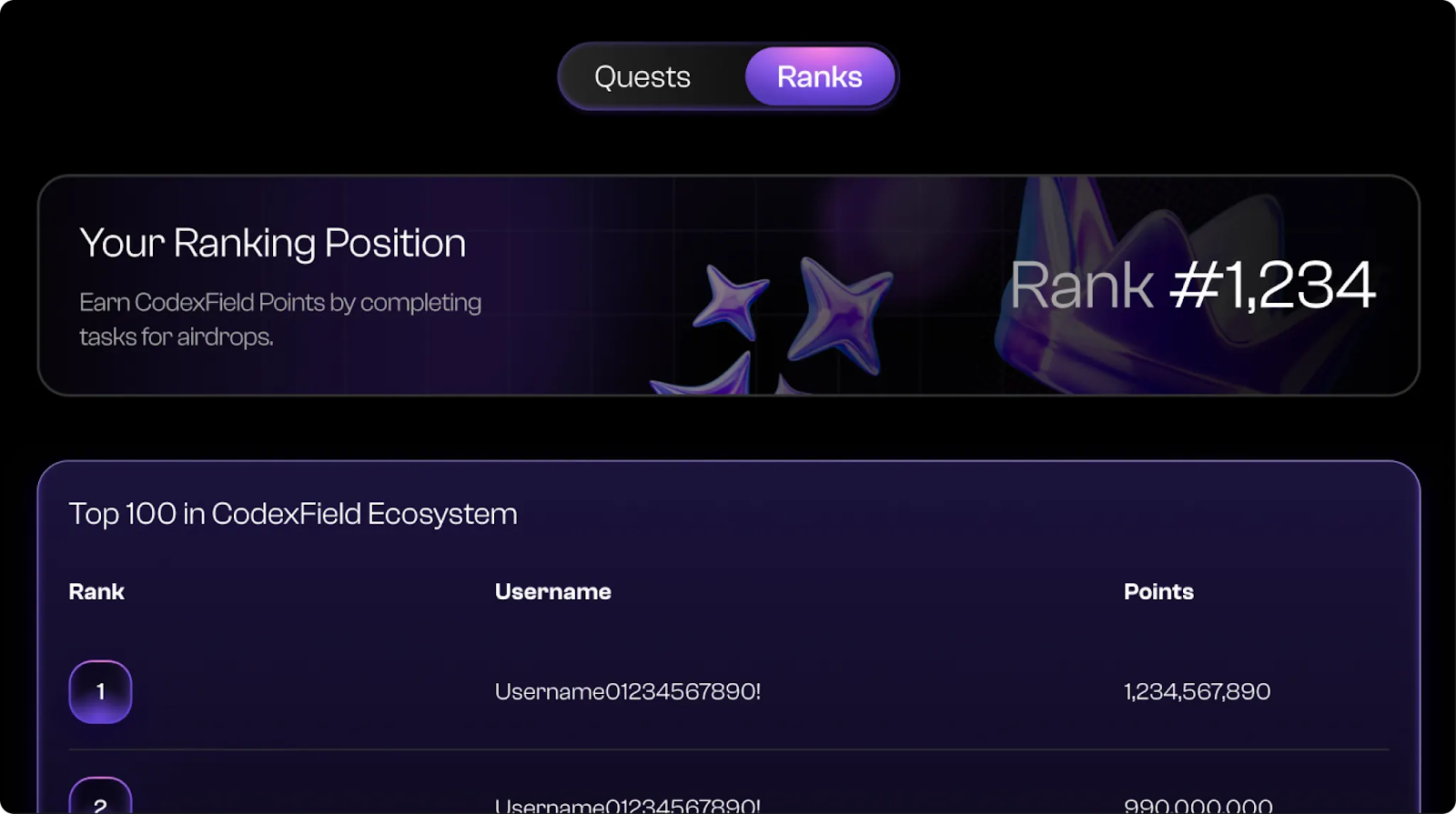
In this system, Quest represents a programmable behavioral task, while Rank is a comprehensive ranking based on task completion, points, and contribution value. A user's Rank level not only determines their visibility and reputation within the ecosystem but also directly relates to governance weight and incentive allocation ratio. Creator tasks and incentive mechanisms are also deeply integrated. For example, completing specific creative tasks, publishing works in the AI Playground, and listing them on the Marketplace can trigger additional resource allocation and revenue rewards, thus forming a value loop of "task, creation, publication, and revenue".
Currently, CodexField has completed the basic construction of its task system, supporting both on-chain (staking, transfers, transactions) and off-chain (social, content interaction) task types, and has entered the internal testing phase. The Rank system has also been tested and run among some community users. In the future, it will launch programmable task templates, allowing third-party projects to access and initiate custom tasks for ecosystem collaboration, community growth, or hackathons. This will make Quest & Rank not only an internal incentive mechanism for CodexField, but also evolve into an open growth engine connecting the external ecosystem and user behavior.
Overall, by deeply integrating rights confirmation, incentives, and collaboration mechanisms, CodexField is making the logic of "creation as asset, use as settlement" a reality. As the ecosystem continues to evolve, a decentralized content network centered on intelligent collaboration and value circulation is taking shape—this is not only the result of the integration of AI and Web3 technologies, but also the prototype of the next generation of digital economy.